








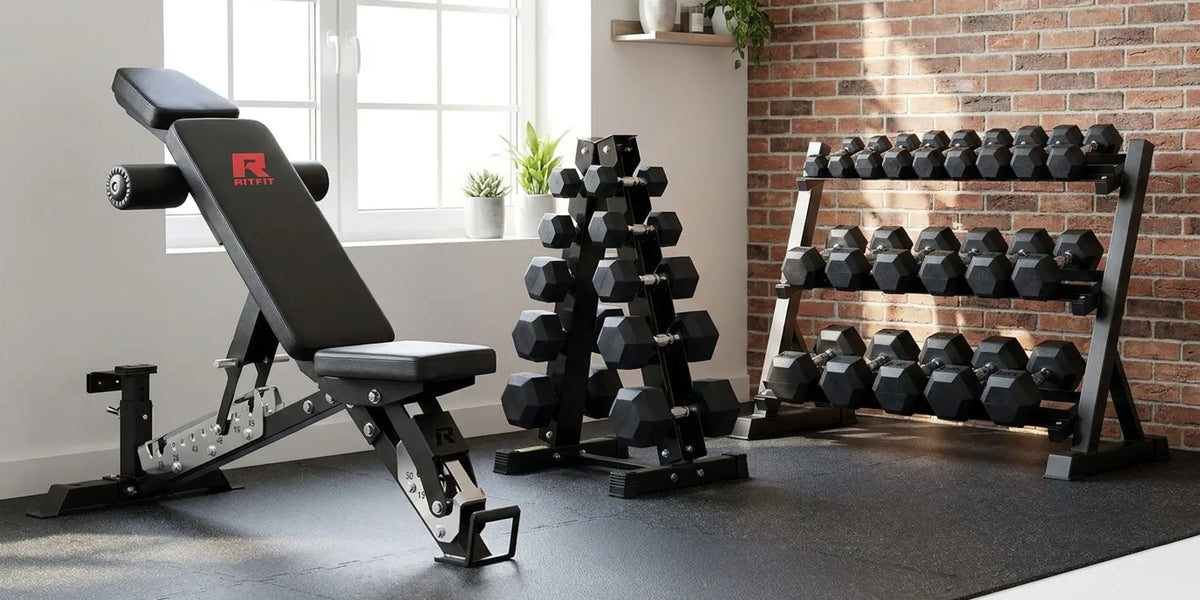
A free gym workout plan for beginners male is a structured strength routine you can run without paying for coaching or an app. It gives you set training days, compound exercises, sets and reps, plus simple rules for adding weight as you get stronger.
This guide lays out a full 3-day full-body plan with substitutions, a beginner-friendly way to choose weights, and safety rules to protect your joints. It works in a commercial gym or at home with a pair of dumbbells and a bench.
Quick Answer: A free gym workout plan for beginners male is a structured 3-day full-body routine using compound dumbbell and bodyweight exercises such as squats, presses and rows. Train three days per week, leave a rest day between sessions, and add small amounts of weight when you can hit every set with good form.
Key Takeaways
- Structure matters: a free beginner gym plan needs three training days, full-body sessions, and clear sets and reps you can follow without guesswork.
- Compound first: leading with squats, presses and rows trains more muscle per minute and builds a stronger foundation than isolation moves.
- Choose weight by form: pick a load that keeps the last two or three reps challenging without breaking form, then add the smallest jump when it gets easy.
- Progress slowly: add weight only when you complete every set with good form on two consecutive workouts.
- Safety rules: rest at least one day between sessions, warm up, and stop any exercise that causes sharp or worsening pain.
What Does a Free Gym Workout Plan for Beginners Male Look Like?
A free gym workout plan for beginners male is a weekly schedule that tells you which days to train, which exercises to do, and how many sets and reps to complete. You follow a proven template instead of improvising, which removes the guesswork that stalls most first-year lifters.
- Fixed schedule: three full-body sessions per week on non-consecutive days keeps recovery simple.
- Compound exercises: squats, presses and rows hit multiple muscle groups per set.
- Clear sets and reps: a target like 3 sets of 10 reps tells you exactly when a set is done.
- Progression rule: a plan is only free and useful if it explains when to add weight.
Free means you spend nothing on the routine itself, not that it is low quality. A sibling plan with the same structure is the Beginner Workout Plan For Females if you want to compare approaches before you commit.
What a Free Beginner Gym Plan Should Include
A solid free plan for a male beginner covers three things: a realistic weekly schedule, compound exercises for every major muscle group, and a clear progression rule for adding weight. Anything that adds complexity beyond that usually hurts consistency, which is the real bottleneck in the first year.
- Weekly schedule: training Monday, Wednesday and Friday gives a rest day between sessions and leaves weekends open.
- Push, pull and legs balance: chest, shoulders and triceps on one day, back and biceps on another, and legs plus core on the third.
- Warm-up: five minutes of light movement and a few easy sets prepare joints for heavier work.
- Rest guidance: 60 to 90 seconds between most sets and two minutes before repeating a hard compound lift.
The plan below follows this exact structure, so you can copy the sessions, print them, and start without signing up for anything.
The 3-Day Full-Body Workout Plan for Men
A 3-day full-body split trains every major muscle group three times per week, which is an efficient frequency for new lifters. EMG data indicate free-weight squat variations activate the quadriceps and posterior-chain muscles more than machine-based isolation substitutes [1], which is why the plan leads with compound dumbbell and bodyweight moves.
Day 1: Push Focus (Chest, Shoulders, Triceps)
| Exercise | Sets | Reps |
|---|---|---|
| Dumbbell Bench Press | 3 | 10 |
| Push-Ups | 3 | As many as possible |
| Seated Dumbbell Overhead Press | 3 | 10 |
| Dumbbell Lateral Raise | 2 | 12 |
| Dumbbell Tricep Extension | 2 | 10 |
Day 2: Pull Focus (Back, Biceps)
| Exercise | Sets | Reps |
|---|---|---|
| Bent-Over Dumbbell Row | 3 | 10 |
| One-Arm Dumbbell Row | 3 | 10 per side |
| Dumbbell Curl | 2 | 10 |
| Hammer Curl | 2 | 10 |
| Rear Delt Fly | 2 | 12 |
Day 3: Legs and Core
| Exercise | Sets | Reps |
|---|---|---|
| Goblet Squat | 3 | 10 |
| Dumbbell Romanian Deadlift | 3 | 10 |
| Dumbbell Lunge | 3 | 10 per leg |
| Front Plank | 2 | 20-30 seconds |
| Standing Calf Raise | 2 | 15 |
Rest 60-90 seconds between sets and two minutes before repeating a hard compound lift. Stop a rep or two short of failure on most sets to keep form clean.
If you want a cardio finisher, add a 10-minute session from the Best HIIT Workouts For Beginners after any training day. Keep the strength sessions the priority for your first eight weeks.
How Do Beginners Choose the Right Weight?
Choose a dumbbell you can lift for the full rep range while keeping the last two or three reps challenging but clean. If every set is easy, the weight is too light; if your form breaks before the target reps, go lighter.
- Start light: for your first session, pick a weight you could lift 15 to 20 times and stop at 10 to practice the movement.
- Use the last-rep test: the final two reps of a set should feel hard but not sloppy.
- Write it down: record the weight and reps so you know exactly what to beat next time.
- Err conservative: beginners rarely benefit from grinding through heavy singles, so build volume first.
A rough starting point is 5 to 15 pounds per dumbbell for upper-body lifts and 15 to 30 pounds for lower-body lifts, then adjust based on the last-rep test.
When and How Should You Add Weight?
Add weight when you can complete every set for the target reps with good form on two consecutive workouts. This simple rule keeps progression steady without risking sloppy reps.
A study measuring muscle activity found pressing intensity near your max increases chest and triceps activation [2], so loading your main lifts matters more than adding random extra sets. Use the smallest available jump, usually five pounds per dumbbell, then repeat the same rep scheme before pushing heavier again.
- Example week-by-week: week one hit 10, 9, 8 at 50 pounds, week two hit 10, 10, 10, so week three you move to 55 pounds.
- Same weight until clean: do not add weight until all sets hit the target with good form.
- Revisit reps: if a weight feels too light at 10 reps, add weight rather than raising the rep count.
If you stop progressing on an exercise for three weeks in a row, check your sleep and food before blaming the plan.
What Are Common Beginner Mistakes and Easy Fixes?
Most beginner setbacks come from training too often, lifting too heavy too soon, or skipping rest days. Each mistake has a simple fix that keeps the free plan on track.
- Training every day: more is not better for a beginner; stick to three sessions and add cardio on rest days only when you feel fresh.
- Too much weight, poor form: lower the load until every rep is clean, then build back up slowly.
- No rest between sets: use a timer and honor the 60 to 90 second target.
- Skipping warm-up: five easy minutes protect your shoulders and knees before pressing and squatting.
- Copying advanced programs: high-volume body-part splits are designed for experienced lifters, so a full-body plan suits a first year better.
Substitute any exercise that does not feel right: replace dumbbell bench press with push-ups, replace barbell rows with one-arm dumbbell rows, and replace goblet squats with bodyweight squats until your form is solid.
Safety, Form and When to Stop an Exercise
Stop immediately if you feel sharp pain, joint discomfort, or pain that gets worse with each rep. Muscle burn and fatigue are normal, but pain is a warning sign, and pushing through it turns a small issue into a long layoff.
- Stop on pain: sharp or worsening pain means the movement is wrong for you today, so swap in an easier variation.
- Control the weight: lower each rep under control rather than letting gravity drop it.
- Respect rest days: muscles grow during recovery, so a rest day is part of the plan, not a sign of weakness.
- Watch your back: brace your core on every squat, deadlift and row and keep a neutral spine.
- Know the difference: a hard last rep is expected, a sharp pinch is not.
Form is the skill that makes every other variable work. Jeff Cavaliere, Physical Therapist and Strength Coach, former Head Physical Therapist for the NY Mets puts it plainly: instead of relying on a spotter to bail you out of the hardest part of a lift, look for ways to improve your ability to complete that lift on your own.
"What I advise in most cases is, instead of looking for a spotter to take you through those areas of a lift that are more difficult, think of other ways you can improve your ability to complete that lift, if strength is your goal."
Jeff Cavaliere, Physical Therapist and Strength Coach, former Head Physical Therapist for the NY Mets, Athlean-X
What Equipment Do You Need to Start?
Research indicates structured home-based resistance training can maintain functional strength without a commercial gym membership [3], so a pair of dumbbells and a bench are genuinely enough to run this plan. You do not need a full rack to make progress in your first year.
- Dumbbells: one set of adjustable or fixed dumbbells covers every exercise in the plan.
- A bench: a flat and incline adjustable bench lets you press and row at multiple angles.
- A mat: a simple mat protects your back during planks and floor work.
- Optional pull-up bar: adds a row and pull variation once you want more back work.
If you want to upgrade to an all-in-one setup later, the RitFit Home Gym Package M1 Smith Machine and the M1 Multi Functional Home Gym Smith Machine cover pressing, squatting and rowing in one frame. Real beginner garages such as Chase Demoors Gym, Cathy Dings Gym and Jamaal Lewiss Gym show how little equipment you actually need, and a Ritfit Lightweight Waterproof Gym Bag keeps your gear organized either way.
FAQs About Free Gym Workout Plans for Beginners
Is there really a free gym workout plan for beginners?
Yes.
A free beginner plan is a structured routine you follow without paying for coaching or apps.
It sets your training days, exercises, sets and reps, and tells you when to add weight.
You only need basic equipment like dumbbells and a bench, so the plan itself costs nothing and adapts to your schedule.
How many days a week should a beginner male train?
Three days per week is the sweet spot for most beginners.
A full-body routine trained three times a week, with at least one rest day between sessions, lets every major muscle group recover and grow while keeping your schedule realistic.
You can add cardio on rest days once your strength routine feels easy.
Should beginners use a full body split or a body part split?
Beginners should start with a full-body split.
Training each major muscle group two to three times per week builds strength and skill faster than a body part split that hits a muscle once weekly.
Full-body sessions also keep workouts shorter and make it easier to practice the compound lifts that give the most results.
How do I choose the right weight as a beginner?
Pick a weight you can lift with clean form for the full rep range while keeping the last two or three reps challenging.
If you finish every set easily, the weight is too light; if form breaks before the target reps, go lighter.
Start on the conservative side and add weight as reps become comfortable.
When should a beginner add weight to an exercise?
Add weight when you can complete every set for the target reps with good form on two consecutive workouts. For most beginners this means adding the smallest increment available on the exercise, such as a five pound jump on dumbbells, and then repeating the same rep and set scheme before pushing heavier again.
How long should a beginner gym workout last?
A beginner full-body session should take roughly 30 to 45 minutes.
That covers a short warm-up, about six to eight exercises, and rest between sets.
If your workout runs much longer, you are likely resting too long or adding unnecessary volume, both of which can stall progress and drain motivation.
When should I stop an exercise during my workout?
Stop immediately if you feel sharp pain, joint discomfort, or pain that gets worse with each rep. Some muscle burn and fatigue are normal, but pain is a warning sign. With a free beginner plan, you can swap in an easier variation and keep training the movement pattern rather than pushing through an injury.
How soon will a beginner see results from a gym plan?
Most beginners notice strength gains within a few weeks because the nervous system learns the movements quickly, with visible muscle changes usually following within two to three months of consistent training. Progress depends on following the plan, eating enough, and getting proper sleep between sessions.
Conclusion
A free gym workout plan for beginners male does not need apps, coaches or a room full of machines. Three full-body sessions per week built on squats, presses and rows, plus a simple rule for adding weight, will carry you through your first months of consistent training.
Start with the lightest weight that lets you finish clean reps, track every session, and add five pounds only when the plan says you are ready. If you decide to build a complete home setup, check RitFit sales for bundles that cover the same movement patterns.
Disclaimer
The information in this article is for general educational purposes and is not medical or professional coaching advice. Consult a qualified trainer or healthcare provider before starting any new exercise program, especially if you have an injury or medical condition.
References
1. Bautista D, Durke D, Cotter JA, Escobar KA, Schick EE. A Comparison of Muscle Activation Among the Front Squat, Overhead Squat, Back Extension and Plank. Int J Exerc Sci. 2020;13(1):714-722. doi:10.70252/BTUH3630. PMCID: PMC7241624
2. Krol H, Golas A. Effect of Barbell Weight on the Structure of the Flat Bench Press. J Strength Cond Res. 2017;31(5):1321-1337. PMCID: PMC5400411
3. De Maio M, Bratta C, Iannaccone A, et al. Home-Based Physical Activity as a Healthy Aging Booster before and during COVID-19 Outbreak. Int J Environ Res Public Health. 2022;19(7). doi:10.3390/ijerph19074317. PMCID: PMC8998434





