








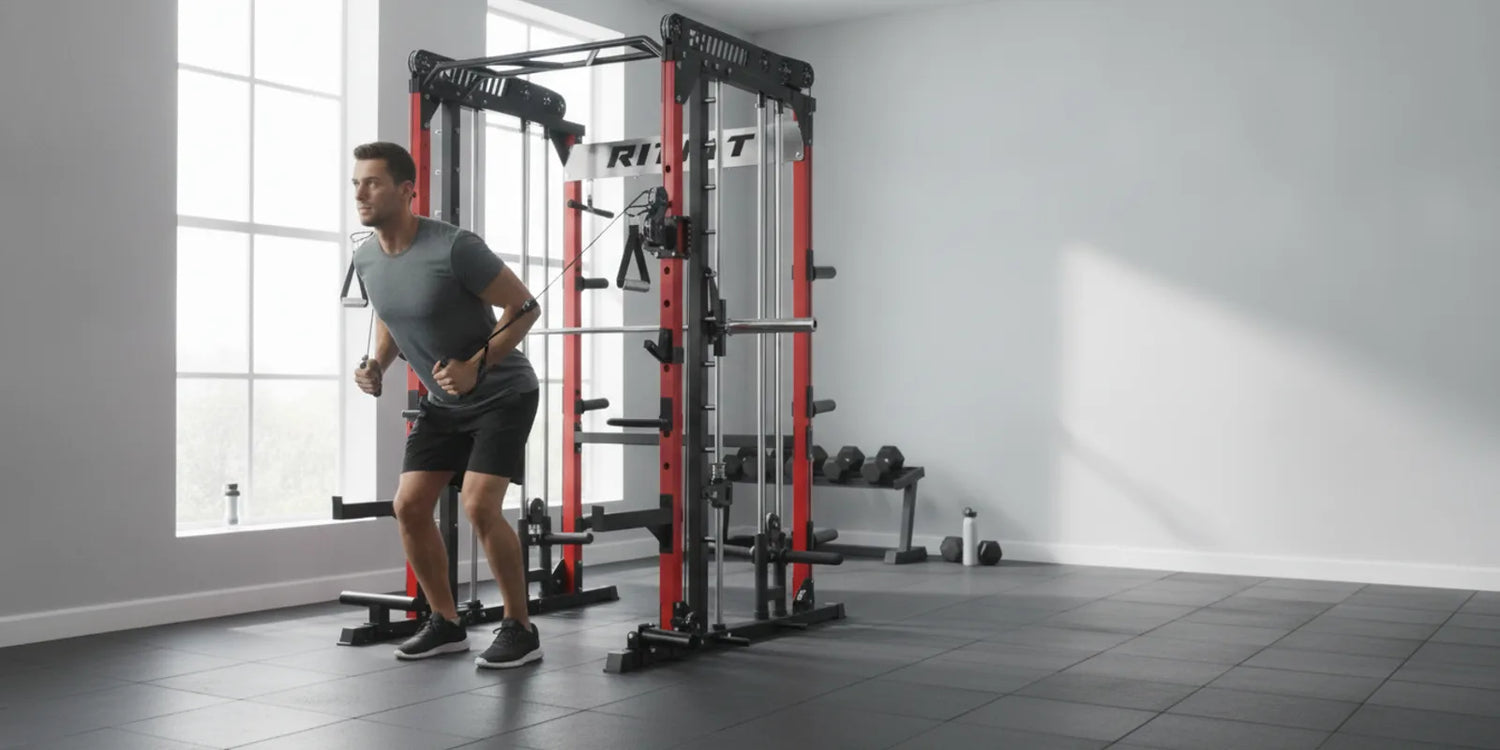
Functional training equipment for home turns even 100 square feet into a high-performance training space, letting you build strength, improve movement quality, and train every major muscle group without a commercial gym membership.
This guide helps apartment dwellers and space-conscious home gym builders choose the most versatile equipment for under 300 square feet, with specific dimensions, a RitFit decision path, a sample routine, and a safety checklist.
Quick Answer: The best functional training equipment for home combines a compact cable system or all-in-one functional trainer with a suspension trainer and adjustable dumbbells. A cable-based unit needs at least a 7-foot ceiling and a 58-inch width footprint, but can replace six or more separate machines and allows progressive overload through full multi-planar movement patterns in under 150 square feet.
Key Takeaways
- Movement efficiency: Functional resistance training enhances movement efficiency more effectively than traditional resistance training, with comparable strength outcomes, making it the smarter choice for home gym investment.[1]
- Equivalent strength gains: Six weeks of functional resistance training produces strength gains comparable to traditional resistance training for squats, bench press, and deadlifts, confirming cable-based home equipment delivers real results.[2]
- Space minimum: Most standalone functional trainers need at least 7 feet of ceiling clearance, approximately 58 inches of width, and 2-3 feet of working clearance in front, making a 10-by-10-foot room the practical floor minimum.
- Replace multiple machines: A single compact all-in-one cable unit can replace a lat pulldown, cable crossover, low row station, and several isolation machines, cutting both cost and floor space significantly.
- Start small, scale up: Beginning with a suspension trainer plus adjustable dumbbells requires almost no floor space, and adding a wall-mounted cable attachment later creates a full functional training environment without rebuilding your setup.
Why Does Functional Training Equipment Outperform Traditional Racks in Small Spaces?
Functional training equipment outperforms traditional racks in small spaces because it allows multi-planar cable movement, uses a compact footprint, and lets you train every major muscle group without multiple single-purpose machines. A 2025 review found that functional resistance training enhances movement efficiency more effectively than traditional resistance training, with comparable strength and muscle mass outcomes.[1]
What makes multi-planar cable resistance so effective?
Cable systems keep constant tension on the working muscle throughout the full arc of movement, unlike free weights where tension drops at certain joint angles. A study found that 6 weeks of functional resistance training produced strength gains in bench squat, bench press, and deadlift that were statistically equivalent to traditional resistance training, confirming you do not sacrifice results by going cable-based.[2]
Why does this matter for space-constrained setups?
Traditional barbell setups require a power rack, separate cable tower, pull-up bar, and a safety zone on all four sides, typically demanding 200 or more square feet of clear floor. Functional training equipment consolidates those functions into a single frame with a 3-by-4-foot to 4-by-4-foot footprint, freeing the rest of your room for warm-up, stretching, or a conditioning circuit.
- Consolidated function: One all-in-one cable unit can replace a lat pulldown machine, cable crossover, low row station, and several isolation accessories.
- Progressive overload intact: Weight stacks on compact functional trainers commonly range from 150 to 260 pounds per side, providing adequate resistance for most intermediate training goals.
- Safer solo training: Cable-guided movement paths allow heavy loading without a spotter, reducing injury risk for people training alone at home.
- Internal link to collection: Explore the full range of functional training equipment available for home gym setups.
- Standalone dual-stack functional trainer: Typically 54-60 inches wide and 48-60 inches deep, plus 24-36 inches of working clearance on each side where you stand.
- All-in-one cable and rack combo: Often fits in a 4-by-4-foot corner footprint with the frame flush against two walls, making it the most space-efficient option for garage and bedroom gyms.
- Wall-mounted cable attachment: Adds minimal projection from the wall (typically 8-14 inches for the bracket), attaches to an existing power rack or wall studs, and uses nearly zero additional floor space.
- Suspension trainer: Requires only a door frame or ceiling anchor point, uses zero permanent floor space, and stores in a bag smaller than a shoebox.
- Ceiling minimum: Leave at least 12 inches of clearance above the tallest point of the machine for overhead movements like shoulder presses and lat pulldowns performed standing.
- Overhead movements: If you plan to use a pull-up bar attachment or do standing cable presses with arms fully extended, measure from floor to ceiling and subtract the machine height, targeting at least 24 inches of overhead space.
- Side clearance: Allow at least 24 inches on the side where you attach weight plates on plate-loaded systems, and at least 18 inches on cable stack systems for natural arm swing.
- Anchor point load rating: Any wall bracket or ceiling anchor for a suspension trainer or cable pulley must be rated for dynamic loads, not just static weight, with a minimum 3:1 safety factor above your target working load.
- Forgetting the working zone: The machine footprint on the spec sheet does not include the space you need to stand, step back, and move through a full range of motion. Add at least 4 feet of clear floor in front of any cable stack.
- Buying before measuring ceiling height: Functional trainers often stand 80-90 inches tall. Measure before ordering, not after delivery.
- Ignoring door swing and shared pathways: A door that opens into your gym space can block equipment access mid-workout. Remap door swing direction or choose a folding setup if your room has a single entry point.
- Placing the bench against the cable machine: Adjustable benches need to slide in and out of position freely. Leave at least 24 inches of side clearance from the cable tower to any fixed wall for bench repositioning.
- Weight stack options: Entry-level units typically offer 150-200 pounds per stack, while mid-range home trainers provide 220-260 pounds per side with a 2:1 pulley ratio, delivering 110-130 pounds of felt resistance per handle.
- Pulley adjustability: Look for at least 10-15 adjustment positions on each pulley column to cover all angles from low row to overhead pull.
- Frame material: 11-gauge steel frames provide the rigidity needed for heavy compound cable work. Thinner gauge (14+) frames may flex under load and reduce cable smoothness.
- Included attachments: A well-equipped unit should include at minimum a straight bar, D-handles, rope attachment, and ankle strap to cover the most common functional training movements out of the box.
- Door anchor setup: Most suspension trainers include a door anchor that slips over the top of a closed door, supporting full bodyweight loads without any drilling or wall modification.
- Exercise range: Rows, push-ups, face pulls, hamstring curls, planks, and single-leg squats are all achievable with a single suspension system, covering push, pull, hinge, squat, and core patterns.
- Travel portability: The system weighs under 2 pounds and fits in a carry bag, doubling as a travel gym for hotel rooms or outdoor training sessions.
- Weight range: For most home gym users, a 5-50 pound adjustable set covers beginner through intermediate loads for all upper body and core movements.
- Dial vs. pin style: Dial-adjust systems change weight in about 2 seconds, keeping rest periods short and workouts efficient in small spaces.
- Floor protection: Place rubber gym flooring tiles under dumbbells and any equipment with a weight stack to protect floors and reduce vibration transmission to downstairs neighbors in apartment buildings.
- Doorway bars: Tension-mount doorway bars cost $20-50, require no tools, and support up to 300 pounds for standard pull-up and chin-up variations.
- Wall-mounted stations: A bolted wall-mounted pull-up station supports loaded pull-up work with weight belts, band-assisted variations, and attachment points for rings or suspension trainers.
- Integration with cable systems: Many all-in-one functional trainers include an integrated pull-up bar at the top of the frame, eliminating the need for a separate installation entirely.
- Step-by-step space test: Clear a 6-by-8-foot area, stand in the center, and swing your arms through a full lateral raise. If you do not hit anything, you have enough space for a full suspension and dumbbell session.
- First upgrade path: Once your space allows, adding a doorway pull-up bar transforms the suspension setup into a full vertical pulling system at minimal cost.
- 1:1 ratio: The cable resistance you feel equals the weight selected on the stack. Preferred for strength training with precise load tracking (e.g., 100 lb selected = 100 lb felt).
- 2:1 ratio: The felt resistance is half the plate weight, giving you greater cable travel distance and a smoother feel for functional movements. A 200 lb stack with a 2:1 ratio delivers 100 lb of felt resistance per handle.
- Stack size guidance: For most home gym users training at intermediate level, a 200-260 lb stack with a 2:1 ratio (100-130 lb felt) covers the full load range for upper body cable work and light lower body accessory exercises.
- Minimum for full-range work: A cable travel distance of at least 80 inches allows standing cable presses, full lat pulldowns, and low-to-high cable chops through a complete range of motion.
- Superior machines: Higher-quality functional trainers offer 86-106 inches of cable travel, enabling exercises that require long cable extension such as standing cable squats and walking lunges with cable resistance.
- Compact alternatives: Shorter cable travel (60-75 inches) limits some overhead movements but is adequate for most upper body and core cable exercises in restricted ceiling height environments.
- Ceiling clearance minimum: Confirm the machine's total height plus at least 12 inches of overhead clearance fits within your room. Most full-size functional trainers stand 80-90 inches tall, requiring at least 92-102 inches of ceiling height for comfortable use.
- Assembly time: Most home functional trainers require 2-4 hours of assembly with basic hand tools. Budget this time realistically, particularly if the machine ships in multiple boxes.
- Floor anchoring: Some machines require floor anchor bolts for stability under heavy loads. Check whether your floor type (concrete slab, wood subfloor) is compatible with the anchoring hardware included.
- Delivery logistics: Full-size functional trainers commonly ship in crates weighing 400-600 pounds. Confirm curbside versus inside-delivery options for your address before purchasing.
- Locate structural members first: Wall brackets must be bolted into wall studs or a load-bearing structural member, not just drywall. Use a stud finder before drilling and confirm stud depth is sufficient for the bolt length specified by the manufacturer.
- Through-bolts for heavy loads: For ceiling mounts supporting suspension trainers or overhead cable pulleys, through-bolts that pass completely through a ceiling joist provide the most reliable load-bearing connection for dynamic exercise loads.
- Test before full load: After installation, hang from the anchor point at body weight for 30 seconds before adding any additional resistance or performing ballistic movements.
- Cable inspection routine: Inspect vinyl-coated cables monthly for kinks, fraying, or coating damage. Replace cables showing wear before they fail under load.
- Stop immediately: Sharp joint pain (especially in shoulders, knees, or wrists during cable exercises), any popping or grinding sensation during movement, or sudden loss of cable tension indicating a hardware failure.
- Rest and reassess: A burning or aching joint pain that persists through warm-up and does not resolve after 2-3 lighter warm-up sets. This signals overuse or technique error, not productive training stimulus.
- Continue with modification: Muscle fatigue, a burning sensation within the working muscle belly during high-rep sets, or mild general exertion discomfort are normal training responses that do not require session termination.
- Home gym safety advantage: Training alone means no peer pressure to push through warning signals. Use this environment to develop the judgment to distinguish productive effort from injury risk, which is a skill that transfers directly to long-term training consistency.
- Cable chest press: 3 sets of 10-12 reps, cables set at mid-chest height, hands starting at shoulder width and pressing to full extension.
- Cable shoulder press (single arm): 3 sets of 10 reps per side, cable at shoulder height, pressing overhead in a controlled arc.
- Tricep pushdown: 3 sets of 12-15 reps, rope attachment, cable set at top position, elbows fixed at sides throughout.
- Dumbbell lateral raise: 3 sets of 15 reps, start light and increase by 2.5-5 pounds when all reps feel controlled through the full range.
- Lat pulldown: 3 sets of 10-12 reps, wide overhand grip, cable set at top, pull to upper chest with full shoulder blade depression.
- Seated cable row: 3 sets of 10-12 reps, close grip handle, sit upright with a neutral spine throughout the pull.
- Face pull: 3 sets of 15 reps, rope attachment, cable at eye level, pull to forehead with elbows high and wide, critical for shoulder health in home gym lifters.
- Cable bicep curl: 3 sets of 12 reps, straight bar, cable set at floor level for constant tension throughout the full curl range.
- Cable goblet squat: 3 sets of 12-15 reps, single handle attachment, cable at waist height, hold the handle at chest and squat to parallel.
- Cable pull-through: 3 sets of 15 reps, rope attachment, cable at floor level, hinge at hips with a neutral spine, excellent hip hinge pattern teacher.
- Cable woodchoppers: 3 sets of 12 reps per side, cable at shoulder height, rotate from shoulder to opposite hip with a straight outside arm.
- Suspension trainer plank rows: 3 sets of 10 reps per side, suspension handles at knee height, plank position with single-arm row to hip, a demanding core stability challenge.
- Cable complex (no rest between exercises): 3 rounds of cable row (10 reps) + cable chest press (10 reps) + cable squat (10 reps), rest 90 seconds between rounds.
- Suspension circuit: 3 rounds of suspension rows (10 reps) + suspension push-ups (10 reps) + suspension hamstring curl (10 reps), rest 60 seconds between rounds.
- Finisher: 3 sets of cable woodchoppers (15 reps per side) with 30 seconds rest between sets.
How Much Space Does a Functional Trainer Actually Require?
Most standalone functional trainers require at least 7 feet of vertical clearance, approximately 58 inches of width, and 2-3 feet of working space in front of the machine for comfortable cable extension during exercises, according to cable machine setup guides. A 10-by-10-foot room is the practical minimum, while a 10-by-12-foot space provides comfortable range of motion for cable pulls, squats, and rotational movements.
What are the footprint benchmarks by equipment type?
Different functional training categories have very different floor requirements, so measuring your space before ordering any equipment is essential.
What ceiling, side clearance, and anchor rules apply?
Ceiling height governs which machines you can safely use, and getting this wrong is an expensive mistake to fix after delivery.
What are the most common layout mistakes in tight rooms?
Small-space home gym builds frequently stall or require costly do-overs because of a handful of predictable errors.
What Are the 4 Essential Functional Training Equipment Categories for a Home Gym?
The four essential categories of functional training equipment for home are: a cable system or all-in-one trainer as the primary investment, a suspension trainer for bodyweight loading, adjustable dumbbells or kettlebells as complementary free weights, and a pull-up or anchor bar for vertical pulling patterns. Together these four categories cover every major movement plane without requiring more than 150 square feet of dedicated space.
1. All-in-one functional trainer or cable system
A compact all-in-one functional trainer is the highest-ROI purchase for small-space home gym builders because it replaces multiple machines in a corner-optimized frame. Research on cable vs. barbell training found similar hypertrophy results, with 7% versus 8% biceps thickness increase after 10 weeks of training and no statistically significant difference, confirming that cable machines deliver muscle-building results on par with free weights.[3]
Pair your cable system with the functional and strength training equipment category for a complete home training solution.
2. Suspension trainer
A suspension trainer uses your bodyweight and gravity to create resistance across hundreds of exercise variations, with zero permanent floor space required. It anchors to any door frame, overhead bar, or wall bracket in seconds and stores in a bag that fits in a desk drawer, making it the most space-efficient tool in any home gym.
3. Adjustable dumbbells or kettlebells
Adjustable dumbbells covering 5-50 pounds provide the complementary free weight loading that cable machines handle less efficiently, particularly for bilateral pressing and unilateral loaded carries. A single pair of adjustable dumbbells replaces 15-20 fixed-weight dumbbells and occupies roughly the same space as a shoe box when stored on their base.
4. Pull-up bar or wall anchor
A doorway pull-up bar or wall-mounted pull-up station provides the one major pulling pattern that cable machines alone cannot fully replicate at high loads, namely vertical pulling with full bodyweight plus added resistance. It also serves as the anchor point for a suspension trainer, making it a dual-purpose investment in compact spaces.
For a curated selection of CrossFit and functional fitness gear that complements cable training, including gymnastic rings and pull-up accessories, explore the dedicated equipment category.
Which RitFit Equipment Fits Your Space and Training Goals?
The right RitFit functional training equipment for your home depends on three variables: available square footage, training experience level, and whether you want strength-focused or conditioning-focused workouts. The table below maps each option to its ideal use case within the RitFit product line.
| Option | Type | Ideal Space | Key Feature | Best For |
|---|---|---|---|---|
| RitFit M1 Multi-Functional Home Gym Smith Machine | All-in-one (Smith + cable + lat pulldown) | 150-300 sq ft | Full cable system plus Smith bar in one unit | Intermediate to advanced lifters who want one machine for everything |
| Suspension Trainer + Adjustable Dumbbells | Bodyweight + free weight starter stack | Under 150 sq ft | Door or wall anchor, 5-50 lb range | Beginners and budget-conscious home gym starters |
| Cable Attachment for Existing Rack | Cable add-on | Small additional footprint | Single or dual cable stacks up to 260 lb per side | Those who already own a power rack and want cable versatility |
RitFit product line internal comparison. All specs based on manufacturer data. Individual results may vary by training experience and available space.
The RitFit M1: the all-in-one answer for 150-300 sq ft
The RitFit M1 Multi-Functional Home Gym Smith Machine combines a Smith machine bar path, a dual cable pulley system, and a lat pulldown station in a single compact frame, making it the most versatile option in the RitFit lineup for moderate-sized home gym spaces. See it in action in the official RitFit walkthrough video below.
Starter stack for spaces under 150 sq ft
For the smallest possible footprint, a suspension trainer anchored to a door frame plus a set of adjustable dumbbells covering 5-50 pounds gives you push, pull, hinge, squat, and core training with no permanent equipment installation. This combination works in a studio apartment, a hotel room, or a small corner of a living room, and can be packed away in minutes after each session.
Long-term upgrade: cable attachment to existing rack
For home gym owners who already own a power rack, adding a cable attachment to the existing uprights delivers full cable versatility without buying a second standalone machine. Cable attachments for standard uprights typically add 220-310 pounds of resistance per side with a 2:1 ratio, projecting less than 14 inches from the rack frame.
For a complete home gym setup guide, visit the complete home gym guide for beginners to sequence your equipment purchases effectively.
How Do You Evaluate Any Functional Trainer Before You Buy?
Evaluating a functional trainer before purchasing requires checking five key specifications: weight stack size and pulley ratio, cable travel distance, height adjustment range, assembly requirements, and minimum ceiling clearance. Getting any one of these wrong can mean a machine that limits your training or does not physically fit in your room.
What do weight stack size and pulley ratio mean in practice?
Pulley ratio determines how much the felt resistance differs from the plate weight on the stack, and this is the most commonly misunderstood specification in home gym equipment research.
Why does cable travel distance matter?
Cable travel distance determines how far the cable can move from its starting position, which directly limits which exercises are possible and through what range of motion.
What assembly and installation requirements should you verify?
Understanding assembly and installation requirements before ordering prevents the frustrating scenario of receiving equipment you cannot set up in your available space or with your available tools.
Looking for an entry point that does not require tools or floor anchoring? The minimum home gym equipment guide covers zero-installation setups that still deliver progressive overload training.
What Does a Safe Functional Training Home Setup Look Like?
A safe functional training setup requires verified anchor point load ratings, correct bolt specifications for wall or ceiling mounts, rubber flooring under all equipment, and a pre-session progressive test before full loading. Rushing past these steps is the most common cause of equipment failure, floor damage, and preventable injuries in home gym environments.
How do you verify anchor points and fastener specifications?
Every wall bracket, ceiling anchor, and power rack floor bolt carries a working load limit that must exceed your peak dynamic load by at least a 3:1 safety factor.
When should you stop a session?
Knowing the difference between productive training discomfort and a signal to stop is essential for long-term injury-free training at home without a coach present.
For a full primer on equipment-specific home training structure, see the home gym training guide, which covers periodization, progressive overload sequencing, and deload planning for self-coached athletes.
"A functional trainer ranks high for its versatility, allowing you to recreate nearly any movement pattern you want, from curls and tricep pushdowns to face pulls and side lateral raises."
Jeff Cavaliere, MSPT, CSCS, Physical Therapist and Strength Coach, Athlean-X
What Does a Sample 4-Day Functional Training Routine Look Like for a Home Setup?
A sample 4-day functional training routine for a home cable system divides training into push, pull, legs and core, and full-body conditioning days, each lasting 45-60 minutes and using only the equipment categories covered in this guide. This structure provides 48 hours of recovery between sessions for each major muscle group while maintaining daily training frequency.
Day 1: Push (cable and dumbbell)
Focus on horizontal and vertical pressing patterns using the cable system at chest height and above for constant tension through the full press arc.
Day 2: Pull (cable and bodyweight)
Target back width, back thickness, and bicep development using a combination of cable machine angles and suspension trainer rows for variety in resistance curve.
Day 3: Legs and core (cable and bodyweight)
Cable-assisted lower body training allows loading patterns not achievable with bodyweight alone in small spaces where a barbell squat would require additional safety equipment.
Day 4: Full-body conditioning
Combine cable complexes and suspension circuits for metabolic conditioning that maintains strength adaptations while improving cardiovascular fitness and work capacity.
For personalized equipment recommendations based on your experience level and budget, explore best home gym equipment under $500 and home gym equipment for seniors if joint-friendly loading is a priority. Women building a home setup will find targeted recommendations in the best home gym equipment for women guide.
FAQs About Functional Training Equipment for Home
What is the minimum room size for a functional trainer at home?
Most standalone functional trainers need at least 7 feet of ceiling clearance, roughly 58 inches of width, and 2 to 3 feet of working space in front of the machine. A 10-by-10-foot room is the practical minimum, though a 10-by-12-foot space gives you far more comfortable range of motion for cable pulls, squats, and rotational movements without constantly repositioning yourself.
Is a functional trainer worth it for a home gym?
Yes, a functional trainer is one of the highest-value investments for home gym owners who want versatility in limited space. A single cable-based unit replaces a lat pulldown machine, cable crossover, low row station, and several isolation machines, allowing you to train every major muscle group through multi-planar movements in one compact frame.
Can a cable machine build as much muscle as free weights?
Yes, cable machines produce comparable muscle hypertrophy to free weights. A published study comparing cable and barbell preacher curl training found similar hypertrophy results, with 7% versus 8% biceps thickness increase and no statistically significant difference after 10 weeks, confirming cable home equipment delivers equivalent muscle-building results.[3]
What functional training equipment should I buy first for a small space?
For the smallest footprint, start with a suspension trainer that mounts to any door frame and weighs under two pounds, paired with adjustable dumbbells covering 5 to 50 pounds. Once budget and space allow, a compact all-in-one functional trainer gives you the full cable exercise library and enables true progressive overload for long-term strength development.
How much does functional training equipment for a home gym cost?
Suspension trainers cost $100-200 with no floor space required, while adjustable dumbbell sets range from $200-500. Compact all-in-one functional trainers start around $800-1,500 for single-stack units, with dual-stack home trainers ranging from $1,500-3,500. Budgeting $1,000-2,000 typically equips a well-rounded small-space functional training setup.
What is the difference between a functional trainer and a Smith machine?
A functional trainer uses dual adjustable cable pulleys on a vertical track, allowing free three-dimensional movement at any angle, ideal for unilateral exercises and rotational patterns. A Smith machine guides the barbell along a fixed rail for stability on heavy compound lifts. All-in-one machines like the RitFit M1 combine both systems in a single compact unit.
Conclusion
Functional training equipment for home does not require a large room or a large budget to deliver real results. A cable system, suspension trainer, and adjustable dumbbells cover every major movement pattern and support progressive overload from beginner through advanced levels in under 150 square feet.
Start by measuring your ceiling height and floor area, then browse the Pilates and functional movement equipment guide for complementary bodyweight options, and explore the full RitFit functional training equipment collection to find the right unit for your space.
Disclaimer
The information in this article is provided for general fitness and educational purposes only and does not constitute medical, physical therapy, or professional training advice. Consult a qualified fitness professional or physician before beginning any new exercise program, particularly if you have a pre-existing health condition or prior injury.
Save on your next RitFit order
Tap the button to copy your code, then paste it at checkout.
References
1. Brogno B. Aging With Strength: Functional Training to Support Independence and Quality of Life. Inquiry. 2025;62:00469580251348133. doi:10.1177/00469580251348133
2. Zuo L, Li X, Zhang W, Bo S. Effects of 6-Week Traditional and Functional Resistance Training on Arterial Stiffness and Muscular Strength in Healthy Young Men. Front Physiol. 2022;13:859402. doi:10.3389/fphys.2022.859402
3. Nunes JP, et al. Placing Greater Torque at Shorter or Longer Muscle Lengths? Effects of Cable vs. Barbell Preacher Curl Training on Muscular Strength and Hypertrophy in Young Adults. Int J Environ Res Public Health. 2020;17(16):5859. doi:10.3390/ijerph17165859





