








Gym equipment for disabled veterans needs to do more than just build muscle. It needs to accommodate mobility limitations, fit safely into a home environment, and ideally qualify for financial assistance through VA benefits, HSA funds, or FSA reimbursement.
This guide covers the best adaptive equipment categories by disability type, explains what the VA does and does not cover, walks through the HSA and FSA reimbursement process, and identifies cost-reduction programs specifically available to disabled veterans.
Quick Answer: The best gym equipment for disabled veterans depends on the type of service-connected disability, but cable machines, adjustable dumbbells, and resistance bands provide the broadest functional coverage from seated or supported positions. The VA covers prescription adaptive sports equipment for qualifying impairments, and adaptive gym equipment may qualify for HSA or FSA reimbursement with a Letter of Medical Necessity.
Key Takeaways
- Equipment by disability type: Cable machines and resistance bands cover the widest range of service-connected disabilities because they allow adjustable resistance from a seated or partially supported position.
- VA coverage: The VA covers prescription adaptive sports equipment for veterans with qualifying service-connected impairments through its Prosthetic and Sensory Aids Service, but does not cover general home gym memberships or equipment.
- HSA and FSA savings: Adaptive gym equipment may qualify for HSA or FSA reimbursement with a Letter of Medical Necessity, potentially reducing costs by up to 30 percent using pre-tax dollars.
- Adapted rowing evidence: A study found that an adapted rowing machine provided greater upper-extremity cardiovascular stimulus than arm-crank ergometry for people with spinal cord injury, making it a functional home option.[2]
- Starter setup: Adjustable dumbbells, a resistance band set, and a cable or functional trainer cover most adaptive training needs in a compact, accessible home space.
Why Does Gym Equipment Matter for Disabled Veterans' Recovery and Independence?
Gym equipment matters for disabled veterans because staying physically active directly supports rehabilitation, independence, and mental well-being after service-connected injury. According to a 2024 narrative review, military veterans have access to a range of adaptive sports and fitness resources that facilitate ongoing physical activity regardless of age or ability level.[1]
- Rehabilitation continuation: Physical therapy has a defined endpoint, but strength and conditioning work can continue at home indefinitely with the right adaptive equipment.
- Mental health connection: Regular exercise is widely recognized as beneficial for managing stress, depression, and PTSD symptoms common among veterans with service-connected injuries.
- Independence: Equipment that can be safely used without a spotter or trainer gives veterans control over their fitness on their own schedule.
- Transition support: Moving from VA facility-based rehab to a home setup requires equipment that bridges therapeutic function and fitness training.
For veterans exploring the full range of minimum home gym equipment options, the same principles of space efficiency and functional coverage apply, adapted for accessibility needs.
Which Equipment Works Best for Common Service-Connected Disabilities?
The best gym equipment for disabled veterans depends on the specific type of impairment, because different disabilities create different movement limitations and risk profiles.
Lower-Limb Amputees and Prosthetic Users
Lower-limb amputees can often perform a wide range of upper-body and seated exercises with standard equipment adapted for stability.
- Adjustable bench: A stable, flat-to-incline bench with wide non-slip feet allows pressing, rowing, and seated curl movements safely.
- Cable machine with seated attachment: Low pulley cable stations enable rows, curls, and tricep work from a seated or standing supported position.
- Resistance bands with door anchors: Portable and adjustable, bands work across a wide range of upper and partial lower-body movements without balance demands.
- Smith machine or guided barbell: A guided bar path removes the lateral balance demands of free barbells, allowing lower-limb amputees to perform press and squat variations more safely.
Spinal Cord Injury and Wheelchair Users
Spinal cord injury creates unique equipment demands focused almost entirely on upper-body strength and cardiovascular health without lower-body engagement.
- Cable functional trainer: Adjustable pulley height is critical for wheelchair users to access pulling, pressing, and core movements from a seated position.
- Adapted rowing machine: A study found that an adapted rowing machine produced greater oxygen uptake than arm-crank ergometry in people with spinal cord injury, making it a strong cardio option for those with trunk stability.[2]
- Adjustable dumbbells with adaptive grips: Lightweight to moderate dumbbells paired with cuff-style adaptive grips allow isolated upper-body work for users with limited hand function.
- Resistance bands with foot or wheelchair anchors: Bands anchored to a wheelchair frame or door provide full upper-body range-of-motion training without needing to transfer.
TBI, PTSD, and Invisible Wounds
Veterans with traumatic brain injury or PTSD benefit most from simple, predictable equipment that minimizes coordination demands and supports consistent routine.
- Resistance bands and bodyweight tools: Low-complexity movements with progressive resistance reduce cognitive load while building fitness habit.
- Adjustable dumbbells: A single set of adjustable dumbbells covers dozens of exercises with minimal setup, supporting routine-based training without the complexity of multi-station machines.
- Stationary bike or recumbent cardio: Repetitive, low-decision cardio is widely used in veteran mental health programs because it pairs physical benefit with meditative consistency.
Upper-Limb Differences and Arm Amputees
Upper-limb amputees require adaptive attachments and single-arm capable equipment to train bilateral strength safely.
- Single-handle cable attachments: Cable machines with individual D-ring handles allow unilateral training that compensates for limb difference.
- Adaptive cuffs and straps: Cuff-style adaptive grips strap around residual limbs and connect to cable machines, barbells, and kettlebells for pulling and pressing movements.
- Landmine barbell attachment: A pivot point at one end of a barbell allows pressing, rowing, and rotation movements that can be executed one-armed with natural stability.
Veterans researching home gym setups with limited space will find useful guidance in this overview of small home gym equipment essentials.
What Does the VA Cover for Adaptive Fitness Equipment?
The VA covers prescription adaptive sports equipment for veterans with qualifying service-connected disabilities through its Prosthetic and Sensory Aids Service, but general gym memberships and standard home gym equipment fall outside the VA medical benefits package.[1]
What the VA Covers Through Prosthetic and Sensory Aids
VA Prosthetic and Sensory Aids provides adaptive sports and recreation equipment when a VA healthcare provider determines it is medically necessary for a qualifying impairment.
- Qualifying conditions: Spinal cord injury, limb loss, visual impairment, traumatic brain injury, and other service-connected neurological or musculoskeletal conditions can qualify.
- Prescription pathway: A VA primary care provider, physiatrist, or recreation therapist submits a clinical justification for the specific equipment needed.
- What is typically covered: Adaptive sports wheelchairs, hand cycles, specialized prosthetic components for sport, and activity-specific adaptive equipment prescribed as part of a rehabilitation plan.
- What is not covered: Standard dumbbells, barbells, benches, and general-purpose gym equipment are excluded from VA coverage by regulation (38 CFR 17.38) even when the veteran plans to use them for fitness.
VA Adaptive Sports Grant Program
The VA Adaptive Sports Grant Program funds community-based organizations to provide adaptive sports opportunities, with the VA awarding $15.9 million to 91 programs serving more than 15,000 veterans and service members in fiscal year 2024.[1]
- How veterans access it: Veterans enroll through grant-funded community organizations such as Veterans Service Organizations, YMCAs, and Paralympic program affiliates, not directly through the VA.
- What it provides: Instruction, adaptive sports equipment loan, coaching, and competition opportunities in Paralympic and adaptive sports including wheelchair basketball, adaptive rowing, and seated volleyball.
- Eligibility: Veterans must be enrolled in VA healthcare and have a disability that limits participation in standard sports programming.
Veterans looking to build a complete home setup alongside community program access will find practical options in this guide to home gym equipment for beginners.
How Can Disabled Veterans Use HSA or FSA Funds for Adaptive Gym Equipment?
Disabled veterans can use Health Savings Account (HSA) or Flexible Spending Account (FSA) funds to purchase adaptive gym equipment when a licensed provider issues a Letter of Medical Necessity connecting the purchase to a diagnosed medical condition.
What Qualifies and What Documentation Is Required
Adaptive gym equipment qualifies for HSA and FSA reimbursement when its primary purpose is treating or mitigating a diagnosed condition, not general fitness.
- Letter of Medical Necessity (LMN): A licensed provider (MD, DO, NP, or PA) must document the specific diagnosis and explain how the equipment directly addresses that condition.
- Examples that tend to qualify: Adaptive cuffs for limb-difference strength training, cable machines prescribed for spinal cord injury rehabilitation, and resistance equipment prescribed for TBI motor recovery.
- Examples that do not qualify automatically: General-purpose barbells, standard benches, and treadmills purchased without a qualifying medical connection are not eligible without an LMN.
- Documentation to keep: The LMN, purchase receipt, and any supporting medical records form the complete file needed if the HSA administrator requests verification.
The Truemed and LMN Process
Services such as Truemed simplify the LMN process by connecting purchasers with licensed providers who review health surveys and issue letters within 1-2 business days for qualifying conditions.
- Potential savings: According to adaptive fitness providers, using pre-tax HSA or FSA dollars can reduce equipment costs by up to 30 percent depending on the individual's tax bracket.
- FSA timing note: FSA funds typically expire annually, so veterans with end-of-year balances should time adaptive equipment purchases accordingly.
- Not a guarantee: The HSA or FSA administrator retains final approval authority, and not every purchase will be approved even with an LMN.
What Are the Best Adaptive Gym Equipment Categories for Home Use?
The best adaptive gym equipment categories for disabled veterans at home are cable machines, adjustable dumbbells with adaptive grips, resistance bands, and adapted rowing setups because they cover upper-body strength, cardiovascular conditioning, and functional movement from seated or partially supported positions.
Cable Machines and Functional Trainers
Cable machines with adjustable pulley heights are the most versatile single piece of adaptive equipment for home use because they allow pulling, pressing, and rotation movements at any angle from any position.
- Pulley height range: A functional trainer with a floor-to-ceiling cable path covers seated rowing (low pulley), lat pulldowns (high pulley), and horizontal pressing for every position between.
- Weight stack accessibility: Stack-loaded cable systems eliminate the need to load plates, which requires standing and bending that may not be possible for all veterans.
- Attachment variety: D-ring handles, tricep ropes, ankle cuffs, and adaptive grip attachments expand the exercise library without changing the machine.
Adjustable Dumbbells and Resistance Bands
Adjustable dumbbells paired with adaptive grip cuffs allow isolated upper-body training at a range of weights without requiring a large equipment footprint.
- Compact range: A set of adjustable dumbbells from 5 to 50 lbs replaces an entire dumbbell rack in the space of a nightstand.
- Resistance bands as primary or complement: Bands provide linear variable resistance that is often gentler on recovering joints than free weights and can be used entirely from a seated position.
- Adaptive cuff compatibility: Veterans with upper-limb differences can attach cuff-style adaptive grips to both dumbbells and resistance band handles to perform bilateral movements.
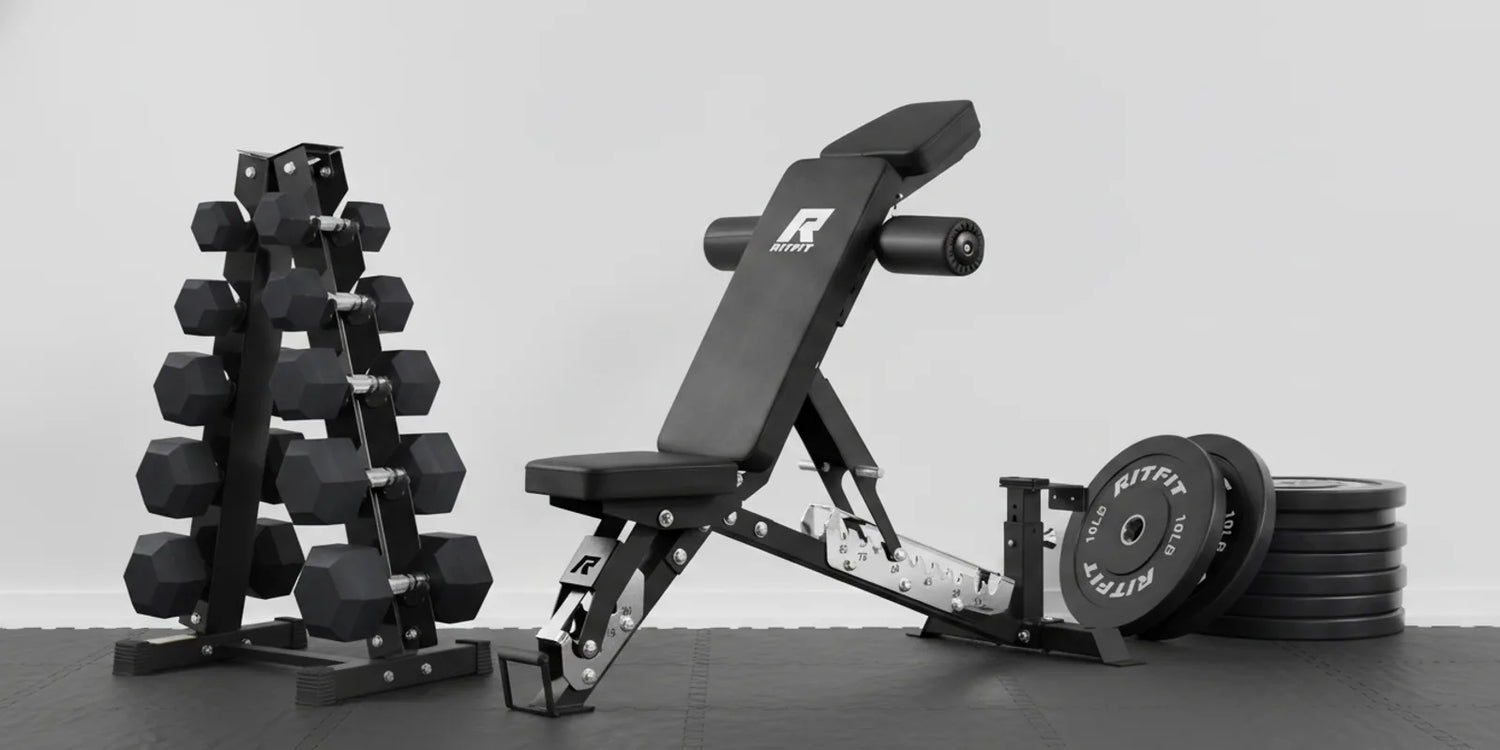
For a broader look at equipment choices by budget, this overview of home gym equipment under $500 covers accessible entry-level configurations. A complete set with rack, such as the RitFit Rubber Hex Dumbbell Set with Rack, keeps the full weight range organized in one accessible footprint.
Rowing Machine Adaptations
Rowing machine adaptations make standard ergometers accessible for veterans with spinal cord injury and wheelchair users, providing effective upper-body cardiovascular training.
- Adapted rowing evidence: A study found that an adapted rowing machine produced greater oxygen uptake than arm-crank ergometry in 14 adults with spinal cord injury, making it a strong home cardio option for those with sufficient trunk stability.[2]
- FES-assisted rowing: A separate study found FES-assisted rowing produced an average 10.5-point reduction in shoulder pain on the Wheelchair User Shoulder Pain Index in manual wheelchair users with SCI, exceeding the minimal detectable change of 5.5 points.[3]
- Practical adaptation: Standard rowing ergometers can be adapted for wheelchair users by removing the sliding seat and adding a chest support frame at lower cost than specialized arm-crank equipment.
Seated Cardio and Upper-Body Ergometers
Seated cardio equipment provides cardiovascular conditioning for veterans who cannot use lower-body machines such as treadmills or standard stationary bikes.
- Arm ergometers: Upper-body cycle ergometers provide sustained aerobic conditioning from a wheelchair or seated position and are the most widely available adaptive cardio option.
- Recumbent bikes: For veterans with partial lower-body function, recumbent bikes reduce hip flexor and knee stress while maintaining a useful cardio load.
- Air bike upper-body mode: Fan bikes with independent arm handles can be used in upper-body-only mode for high-intensity interval work from a seated surface.
This video demonstrates resistance band training exercises from a wheelchair, showing how minimal equipment can support a complete adaptive upper-body session at home:
"Free weights or barbells are more accessible and functional than stationary pieces of equipment. Create an environment where adaptive athletes can be treated as whole, by addressing their physical, mental, and emotional health."
Emily Kramer-Throckmorton, ACE-Certified Adaptive Fitness Specialist and Strength Coach, Kaizen Adaptive Training
What Safety and Stability Features Should Disabled Veterans Prioritize?
Disabled veterans should prioritize stability, adjustability, and transfer-friendly design when selecting home gym equipment because standard gym equipment is built for able-bodied standing users and does not account for balance limitations, wheelchair clearance, or single-arm use.
- Weight capacity ratings: Equipment must support the combined weight of the user plus any adaptive positioning devices such as seat cushions or support frames.
- Non-slip base and wide footprint: Machines with a wide, rubber-footed base resist tipping during lateral or off-center pulling movements common in adaptive training.
- Cable machine clearance: Functional trainers with at least 24 inches of clearance between uprights allow wheelchair users to position and exit safely without assistance.
- Quick-release or single-clip attachments: Cable attachments with snap hooks rather than screw collars allow one-handed transitions between exercises.
- Shoulder-safe resistance paths: Pulling movements that allow the elbows to move naturally rather than in a fixed arc reduce rotator cuff impingement risk, which is elevated in manual wheelchair users.
- When to stop: Any sharp or shooting pain in the shoulder, neck, or wrist during exercise is a signal to stop immediately, reduce load, and consult a VA physical therapist before continuing.
Veterans evaluating complete home gym packages with a focus on structural safety will find useful context in this review of garage gym equipment packages.
Are There Veteran Discount Programs for Adaptive Gym Equipment?
Several programs help disabled veterans reduce out-of-pocket costs for adaptive gym equipment, ranging from manufacturer discounts to nonprofit grant programs and tax-advantaged accounts.
- Manufacturer veteran discounts: Many fitness equipment brands offer 10-15 percent discounts with verified proof of military service, typically through ID.me or SheerID verification at checkout.
- Wounded Warrior Project: The Wounded Warrior Project's Adaptive Sports program connects eligible veterans with equipment subsidies and program-funded gym access.
- Team Red, White and Blue: This nonprofit connects veterans with local fitness communities and sometimes subsidizes equipment or facility memberships for members.
- VA Monthly Assistance Allowance: Veterans with disabilities training in Paralympic or Olympic sports may qualify for a monthly stipend from VA's Monthly Assistance Allowance Program, which can offset equipment costs.
- Combined savings: Using a veteran discount alongside HSA or FSA pre-tax reimbursement can compound savings significantly on a single purchase.
For veterans setting up a workout space on a limited budget, the RitFit functional training collection includes versatile equipment suited to adaptive home gym builds.
What Is the Minimum Equipment Needed for a Functional Adaptive Home Gym?
A functional adaptive home gym for most disabled veterans requires three core items: a cable machine or functional trainer, adjustable dumbbells with adaptive grip options, and a resistance band set with anchor points.
- Cable machine or functional trainer: Covers upper-body pulling, pressing, rotation, and core movements from any position with adjustable load and no plate loading required.
- Adjustable dumbbells (5-50 lbs): Compact, versatile, and compatible with adaptive cuff attachments for veterans with upper-limb differences.
- Resistance band set with door and wheelchair anchors: Provides portable resistance for warm-up, mobility, and moderate strength work with zero setup complexity.
- Optional: adapted rowing ergometer: For veterans with spinal cord injury who want dedicated cardiovascular training, a rowing ergometer adapted for wheelchair use adds a significant cardio dimension.
- Optional: adjustable bench: A stable bench with multiple incline settings expands pressing and supported rowing options for veterans with lower-limb limitations who can still transfer and sit.
Veterans building out from a minimal starter setup will find practical progression ideas in this guide to home gym equipment for seniors, which addresses many of the same mobility and safety priorities. For apartment or small-space configurations, this apartment gym equipment guide covers compact setups that work well in accessible living environments.
This video from the RitFit team walks through a complete home gym build, showing how a functional training setup fits a real home space from start to finish:
FAQs About Gym Equipment for Disabled Veterans
Does the VA pay for gym equipment for disabled veterans?
The VA covers prescription adaptive sports equipment for veterans with qualifying service-connected disabilities through Prosthetic and Sensory Aids. General gym equipment is excluded from the VA medical benefits package, but a VA provider can prescribe specific adaptive equipment when medically necessary, and the Adaptive Sports Grant Program funds community organizations that provide access to adaptive sports activities.
Can I use HSA or FSA funds to buy adaptive gym equipment?
Yes, adaptive gym equipment may qualify for HSA or FSA reimbursement when a licensed provider issues a Letter of Medical Necessity linking the purchase to a diagnosed condition, with services like Truemed simplifying the process. Using pre-tax HSA or FSA dollars can reduce equipment costs by up to 30 percent depending on your tax bracket.
What gym equipment is best for veterans with spinal cord injuries?
Veterans with spinal cord injuries benefit most from upper-body focused equipment: cable machines with adjustable pulley heights, resistance bands, seated rowing adaptations, and adjustable dumbbells with adaptive grips. A study found that adapted rowing provides effective upper-extremity cardio while producing greater oxygen uptake than arm-crank ergometry for wheelchair users.[2]
What is the minimum home gym setup for a disabled veteran?
A functional starter setup for most disabled veterans includes adjustable dumbbells or a resistance band set, a cable machine or functional trainer with low attachment points, and a stable exercise bench. These three items cover pulling, pressing, and isolation movements for virtually any upper or lower body limitation and fit in a small accessible space.
Are there veteran discounts on adaptive fitness equipment?
Many adaptive fitness brands offer veteran discounts when proof of service is provided, and the Wounded Warrior Project, Team Red White and Blue, and VA-partnered community organizations sometimes subsidize equipment purchases. Combined with HSA or FSA pre-tax savings, disabled veterans can significantly reduce out-of-pocket costs for medically necessary adaptive gym equipment.
What is the difference between HSA and FSA for adaptive gym equipment?
An HSA requires a high deductible health plan and rolls unused funds over year to year, while an FSA is offered by employers and usually expires at the end of the plan year. Both can reimburse adaptive gym equipment when a licensed provider issues a Letter of Medical Necessity. Check your plan rules before buying.
How do I apply for adaptive sports equipment through the VA?
Start by asking your VA primary care provider or physiatrist for a referral to Prosthetic and Sensory Aids. A clinician submits a justification that links the equipment to a qualifying service-connected condition, and approval depends on medical necessity. Veterans can also access equipment loans through Adaptive Sports Grant community organizations.
Conclusion
Gym equipment for disabled veterans works best when it matches the specific disability type, fits a safe accessible space, and is purchased with available financial assistance. Cable machines and adjustable dumbbells cover the widest functional range, while VA prescription coverage, HSA and FSA reimbursement, and veteran discount programs can meaningfully reduce costs.
Start by identifying your primary disability type and the movements it limits, then build a minimal functional trainer setup before adding specialized equipment. Explore basement gym equipment essentials to find equipment that fits your space and recovery goals.
Disclaimer
This article provides general informational guidance about adaptive gym equipment and veteran benefits programs, and does not constitute medical, legal, or financial advice. Veterans with service-connected disabilities should consult a VA healthcare provider, physical therapist, or licensed financial advisor before purchasing adaptive fitness equipment or submitting HSA or FSA reimbursement claims.
References
1. Tinney MJ, Nguyen C. Supporting a lifetime of fitness for the military veteran athlete: a narrative review. Front Sports Act Living. 2024;6:1510422. doi:10.3389/fspor.2024.1510422. PMCID: PMC11669501
2. Sawatzky B, et al. Acute physiological comparison of sub-maximal exercise on a novel adapted rowing machine and arm crank ergometry in people with a spinal cord injury. Spinal Cord. 2022;60(8):694-700. doi:10.1038/s41393-022-00757-2. PMCID: PMC8810340
3. Dolbow DR, Gorgey AS, Khalil RK, Gater DR, Bickel CS. Effects of functional electrical stimulation assisted rowing on aerobic fitness and shoulder pain in manual wheelchair users with spinal cord injury. J Spinal Cord Med. 2016;39(6):645-654. doi:10.1179/2045772315Y.0000000052. PMCID: PMC5137570
Save on your next RitFit order
Tap the button to copy your code, then paste it at checkout.





