Gym stuff for girls means the practical equipment women actually need to train at home, from adjustable dumbbells to resistance bands. This guide cuts through the marketing to show what is essential and what can wait.
You will learn how to choose gear by goal and budget, set up a small space, and start training safely. No bulky muscle myths, just clear and useful advice.
Table of Contents
- Why Does the Right Gym Equipment Matter for Women?
- What Are the Real Essentials Every Girl's Home Gym Needs?
- How Much Space and Storage Do You Need?
- How Do You Choose Your Gear by Goal?
- Is It Worth the Price? Budget Tiers From Under $100 to $500
- What Are the Long Term Upgrade and Expansion Costs?
- How Do You Actually Use Your New Gym Stuff?
Key Takeaways
- Start small: Adjustable dumbbells, resistance bands, and a mat cover full body training for most beginners.
- No bulk worry: Typical strength training makes most women stronger and more toned, not bulky.
- Buy by goal: Match your gear to glutes, conditioning, or overall strength rather than buying everything at once.
- Small space works: A clear five by five foot corner is enough to train effectively at home.
- Consistency wins: Train at least two days a week and add equipment as your routine grows.
Why Does the Right Gym Equipment Matter for Women?
The right gym equipment matters because it removes friction and lets women train consistently for real health gains. Resistance training improves strength, body composition, bone health, cardiovascular function, and mental wellbeing in women.[1]
- Strength and function: A systematic review of older women found every study measuring strength saw at least one muscle group get stronger.[2]
- Confidence: Owning gear that fits your space and goals makes you far more likely to keep showing up.
Many women still fear that lifting weights will make them bulky, which keeps them from training at all.
"Many women never bulk up or develop bulging muscles. This is why the typical strength training advice, to focus on progressive overload on a handful of primary movement patterns, works for a good percentage of women."
Bret Contreras, PhD, Sports Science, Contreras Strength Institute
For a deeper roundup, see our guide to the best home gym equipment for women.
What Are the Real Essentials Every Girl's Home Gym Needs?
The real essentials are a pair of adjustable dumbbells, a set of resistance bands, and a quality mat. This trio covers full body strength, mobility, and warm ups while staying compact and affordable.
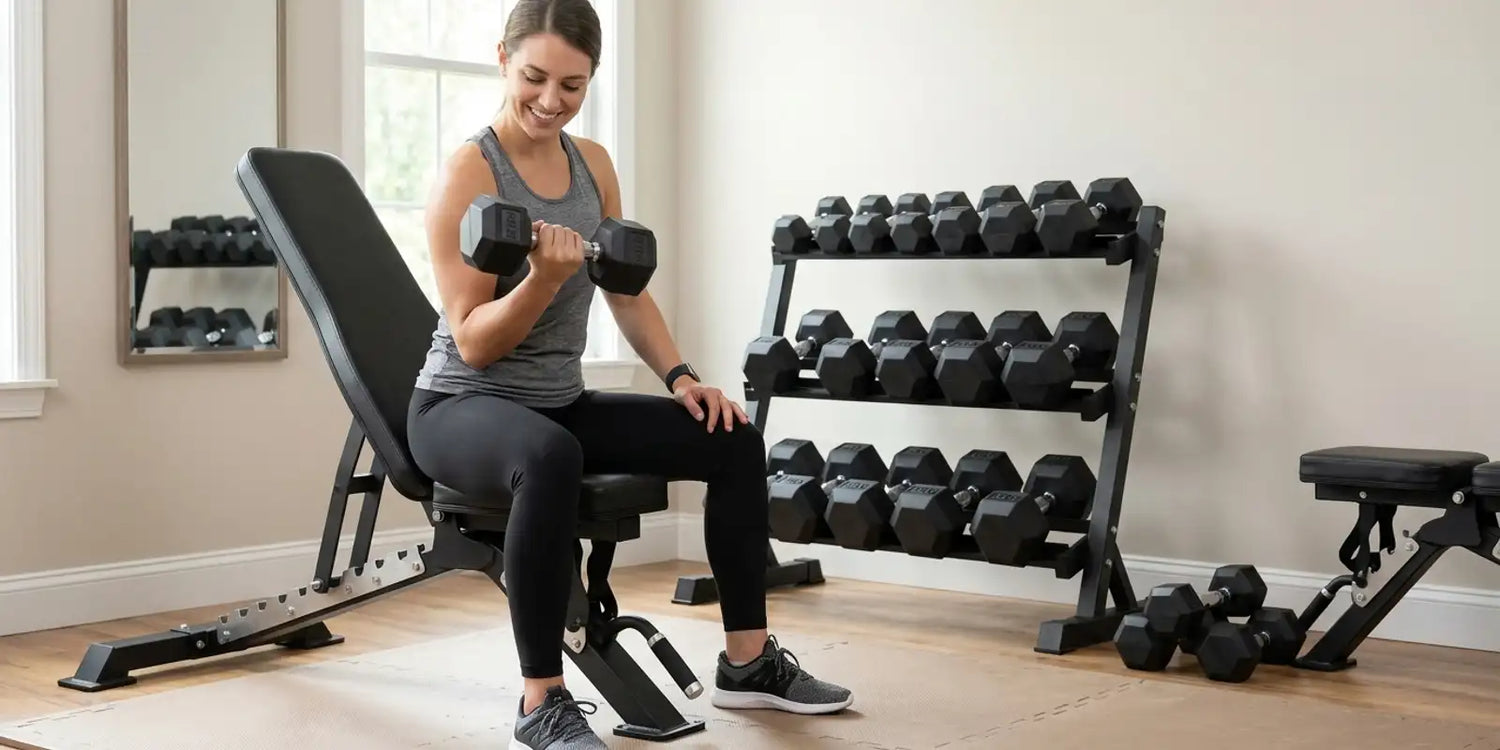
Adjustable Dumbbells and a Dumbbell Rack
Adjustable dumbbells replace a whole shelf of fixed weights and let you load exercises progressively, which is the engine of real strength gains. Keep them tidy with a RitFit A-frame dumbbell rack or a space saving RitFit 3-tier dumbbell rack.
Resistance Bands and a Mat
Resistance bands are inexpensive, joint friendly, and ideal for warm ups, glute activation, and learning new movements before adding load.
A Kettlebell for Glutes and Conditioning
A single kettlebell unlocks swings, goblet squats, and loaded carries that build the posterior chain and double as conditioning work. Browse more options in our functional training equipment collection.
How Much Space and Storage Do You Need?
You need surprisingly little space, often just a clear five by five foot corner with a flat floor. That footprint comfortably holds dumbbells, bands, a kettlebell, and a mat without a dedicated room.
- Ceiling height: Leave enough overhead clearance to raise your arms fully for presses and stretches.
- Storage first: A simple rack or basket keeps gear off the floor so the space stays inviting to use.
For tight apartments, see our list of minimum home gym equipment.
How Do You Choose Your Gear by Goal?
Choose your gear by matching equipment to your main training goal rather than buying everything at once. The table below splits the RitFit starter line by goal, space, and budget so you can pick with confidence.
| RitFit Option | Best Goal | Space | Budget Fit |
|---|---|---|---|
| Dumbbells and A-Rack package | All in one starter strength | Minimal | Best beginner value |
| A-frame dumbbell rack | Storage for 3 to 5 pairs | Small footprint | Affordable add on |
| 3-tier dumbbell rack | Larger dumbbell collection | Wider | Mid range |
| Functional training gear | Glutes and conditioning | Minimal | Flexible |
If glutes are your focus, our guide to the best gym equipment for thighs goes deeper.
Is It Worth the Price? Budget Tiers From Under $100 to $500
Yes, a starter setup is worth it because you can build a functional gym in clear budget tiers without overspending. Each tier adds capability so you only pay for what your routine actually needs.
- Under $100: A mat, a set of resistance bands, and a foam roller cover mobility and full body basics.
- $100 to $300: Add adjustable dumbbells and a rack for real progressive strength training.
- $300 to $500: Add a kettlebell and functional gear for glutes, swings, and conditioning variety.
Compare value picks in our roundup of the best affordable home gym equipment.
What Are the Long Term Upgrade and Expansion Costs?
Long term costs stay low because quality starter gear grows with you rather than needing replacement. The smart path is to expand by adding pieces, not by rebuying the basics.
- Heavier loads: A higher capacity adjustable dumbbell set or extra plates covers years of progress.
- Variety: Bands and a kettlebell add new movement patterns for a small one time cost.
If you want a styled space, our picks for pink gym equipment for home gyms blend looks and function.
How Do You Actually Use Your New Gym Stuff?
You use your gym stuff by training two or three full body sessions a week with progressive overload. Physical activity guidelines recommend muscle strengthening on at least two days weekly alongside aerobic activity.[3]
- Reps and sets: Start with 2 to 3 sets of 10 to 15 reps per exercise and rest a day between sessions.
- Progress: Add a little weight or one more rep once a set feels easy, then repeat.
Apply it with our chest and back workout for women.
FAQs About Gym Stuff for Girls
What gym equipment should a girl buy first?
Start with a pair of adjustable dumbbells, a set of resistance bands, and a quality mat. This trio covers full body strength, mobility, and warm ups for under a hundred dollars in most cases. Add a kettlebell and a dumbbell rack next as your routine grows and you learn which movements you enjoy most.
Will lifting weights make a woman look bulky?
No. Building large bulging muscles takes years of dedicated heavy training, specific genetics, and a calorie surplus. Typical strength training built around progressive overload tends to make women stronger and more toned rather than bulky, while improving bone health, body composition, and overall confidence.
How much space do I need for a home gym as a woman?
Very little. A clear five by five foot corner with a flat floor and enough ceiling height to raise your arms overhead is enough for dumbbells, bands, a kettlebell, and a mat. Apartments, bedrooms, and spare corners all work, so you do not need a dedicated room to train effectively at home.
Are dumbbells or resistance bands better for beginners?
Both serve different roles, so most beginners benefit from owning each. Resistance bands are inexpensive, joint friendly, and great for warm ups and learning movements. Dumbbells let you load exercises progressively for real strength gains. Starting with bands first and adding adjustable dumbbells as you progress is a smart, budget friendly path.
How often should women strength train?
Physical activity guidelines recommend muscle strengthening activity on at least two days per week alongside aerobic activity for health benefits. Beginners can start with two or three full body sessions weekly, leaving rest days between them. Consistency over weeks and months matters far more than training intensity or buying expensive equipment up front.
Conclusion
The best gym stuff for girls is a small, intentional kit that fits your space, goals, and budget. Start with adjustable dumbbells, bands, and a mat, then expand with a kettlebell and storage as you progress.
Pick one budget tier, clear a corner, and train two to three days a week. Consistency, not gear, builds the results you want.
Disclaimer
This article is for general informational and educational purposes only and is not medical or training advice. Consult a qualified healthcare or fitness professional before beginning any new exercise program, especially if you have an existing health condition.
References
1. Kraemer WJ, Fragala MS, Ratamess NA. Evolution of resistance training in women: History and mechanisms for health and performance. Sports medicine and health science. 2025;7(5):351-365. https://pmc.ncbi.nlm.nih.gov/articles/PMC12421175/
2. Ransdell LB, Wayment HA, Lopez N, et al. The impact of resistance training on body composition, muscle strength, and functional fitness in older women (45-80 years): A systematic review (2010-2020). Women (Basel, Switzerland). 2021;1(3):143-168. https://pmc.ncbi.nlm.nih.gov/articles/PMC9191851/
3. Kamada M, Shiroma EJ, Buring JE, Miyachi M, Lee IM. Strength Training and All-Cause, Cardiovascular Disease, and Cancer Mortality in Older Women: A Cohort Study. Journal of the American Heart Association. 2017;6(11). https://pmc.ncbi.nlm.nih.gov/articles/PMC5721806/