








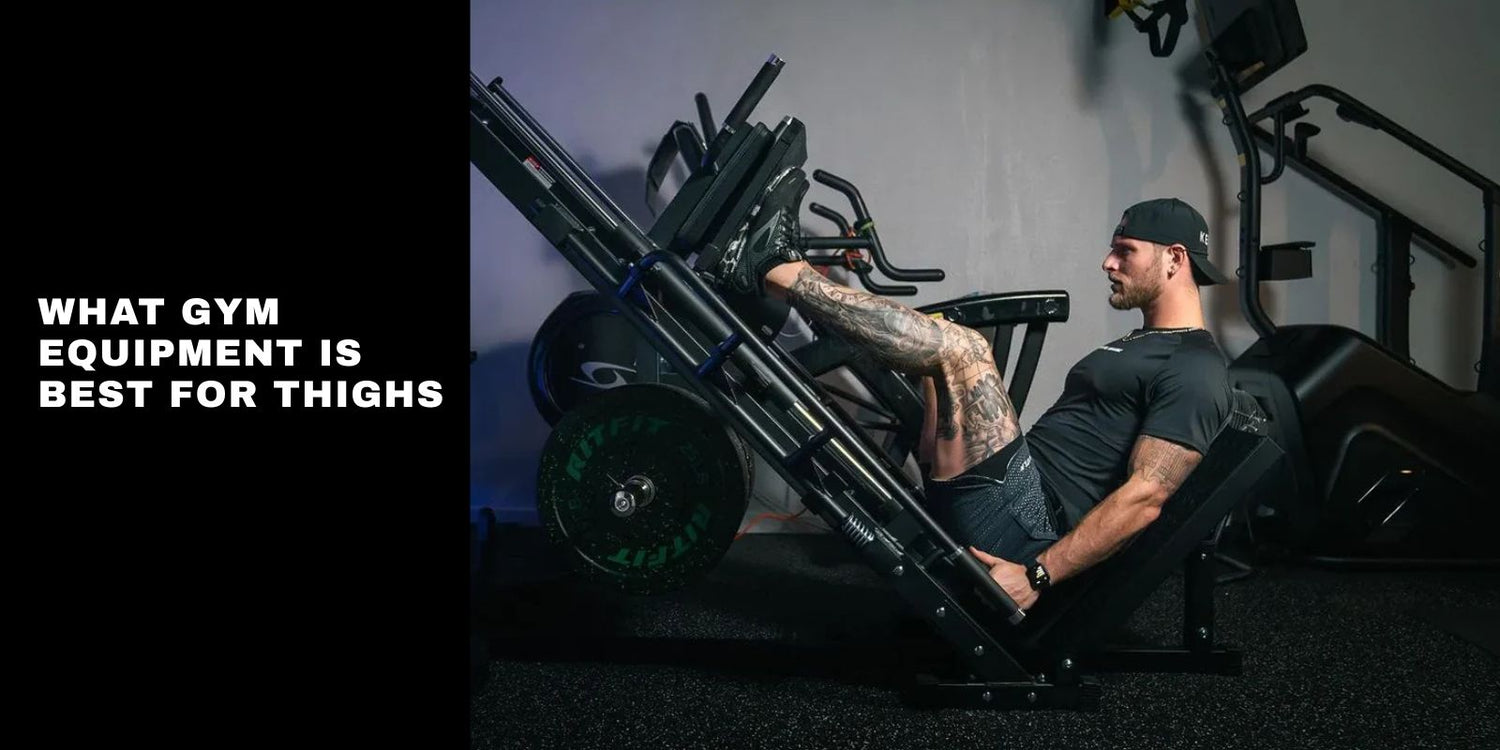
The best gym equipment for thighs is a leg press and hack squat machine, because it combines heavy compound loading with quad, glute, and hamstring engagement. Adding targeted isolation work and inner thigh accessories builds balanced, complete legs.
This guide compares seven thigh equipment options, including leg press machines, hack squat machines, leg extension and curl machines, Smith machines, dumbbells, and cable systems. Each section covers what the equipment does best, which muscles it trains, and how to choose the right setup for your space and goals.
Quick Answer: The best gym equipment for thighs is a leg press and hack squat machine for compound strength, paired with leg extension and leg curl machines for quad and hamstring isolation. Cable machines and dumbbells add inner thigh and unilateral work to complete a balanced home gym thigh routine.
Key Takeaways
- Best overall thigh equipment: A leg press and hack squat machine gives the strongest mix of quad, glute, and lower body strength training in one station.
- Best for quads: Hack squats and leg extensions help target the front of the thighs with less balance demand than free weight squats.
- Best for hamstrings: Leg curls and Romanian deadlift setups train the back of the thighs with direct knee flexion and hip extension work.
- Best for inner thighs: Cable adduction, hip adductor work, and wide stance lower body movements are the most useful options for training the adductors.
- Best for home gyms: Choose equipment that combines safety, compact footprint, progressive loading, and multiple lower body exercises in one unit.
What Muscles Make Up the Thighs?
The thighs include the quadriceps on the front, hamstrings on the back, adductors on the inner thigh, and supporting hip muscles that help control the leg. A good thigh equipment setup should train knee extension, knee flexion, hip extension, hip adduction, and loaded squatting patterns.
- Quadriceps: The quads extend the knee and are heavily trained by leg press, hack squat, Smith machine squat, and leg extension movements.
- Hamstrings: The hamstrings flex the knee and extend the hip, so they need leg curls, Romanian deadlifts, and hip hinge work for balanced development.
- Adductors: The inner thigh muscles pull the legs toward the midline and support squats, lunges, and controlled hip adduction movements.
- Glutes: The glutes are not technically thigh muscles, but they strongly support leg press, hack squat, lunges, and hip extension patterns.
How Do the Best Thigh Machines Compare?
The best thigh equipment depends on whether you want overall leg size, quad focus, hamstring balance, inner thigh work, or a compact home gym setup. Use the table below to match the equipment to the main training goal.
| Equipment | Best For | Main Muscles | Home Gym Value |
|---|---|---|---|
| Leg press machine | Overall thigh strength | Quads, glutes, hamstrings | High |
| Hack squat machine | Quad focus | Quads and glutes | High |
| Leg extension machine | Quad isolation | Quadriceps | Medium to high |
| Leg curl machine | Hamstring isolation | Hamstrings | Medium to high |
| Smith machine | Guided squats and split squats | Quads, glutes, hamstrings | High |
| Dumbbells | Budget thigh workouts | Quads, hamstrings, glutes | High for small spaces |
| Cable machine | Inner and outer thigh work | Adductors, abductors, glutes | Medium to high |
Equipment value ratings reflect general home gym utility based on training versatility, footprint, and progressive loading potential.
What Is the Best Thigh Workout Equipment for Each Goal?
The best thigh workout equipment depends on the muscle you want to prioritize. A leg press and hack squat machine builds overall thigh size, a leg extension isolates the quads, a leg curl targets the hamstrings, and a cable machine handles the inner and outer thighs.
1. Leg Press Machine
A leg press machine is one of the best overall choices for thigh strength because it lets you train the quads and glutes with a stable loaded pattern. A systematic review on leg press variations found strong quadriceps involvement during the exercise, making it especially relevant for thigh focused training.[1]
- Best for: Building overall thigh size, training with heavier loads, and reducing balance demand compared with free squats.
- How it trains thighs: Lower foot placement usually increases quad emphasis, while a higher foot position may shift more work toward the glutes and hamstrings.
- Home gym tip: A 45 degree leg press or compact leg press is usually easier to fit in a garage or basement than a large commercial unit.
"Wow, the leg press machine is better than I expected. Training legs at home is more relaxed and can be performed at my own leisure. The machine was very easy to build, I did it alone in less than two hours. I love the quality of the machine and it's very comparable to.machine I've used at my local gym."
Richard R. Verified Buyer, RitFit GAZELLE PRO 3-In-1 Leg Press and Hack Squat Machine
2. Hack Squat Machine
A hack squat machine is best for lifters who want more front thigh focus without managing a free barbell. A study comparing leg press and Smith machine patterns found that lower body machines can meaningfully change quadriceps activation and perceived effort, so exercise choice should match the training goal.[2]
- Best for: Quad focused hypertrophy, controlled squat patterns, and lifters who want a guided lower body path.
- How it trains thighs: The angled body position and foot placement often make it easier to keep tension on the quadriceps throughout the range of motion.
- Safety tip: Use a range of motion you can control, and avoid locking the knees aggressively at the top of each rep.
3. Leg Extension Machine
A leg extension machine is best for isolating the quadriceps because it trains knee extension without requiring the hips to drive the movement. Single joint and multi joint lower body training can both improve strength, but the most direct strength gains usually come from practicing the specific movement pattern you want to improve.[3]
- Best for: Quad isolation, finishing sets after compound lifts, and building a stronger mind muscle connection with the front thighs.
- How it trains thighs: The movement focuses on the quads through knee extension, especially when reps are controlled through the full range of motion.
- Home gym tip: A combined leg extension and curl machine can save space while covering both front and back thigh work in one unit.
4. Leg Curl Machine
A leg curl machine is best for hamstrings because it directly trains knee flexion. This matters because many thigh routines overemphasize quads and undertrain the back of the thighs.
- Best for: Hamstring isolation, knee flexion strength, and balancing quad dominant leg press or squat work.
- How it trains thighs: The pad position lets the hamstrings pull the lower leg toward the body under resistance for targeted knee flexion.
- Programming tip: Pair leg curls with Romanian deadlifts for a more complete hamstring plan that covers both knee flexion and hip extension.
5. Smith Machine
A Smith machine is best for versatile thigh training when you want guided squats, split squats, lunges, calf raises, and Romanian deadlifts in one station. It is especially useful for solo home gym training because the guided bar path and safety stops make setup more controlled.
- Best for: Beginners, solo lifters, garage gyms, and people who want a full lower body station beyond one dedicated leg machine.
- How it trains thighs: Smith squats and split squats can emphasize the quads, while Smith Romanian deadlifts train the hamstrings and glutes.
- Home gym tip: Explore the RitFit Smith Machine Collection if you want guided lower body training plus upper body exercise options in one station.
6. Dumbbells
Dumbbells are the best budget option for thigh workouts because they support squats, lunges, step ups, split squats, and Romanian deadlifts. A systematic review on range of motion suggests that using an appropriate controlled range is an important training variable for muscle development, especially in lower body exercises.[4]
- Best for: Small spaces, beginners, unilateral training, and budget friendly thigh workouts.
- How it trains thighs: Goblet squats and split squats train the quads, while Romanian deadlifts and lunges add hamstring and glute involvement.
- Home gym tip: The RitFit Hex Rubber Dumbbells are a practical starting point for compact lower body training.
7. Cable Machine
A cable machine is best for inner thigh and outer hip work because it lets you train hip adduction and abduction with adjustable resistance. This makes it a useful accessory for lifters who already have compound thigh training covered.
- Best for: Inner thighs, outer hips, glute medius work, and accessory lower body training.
- How it trains thighs: Cable adduction targets the inner thighs, while cable abduction supports outer hip stability.
- Home gym tip: The RitFit Cable Crossover Machine can support hip adduction, hip abduction, cable squats, and other accessory exercises for a complete lower body routine.
If your space is limited, a good set of adjustable dumbbells might be your better option. They will allow you to progress to heavier weight as you get stronger.Jeff Cavaliere, MSPT, CSCS, Physical Therapist and Strength Coach, Athlean-X, Ultimate Total Body Dumbbell Workout
Which Thigh Equipment Should You Choose?
Choose thigh equipment by matching the machine to your main goal instead of buying the largest machine first. A strong home gym plan should cover heavy compound training, targeted isolation, and enough progression for long term results.
- For bigger thighs: Choose a leg press and hack squat machine as your main lower body station.
- For quad definition: Choose hack squats and leg extensions to keep more tension on the front thighs.
- For hamstrings: Choose leg curls, Romanian deadlifts, and hip hinge exercises.
- For inner thighs: Choose cable adduction, hip adductor work, and controlled wide stance lower body movements.
- For small home gyms: Choose compact equipment that combines more than one lower body function in a single unit.
- For beginners: Choose guided machines, lighter dumbbells, and simple movement patterns before heavy free weight training.
What RitFit Equipment Is Best for Thigh Training?
RitFit thigh training equipment should be selected by training priority, room size, and the type of resistance you want. For most home gym owners, the best setup combines one lower body machine, one guided rack or Smith machine, and adjustable free weights.
- Best overall thigh machine: The RitFit GAZELLE PRO 3 In 1 Leg Press and Hack Squat Machine is the strongest match for users who want leg press and hack squat training in one unit.
- Best compact lower body option: The RitFit BLP01 3 In 1 Leg Press and Hack Squat Machine fits users who want thigh training with a more space aware home gym setup.
- Best isolation machine: The RitFit PLC01 Leg Extension Curl Machine is best for direct quad and hamstring isolation in a single compact unit.
- Best all around guided station: The RitFit M1 PRO Smith Machine Weight Stack Home Gym Package supports squats, split squats, lunges, cable work, and full body training.
- Best product category to compare: The RitFit Strength Machines Collection helps you compare leg press, hack squat, cable, and isolation machine options in one place.
What Does a Sample Thigh Workout Look Like?
A balanced thigh workout should start with a compound movement, then add isolation work for the quads, hamstrings, and inner thighs. A study on resistance training loads suggests that strength, hypertrophy, and endurance adaptations can be trained across different rep ranges when effort and progression are managed well.[5]
Beginner Thigh Workout
Use this plan if you are new to home gym thigh training and want simple equipment choices with controlled volume.
- Leg press: 3 sets of 10 to 12 reps.
- Leg extension: 2 sets of 12 to 15 reps.
- Leg curl: 2 sets of 12 to 15 reps.
- Dumbbell Romanian deadlift: 3 sets of 8 to 10 reps.
- Cable hip adduction: 2 sets of 12 to 15 reps per side.
Intermediate Thigh Workout
Use this plan if you already train lower body and want more quad, hamstring, and inner thigh volume.
- Hack squat: 4 sets of 8 to 10 reps.
- Smith machine split squat: 3 sets of 8 to 10 reps per side.
- Leg extension: 3 sets of 10 to 15 reps.
- Leg curl: 3 sets of 10 to 15 reps.
- Cable adduction: 2 sets of 12 to 15 reps per side.
For more lower body programming ideas, read the Lower Body Machine Workout Guide and the Best Leg Press Machine for Home Gym Guide.
What Should You Look for When Buying Thigh Equipment?
The best thigh equipment should match your training goal, available space, strength level, and safety needs. Do not buy a machine only because it looks impressive, buy it because it solves the training problem you actually have.
- Training coverage: Choose equipment that covers quads, hamstrings, inner thighs, and glutes instead of only one movement.
- Footprint: Measure your room before buying, including walking space and plate loading space around the machine.
- Progressive loading: Make sure the machine allows gradual resistance increases as your legs get stronger over time.
- Safety features: Look for stable frames, secure adjustment points, controlled movement paths, and safety stops when available.
- Exercise variety: Prioritize machines that support more than one lower body movement if your space is limited.
- User fit: Check pad positions, seat adjustments, footplate size, and range of motion before choosing a machine.
- Accessory compatibility: If you already own plates, racks, or cable attachments, choose equipment that fits your current setup.
Common Mistakes When Choosing Thigh Equipment
The most common mistake is buying equipment that trains only one thigh area while ignoring the rest of the lower body. A better choice is a balanced setup that includes a compound machine, isolation work, and enough accessory options for weak points.
- Ignoring hamstrings: Many lifters train leg press and leg extension but forget direct hamstring work, creating muscle imbalances.
- Buying too large: A machine that blocks movement space can make the home gym harder to use and less enjoyable.
- Skipping adjustability: Poor pad or seat fit can limit range of motion and reduce training comfort and effectiveness.
- Using too much weight too soon: Heavy loading before control often leads to poor form and inconsistent progress.
- Choosing isolation first: Isolation machines are useful, but most users should build the base with compound lower body work first.
FAQs About Best Gym Equipment for Thighs
What gym equipment is best for thighs overall?
The best gym equipment for thighs overall is a leg press and hack squat machine because it trains the quads, glutes, and lower body through heavy compound movement. For most home gyms, it gives more thigh building value than a single isolation machine.
What machine is best for building bigger quads?
The best machine for bigger quads is a hack squat or leg extension machine. Hack squats load the thighs through a compound pattern, while leg extensions isolate knee extension and help add focused work after heavier lower body sets with less balance demand.
Which equipment works the inner thighs at home?
The best equipment for inner thighs at home is a cable machine, hip adductor setup, or controlled wide stance lower body work. Cable adduction is useful because it lets you train the adductors with adjustable resistance and a clear range of motion.
Can dumbbells build strong thighs?
Yes. Dumbbells can build strong thighs when you use squats, lunges, split squats, step ups, and Romanian deadlifts with progressive overload. They are a practical starting point for small spaces, but heavy thigh growth often becomes easier with machines or racks.
Is a leg press better than squats for thighs?
Not always. A leg press is better when you want stable, high effort thigh training with less balance demand, while squats train more total body coordination. The best choice depends on your goals, space, experience, and whether you train alone at home.
Should beginners use a Smith machine for thigh workouts?
Yes. Beginners can use a Smith machine for thigh workouts because the guided bar path makes squats, split squats, and lunges easier to control. It still requires proper setup, steady tempo, and conservative loading before adding heavier weight, so start light and progress gradually.
How often should I train thighs?
Most lifters can train thighs two times per week if volume, recovery, and exercise selection are managed well. Beginners should start with one or two focused sessions per week, then add sets gradually as technique and soreness tolerance improve over time.
What RitFit equipment is best for thigh workouts?
The best RitFit equipment for thigh workouts depends on your priority. The GAZELLE PRO suits overall leg press and hack squat work, the PLC01 supports quad and hamstring isolation, and a Smith machine setup adds squats, lunges, and Romanian deadlifts.
Conclusion
The best gym equipment for thighs is the equipment that trains your whole lower body, fits your space, and lets you progress safely. For most home gyms, a leg press and hack squat machine offers the strongest foundation, while leg extension, leg curl, Smith machine, dumbbells, and cable work help complete the plan.
Start with the compound machine that matches your primary goal, add isolation work as your routine develops, and explore the RitFit Strength Machines Collection to compare options. Check the RitFit discount guide for current offers before you buy.
Disclaimer
This article is for general fitness education only and is not medical advice. If you have knee, hip, back, or joint concerns, consult a qualified healthcare professional or certified trainer before starting a new thigh workout program.
References
1. Martin-Fuentes I, Oliva-Lozano JM, Muyor JM. Evaluation of the Lower Limb Muscles' Electromyographic Activity during the Leg Press Exercise and Its Variants: A Systematic Review. Int J Environ Res Public Health. 2020;17(13):4626. doi:10.3390/ijerph17134626. PMCID: PMC7369962
2. Migliaccio GM, Dello Iacono A, Ardigo LP, Samozino P, Iuliano E, Grgantov Z, Padulo J. Leg Press vs. Smith Machine: Quadriceps Activation and Overall Perceived Effort Profiles. Front Physiol. 2018;9:1481. doi:10.3389/fphys.2018.01481. PMCID: PMC6200843
3. Stien N, Pedersen H, Ravnoy AH, Andersen V, Saeterbakken AH. Training specificity performing single-joint vs. multi-joint resistance exercises among physically active females: A randomized controlled trial. PLoS One. 2020;15(5):e0233540. doi:10.1371/journal.pone.0233540. PMCID: PMC7241825
4. Schoenfeld BJ, Grgic J. Effects of range of motion on muscle development during resistance training interventions: A systematic review. SAGE Open Med. 2020;8:2050312120901559. doi:10.1177/2050312120901559. PMCID: PMC6977096
5. Schoenfeld BJ, Grgic J, Van Every DW, Plotkin DL. Loading Recommendations for Muscle Strength, Hypertrophy, and Local Endurance: A Re-Examination of the Repetition Continuum. Sports. 2021;9(2):32. doi:10.3390/sports9020032. PMCID: PMC7927075





