








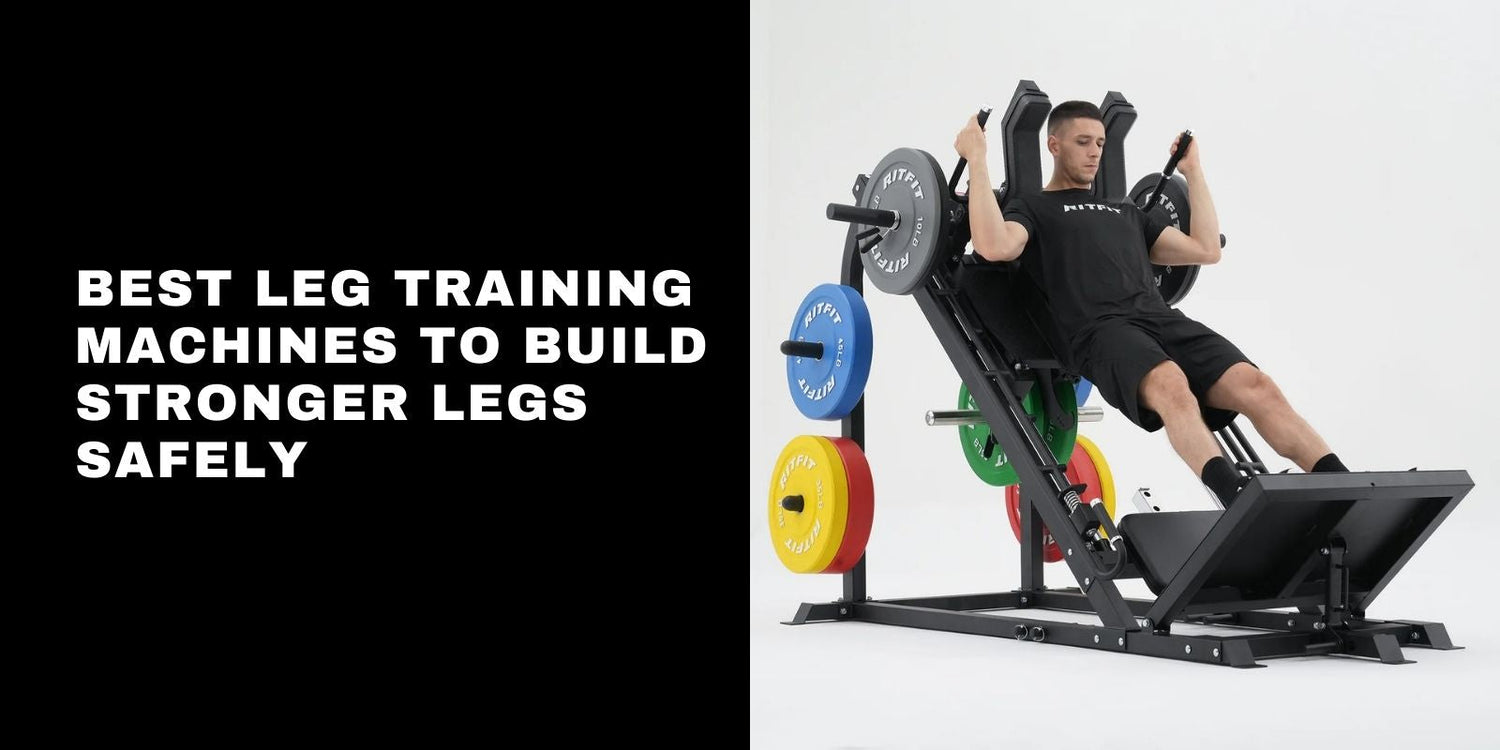
Leg day is often viewed with a mix of dread and respect, yet it is essential for total-body strength, metabolism, and athletic performance. Training machines for legs provide a safe and effective alternative to heavy barbells, with fixed movement paths that suit beginners, returning lifters, and advanced athletes alike.
This guide explains the key lower body muscles, the main leg machines and how to use them, sample routines for every level, and the programming principles that turn machine training into measurable results.
Quick Answer: Training machines for legs can build strength and size as effectively as free weights when you apply progressive overload and proper setup. Compound machines like the leg press and hack squat deliver the most value, while isolation machines such as leg extension and seated leg curl target specific muscles for balanced lower body development.
Key Takeaways
- Machine training works: Leg machines build strength and size as effectively as free weights when you use progressive overload and good form.
- Order matters: Start with compound machines for the most value, then add isolation machines to fully fatigue specific muscles.
- Setup beats load: Adjust the seat, back pad, and foot position before adding weight, because great setup matters more than load on machines.
- Knee friendly options: For joint comfort, prioritize controlled tempo, a comfortable range, the seated leg curl, and a higher foot placement on leg press.
- Follow a plan: A simple eight-week progression plan outperforms random workouts even when your exercise list stays the same.
Which muscles do lower body machines work?
Lower body machines work the quadriceps, hamstrings, glutes, calves, and hip adductors and abductors. Understanding these muscle groups helps you select machines that correct imbalances instead of reinforcing the exercises you find easiest.
- Quadriceps: The muscles on the front of the thigh responsible for knee extension or straightening the leg.
- Hamstrings: The muscles on the back of the thigh responsible for knee flexion and hip extension.
- Glutes: The powerhouse of the posterior chain that drives hip extension and stability.
- Calves: The gastrocnemius and soleus handle ankle flexion and lower-leg stability.
- Adductors and abductors: The inner and outer thigh muscles control lateral movement and hip stability.
What are the benefits of lower body machine workouts?
Lower body machine workouts improve form, protect joints, isolate specific muscles, and make progressive overload simple. A fixed range of motion keeps the body aligned while a pin-loaded weight stack allows quick incremental changes between sets.
- Improved form and technique: Machines provide a fixed range of motion that forces correct alignment, which is invaluable for beginners learning movement patterns.
- Safety and joint support: Removing the need to stabilize a heavy bar in space reduces the risk of losing balance, making machines safer for those with back or knee concerns.
- Muscle isolation: Machines isolate specific muscles better than free weights, such as isolating the quadriceps with a leg extension machine without heavy glute involvement.
- Progressive overload made simple: Most machines use a pin-loaded weight stack so you can make quick, incremental weight changes to ensure consistent progress.
What types of training machines for legs are there?
The main types of training machines for legs are compound push machines, isolation machines, stabilization accessories, and hybrid stations. Most gym floors are organized around these categories, and a balanced plan typically draws from each one.
- Compound push machines: Leg press and hack squat for heavy, multi-joint loading.
- Isolation machines: Leg extension and seated or lying leg curl for single-joint targeting.
- Stabilization and accessory machines: Hip abductor and adductor, glute drive or kickback, and calf raise stations.
- Hybrid machines: Smith machine and cable stations for guided or constant-tension work.
Browse the full RitFit leg machine collection to compare options for a home setup.
How do you use each core leg machine correctly?
Each core leg machine works best with a specific setup and range of motion, so the details below matter more than the load. Start with one compound machine and one isolation machine until the movements feel smooth.
Leg press machine
The leg press is a staple for heavy loading without spinal compression, and it targets the quads, glutes, and hamstrings. A 3-in-1 option like the RitFit BLP01 leg press and hack squat machine adds calf work to the same footprint.
- Setup: Sit with your back flat against the pad and place your feet shoulder-width apart on the platform.
- Execution: Lower the weight until your knees form a 90-degree angle, then drive back up through your heels.
- Mistake to avoid: Never lock your knees out completely at the top, and keep a slight bend to protect the joint.
Hack squat machine
The hack squat machine mimics a barbell squat while supporting the back, placing significant emphasis on the quadriceps. It is a strong machine-based option for lifters who want squat depth without balance demands.
- Setup: Position your shoulders under the pads and your feet on the platform.
- Execution: Descend deep while keeping your knees tracking over your toes, then drive up through the platform.
- Modification: If you have knee sensitivity, place your feet higher on the platform to shift load to the glutes and reduce knee shear.
Leg extension machine
The leg extension machine is the primary tool for isolating the quadriceps through knee extension. For a compact home option, the RitFit Mustang PRO leg extension and curl machine pairs the movement with a seated leg curl.
- Setup: Adjust the back pad so your knee aligns with the machine's pivot point, and position the ankle pad just above the foot.
- Usage: Extend your legs fully, squeeze the quads at the top, then lower slowly under control.
Leg curl machines, seated and lying
Leg curl machines are essential for hamstring development and knee health. The seated version stretches the hamstrings at the hip, often leading to better hypertrophy, while the lying version allows a full contraction.
- Form tip: Keep your hips pressed firmly against the pad so the lower back does not arch and take over the load.
Hip abductor and adductor machines
These machines target the inner thighs and the outer glutes or gluteus medius, which are often neglected. Strengthening these stabilizers helps prevent knee cave during squats and improves hip mobility.
Glute-focused machines
Machines such as the glute drive or hip thrust station and kickback stations allow heavy glute loading without setting up a barbell. Focus on the hip hinge and squeeze the glutes hard at the top without hyperextending the lower back.
Calf raise machines
Calves respond best to deep stretches and full contractions, so tempo matters. Standing calf raises target the gastrocnemius, while seated versions target the soleus.
- Tip: Perform reps with a controlled tempo and do not bounce.
Smith machine and cables
The Smith machine offers a guided bar path for squats and lunges, making it easier to maintain balance than a free barbell. Cables are excellent for constant-tension exercises such as pull-throughs and kickbacks, and you can see our best Smith machine leg workouts for guided routines.
What are the best lower body machine workout routines?
The best lower body machine workouts pair a compound movement with two isolation movements and finish with calves or glute work. The routines below cover beginners, intermediate lifters, joint-friendly training, and glute-focused goals.
Beginner machine-only leg day
Focus: Learning movement patterns and building consistency.
- Leg press: 3 sets of 10-12 reps
- Leg extension: 3 sets of 12-15 reps
- Seated leg curl: 3 sets of 12-15 reps
- Standing calf raise: 3 sets of 15 reps
Intermediate strength and hypertrophy
Focus: Increasing volume and intensity on key muscle groups.
- Hack squat: 4 sets of 8-10 reps
- Leg press: 3 sets of 10-12 reps
- Lying leg curl: 4 sets of 12 reps
- Leg extension: 3 sets of 15 reps, holding the squeeze at the top
- Glute kickback machine: 3 sets of 12 reps per leg
Joint-friendly routine
Focus: Low impact, controlled tension for those with back or knee issues.
- Seated leg curl: 3 sets of 15 reps to warm up the knees
- Leg press with high foot placement: 3 sets of 12 reps to reduce knee stress
- Glute drive machine: 3 sets of 10-12 reps
- Abductor machine: 3 sets of 15 reps
Glute-focused routine
Focus: Posterior chain development.
- Hip thrust machine: 4 sets of 8-10 reps
- Smith machine reverse lunges: 3 sets of 10 reps per leg
- Wide-stance leg press: 3 sets of 12 reps
- Cable kickbacks: 3 sets of 15 reps per leg
"Leg extensions create hypertrophy in the quads and can be overloaded. However, there are some potential safety issues for people with tendonitis or knee issues, as it places a lot of force and tension on the patella. It's a good exercise for some, definitely not all."
Jeff Cavaliere, MSPT, CSCS, Physical Therapist and Strength Coach, former Head Physical Therapist for the NY Mets, Athlean-X
How do you program machine leg days for results?
Programming machine leg days for results comes down to frequency, progressive overload, and intelligent intensity. You do not need complicated periodization, but you do need a plan that increases demand over time.
- Frequency: Train legs one to two times per week, and split the volume so each session supports recovery.
- Progressive overload: You cannot use the same pin placement forever, so aim to increase weight, reps, or technique quality every session.
- Intensity techniques: Machines are safe for drop sets and rest-pause sets because you do not have to re-rack a heavy bar, so use them when progress stalls.
How do you stay safe, warm up, and recover?
Even though machines are safer than free weights, injury is still possible without preparation. A short warm-up, honest joint checks, and deliberate recovery keep machine leg days productive.
- Warm up: Spend 5-10 minutes on light cardio, then follow it with dynamic stretching such as leg swings and light warm-up sets on the first machine.
- Injury prevention: Listen to your joints. If a machine feels unnatural, adjust the seat or back pad, and swap the exercise if pain persists.
- Recovery: Legs are large muscle groups that need significant energy to repair, so prioritize sleep and protein intake after training.
What mistakes should you avoid with leg machines?
The most common mistakes with training machines for legs are ego lifting, skipping setup, and neglecting the hamstrings. Avoiding these three errors keeps results high and joints healthy.
- Ego lifting: Loading the leg press with every plate in the gym but moving it only two inches minimizes results and risks injury, so use a full range of motion.
- Skipping setup: Not adjusting the machine to your height leads to poor leverage and joint strain, so always set the pads before adding weight.
- Neglecting hamstrings: Focusing only on quads with extensions and presses while ignoring the back of the leg creates imbalances, so keep curl work in every plan.
How do you adapt machine workouts to your goals?
Machine workouts adapt to your goals by changing rep ranges, rest periods, and exercise selection. Match the approach below to whether you prioritize muscle growth, strength, or conditioning.
- For muscle growth: Stick to the 8-15 rep range and focus on a slow, controlled lowering phase.
- For strength: Build strength on machines such as the hack squat by using 5-8 reps with heavier loads and ample rest.
- For fat loss and conditioning: Use machines in a circuit fashion with short rest periods to keep the heart rate elevated, like the routines in our full-body circuit training guide.
For a balanced home setup, compare the RitFit leg press machine options alongside the machines above.
FAQs About Training Machines for Legs
Are machines enough to build big legs?
Yes.
Your muscles respond to tension and resistance, so machines can stimulate significant growth when you apply progressive overload.
Combine compound presses with isolation work, train legs one to two times per week, and keep adding weight or reps over time.
What if I only have 30 minutes?
Focus on compound machines because they work several muscles at once.
A short session built around the leg press and lying leg curls, performed with high intensity, is very effective in a limited window.
Add one calf or glute movement if time allows.
Can I train legs on machines with knee pain?
Often yes, because machines add stability and a fixed movement path.
Use a higher foot placement on the leg press to offload the knees, and favor the seated leg curl for knee comfort.
Consult a professional before training if you have chronic pain.
How often should I train legs on machines?
Train legs one to two times per week with machines.
Splitting the volume across two sessions supports recovery, and each session should apply progressive overload so the same pin placement is never used forever.
Consistency beats intensity in the short term.
Do leg machines build as much muscle as free weights?
Yes, when progressive overload and good form are applied.
Muscles respond to tension and resistance regardless of the implement, so machine-based training can produce growth comparable to free weights.
The movement you repeat with increasing load is what drives results.
Conclusion
Training machines for legs let you build a strong, balanced lower body safely and effectively, from a beginner learning movement patterns to an advanced lifter isolating specific muscles. The keys are smart setup, consistent progressive overload, and choosing a routine you can repeat.
Pick one routine from this guide, follow it for eight weeks, and review current RitFit deals when you are ready to build a home leg day.
Disclaimer
This article is for general educational purposes only and is not medical advice. Consult a qualified clinician before starting any exercise program, especially if you have joint pain, a recent injury or surgery, and stop any exercise that causes sharp pain.





