








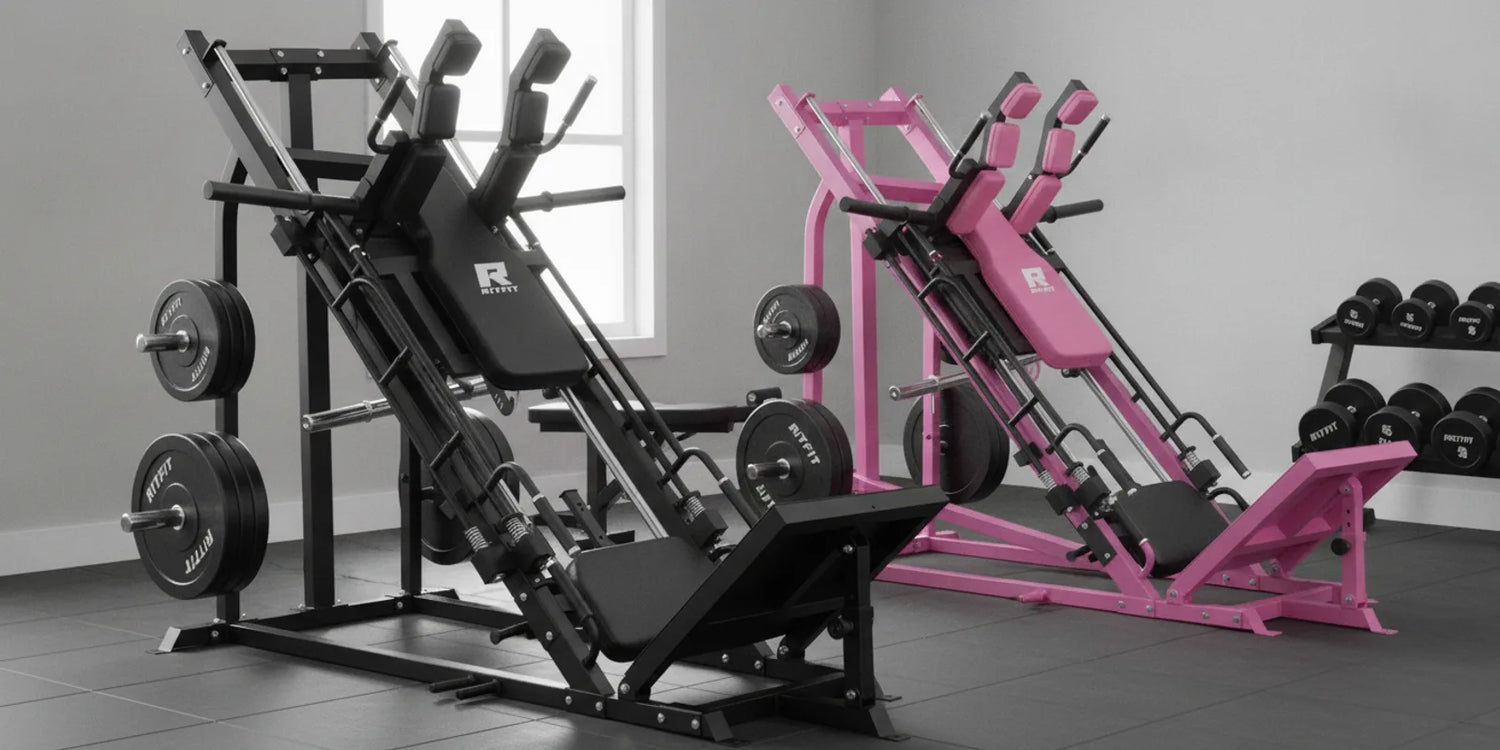
A hack squat machine for a home gym solves one of the hardest problems in garage training: getting true quad-dominant leg work without a spotter, a large footprint, or a full commercial setup. The fixed back pad, shoulder harness, and guided sled all work together to let you load your quads progressively and safely, even when training alone.
This guide walks intermediate home gym lifters through space planning, machine selection, setup, and programming, so you can buy with confidence and start building quad strength on day one.
Quick Answer: A hack squat machine for a home gym requires roughly 6 to 8 feet of floor length, 4 to 5 feet of width, and 7 to 8 feet of ceiling height. For most intermediate lifters, an 800 to 1,000 pound capacity machine suits spaces from 50 square feet (compact combo) up to 130 square feet (dedicated standalone).
Key Takeaways
- Space requirement: Most home-use hack squat machines measure roughly 6 to 8 feet long and 4 to 5 feet wide; plan for at least 7 to 8 feet of ceiling height before ordering.
- Quad bias is mechanical: The back pad enforces an upright trunk angle, which shifts the load from the hips to the quadriceps, a relationship confirmed by biomechanical research.
- 2-in-1 vs dedicated: A compact combo like the RitFit Gazelle 3-in-1 suits spaces under 100 square feet; the RitFit BLP01 is the better pick when you have 80 to 130 square feet and want a stiffer, more loaded feel.
- Weight capacity: Equipment guides suggest 800 to 1,000 pounds capacity is sufficient for most intermediate home lifters who typically work in the 300 to 500 pound range.
- Programming starting point: Three to four sets of 8 to 12 reps, one to two times per week, paired with a hip-dominant pull, covers balanced lower-body development for most intermediate trainees.
What Makes a Hack Squat Machine Different from a Leg Press?
A hack squat machine positions your body diagonally with shoulder pads and a backrest, keeping your trunk relatively upright as you push the sled downward along guided rails, while a leg press has you seated or reclined pushing a sled away from you at a fixed angle. That single postural difference changes which muscles do the most work.
- Trunk orientation: The hack squat holds your back against an angled pad, limiting forward lean and directing more of the load through the knee extensors rather than the hips.
- Movement plane: Both machines use a guided rail, but the hack squat's diagonal path places the quadriceps at a mechanical disadvantage compared to a seated press, requiring them to produce more force through the full range of motion.
- Hip involvement: The leg press allows greater hip flexion and posterior-chain recruitment, especially when the feet are placed high on the platform, making it a useful complement rather than a direct substitute.
- Safety for solo training: Both machines eliminate the need for a spotter, but the hack squat's locking safety catches and shoulder harness make unracking and re-racking straightforward when training alone at home.
- Fixed path benefit: The linear bearing rails remove the balance demand of a barbell squat, letting you focus entirely on quad contraction and progressive loading without worrying about lateral stability.
A best leg press hack squat combo for home gym guide covers how to evaluate whether one machine can serve both functions in your specific space.
Why Does the Hack Squat Deliver Superior Quad Bias Compared to a Barbell Squat?
The hack squat's back pad mechanically enforces an upright trunk, and that upright position directly increases the knee flexion moment, which is the force demand placed on the quadriceps. A 2024 biomechanical review in Int J Sports Phys Ther explains that trunk and tibia inclination have opposite effects on knee flexion moments: forward trunk lean reduces quad demand, while the hack squat's constrained upright trunk does the reverse.[1]
Upright trunk angle and quadriceps bias
A 2023 study in Physical Therapy in Sport found that trunk angle and shank angle each contribute to the hip-to-knee moment ratio during the bilateral squat, with a more upright trunk consistently shifting the ratio toward greater knee extensor demand.[2]
- Trunk-tibia relationship: When the shin tracks forward over the toes and the trunk stays upright, the knee must do more work to control the descent and drive the ascent.
- Back pad as a cue: The hack squat's padded backrest acts as a passive constraint, preventing the compensation that most lifters unconsciously use during free-weight squats.
- Reduced hip extensor dominance: Because the trunk stays vertical, the glutes and hamstrings contribute less, leaving the quadriceps to manage the majority of the load through the range of motion.
Fixed movement path for reliable home solo training
The guided rails on a dedicated hack squat machine remove lateral balance demands entirely, which matters most for home lifters who train without a spotter and cannot afford a failed rep at the bottom of a loaded squat.
- No wobble tax: Unlike a barbell hack squat, the machine path stays consistent rep after rep, so technique fatigue does not distort the movement or shift load away from the quads.
- Progressive overload simplicity: Adding a 10-pound plate and hitting the target rep range is a clean feedback loop; the machine does not penalise minor form breakdown the way a free-bar variation does.
"There's no better machine for the quads. The tilted foot plate promotes normal biomechanics at the knee and hip."
Jeff Cavaliere, MSPT, CSCS, Physical Therapist and Strength Coach, Athlean-X
What Floor Space and Ceiling Height Do You Need Before Buying a Hack Squat Machine?
According to fitness equipment guides, most home-use hack squat machines measure roughly 6 to 8 feet long and 4 to 5 feet wide. You need at least 2 to 3 feet of clearance on each side for safe plate loading, and a ceiling height of at least 7 to 8 feet.
Minimum footprint: 6 ft x 4 ft plus side clearance
Compact 2-in-1 combo models sit closer to the 4 to 5 foot wide end of the range; dedicated standalone hack squats typically run longer and benefit from the full 8-foot length allowance.
- Measure diagonally: The sled travels at an angle, so the machine's listed footprint understates the total envelope during use; always add 12 to 18 inches to the stated length.
- Side clearance for Olympic plates: Standard 45-pound plates extend roughly 9 inches from the sleeve; a 20-inch clearance per side ensures you can load and unload without pinching a wall or another piece of equipment.
- Door swing and traffic lanes: Mark the machine's footprint on the floor with tape before it arrives, then test whether the room still functions with normal entry, exit, and movement around other equipment.
- Mat base: Fitness equipment guides recommend a minimum 3/4-inch rubber mat under the machine to protect flooring, reduce vibration, and prevent sliding on smooth concrete.
Ceiling height: at least 7-8 ft, 9 ft for taller users
The sled rises above your shoulders at the top of each rep, so a low ceiling creates a genuine collision risk with taller users or high-loading configurations.
- Measure at the machine location: Garage ceilings often slope near side walls or have overhead door mechanisms that reduce usable height; measure exactly where the machine will sit.
- Overhead obstruction check: HVAC ducts, lighting fixtures, and garage door tracks can all reduce effective ceiling height by 6 to 12 inches; account for all of them before confirming a machine fits.
- Stack height at full extension: Loaded plates add height above the machine's frame; a fully loaded sled can add 8 to 12 inches above the unloaded stack height.
Which RitFit Hack Squat Machine Is Right for Your Home Gym?
The right machine depends on three factors: available floor space, training goal, and whether you want a standalone hack squat or a combo unit. Equipment guides suggest 800 to 1,000 pounds capacity is sufficient for most intermediate home lifters who typically work in the 300 to 500 pound range for leg press movements.
Browse the full leg machines collection to compare all available models before deciding.
Decision matrix: by space, budget, and training goal
| Machine | Best Space | Capacity | Best For |
|---|---|---|---|
| RitFit Gazelle 3-in-1 | 50-100 sq ft | 600-800 lb range | Budget-conscious buyers who want combo leg press + hack squat in a compact footprint |
| RitFit BLP01 | 80-130 sq ft | 800 lb+ | Dedicated quad training with a stiffer feel and heavier loading capacity |
| RitFit BLP01 + PLC01 Set | 100-150 sq ft | 800 lb+ | Advanced home leg days combining hack squat with leg extension and curl for full leg coverage |
| RitFit M1 Pro + BLP01 Package | 130-200 sq ft | Full gym capacity | Lifters building a complete home gym who want Smith machine pressing alongside dedicated hack squat work |
Is a 2-in-1 leg press and hack squat combo worth it for small spaces?
A 2-in-1 combo machine earns its keep in spaces under 100 square feet because it replaces two separate machines with one footprint, and the movement adjustment from hack squat to leg press typically requires only a pad repositioning or seat angle change.
- When a combo makes sense: Your gym is 50 to 100 square feet, you want both hack squat and leg press movements, and your loading rarely exceeds 400 to 500 pounds on the sled.
- When a standalone is better: You have 80 square feet or more dedicated solely to leg work, you want maximum rigidity under heavy loads, or you plan to pair the machine with a separate RitFit M1 Smith Machine for upper-body pressing.
- Combo limitations: The frame geometry optimized for both movements involves trade-offs in pad angle and rail inclination that a purpose-built hack squat machine avoids.
Is it worth upgrading? Long-term cost and expandability
The RitFit M1 Pro + BLP01 Home Gym Package bundles the cable crossover system and Smith machine with the BLP01, making it the most cost-effective path for lifters who know they will eventually want full-gym capability.
- Start smaller, add later: Buying the Gazelle now and adding the RitFit M1 Home Gym Package later is a viable two-step approach if budget is the primary constraint today.
- Commercial-grade steel gauge: RitFit machines use heavy-gauge steel that maintains structural integrity under repeated heavy loading, which matters for long-term durability in a home context where maintenance support may be limited.
- Resale value: A well-maintained dedicated hack squat machine holds value better than a lighter combo unit, particularly as the home gym market continues to grow.
How Do You Set Up and Use a Hack Squat Machine for Maximum Quad Gains?
Setting up the hack squat correctly determines whether the machine targets your quads effectively or redistributes load to your lower back and hips. The key adjustment points are shoulder pad height, footplate position, and depth cue.
Step 1: Shoulder pad and backrest adjustment
Position the shoulder pads so they sit flush against your trapezius at the top of your shoulder, not digging into the neck or leaving a gap above the clavicle.
- Pad height: The pads should make contact before you release the safety handles; if you have to stand on your toes to get under them, raise the starting position.
- Back contact: Maintain full contact between your lower back and the backrest throughout the movement; any gap or peel-off signals that the load is too heavy or the depth is too aggressive for your current mobility.
- Safety handles: Practice engaging and disengaging the handles unloaded before adding plates; this is your primary emergency exit during solo training.
Step 2: Foot position for quad vs glute emphasis
Lower and narrower foot placement on the footplate increases knee flexion demand and shifts the stimulus toward the quadriceps; higher and wider placement recruits more glutes and inner thighs.
- Quad-focused position: Feet roughly hip-width, placed in the lower third of the plate, toes pointed slightly outward (15 to 30 degrees).
- Glute-focused position: Feet in the upper half of the plate, shoulder-width or slightly wider, toes turned out 30 to 45 degrees.
- Heel flat: Keep both heels flat on the platform throughout the rep; rising heels shift load anteriorly onto the knees in a less controlled way and reduce stability.
- Knee tracking: Knees should travel in line with the second and third toes; excessive inward collapse or outward flare both indicate the weight is too heavy or foot position needs adjustment.
Step 3: Depth, back-pad contact, and knee tracking
A study found that quadriceps muscle activation (vastus lateralis, vastus medialis, and rectus femoris) peaked at 90 degrees of knee flexion during isometric squatting, supporting the case for reaching at least parallel depth on each rep.[3]
- Target depth: Aim for thighs parallel to the footplate or slightly below; at 90 degrees of knee flexion the quad recruitment is at or near its maximum.
- Back-pad cue: If your lower back peels off the pad before you reach parallel, stop at the point of contact loss and work on hip flexor and ankle mobility before progressing depth.
- Controlled descent: A 2 to 3 second eccentric phase increases time under tension and reduces the risk of bouncing out of the bottom position with momentum rather than muscle force.
Common mistakes to avoid
- Ceiling not measured first: Many buyers discover too late that their garage ceiling is 7 feet rather than 8, and the loaded sled at full extension clears it by only inches or not at all.
- No rubber flooring: Operating a hack squat machine on bare concrete without at least 3/4-inch rubber matting allows the machine to vibrate, slide, and transfer impact directly to the floor, accelerating wear on both the equipment and the structure.
- Starting too heavy: The sled weight alone can range from 50 to 100 pounds; confirm the unloaded sled weight before your first session and treat it as your starting load when learning the movement.
- Skipping the safety latches: Always engage and test the safety handles before unracking; a missed latch during solo training with a loaded sled creates a genuine injury risk.
- Plate clearance oversight: Loading long sleeves with many large plates can reduce side clearance; leave at least 12 to 18 inches between the outermost plate and any wall or adjacent equipment.
The video below demonstrates correct coach cues for the hack squat machine, covering shoulder pad placement, foot positioning, and depth targets.
How Should You Program Hack Squats into Your Home Leg Day?
Hack squats work best as a primary quad movement placed early in the leg session when neural drive is highest, followed by hip-dominant work that targets the posterior chain and creates balanced lower-body development.
Recommended sets, reps, and loading scheme
Most intermediate lifters benefit from hack squats one to two times per week, using 3 to 4 sets of 8 to 12 reps as a starting point.
- Week 1-2 (orientation): Use the unloaded sled or a light load, focus on movement quality, and practice the full safety-handle engagement sequence before adding any plates.
- Working sets: 3 sets of 10 reps at a moderate load; once you can complete 12 clean reps on all sets, add the next plate increment.
- Rest periods: 2 to 3 minutes between sets allows adequate recovery for a multi-joint, loaded squat pattern without extending the session unnecessarily.
- Intensity guidance: Stop each set 1 to 2 reps short of absolute failure; the machine allows you to push harder than free-weight squats because the safety mechanism provides a clear bail-out point.
How to progress and when to add weight
The most reliable progression method for machine work is double progression: increase reps within a range before increasing weight.
- Rep-range ceiling: Once you hit the top of your target rep range (e.g., 12 reps) on all working sets with controlled form, add a half-plate increment on the following session.
- Deload signal: If you miss the bottom of your rep range (e.g., cannot complete 8 reps) on the first set of two consecutive sessions, reduce the load by one plate increment and rebuild.
- Variation for advanced trainees: Pausing at the bottom for 2 seconds, or using a slow eccentric of 4 seconds, adds stimulus without requiring more external load and can break through plateaus.
Pairing with hip-dominant movements for balanced development
The hack squat heavily taxes the quad and knee extensor chain, so the session should include at least one movement that loads the glutes and hamstrings through hip extension to prevent imbalanced development.
- Romanian deadlift (RDL): A natural partner movement; after 3 to 4 sets of hack squats, 3 sets of 8 to 10 RDLs completes the quad-and-hip-dominant pairing that most intermediate programs recommend.
- Hip thrust: Useful when lower-back fatigue from deadlift patterns is a concern; the supine position means the spinal loading from hack squats does not compound directly with the hip thrust.
- Leg curl: If you have the RitFit BLP01 + PLC01 Leg Extension/Curl Set, adding seated or lying leg curls closes the hamstring isolation gap that compound movements alone leave open.
- Sample session order: Hack squat (quad primary), Romanian deadlift (hip primary), leg curl or hip thrust (posterior-chain isolation), calf raise.
- Frequency: One dedicated lower-body session per week with this structure is enough for most intermediate trainees; a second lighter session (higher reps, lower load) accelerates hypertrophy without excessive fatigue accumulation.
For users who also own a Smith machine, learning how to do the Smith machine hack squat adds a useful variation that emphasises a slightly different quad recruitment pattern and extends exercise variety across training blocks.
Lifters building toward a larger setup can explore the RitFit M3 Home Gym Smith Machine as the premium all-in-one option for dedicated larger spaces where both pressing and lower-body machine work are priorities.
FAQs About Hack Squat Machines for Home Gyms
How much space do I need for a hack squat machine in a home gym?
Most home-use hack squat machines require a floor footprint of roughly 6 to 8 feet long by 4 to 5 feet wide, plus at least 2 to 3 feet of side clearance for plate loading. Ceiling height should reach at least 7 to 8 feet, with 9 feet recommended for users over 6 feet tall.
Is a hack squat machine the same as a leg press?
No. A hack squat machine keeps your trunk upright via a shoulder pad and backrest, so the quadriceps handle most of the load. A leg press has you reclined pushing a sled away, shifting more demand to the glutes and hips, making the two movements useful complements rather than direct substitutes.
What weight capacity should I look for in a home gym hack squat machine?
For most intermediate home gym users, a machine rated for 800 to 1,000 pounds is sufficient, given that typical working loads fall in the 300 to 500 pound range. The sled itself weighs around 50 to 100 pounds, so confirm the unloaded sled weight before your first session and treat it as your baseline starting load.
How do I set foot position on a hack squat machine to target my quads?
Place your feet lower and closer on the foot plate to shift emphasis onto the quadriceps, promoting greater knee flexion and a more upright shin angle. Keep your heels flat, maintain back-pad contact throughout, and aim for at least 90 degrees of knee bend for maximum quad activation based on exercise science research.
Can I use a hack squat machine if I have knee discomfort?
If you experience knee pain, consult a qualified physical therapist before using any squat machine. The hack squat's fixed path and back support can reduce spinal loading, but starting light, gradually increasing range of motion, and keeping your back flat against the pad are key safety practices regardless of joint history.
How often should I program hack squats in my home leg day?
Most intermediate lifters benefit from hack squats one to two times per week as a primary quad movement, starting with three to four sets of eight to twelve reps. Add weight when you complete the upper end with solid form, and pair each session with a hip-dominant movement like a Romanian deadlift for balanced development.
Conclusion
A hack squat machine for a home gym is one of the most effective investments for reliable quad development in a space-constrained setting. Measure your floor plan and ceiling before buying, match the machine size to your square footage, and start with an unloaded sled to learn the safety-handle sequence before adding plates.
Browse the RitFit BLP01 3-in-1 Leg Press and Hack Squat Machine or the full RitFit home gym range to find the setup that fits your space and training goals.
Disclaimer
The information in this article is intended for educational purposes only and does not constitute medical advice, diagnosis, or personalized training guidance. Consult a qualified healthcare professional or certified strength and conditioning specialist before beginning any new exercise program, particularly if you have a pre-existing injury, joint condition, or health concern.
Save on your next RitFit order
Tap the button to copy your code, then paste it at checkout.
References
1. Straub RK, Powers CM. A Biomechanical Review of the Squat Exercise: Implications for Clinical Practice. Int J Sports Phys Ther. 2024;19(4):490-501. doi:10.26603/001c.116473
2. Graber KA, Halverstadt AL, Gill SV, Kulkarni VS, Lewis CL. The effect of trunk and shank position on the hip-to-knee moment ratio in a bilateral squat. Phys Ther Sport. 2023;61:102-107. doi:10.1016/j.ptsp.2023.04.009
3. Marchetti PH, Jarbas da Silva J, Jon Schoenfeld B, et al. Muscle Activation Differs between Three Different Knee Joint-Angle Positions during a Maximal Isometric Back Squat Exercise. J Sports Med (Hindawi Publ Corp). 2016;2016:3846123. doi:10.1155/2016/3846123





