








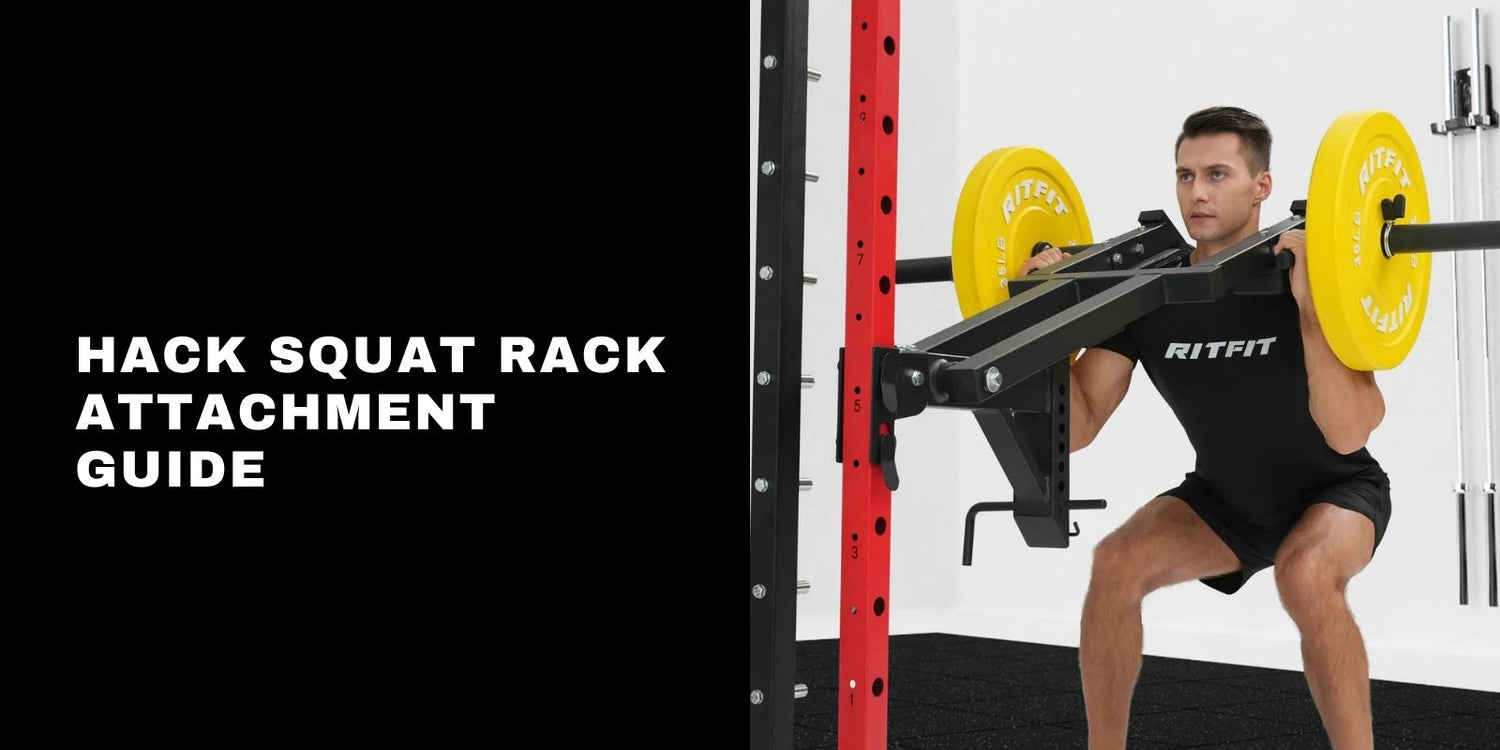
A hack squat rack attachment mounts directly to your power rack uprights, giving you a dedicated quad-focused squatting station without consuming valuable floor space. It delivers commercial-grade machine stability and targeted lower-body hypertrophy for home gym owners.
This guide explains compatibility requirements, step-by-step installation, proper lifting mechanics, and programming tips to maximize your leg workouts safely.
Quick Answer: A hack squat rack attachment connects to power rack uprights to provide a guided, spine-sparing squatting motion that isolates quadriceps without requiring a separate machine. It delivers commercial leg machine performance while preserving garage gym floor space and equipment budget.
Key Takeaways
- Space Savings: A hack squat attachment delivers dedicated machine-guided quad isolation while preserving floor space in compact home gyms.
- Spinal Support: Guided back pads stabilize the lumbar spine and eliminate balance constraints, allowing direct overload on the quadriceps.
- Compatibility Checks: Upright dimensions, hole diameter, and hole spacing must precisely match your power rack before purchasing.
- Form Mechanics: Controlled descent, firm back contact, and stable foot placement ensure optimal quad activation without excessive patellar shear.
- Versatile Training: The attachment supports standard hack squats, reverse hack squats, and standing calf raises for full lower-body development.
What Is a Hack Squat Rack Attachment?
A hack squat rack attachment is a specialized training accessory designed to mount directly onto the steel uprights of a power rack or squat stand. It provides a fixed sliding or pivoting carriage with shoulder pads and a backrest to replicate commercial machine mechanics.
Unlike standalone units that occupy dedicated floor footprints, an add-on unit like the RitFit AT02A Hack Squat Rack Attachment for 2x2 2x3 3x3 Rack leverages your existing cage for structural rigidity. This design lets lifters achieve deep knee flexion while keeping the spine supported throughout the full range of motion.[1]
Why Choose a Hack Squat Attachment Over Standalone Machines?
Choosing an attachment over a standalone machine saves significant floor area and reduces equipment investment while maintaining high training stimulus. Lifters with limited garage space gain access to machine-guided leg training without sacrificing open room for other barbell lifts.
Dedicated machines like the RitFit 3 in 1 Leg Press and Hack Squat Machine BLP01 offer premium heavy commercial capacity, but compact modular Rack Attachments fit comfortably into space-constrained home gyms. You can explore versatile training setups across complete Racks Package systems to build an efficient workout zone.
What Types of Hack Squat Rack Attachments Are Available?
Modern home gym attachments fall into three primary designs including linear rail sleds, pivoting lever arms, and landmine-assisted platforms. Each mechanism balances mechanical feel, installation speed, and budget differently.
- Linear Sled Systems: These use smooth roller bearings along steel rails to provide an authentic 45-degree linear glide path identical to commercial gym stations.
- Lever Arm Attachments: These connect to jammer arms on your rack to move the load in a smooth fixed arc.
- Specialized Add-ons: Lifters can also pair lower-body modules like the RitFit AT03 Belt Squat Attachment for 2x2 2x3 3x3 Rack or the RitFit LEM2 Leg Extension Rack Attachment for varied quad stimulus.
Selecting the right attachment format depends on whether you prefer pure linear travel or modular multi-joint flexibility in your training routine.
How Do You Check Power Rack Compatibility Before Buying?
Verifying rack compatibility requires measuring upright tube dimensions, pin hole diameter, hole spacing, and total rack base stability. Failing to confirm these specifications can lead to improper bracket seating or dangerous equipment slippage during heavy lifts.
| Specification | Standard Home Rack | Commercial Grade Rack | Compatibility Action |
|---|---|---|---|
| Upright Dimension | 2x2 inches or 2x3 inches | 3x3 inches | Measure outer steel tube with calipers or tape |
| Hole Diameter | 5/8 inch (16 mm) | 1 inch (25 mm) | Match locking pin diameter to upright holes |
| Hole Spacing | 2-inch standard spacing | 1-inch Westside spacing | Verify vertical pin bracket alignment |
| Rack Anchoring | Rear weight peg ballast | Bolted floor mounting | Test frame tipping resistance under load |
Measurement standard based on universal power rack engineering specifications.
Always double-check that your upright brackets match accessories like your RitFit Upgraded J Hook Attachment for 2 x 2 Racks to ensure seamless hardware integration.
How Do You Install and Set Up a Hack Squat Attachment?
Installing a hack squat attachment involves mounting base brackets, securing safety locking pins, and performing a dry test run before loading weight plates. A methodical setup prevents frame misalignment and ensures effortless sled travel.
- Mount Support Brackets: Position the primary mounting brackets at your designated height on both uprights and hand-tighten the alignment bolts.
- Insert Safety Pins: Push heavy-duty hitch pins fully through both upright walls and engage secondary safety cotter pins.
- Secure Footplate: Anchor the angled footplate firmly to the lower crossmember or rack base to eliminate wobble.
- Dry Run Verification: Step into the unit without weight to confirm that the carriage glides smoothly without catching or racking.
If you notice any friction along the guide tracks, check that the uprights remain parallel and apply silicone lubricant to the contact rails.
How Do You Execute Proper Form on a Hack Squat Attachment?
Proper hack squat execution requires pressing your entire back against the support pad, placing your feet shoulder-width apart, and descending under complete control. This mechanical setup isolates the quadriceps while keeping lumbar shear forces minimal.
Set your feet in the middle of the platform with toes slightly flared outward. Lower the carriage until your knees reach a ninety-degree angle or full comfortable depth, then drive upward through your midfoot and heels without locking out your knees aggressively.[2]
"The best quad exercise in the world is going to be your hack squats. You're always going to get more press on the front thighs. If you can get into a hack squat machine and it does not hurt, this is the ultimate exercise to build those frontal thighs."
Jay Cutler, Four-time Mr. Olympia, Generation Iron Interview
How Should You Program Hack Squats in Your Training?
Programming hack squats as a primary quad hypertrophy exercise allows you to train close to muscular failure with high safety margins.[3] You can position them immediately after barbell squats or use them as your primary compound leg movement.
For maximum muscle growth, perform 3 to 4 working sets of 8 to 12 repetitions with a controlled three-second eccentric phase. Lifters focusing on joint-friendly quad volume can also transition to complete machines like the RitFit Gazelle Pro 3 in 1 Leg Press and Hack Squat Machine during heavy training blocks.
What Exercise Variations Can You Perform on the Attachment?
A versatile hack squat attachment supports multiple lower-body exercises beyond traditional quad-dominant squats. Modifying your foot placement and torso orientation shifts mechanical load across different muscle groups.
- Reverse Hack Squat: Turn to face the back pad to increase hip flexion and heavily engage the gluteus maximus and hamstrings.
- Standing Calf Raises: Position the balls of your feet on the bottom lip of the footplate to perform deep calf stretches under load.
- Narrow Stance Quad Press: Bring feet close together on the lower platform to emphasize the vastus lateralis outer sweep.
- Single-Leg Hack Squat: Perform unilateral repetitions to correct bilateral strength discrepancies and enhance knee stability.
Incorporating these variations into your weekly split builds balanced leg development while maximizing the utility of your rack attachment.
What Safety Rules Protect Your Joints During Heavy Sets?
Safety on a hack squat attachment depends on setting mechanical safety stop pins, wearing flat lifting shoes, and maintaining strict spinal contact. Setting the safety catch just below your active range of motion ensures the carriage stops safely if muscle fatigue occurs.
Always inspect weight collar clamps and avoid bouncing out of the bottom position to safeguard your patellar tendons. Maintaining continuous muscular tension protects connective tissues and produces superior hypertrophy results.
FAQs About Hack Squat Rack Attachments
Is a hack squat rack attachment as effective as a commercial machine?
A hack squat rack attachment provides virtually identical quad muscle activation compared to commercial gym machines. Because the attachment guides your body along a stable track and supports your spine, you can push your quadriceps close to failure without needing a spotter.
Are hack squats safe for lifters with knee discomfort?
Hack squats are generally safer on the lower back and knees because the fixed backrest eliminates spinal flexion and torso sway. Lifters experiencing knee discomfort can place their feet slightly higher on the footplate to reduce patellar shear while maintaining high quad tension.
Do I need to bolt my power rack to the floor before installing the attachment?
Bolting your rack to concrete is recommended for optimal stability, but loading heavy counterweight plates on rear storage pegs also provides adequate support. Always test the frame with a gentle lateral push to confirm it remains completely immovable under leverage loads.
Can a hack squat attachment replace traditional barbell back squats?
A hack squat attachment can effectively replace traditional barbell back squats when your primary training objective is quadriceps hypertrophy and lower-body muscle development. While free barbell squats develop systemic coordination and spinal stability, machine hack squats deliver direct mechanical tension to the thighs with substantially reduced lower-back fatigue and compressive strain.
How much weight can a standard hack squat rack attachment hold?
Most heavy-duty hack squat rack attachments are engineered to support between 400 and 800 pounds of Olympic weight plates safely. Always verify the maximum load capacity specified by the manufacturer for both your attachment brackets and your power rack uprights before loading heavy working sets.
Conclusion
A hack squat rack attachment provides high-yield quadriceps isolation, spinal support, and exceptional space efficiency for home gym training. Upgrading your power rack with a dedicated leg module helps you build muscular lower-body strength without cluttering your floor.
Select a compatible attachment for your rack dimensions, maintain strict lifting mechanics, and check the RitFit Discount Guide to secure the best equipment savings today.
Disclaimer
This article provides general fitness information and is not a substitute for professional medical guidance. Consult a qualified physician or certified strength coach before beginning any high-intensity resistance training program.
References
1. Schoenfeld BJ, Contreras B, Tiryaki-Sonmez G, Wilson JM, Kolber MJ, Peterson MD. Regional differences in muscle activation during squats: A systematic review. J Strength Cond Res. 2014;28(10):2910-2920. doi:10.1519/JSC.0000000000000486. PMCID: PMC4085831
2. Lorenzetti S, Ostermann M, Zeidler F, et al. How to squat: A systematic review on knee and hip kinetics. J Sports Sci Med. 2018;17(4):550-563. PMCID: PMC6243627
3. Clark DR, Lambert MI, Hunter AM. Trunk muscle activation in the back and hack squat. J Strength Cond Res. 2012;26(11):3073-3080. doi:10.1519/JSC.0b013e318242f2ec. PMCID: PMC3489827





