Setting up a home gym within 300 square feet works when one all-in-one station carries the main strength work and the rest of the room is divided into zones. RitFit lists the M1 PRO at a 20.9 square foot footprint, which leaves most of a 300 square foot room free for moving, loading, and training.
This guide gives you the equipment combination to buy, the measurements to take before ordering, the clearances that keep every zone usable, and the stop signs that mean a layout needs reworking.
Quick Answer: A 300 square foot home gym works with one all-in-one station such as the RitFit M1 PRO, an adjustable bench, a 7 foot Olympic barbell with bumper plates, and a dumbbell set, keeping 2 to 3 feet of walkway around every zone.
Key Takeaways
- One anchor, not four machines: An all-in-one station that combines a Smith bar, cable crossover, squat rack, pull-up bar, and plate storage is what makes 300 square feet feel roomy.
- Measure before you buy: Usable floor area, ceiling height, and the access path decide the layout long before brand or color does.
- Clearance is the real constraint: Keep 2 to 3 feet of open floor around the station and 1.5 to 2 feet beyond each end of a 7 foot bar.
- Zone the room on paper: A strength wall, a free weight strip, a 6 by 6 foot open floor, and a clear center lane cover nearly every program.
- Budget follows structure: RitFit cost planning puts an intermediate strength setup at $1,000 to $3,000, which is enough for a station, bench, bar, and plates.
Which RitFit Equipment Combination Should You Choose for a 300 Square Foot Home Gym?
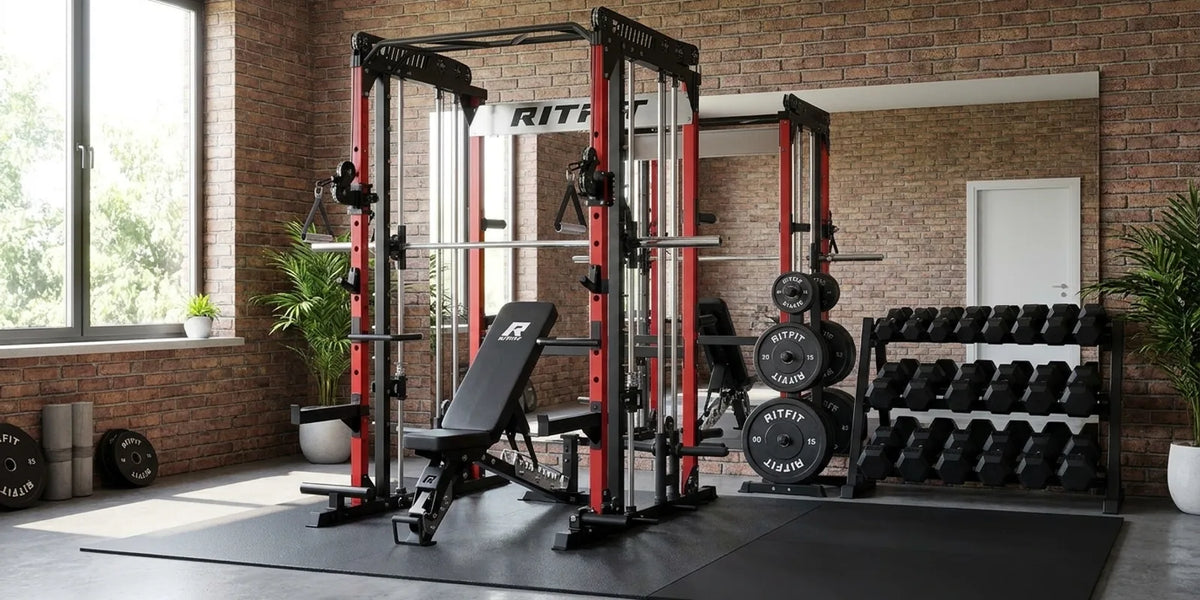
The right combination for 300 square feet is one anchor station plus a bench, a barbell set, and dumbbells. That roster covers guided pressing, squatting, cable work, free weight lifts, and single-arm accessories without a second large machine eating the open floor.
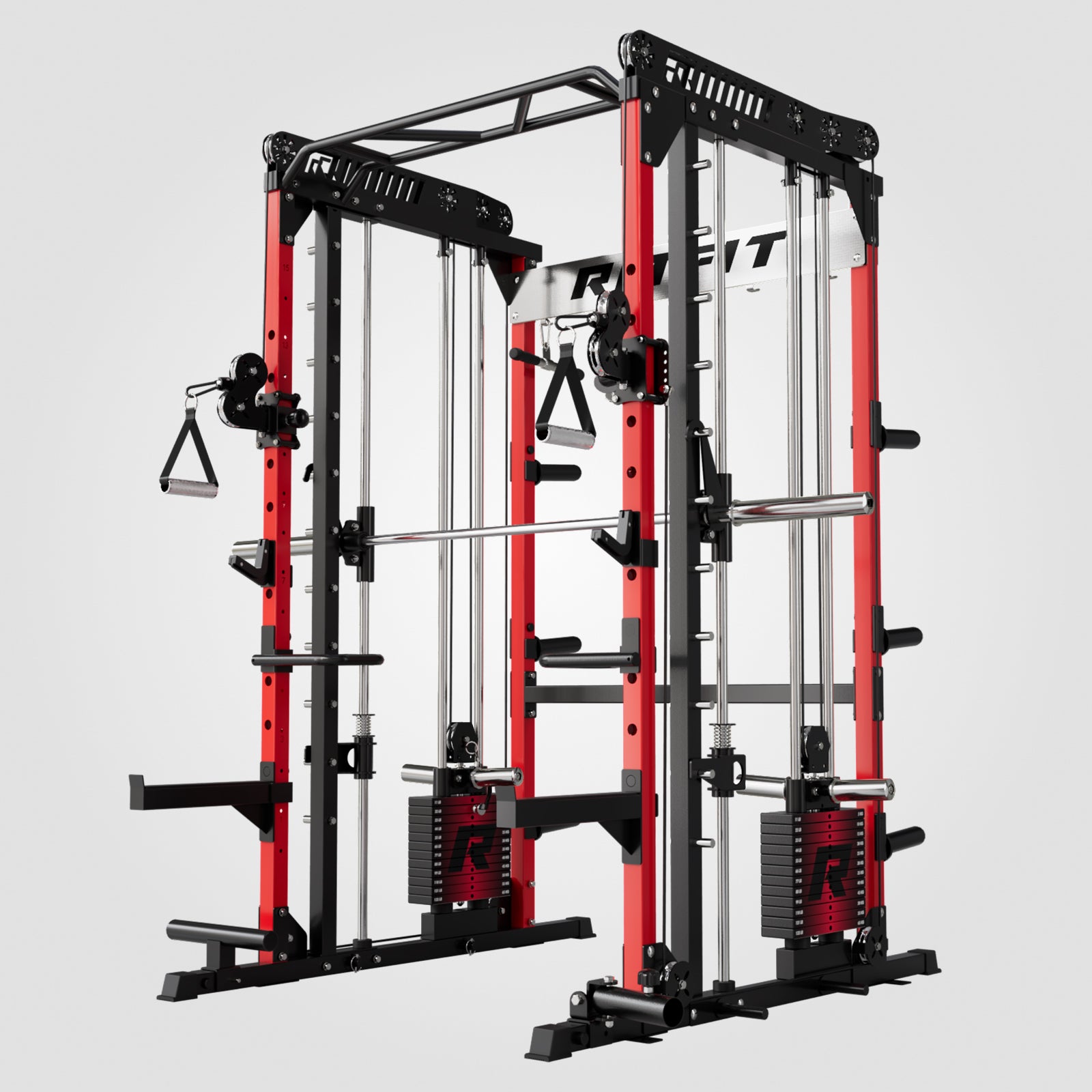
- Anchor station: The RitFit M1 PRO Multi-Functional Smith Machine carries the Smith bar, dual cable crossover, squat rack, pull-up bar, and plate storage inside one listed footprint.
- Bench: The RitFit GATOR Adjustable Weight Bench adds flat, incline, and decline pressing plus seated accessory work, with a listed 1,600 pound capacity and 10 back pad angles.
- Barbell and plates: A RitFit 7FT Olympic Barbell Bar with RitFit Olympic Bumper Weight Plates handles the floor pulls and free bar pressing that a guided rail cannot replicate.
- Dumbbells: A RitFit Rubber Hex Dumbbell Set with Rack replaces a long line of fixed machines for warm-ups, unilateral work, and short rest intervals.
- Floor and storage: Rubber flooring protects the subfloor under the free weight strip, and a wall rack keeps dumbbells out of the training lane.
| Piece | Role in a 300 square foot room | Key listed specification |
|---|---|---|
| All-in-one station | Anchor for guided bar work, cables, rack work, pull-ups, and storage | 20.9 sq ft footprint, 1,600 lb maximum listed capacity |
| Adjustable bench | Pressing surface for flat, incline, and decline angles | 1,600 lb capacity, 10 back pad angles |
| 7 foot Olympic bar | Free weight work outside the guided rail | 20 kg, 28 mm shaft, 50 mm sleeves |
| Bumper plates | Loadable weight that can be set down on protected flooring | 2 inch Olympic center hole |
| Dumbbell set with rack | Unilateral work and warm-ups without extra machines | Hex rubber heads, knurled handles, rack included |
Specifications are manufacturer published values for the RitFit models named in this guide; confirm the current variant, price, and included attachments on the product page before ordering.
Why the M1 PRO Multi-Functional Smith Machine With Cable Crossover Is the Anchor Station
One station that covers Smith work, cables, a squat rack, a pull-up bar, and plate storage removes three or four separate purchases, which is what makes 300 square feet workable. Its listed 339 pound frame weight, 1,600 pound maximum capacity, 2 to 1 pulley ratio, and 15 cable adjustment positions describe the workload it can carry.
"Smooth cables and pulleys, great for single and crossover exercises… I don't like them for pull downs and rows. Nice smith."
Chad D. Verified Buyer, RitFit M1 PRO Multi-Functional Smith Machine with Cable Crossover System and Squat Rack for Home Gym
How the Remaining Pieces Divide the Room
Give the barbell its own strip of wall so plate loading never crosses the walkway, then park the bench and dumbbells in the two corners nearest the station. If you prefer a narrower frame without a Smith rail, the RitFit P3 Power Cage with Smooth Cable System is listed at 67.2 inches long, 59.1 inches wide, and 81 inches tall with 11 gauge 3 by 3 inch steel rated to 1,200 pounds.
"Few pieces of equipment in the home exercise industry are as comprehensive and versatile as this all-in-one gym system. The robust system provides a natural, centered bar path for compound lifts like squats, presses, and rows, and incorporates a dual cable crossover station with a full rack of precision-engineered attachments."
Tom Eskey, CF-L1, CPT, Home Gym Equipment Reviewer, Garage Gym Revisited, RitFit M1 Multi-functional Smith Machine Review
How Do You Measure a 300 Square Foot Room Before You Buy?
Measure the usable length, width, ceiling height, and access path before you compare any equipment. One RitFit planning guide puts a rack or Smith machine setup at 150 to 200 square feet, so in a 300 square foot room the measurements decide where the remaining zones go, not whether they fit at all.
- Usable floor area: Confirm roughly 300 clear square feet, which can look like 15 feet by 20 feet or 12 feet by 25 feet once door swings and built-in shelving are subtracted.
- Ceiling height: Plan for at least 8 feet for standard rack and pull-up work, and 9 to 10 feet if you press overhead with a loaded bar.
- Longest wall: A 7 foot Olympic bar spans about 86 inches, so the wall hosting it needs 1.5 to 2 feet of clear space beyond each sleeve.
- Perimeter clearance: Keep 2 to 3 feet of open floor on every side of the station you load plates from or walk around.
- Delivery path: Measure the entry door, hallway turn, and stair width against the shipping box sizes, because a station that cannot reach the room is not a station you own.
- Flooring build up: Rubber mats and drop pads raise the finished floor, so subtract their thickness from your usable ceiling height.
Write the numbers down and keep them with your equipment shortlist, because every later decision in this guide references them. For the wider planning context, the home gym size and clearance guide and the 12x12 home gym layout apply the same measuring order at smaller room sizes.
How Should You Zone 300 Square Feet for Training?
Zoning 300 square feet means anchoring the station to a wall and keeping the center clear. A home-based circuit training randomized controlled trial with 70 participants found that training at home improved musculoskeletal fitness and quality of life, which shows the room does not need commercial square footage to support real progress.[1]
- Strength zone: Push the station against a long wall or into a corner so the tall frame does not consume the walkway.
- Free weight strip: Give the barbell its own wall run with 1.5 to 2 feet beyond each sleeve, and place the dumbbell rack within arm's reach of the bench.
- Open lane: Keep 2 to 3 feet of clear floor along the route between the door and the station, since this lane is what makes the room feel bigger than its dimensions suggest.
- Functional corner: RitFit layout guidance suggests a dedicated functional corner with kettlebells and bands once a room passes 300 square feet, which keeps small tools off the main lane.
- Recovery space: Reserve about 6 feet by 6 feet of open floor for warm-ups, stretching, and floor work so the station does not become the only usable surface.
How Much Clearance Does a Full Strength Station Need?
A full strength station needs 2 to 3 feet of open floor on every side you load or walk. The RitFit M1 PRO is listed at 79.1 inches long, 68.1 inches wide, and 85.3 inches tall, so the working envelope matters more than the footprint number on its own.
| Listed specification | RitFit M1 PRO station | RitFit P3 power cage |
|---|---|---|
| Length | 79.1 in | 67.2 in |
| Width | 68.1 in | 59.1 in |
| Height | 85.3 in | 81 in |
| Frame | 339 lb rack weight | 11 gauge 3 by 3 in steel |
| Maximum listed capacity | 1,600 lb | 1,200 lb |
| Cable system | 420 lb per side, 2 to 1 pulley ratio | Smooth cable system with aluminum pulleys |
Manufacturer published specifications for the RitFit M1 PRO and RitFit P3; the compact power cage sizing breakdown covers narrower rooms, and the selected variant should be confirmed before ordering.
The 85.3 inch height clears a standard garage ceiling but not every finished basement joist, so measure the lowest point of the room rather than its average. A 12 week graded progressive home-based resistance program improved knee extensor strength in older adults with sarcopenia at P = 0.036, and that style of training depends on a full and unobstructed range of motion.[2]
Warranty length and coverage differ across the RitFit product lines, so read the current policy page attached to the exact model you are buying instead of assuming one term applies to the whole room. That check takes a minute and prevents the most common post purchase surprise in a home gym build.
What Else Should You Add to Complete the Room?
Add a bench, a barbell with plates, dumbbells, flooring, and storage to finish a 300 square foot room. The anchor station covers the large movements, and these pieces fill the angles and loads it cannot reach.
Why the GATOR Bench Fits Inside the Station
The RitFit GATOR Adjustable Weight Bench is built with 14 gauge steel and a listed 1,600 pound capacity, matching a station rated for the same load and removing the weakest link in a heavy pressing setup. Ten back pad angles, three seat positions, and a five way adjustable head rest let one bench serve flat pressing, incline work, and decline movements without buying a second unit.
"Super easy to put together, very sturdy when lifting, and fits me perfectly! I look forward to hitting my fitness goals using this bench!"
Jeff F. Verified Buyer, RitFit GATOR 1600LB Adjustable Weight Bench
Free Weights, Flooring, and Storage
A 20 kg Olympic bar with 50 mm sleeves covers the pulls and presses a guided rail cannot, while bumper plates let you set the bar down without rebuilding the floor every session. Rubber flooring belongs under the free weight strip first, and a wall rack keeps dumbbells out of the lane between the door and the station; browse the hexagon dumbbell sets and mats and flooring ranges before you commit to a weight range or a tile thickness.
How Much Should a 300 Square Foot Build Cost?
Budget roughly $1,000 to $3,000 for a 300 square foot strength room. That is the intermediate tier in RitFit cost planning, and it covers an all-in-one station, an adjustable bench, an Olympic bar, and plates.
| Planning tier | Estimated cost | What it typically buys |
|---|---|---|
| Basic starter | $300 to $1,000 | Dumbbells, bands, mat, folding bench |
| Intermediate strength room | $1,000 to $3,000 | Station or rack, bench, barbell, plates |
| Advanced garage gym | $3,000 to $7,000 | All-in-one machine, dumbbells, flooring, storage |
| Premium dedicated room | $7,000 to $25,000 plus | Multiple machines, cardio, flooring, ventilation, mirrors |
Planning estimates from RitFit home gym cost guidance; current prices, shipping terms, and promotions should be checked before ordering.
Spend the first dollars on structure rather than variety, because a station that survives years of loading costs less than replacing equipment twice. A 12 week home-based resistance training program with 48 participants improved muscle and physical function during weight loss while body composition outcomes did not differ between groups, which points to usable equipment and repeatable sessions over machine count.[3]
Financing spreads a station across monthly payments instead of one lump sum, and that monthly figure is worth comparing against a gym membership you may stop using. If the build can wait a few weeks, seasonal promotions on the same station free up budget for flooring and storage.
What Are the Most Common Mistakes in a 300 Square Foot Layout?
Most 300 square foot builds fail on clearance rather than equipment choice. These are the planning misses that shrink a room faster than any purchase.
- Buying cardio first: A treadmill or bike consumes floor a station can share, and it rarely earns the weekly use that strength equipment does.
- Skipping the ceiling measurement: An 85.3 inch station clears a standard garage ceiling but not every basement joist, and ducts or cabinets reduce the number further.
- Pushing the rack into a corner: Loading one side of a bar against two walls makes every set awkward, so keep the plate side open.
- Ignoring the delivery path: Check the entry door, hallway turn, and stair width against box dimensions before ordering.
- Leaving no open floor: Without a 6 by 6 foot clear patch there is nowhere to warm up, stretch, or do floor work.
- Adding a second large machine: Two big frames in 300 square feet usually costs the walkway, and the walkway is what makes the room feel usable.
When Should You Stop a Session and Rework the Layout?
Stop a session when the equipment or the room, not your effort, is the limiting factor. Layout problems often masquerade as strength plateaus, and the correction is spatial rather than more weight.
- The bar contacts a wall: If a plate stops against a surface during the lift, the wall run is too short for the bar and you need 1.5 to 2 feet beyond each sleeve.
- The frame moves under load: Any rocking or lifting of a station foot means the floor is uneven, the frame is unsecured, or the load exceeds the rated capacity, so stop and inspect before the next set.
- Your head nears the ceiling: End overhead work when there is no clear margin above the bar at the top of the rep, then lower the movement or move the station.
- Flooring lifts at the edges: Curled mats and tiles create a trip and roll hazard, so reseat or replace them before the next session.
- The lane disappears: When storage or a new purchase blocks the walkway, rework the layout that week instead of working around it.
FAQs About Setting Up a Home Gym within 300 Square Feet
Is 300 square feet enough for a complete home gym?
Yes. A 300 square foot room can hold a full strength setup, including one all-in-one station, an adjustable bench, a barbell with plates, dumbbells, and an open training lane. RitFit planning guidance puts a rack or Smith machine setup at 150 to 200 square feet, so the extra 100 square feet becomes your free weight zone and walkway.
How much ceiling height does a 300 square foot home gym need?
Plan for at least 8 feet of ceiling height for standard racks and pull-ups, and 9 to 10 feet if you press overhead. Measure from the finished floor, then subtract your flooring thickness, because rubber mats and drop pads reduce usable vertical clearance before the station even arrives.
How much clearance should you leave around a Smith machine?
Leave 2 to 3 feet of open perimeter around the station for loading plates and moving a bench. If you also load a 7 foot Olympic barbell outside the rack, keep 1.5 to 2 feet beyond each sleeve so plates never contact a wall, and measure the longest single piece you own.
Can you fit both a Smith machine and free weights in 300 square feet?
Yes, when the Smith machine carries rack, cable, pull-up, and plate storage duties in one footprint. That frees the remaining floor for a bench path, a dumbbell corner, and an open lane. Adding a second large machine is what usually forces people to give up the walkway.
Do you need a rack and a separate bench in a small home gym?
You need both functions, and one adjustable bench can serve them. A bench with multiple back angles supports flat, incline, and decline pressing plus seated work. Confirm its declared weight capacity and check that the seat position clears the station uprights when the bench rolls into place.
When should you stop a set and rework your home gym layout?
Stop when the bar or machine contacts a wall, when the station rocks or lifts under load, or when your head nears the ceiling at the top of an overhead rep. Those are layout and clearance problems rather than effort problems, so fix the position before adding more weight.
Conclusion
A home gym within 300 square feet succeeds when one all-in-one station carries the guided and cable work and the rest of the room is zoned around measured clearances. Buy the station, bench, bar, plates, and dumbbells first, then add flooring and storage as budget allows.
Measure your room this week, write the numbers next to your shortlist, and place the station against the longest wall before anything else arrives. Check the RitFit discount guide before ordering so the first purchase stretches across the whole build.
Disclaimer
This guide provides general home gym planning and equipment information and is not medical, safety, or engineering advice for your specific space or condition. Consult a qualified professional and verify load ratings, clearances, and installation requirements before starting a training program or building a permanent setup.
References
1. Al-Mhanna SB, Batrakoulis A, Mohamed M, et al. Home-based circuit training improves blood lipid profile, liver function, musculoskeletal fitness, and health-related quality of life in overweight/obese older adult patients with knee osteoarthritis and type 2 diabetes: a randomized controlled trial during the COVID-19 pandemic. BMC Sports Sci Med Rehabil. 2024;16(1):125. doi:10.1186/s13102-024-00915-4. PMCID: PMC11145895
2. Liu M, Li J, Xu J, et al. Graded Progressive Home-Based Resistance Combined with Aerobic Exercise in Community-Dwelling Older Adults with Sarcopenia: A Randomized Controlled Trial. Clin Interv Aging. 2024;19:1581-1595. doi:10.2147/CIA.S473081. PMCID: PMC11444075
3. Binmahfoz A, Johnston L, Dunning E, Gray CM, Gray SR. The effects of a home-based resistance training program on body composition and muscle function during weight loss in people living with overweight or obesity: a randomised controlled pilot trial. Nutr Metab (Lond). 2025;22(1):90. doi:10.1186/s12986-025-00986-1. PMCID: PMC12323239