








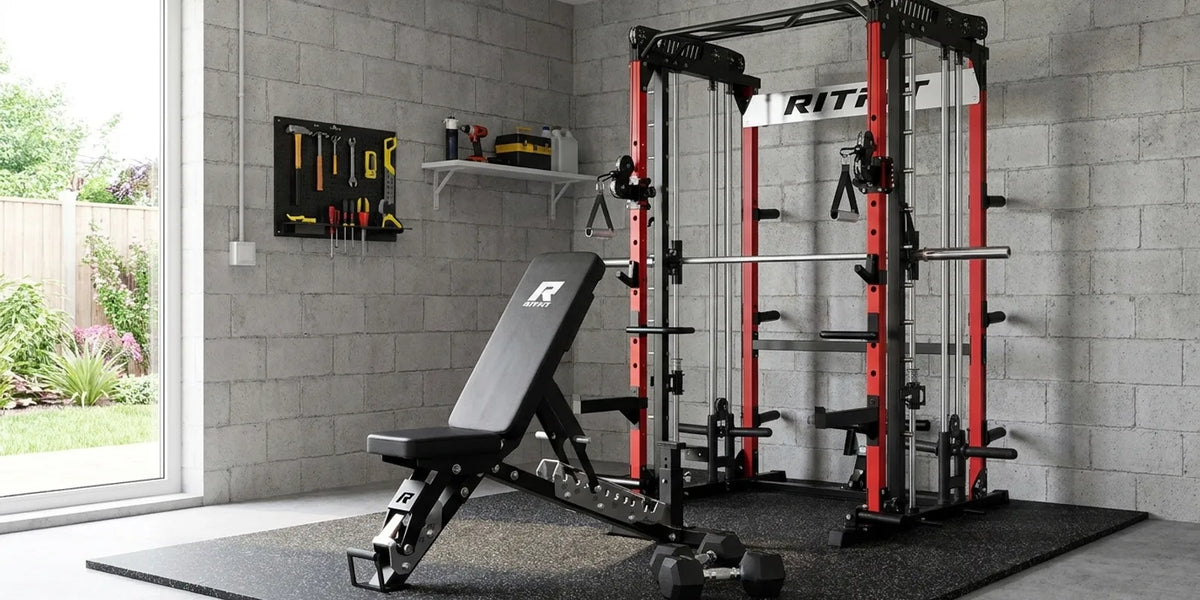
A home gym 100 square feet or smaller is roughly a 10 by 10 foot room, and the floor left for training is much less than the room's total square footage suggests.
This guide shows you how to measure usable floor and ceiling height first, then choose one all-in-one machine and one bench that genuinely fit. It also covers the clearance each lift needs, three layouts for a square 10 by 10 room, the mistakes that make a small gym unusable, and when to scale the plan down instead of forcing equipment in.
Quick Answer: A 100 square foot home gym is about 10 by 10 feet, which fits one all-in-one machine and one adjustable bench once you subtract working clearance. Measure usable floor and ceiling height before ordering, because a separate power cage, a 7 foot Olympic bar and a lifting platform will not fit.
What Is the Best RitFit Home Gym Setup for 100 Square Feet?
The best RitFit setup for a 100 square foot room pairs one all-in-one machine with one adjustable bench. Both builds below are measured for real spaces and state exactly what each machine takes out of the floor.
Setup A, the compact build around the PSR05 2.0
At 14.91 sq ft the PSR05 2.0 is the smallest machine in the RitFit all-in-one line, so it leaves about 85 sq ft of a 100 sq ft floor for a bench, a mat and a walkway. Its rack height is 82 inches including the pull-up bar, which clears an eight foot ceiling of 96 inches with more than a foot to spare.
- Machine: PSR05 2.0 at 14.91 sq ft, just under 15 percent of the floor, with a 1:1 pulley ratio, a stainless steel rail and a 1,000 lb Smith capacity.
- Bench: the RitFit GATOR 1600LB adjustable weight bench, rated to 1,600 lb and light enough to stand against a wall between sessions.
- Floor and storage: interlocking rubber floor tiles under the machine, plus an A-frame dumbbell rack to lift weight off the floor.
- Who it suits: a household training with moderate loads, or a room where a low joist or a narrow doorway rules out a taller frame.
"It's compact yet heavy-duty and fits perfectly in the space I have it set up."
Carol D. Verified Buyer, RitFit PSR05 2.0 Multifunctional Smith Machine Power Rack with LAT-Pull Down System
Setup B, the full build around the M1 PRO
At 20.9 sq ft the M1 PRO takes about a fifth of a 100 sq ft floor and leaves roughly 79 sq ft for the bench, the mat and the clear center square. It uses 2x2 inch 14-gauge steel with a 1,600 lb frame capacity, 15 cable positions and 11 Smith bar positions.
- Machine: M1 PRO at 20.9 sq ft and 85.3 inches tall, for a household that needs one adjustment range to cover lifters from 5 foot 3 to 6 foot 1.
- Warranty: RitFit lists 3 years on the M1 PRO frame and welding and 1 year on the bolts and pulleys.
- Pulley material: RitFit lists the M1 PRO pulleys as aluminum, the material to require on a cable machine rather than plastic or industrial nylon.
- Bench: the same GATOR adjustable bench as Setup A, so the only variable between the two builds is the machine.
- Value: RitFit lists the M1 PRO at $1,299.99 without a weight stack and $2,199.99 with the 264 lb stack.
- Who it suits: a household that wants heavier frame capacity and more cable positions, and has the 85.3 inch ceiling clearance to run it.
| 100 sq ft build | Machine footprint | Share of the floor | Floor left over | Rack height |
|---|---|---|---|---|
| Compact build | PSR05 2.0, 14.91 sq ft | Just under 15 percent | About 85 sq ft | 82 inches |
| Full build | M1 PRO, 20.9 sq ft | About one fifth | Roughly 79 sq ft | 85.3 inches |
Footprints and rack heights are the published specifications on the RitFit product pages, and the floor left over is 100 sq ft minus the listed footprint, before working clearance and a bench are counted.
"Love the fact I can easily go into my garage to get a quick workout instead of driving to a gym. Saves a lot of time. Able to do alot of different workouts with this Smith Machine. Overall happy with the product and customer service."
Jose A. Verified Buyer, RitFit M1 PRO Smith Machine Home Gym Package Comprehensive All-In-One Workout System
Key Takeaways
- Usable floor comes first: A 100 sq ft room is about 10 by 10 feet, and any all-in-one machine takes 14.91 to 22.8 sq ft of it, so the walking and lifting zones have to be planned before anything is ordered.
- Ceiling height decides the machine: The RitFit M1 PRO lists an 85.3 inch rack height and the PSR05 lists 82 inches including the pull-up bar, so a low joist can rule out a rack that fits the floor.
- One machine beats two stations: A single all-in-one with a Smith bar and a cable system covers squat, press, row and pulldown in the footprint of one frame.
- An independent power cage does not fit: A free barbell needs walk-around room on both sides, which a 10 by 10 room cannot give once a bench and storage are in place.
- Tape the layout before you buy: Marking the machine footprint and the working zones on the floor first is what keeps a small gym usable instead of merely full.
What Does 100 Square Feet Actually Give You in a Home Gym?
A 100 square foot home gym measures about 10 by 10 feet of open floor. Everything that fits has to fit inside that square, so the planning starts by subtracting what each machine and each lift takes.
- Listed footprint covers the frame only: The RitFit PSR05 2.0 lists 14.91 sq ft and the M1 PRO lists 20.9 sq ft, and neither number includes the aisle you stand in.
- Working clearance is the hidden cost: A squat, a bench press and a row each need a zone where the bar or your arms travel, and those zones decide whether the room works at all.
- Ceiling height sets the ceiling on choice: A machine with a pull-up bar adds height, so a low basement joist can rule out a machine that fits the floor perfectly.
- Storage decides the final answer: Plates, dumbbells and a bench all need a home between sessions, and vertical storage is what keeps the middle of the room clear.
If your room is closer to a full 12 by 12 feet, the trade-offs change and the 12x12 home gym layout guide covers that size band directly. For the standard dimensions behind every room size, the home gym size guide maps what each footprint band can hold.
How Do You Measure Your Room Before Buying Any Equipment?
Measuring usable floor area and ceiling height before you order is what decides which machines are even possible. Three measurements in this order cover almost every mistake a small room can create.
Step 1 - Measure usable floor area, not wall to wall
Measure the largest clear rectangle you can walk around, not the room's total square footage. A water heater, a stair stringer, a swinging door or a parked car each remove floor that never appears in a listing measurement.
Then subtract the space you need to stand in. A practical minimum is 24 inches of open walkway on at least two sides of the machine, which in a 10 by 10 room is the difference between a training space and a storage room.
Step 2 - Measure ceiling height to the joist, not the light fixture
Measure from the floor to the lowest solid obstruction above the machine, which is usually a joist, a duct or a garage door rail. Light fixtures and pull cords move or come out, so measure past them.
An 8 foot ceiling is 96 inches, and the RitFit M1 PRO lists a rack height of 85.3 inches with the pull-up bar fitted. That leaves roughly 10 inches above the rack, which is workable for chin-ups but tight, and a lower joist will not clear it at all.
Step 3 - Mark the working clearance zones with tape before you order
Tape the machine footprint and every working zone on the floor, then step through each lift with a broom handle standing in for the bar. A feasibility study reported that home-based strength training was feasible and acceptable to participants[1], which points to layout rather than the setting as the real barrier in a small room.
Protect the subfloor in the same pass, because gym flooring mats add thickness that changes your ceiling measurement and keep a dropped plate off bare concrete.
What Equipment Actually Fits in a 100 Square Foot Home Gym?
One all-in-one machine plus one adjustable bench is the combination that fits a 100 square foot home gym. A separate power cage, a 7 foot Olympic bar and a lifting platform do not, because a free bar needs walk-around room on both sides.
Commit to one all-in-one machine instead of two stations
A single machine carrying both a Smith bar and a cable system replaces a rack, a cable tower and a lat pulldown station in one footprint. That trade is what makes the floor math work, because two stations would need two footprints and two separate working zones.
A systematic review and meta-analysis found that home- and gym-based resistance training produced comparable outcomes[2], which is the evidence behind choosing one well-equipped machine instead of a room full of stations.
| RitFit all-in-one | Listed footprint | Rack height | Frame capacity |
|---|---|---|---|
| PSR05 2.0 | 14.91 sq ft | 82 inches | 1,000 lb Smith capacity |
| M1 PRO | 20.9 sq ft | 85.3 inches | 1,600 lb |
| M2 3D | 22.8 sq ft | 86.14 inches | 2,000 lb |
| M2 Pro | 22.8 sq ft | 86.14 inches | 2,000 lb |
| M3 Pro | 21.5 sq ft | 84 inches | 2,500 lb |
Footprint and height figures are the published specifications on the RitFit all-in-one product pages, checked in 2026. Frame capacity is the manufacturer rating for the structure, not a tested limit for an individual lifter.
The RitFit PSR05 2.0 Smith Machine Home Gym Package is the smallest footprint in the line
At 14.91 sq ft, the RitFit PSR05 2.0 Smith Machine Home Gym Package takes under a sixth of a 100 sq ft floor, which is the difference between keeping a walkway and losing one. Its rack height is 82 inches including the pull-up bar, the rack length is 70.8 inches including the Smith bar, and the rack width is 46.3 inches, so it can sit against one wall without reaching into the next.
RitFit lists a 1:1 pulley ratio and a stainless steel rail on the PSR05 2.0, and that ratio matters on a small footprint because the cable moves at bar speed instead of covering half the distance. The honest trade is a 1,000 lb Smith capacity rather than the heavier ratings further up the line, which suits a household training with moderate loads in a tight room.
"If you're short on space, this compact Smith machine delivers everything you need for a complete strength-training experience. The machine is well designed with a small footprint, making it ideal for my home gym. Very happy with this purchase."
Maria del Carmen S. Verified Buyer, RitFit PSR05 2.0 Smith Machine Home Gym Package
M1 PRO Multi-Functional Smith Machine with Cable Crossover System and Squat Rack sets the baseline
The RitFit M1 PRO Multi-Functional Smith Machine lists a footprint of 20.9 sq ft and a rack height of 85.3 inches, and it is the machine most 10 by 10 rooms should be measured against before anything else is considered. It uses 2x2 inch 14-gauge steel with a 1,600 lb frame capacity and 15 cable positions, which is enough adjustment range to keep a 5 foot 3 inch lifter and a 6 foot 1 inch lifter on the same machine.
RitFit covers the M1 PRO frame and welding with a 3 year warranty and the bolts and pulleys with a 1 year warranty, rated for home and light commercial use. A version with a built-in 264 lb weight stack is also listed for households that want selectorized resistance without loading plates by hand.
"I bought this to replace a squat cage and separate cable machine. My space is a bit limited so I wanted an all in one type machine that included a smith machine. I've looked at all the competition and initially purchased from another company until they realized they offered free shipping and it was coming to Alaska. That deal fell through and I decided RitFit was the way to go. I'm glad I made that decision as the M1 Pro with the included weight stacks is really good so far. It's solid and both the cable portion and smith machine portion are super smooth. Highly recommend this setup."
Joe C. Verified Buyer, RitFit M1 PRO Multi-Functional Smith Machine with Cable Crossover System and Squat Rack for Home Gym
Bench, adjustable dumbbells and storage that earn their footprint
A bench only earns its floor space if it folds, and the RitFit GATOR adjustable weight bench can be stood against a wall between sessions. Adjustable weights beat a fixed rack in a room this size, and a set of adjustable dumbbells covers the same exercises while occupying one small square of storage.
Storage is the last piece and the one small rooms most often get wrong. A storage rack lifts plates and dumbbells off the floor, which preserves the clear center square that makes the room usable rather than merely full.
Seeing a one machine setup running in a small room makes the clearance zones far easier to picture before you tape them out on your own floor.
"If your space is limited, a good set of adjustable dumbbells might be your better option. They will allow you to progress to heavier weight as you get stronger."
Jeff Cavaliere, MSPT, CSCS, Physical Therapist and Strength Coach, Creator of ATHLEAN-X, Ultimate Total Body Dumbbell Workout
How Much Clearance Does Each Lift Need in a Tight Space?
Every lift needs its own working zone, and in a 10 by 10 room those zones overlap. Tape the largest zone first and let the smaller movements share it.
| Movement | Planning clearance | What it protects |
|---|---|---|
| Smith squat | 24 to 30 inches behind the bar travel path | Room to step back and reset your stance |
| Bench press | 12 inches at the head end | Clearance to slide in and out from under the bar |
| Standing overhead press | Bar height plus 6 inches of headroom | Enough ceiling height to lock out without ducking |
| Cable row and pulldown | 36 inches in front of the cable column | Room for a full stretch at the end of the rep |
| Pull-up | Rack height plus 10 inches | Headroom for a full hang and chin over the bar |
These are planning minimums for laying out a small room, measured from the machine frame outward. Check them against your own frame dimensions and ceiling height before ordering.
A squat zone and a bench zone in the same corner compete for the same floor, which is why a 10 by 10 room trains one lift at a time. That is a normal way to train rather than a compromise, because a fixed bar path removes the walk-around room a free bar demands.
Which 10x10 Home Gym Layout Should You Choose?
A single-wall layout with a clear center square is the safest fit for a square 10 by 10 room. The other two options trade that center square for access, and the choice comes down to who else trains in the room.
Layout A, single wall with a center working zone
Set the machine against the longest clear wall and keep the middle of the room empty. Once a 20.9 sq ft machine is in place, a square room still leaves a wide lane down the center, so you can step back from the bar without turning sideways.
This is also the layout that rules out the alternatives, because an independent RitFit P3 power cage and a free barbell need open floor on both sides of the bar rather than against a wall.
Layout B, corner placement with an open entry
Pushing the machine into a corner frees the widest part of the room for a bench and a walk-in path. The trade-off is a diagonal approach to the bar, so this layout suits a household that presses and pulls more often than it squats heavy.
Floor protection matters more in this layout because the entry path crosses the lifting zone. Mats edge to edge along the walking line keep the floor flat and stop a dropped plate from cracking a slab.
Layout C, split wall for two users
Splitting the room across two walls lets two people train without one of them waiting behind a loaded bar. It only works if the room is at least ten feet across, because each side needs its own working zone and the middle lane has to stay clear for both.
This is where a smaller footprint pays off twice. Two 14.91 sq ft machines fit a 10 by 10 room far more comfortably than two 22.8 sq ft machines, and the RitFit M2 series modular package sits at the upper end of what the floor can take.
A finished home setup is the fastest way to judge which of the three layouts matches the room you actually have.
What Are the Most Common Mistakes in a 100 Square Foot Home Gym?
Buying the machine before measuring the room causes almost every other problem in a small home gym. The rest come from treating the room as a place to store equipment rather than a place to train.
- Ordering before measuring: A rack that clears the floor by its listed dimensions can still fail on ceiling height, and returning freight costs far more than a tape measure.
- Counting listed footprint as total space: A 20.9 sq ft machine still needs a working zone around it, so the machine plus its zone is the number that has to fit, not the machine alone.
- Buying a free bar for a square room: A standard Olympic bar is a little over 7 feet long, which leaves almost no side clearance in a 10 by 10 room once plates are loaded.
- Leaving plates on the floor: Loose plates beside the working zone turn a clean lift into a trip hazard, and a storage rack removes that risk for the price of one square of floor.
- Filling the center of the room: The clear middle square is the most valuable floor in a small gym, and anything parked there permanently makes every session harder.
If the room is genuinely too tight after the tape test, the next step is the small home gym equipment essentials list, which starts from the equipment side and works up to the room instead.
When Should You Stop and Scale Your Setup Down?
Scale the plan down when the tape test leaves under 24 inches of walkway. A ceiling with fewer than 10 inches above a rack, or equipment that has to move before a door will open, are the other two stop signs.
A review in Sports Medicine found that time-efficient programming can support strength and hypertrophy when intensity and effort are preserved[3], which is the argument for training fewer movements well instead of crowding in more stations.
- Scale the machine down: Moving from a 22.8 sq ft all-in-one to a 14.91 sq ft model buys back almost 8 square feet of working floor without giving up the cable system.
- Scale the movement list: A RitFit BE01 back extension machine adds posterior chain work without opening a second workstation.
- Scale the household plan: If two people train together, split the room or stagger sessions rather than buying a second machine for a room that cannot hold one.
- Scale the timeline instead: Clearing a garage bay later costs less than buying twice, so buy for the room you have now and plan the upgrade as a separate project.
Before choosing between models, the RitFit Smith machine range lays out every footprint side by side, which turns the tape measurements into a shortlist rather than a guess.
FAQs About a 100 Square Foot Home Gym
Can a Smith machine fit in a 100 square foot room?
Yes, if you pick the right model. The RitFit PSR05 2.0 lists a footprint of 14.91 sq ft, so it uses under a sixth of a 100 sq ft floor. Larger all-in-one machines list 20.9 to 22.8 sq ft, which still fits but leaves far less room for a bench and free weights.
What ceiling height do I need for a home gym with a pull-up bar?
Measure to the joist, not the light fixture. The RitFit M1 PRO lists an 85.3 inch rack height and the PSR05 lists 82 inches including the pull-up bar. An eight foot ceiling is 96 inches, so an 85.3 inch rack leaves roughly ten inches above it, which is workable but tight for a full pull-up.
Is 100 square feet enough for squats and bench press?
It is enough for both if you train inside one machine rather than a separate rack and bench station. A Smith machine fixes the bar path, so you do not need the walk-around room a free barbell demands. Tape out your working zones first and confirm you can step back safely with a loaded bar.
Should I buy a power rack or a Smith machine for a small room?
In a 10x10 room a Smith machine or all-in-one usually wins, because a power cage needs generous clearance on all sides for a free bar. Reserve a power cage for rooms closer to 12 by 12 feet. If you already own a cage, measure the bar travel path before adding anything else.
How do I stop a small home gym from feeling cramped?
Store vertically and keep one open working zone. Floor mats, wall hooks and a plate tree move weight off the floor, and a folding bench stows against a wall between sessions. Leaving a clear center square is what makes a 100 sq ft gym usable rather than merely full.
How many people can use a 100 square foot home gym at once?
One person trains comfortably and two can share the room only if the layout is split along separate walls. Anything narrower than about ten feet across risks trapping a second person behind a loaded bar. If your household trains together, choose a split-wall layout over a corner layout.
Conclusion
Setting up a home gym 100 square feet in size is a measurement problem before it is a shopping problem. Measure usable floor and ceiling height, tape the working zones, then commit to one all-in-one machine and one folding bench.
Choose the machine only after the tape test passes, and keep the center of the room clear. New buyers can start with the RitFit discount guide before ordering a first machine.
Disclaimer
This article provides general guidance on home gym layout and equipment selection rather than medical or physical therapy advice. Speak with a qualified professional before starting a strength training program, and confirm current specifications and safety limits with the manufacturer before use.
References
1. Gorzelitz J, Costanzo E, Gangnon R, et al. Feasibility and acceptability of home-based strength training in endometrial cancer survivors. J Cancer Surviv. 2023;17(1):120-129. doi:10.1007/s11764-021-00990-3. PMCID: PMC9362896
2. Bärg M, Idiart-Borda Polotto V, Geiger S, Held S, Brinkmann C. Effects of home- and gym-based resistance training on glycemic control in patients with type 2 diabetes mellitus-a systematic review and meta-analysis. Diabetol Metab Syndr. 2025;17(1):228. doi:10.1186/s13098-025-01793-7. PMCID: PMC12175443
3. Iversen VM, Norum M, Schoenfeld BJ, Fimland MS. No Time to Lift? Designing Time-Efficient Training Programs for Strength and Hypertrophy: A Narrative Review. Sports Med. 2021;51(10):2079-2095. doi:10.1007/s40279-021-01490-1. PMCID: PMC8449772





