








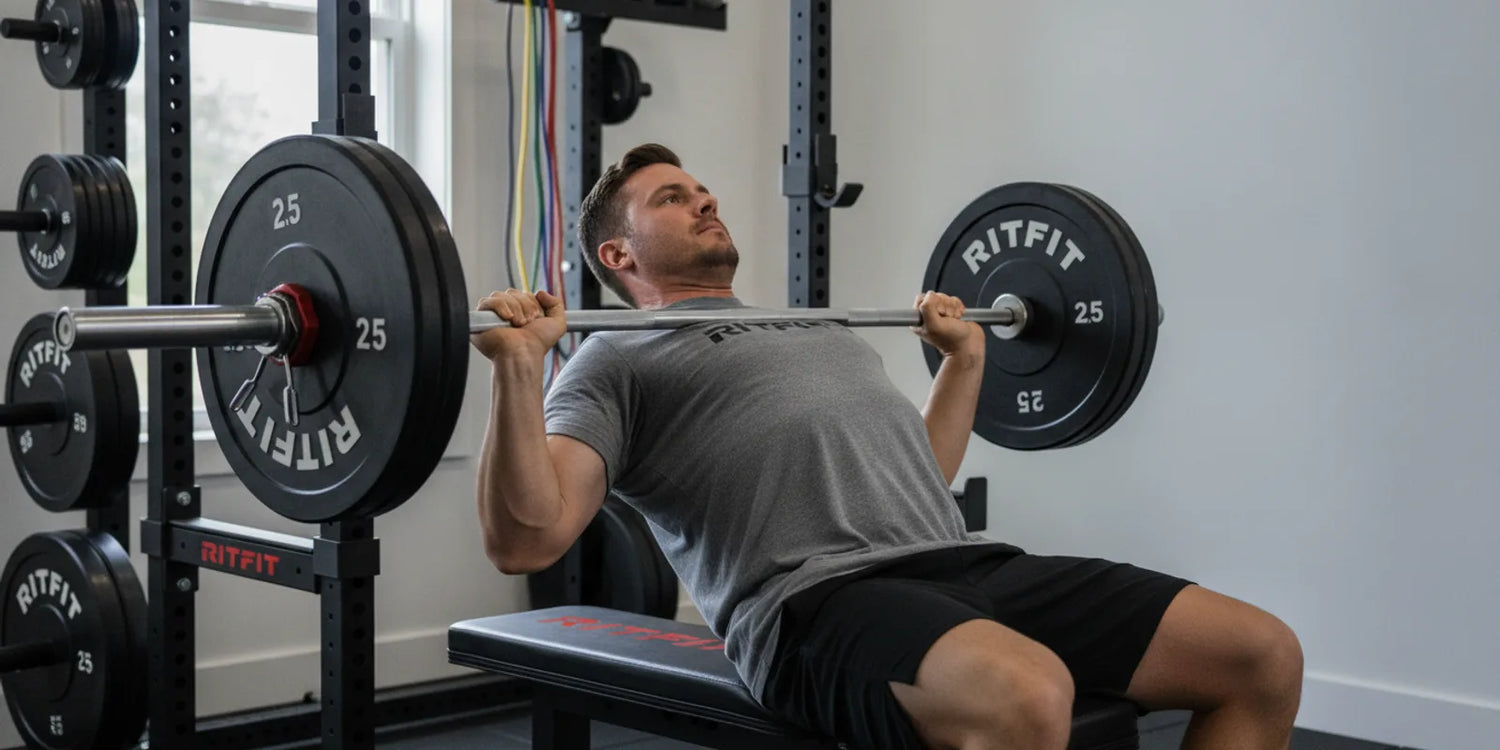
Two plates on the bench press means two 45 lb plates loaded on each side of a standard 45 lb Olympic barbell, for a total of 225 lb. It is one of the most recognized strength milestones in any gym.
This guide confirms the exact number, explains when the total changes, shows how rare a 225 bench really is, and gives you a realistic plan to get there safely.
Table of Contents
Key Takeaways
- Two plates equals 225 lb: Two 45 lb plates per side plus a 45 lb bar totals 225 lb, not 180 lb.
- The bar always counts: Four 45 lb plates weigh 180 lb, so you must add the 45 lb barbell to reach 225.
- 225 is a strong milestone: In one lifter survey, only about 17 percent of responding men had ever benched 225 lb.
- One to two plates takes time: Going from a 135 lb to a 225 lb bench commonly takes one to two years of consistent training.
- Setup changes the total: Women's 35 lb bars, 20 kg bars, and counterbalanced Smith machines all shift the final number.
How Much Is Two Plates on the Bench Press?
Two plates on the bench press is 225 lb on a standard barbell. That total comes from two 45 lb plates on each side, which is four plates and 180 lb, plus the 45 lb Olympic bar itself.
- Plates per side: Two 45 lb plates, so 90 lb loaded on each end of the bar.
- Total plate weight: 90 lb plus 90 lb equals 180 lb of plates before the bar.
- Final load: 180 lb of plates plus the 45 lb bar equals 225 lb.
This 225 lb figure only holds when the bar weighs a true 45 lb, so the equipment you use still matters. You can build this exact load with standard barbells and weight plates.
Why Does Two Plates Equal 225 and Not 180?
Two plates equals 225 because the barbell is part of the lift, not just the plates. Four 45 lb plates weigh 180 lb, and adding the standard 45 lb bar brings the true load to 225 lb.
Forgetting the bar is the single most common plate math mistake. It makes your training log read 45 lb lighter than what you actually pressed.
How Do You Count the Bar Correctly?
Use one simple rule: total the plates on one side, double that number, then add the bar weight. For two plates that is 90, doubled to 180, plus 45 equals 225 lb. Standard 45 lb weight plates make this math clean.
What Setups Change the Total?
The 225 number assumes a 45 lb bar, so other equipment shifts it immediately. A few common cases change the final load even with the same two plates per side.
- Women's bar: A 35 lb women's bar with two plates per side totals 215 lb, not 225.
- 20 kg bar: A 20 kg bar weighs about 44 lb, so metric setups land near 224 lb.
- Smith machine: Counterbalanced Smith bars rarely weigh 45 lb, so two plates can total well under 225.
For a deeper breakdown of the calculation, see our guide on two 45 lb plates on each side and the explainer on how much a bench press barbell weighs.
Is a 225 Bench Press Actually Good?
Yes, a 225 lb bench press is a strong and respected milestone for most recreational lifters. In one survey of lifters, only about 17 percent of responding men had ever benched 225 lb, and only around 1 percent had reached a 315 lb three plate bench.
Those survey figures come from a fitness community poll, not a representative population study, so treat them as directional rather than exact. Even so, a two plate bench clearly sits well above absolute beginner territory.
- Context matters: A 225 bench is rare at many commercial gyms but common in dedicated powerlifting gyms.
- It signals real training: Reaching 225 usually reflects months or years of consistent, progressive work.
- It is a checkpoint, not a ceiling: Many lifters use 225 as a base on the way to 275 and 315.
If your goal is technique before chasing the number, start with our breakdown of best bench press form.
How Do You Go From One Plate to Two Plates?
You reach a two plate bench by adding small, consistent increments to a structured pressing routine over many months. Going from a 135 lb one plate bench to 225 lb commonly takes one to two years of steady, progressive training for many beginners.
Greg Nuckols, a strength researcher who holds multiple powerlifting world records, frames steady progress as claiming each weight as your own before reaching for the next.
"It's a weight you can hit every time you enter the gym, regardless of circumstances. As you get stronger, you claim the next increment. Then the next. Then the next. It's sort of like a psychological placeholder that makes the weights seem like they're never getting any heavier."
Greg Nuckols, MA, Strength Researcher and Coach, Stronger By Science
The video below walks through a practical warm up and approach for hitting 225 for the first time.
How Do You Pick Your Working Weight?
Choose a working weight you can control for clean reps, then build from there. Bench press load is a reliable predictor of your other upper body lifts, and your one rep max can be estimated from a tested six rep load by dividing it by 0.85[1].
- Start submaximal: Train most sets at a weight you can move with good form, not a grinding max.
- Use rep targets: Sets of 5 to 10 reps build the base strength that carries over to 225.
What Is a Simple Twice Weekly Progression?
A straightforward plan benches twice per week and adds small jumps when you complete all your reps. Many beginners run 3 sets of 5 to 10 reps and add 5 lb to the bar each time they finish every set cleanly.
- Heavy day: Press in the 3 to 5 rep range with longer rest of 2 to 3 minutes.
- Volume day: Press in the 8 to 10 rep range to build muscle and practice the movement.
Which Swap In Exercises Build the Press?
Accessory lifts that train the chest, shoulders, triceps, and upper back fill the gaps a flat barbell press leaves. You can rotate these in when you want variation or are short on a barbell.
- Dumbbell press: Builds pressing strength and stability, compared in our dumbbell vs barbell bench press guide.
- Rows and pulldowns: A stronger upper back creates a stable pressing platform.
- Triceps work: Pushdowns and close grip presses strengthen lockout.
When Should You Add Weight and When Should You Stop a Set?
Add weight when bar speed stays strong and your last reps still look controlled. Research on the load velocity relationship shows that the speed of the bar at 70 to 90 percent of your max gives reliable feedback on true effort[2], and relative intensity tools help match load to your individual strength level[3].
- Add load: When you finish all prescribed reps with bar speed and form intact.
- End the set: When bar speed slows sharply or your form breaks down on a rep.
- Stop entirely: If you feel sharp shoulder, elbow, or chest pain, rack the bar and rest.
What Plate Math and Training Mistakes Should You Avoid?
The most common errors are miscounting the load and rushing the jump to 225. Both lead to inaccurate logs, stalled progress, or unsafe lifts under a weight you cannot control.
- Forgetting the bar: Counting only plates makes 225 look like 180 and undercounts every lift.
- Assuming every bar is 45 lb: Women's bars, metric bars, and Smith machines change the total.
- Maxing too often: Frequent all out singles burn out recovery without building the base.
- Skipping upper back work: A weak back limits how much you can stably press.
- Big weight jumps: Adding 20 lb at once instead of 5 lb stalls progress and risks form breakdown.
What Gear Helps You Train Safely Toward Two Plates?
A stable bench, a quality bar, and secure plate collars are the core gear for pressing heavy loads safely. The right setup lets you focus on the lift instead of worrying about your equipment shifting under 225 lb.
- Sturdy bench: The RitFit 1300LB adjustable weight bench supports heavy pressing with adjustable angles.
- Heavy duty option: The RitFit Gator adjustable weight bench is rated for serious two plate work.
- Secure your plates: A set of Olympic barbell clamps keeps both sides locked during the press.
- Standard plates: Build the load with durable cast iron weight plates.
FAQs About Two Plates on the Bench Press
How much is two plates on the bench press?
Two plates means two 45 lb plates loaded on each side of the bar, which is four 45 lb plates in total. Added to a standard 45 lb Olympic barbell, the full load comes to 225 lb. That is why lifters call a 225 lb bench press a two plate bench.
Why is two plates 225 and not 180?
The 180 figure counts only the plates, since four 45 lb plates weigh 180 lb. You must also add the barbell itself, which weighs 45 lb on a standard Olympic bar. Plates plus bar equals 225 lb, so forgetting the bar is the most common plate math mistake.
Is a 225 lb bench press good?
Yes, for most recreational lifters a 225 bench is a strong, respected milestone. In one survey of lifters, only about 17 percent of responding men had ever benched 225 lb. It is well above an absolute beginner level, though common in powerlifting gyms and among trained athletes.
How long does it take to bench two plates?
For many beginners it takes roughly one to two years of consistent, progressive training to move from a one plate, 135 lb bench to two plates at 225 lb. Your starting strength, body weight, consistency, recovery, and nutrition all change the timeline meaningfully.
Does a Smith machine bench equal 225 with two plates?
Not necessarily, because a Smith machine bar is rarely a true 45 lb. Many Smith bars are counterbalanced and effectively weigh far less, so two plates per side may total well under 225 lb. Check your specific machine before comparing it to a free barbell.
Conclusion
Two plates on the bench press is 225 lb, built from two 45 lb plates per side plus the 45 lb bar. Always count the bar, and confirm it weighs a true 45 lb before trusting the number.
If you are chasing your first two plate bench, train twice a week, add small 5 lb jumps, build your upper back, and stop any set when bar speed or form fails. Progress shows up over months, not days.
Disclaimer
This article is for general educational purposes only and does not replace personalized coaching or medical advice. Consult a qualified trainer or healthcare professional before starting a new heavy lifting program, especially if you have any pain or pre existing condition.
References
1. Wong DP, Ngo KL, Tse MA, Smith AW. Using bench press load to predict upper body exercise loads in physically active individuals. J Sports Sci Med. 2013;12(1):38-43. https://pmc.ncbi.nlm.nih.gov/articles/PMC3761768/
2. Marques DL, Abohasel W, Alkahtani S, et al. Load-velocity relationship in the free-weight horizontal and incline bench press. Scientific Reports. 2025;15(1):26203. https://pmc.ncbi.nlm.nih.gov/articles/PMC12274453/
3. Maté-Muñoz JL, Garnacho-Castaño MV, Hernández-Lougedo J, et al. Analysis of the use and applicability of different variables for the prescription of relative intensity in bench press exercise. Biology (Basel). 2022;11(2):336. https://pmc.ncbi.nlm.nih.gov/articles/PMC8869395/





