Choosing the right dumbbell weight is less about finding one magic number and more about following a simple, repeatable method. The correct load is one you can control with good form while still feeling challenged.
This guide shows you how to pick weight by exercise, goal, and experience level, how to spot loads that are too heavy or too light, and how to progress safely over time.
Table of Contents
Key Takeaways
- There is no single right number: the right dumbbell weight is a method, not a fixed pound value that works for everyone.
- Use the last 2 to 3 reps test: the load is right when your final reps feel hard but stay controlled with good form.
- Weight changes by exercise: large compound moves use far more weight than small isolation moves like lateral raises.
- Your goal sets the load: heavier weight and fewer reps build strength, moderate loads build muscle, lighter loads build endurance.
- Progress in small jumps: add roughly 2.5 to 5 pounds once your target reps start to feel easy.
The Core Rule, Challenging But Controlled
The right dumbbell weight lets you finish your target reps with good form while the last 2 to 3 reps feel genuinely hard. This single rule matters more than any chart.
Trainers often recommend judging load by two things, your form and how the final reps feel. Use that feedback on every set.
- Too light: if every rep feels easy and you finish without effort, the weight is not challenging your muscles.
- Too heavy: if your form breaks down in the first few reps or you cannot reach your rep target, drop the weight.
- Just right: you complete the set with control, feel the working muscles, and the closing reps slow down but stay clean.
A common guideline is to start lighter than you think and add weight once the set feels controlled. If you are buying your first pair, see our guide to the best dumbbells for beginners to build muscle.
How Dumbbell Weight Changes By Exercise
You will almost never use the same dumbbell for every move. Larger muscle groups and multi joint exercises handle far more weight than small, single joint ones.
Compound moves like presses, rows, and squats recruit several muscles at once, so they tolerate heavier loads. Isolation moves like curls and lateral raises target one small muscle and need much less.
- Compound exercises: dumbbell bench press, rows, goblet squats, and shoulder presses use your heaviest dumbbells.
- Isolation exercises: biceps curls, triceps extensions, and lateral raises use noticeably lighter dumbbells.
- Upper versus lower: legs and back generate more force than arms, so lower body and pulling moves go heavier than arm work.
One study of 29 participants even found that your bench press strength can roughly predict upper body assistance loads, for example a dumbbell shoulder press 6 rep max estimated as bench load times 0.42 plus 5.84 kilograms.[1] Treat this as a rough estimation tool, not an exact rule.
Beginner Starting Ranges By Exercise
General guides suggest the following rough starting points for new lifters, to be adjusted by your form and how each set feels.
| Exercise | Type | Rough Beginner Range |
|---|---|---|
| Biceps curl | Isolation | 8 to 15 lb |
| Lateral raise | Isolation | 3 to 8 lb |
| Shoulder press | Compound | 10 to 20 lb |
| Goblet squat | Compound | 15 to 25 lb |
These are starting points, not prescriptions, and your height, body weight, and training history all shift where you begin. For a deeper look, see what dumbbell weight a man should start with.
Match The Load To Your Goal
Your training goal decides the rep range, and the rep range decides the weight. Weight and reps move in opposite directions.
Research shows that gains in maximal strength are greater with moderate and high loads than with low loads, while muscle growth can occur across a wide spectrum of loads, roughly 30 to 90 percent of your one rep max, when sets are taken close to failure.[2] That gives you real flexibility in how you train.
- Strength: heavier dumbbells for about 4 to 6 reps, with longer rest between sets.
- Muscle growth: moderate to heavy dumbbells for about 8 to 12 reps, the classic hypertrophy range.
- Endurance: lighter dumbbells for 15 or more reps with shorter rest periods.
A systematic review of 22 studies also found that both percentage of one rep max and repetition maximum targets work well for building strength, so you do not need perfect numbers to progress.[3] Pick a rep target, then choose a weight that makes the last reps hard from the RitFit dumbbells range.
Signs Your Dumbbells Are Too Heavy Or Too Light
Your body gives clear signals when the load is wrong. Watch your form and your last few reps on every set.
Too-heavy loads force compensation, while too-light loads leave your muscles unchallenged. Both slow your progress in different ways.
- Too heavy: you swing or jerk the weight, recruit other muscles, or cannot finish your planned reps with clean form.
- Too light: you breeze through all reps, feel little muscle tension, and could easily do many more.
- Just right: form stays solid, the working muscle fatigues, and the final reps slow but never collapse.
When form breaks, drop the weight and rebuild from a load you control. A repair-friendly home setup like an adjustable weight bench for beginners makes it easier to test loads safely.
Progressive Overload, When And How Much To Add
Add weight once your current load starts to feel easy at your target reps. Small, steady jumps beat big, risky ones.
Progressive overload means gradually increasing the demand on your muscles over time. With dumbbells, the simplest lever is adding a little weight.
- When to add: once you hit the top of your rep range with clean form for two sessions in a row.
- How much: jump roughly 2.5 to 5 pounds per dumbbell, then drop back to the lower end of your rep range.
- Other levers: add reps, add sets, or slow your tempo when a weight jump feels too large.
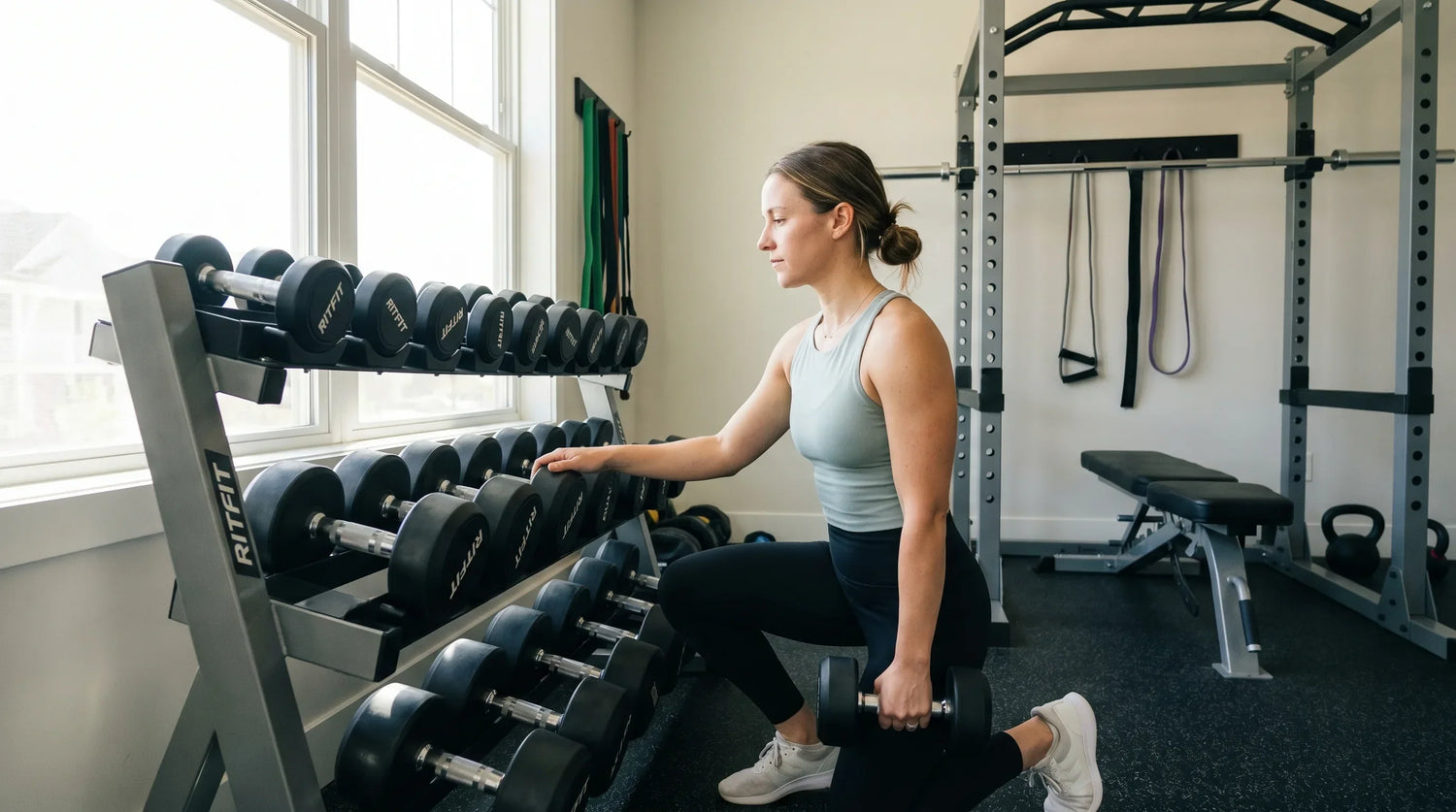
Plan your jumps with a tidy storage option like the RitFit 3-tier dumbbell weight rack so each load stays within reach.
Is A 60 lb Dumbbell Heavy
Whether a 60 lb dumbbell is heavy depends entirely on the exercise and your training experience. It is a serious load for curls or lateral raises, yet manageable for many lifters on rows, goblet squats, or chest presses.
Fixed Versus Adjustable Dumbbells
Adjustable dumbbells let you change weight on one pair, while fixed dumbbells offer instant grab-and-go loads. Your space, budget, and lifting style decide which fits.
Since the right weight changes by exercise, having access to several loads matters more than any single number.
- Adjustable dumbbells: cover a wide range in one compact unit, ideal for small spaces and varied workouts. Browse adjustable dumbbells.
- Fixed dumbbells: faster between sets and very durable, but they need more storage and a wider budget. See hexagon dumbbell sets.
For most home lifters chasing the right weight per exercise, an adjustable pair removes the guesswork of buying many fixed loads at once.
FAQs About Choosing Dumbbell Weight
What weight dumbbells should a beginner start with?
Start lighter than you expect and adjust by feel. Many new lifters begin around 8 to 15 pounds for curls and 10 to 20 pounds for presses. The right load lets you finish your reps with control while the last two or three feel genuinely hard.
How do I know if a dumbbell is too heavy?
A dumbbell is too heavy when your form breaks in the first few reps. You may swing the weight, recruit other muscles, or fail to reach your rep target. If any of these happen, drop the load and rebuild from a weight you fully control.
Is a 60 lb dumbbell heavy for most people?
It depends on the exercise and your experience. A 60 lb dumbbell is very heavy for curls or lateral raises, yet many trained lifters handle it on rows, goblet squats, or chest presses. Match the load to the movement, not to a single number.
When should I increase my dumbbell weight?
Increase the weight once you can hit the top of your rep range with clean form for two sessions in a row. Add roughly 2.5 to 5 pounds per dumbbell, then return to the lower end of your rep range and build back up over time.
Should I use the same dumbbell weight for every exercise?
No. Larger compound moves like presses, rows, and squats handle far more weight than small isolation moves like curls and lateral raises. Using one weight for everything either overloads small muscles or undertrains large ones, so adjust the load for each movement.
Are adjustable dumbbells better than fixed ones?
It depends on your space and budget. Adjustable dumbbells pack many loads into one compact pair, which suits home gyms and varied workouts. Fixed dumbbells are faster between sets and very durable, but they need more storage room and a larger upfront investment.
How many reps should I do at a given weight?
Your goal sets the reps. Use about 4 to 6 reps with heavier loads for strength, 8 to 12 reps with moderate loads for muscle growth, and 15 or more reps with lighter loads for endurance. Pick the weight that makes those final reps hard.
Conclusion
The right dumbbell weight is a method, not a magic number. Choose a load you can control with good form while the last two or three reps feel hard, then adjust by exercise and goal.
Start lighter than you think, progress in small jumps, and let your form guide every change. With a few well-chosen loads, you can train strength, size, and endurance from one simple setup.
Disclaimer
This article is for general educational purposes only and is not medical or professional training advice. Consult a qualified healthcare provider or certified trainer before starting a new exercise program, especially if you have an injury or health condition. Train within your ability and stop if you feel pain.
References
- Wong DP, Ngo KL, Tse MA, Smith AW. Using bench press load to predict upper body exercise loads in physically active individuals. J Sports Sci Med. 2013;12(1):38-43. https://pmc.ncbi.nlm.nih.gov/articles/PMC3761768/
- Lacio M, Vieira JG, Trybulski R, et al. Effects of resistance training performed with different loads in untrained and trained male adult individuals on maximal strength and muscle hypertrophy: a systematic review. Int J Environ Res Public Health. 2021;18(21):11237. https://pmc.ncbi.nlm.nih.gov/articles/PMC8582674/
- Thompson SW, Rogerson D, Ruddock A, Barnes A. The effectiveness of two methods of prescribing load on maximal strength development: a systematic review. Sports Med. 2019;50(5):919-938. https://pmc.ncbi.nlm.nih.gov/articles/PMC7142036/