








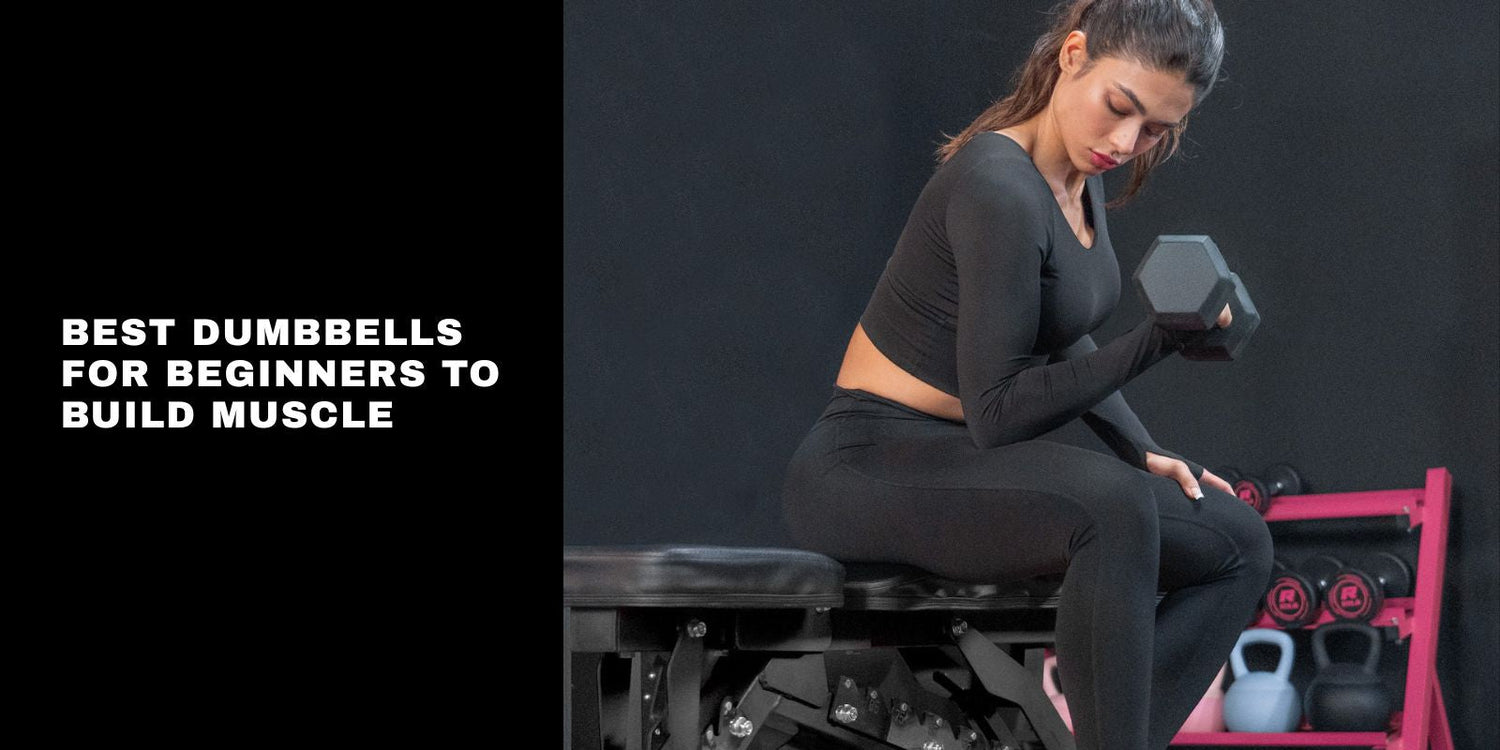
The best beginner dumbbells for building muscle are the pairs you can control now and still progress with over time. This guide covers how to choose your starting weight, compare current RitFit options, build a simple routine, and set up a home gym that stays practical as you get stronger.
It is written for first time home gym buyers, apartment lifters, and anyone deciding between lighter coated pairs, heavier hex pairs, or a rack bundle. Use the weight ranges and progression plan below to start training with confidence.
Quick Answer: The best beginner dumbbells for building muscle are fixed pairs you can control now and still progress with over time. For most home users, RitFit Rubber Hex Dumbbells offer the strongest balance of stability, exercise variety, and progression runway, while lighter PVC coated pairs suit gentle starter work.
Key Takeaways
- Choose for progression: The right beginner dumbbells are not the heaviest pair, they are the pair you can lift with clean form now and still grow with over the next several months.
- Hex beats guesswork: Rubber hex dumbbells usually give beginners the best mix of stability, exercise variety, and long term value for home training.
- Lighter pairs still matter: PVC coated round dumbbells are useful for presses, raises, arm work, and confidence building when heavier fixed pairs feel intimidating.
- A bench expands your training: A good adjustable bench turns a dumbbell setup into a far more complete muscle building station for presses, rows, split squats, and chest supported work.
- Progression drives results: Muscle growth comes from consistent training, enough effort, and gradual progression in weight, reps, or sets, not from buying one oversized pair on day one.
Why Dumbbells Are a Smart Starting Point for Building Muscle
Dumbbells are a smart starting point for building muscle because they train each side independently, fit small spaces, and make it easier to learn pressing, rowing, squatting, and hinging patterns at home. Muscle growth depends on consistent resistance training with enough effort and repeatable progression, not on overly complex equipment.[1]
Why Dumbbells Work for Beginners
Dumbbells work well for beginners because each hand works on its own, which helps fix strength imbalances and build coordination. They also let you scale each side separately as your control improves.
Who This Guide Is For
This guide is for beginners who want to build muscle at home without wasting money on the wrong weight range, the wrong format, or a setup that becomes frustrating after a few weeks. It is especially useful for apartment lifters, first time home gym buyers, and anyone deciding between lighter coated pairs, heavier hex pairs, or a rack bundle.
How to Choose the Best Dumbbells for Beginners
The best dumbbells for beginners match your goal, your space, and your progression plan rather than a single weight or format. A beginner setup that supports compound lifts will give you more training return than a lighter pair chosen only for comfort.
Start With Your Goal
If your goal is muscle growth, buy dumbbells that cover your main pressing, rowing, squatting, and lunging patterns instead of focusing only on curls or shoulder raises. A setup built around compound lifts will serve your progress longer.
Start With Your Space
If your room is tight, every dumbbell decision should account for storage, floor protection, and how fast you need to switch exercises. A compact pair plus a rack often feels better long term than scattered weights on the floor, especially when your home gym also includes a RitFit GATOR Adjustable Weight Bench.
Start With Your Progression Plan
The best beginner purchase leaves room to progress by weight, repetitions, or added sets as your form improves. Research shows you can continue progressing by adding reps as well as load, which matters when the next dumbbell jump feels too aggressive early on.[2]
Fixed vs Adjustable Dumbbells for Beginners
Fixed dumbbells are usually the simpler starting point for beginners, while adjustable dumbbells make sense when floor space is your biggest limit. Both formats can build muscle if you train hard enough and progress over time.[4]
When Fixed Dumbbells Make More Sense
Fixed dumbbells make more sense when you want faster transitions, more stable handling, and less disruption during supersets, circuits, or partner training. They are also easier to organize with a rack, and they pair naturally with guides like this hex dumbbell rack guide.
When Adjustable Dumbbells Make More Sense
Adjustable dumbbells make more sense when floor space is your biggest limit and you want one compact system instead of multiple fixed pairs. Recent community discussions still show a common beginner concern around adjustment speed, feel, and long term durability, so fixed pairs remain the simpler starting point for many home users.
Which Option Is Better for Building Muscle
Both fixed and adjustable formats can build muscle if they let you train hard enough and progress over time, so the better option is the one you will use consistently. You also do not need to stay locked into one narrow rep zone, because hypertrophy can be supported across a broad loading range when sets are challenging enough.[4]
"If your space is limited, a good set of adjustable dumbbells might be your better option. They will allow you to progress to heavier weight as you get stronger."
Jeff Cavaliere, MSPT, CSCS, Physical Therapist and Strength Coach, Ultimate Total Body Dumbbell Workout (Athlean-X)
How to Choose Your Starting Dumbbell Weight
Your starting dumbbell weight should let you finish all planned repetitions with steady range of motion, clean joint positions, and one or two reps left in reserve. Many beginners need lighter pairs for raises and curls, and a heavier pair for squats, rows, and carries.
Use Exercise Control, Not Ego
Your first dumbbell weight should let you finish all planned repetitions with steady range of motion, clean joint positions, and one or two reps left in reserve. If the weight forces shortened reps, unstable shoulders, or a rushed lowering phase, it is too heavy for productive beginner work.
Use Different Weights for Different Patterns
Many beginners need lighter pairs for lateral raises, curls, and overhead pressing, and a heavier pair for goblet squats, Romanian deadlifts, rows, and carries. Lower body and back patterns usually tolerate heavier loading faster than smaller upper body isolation work.
Use This Practical Starting Range
For many beginners, around 5 to 15 lb per hand works for lighter upper body training, while around 10 to 30 lb per hand often makes more sense for rows, goblet squats, and lower body patterns. Treat these as practical starting examples, not universal rules, because body size, training age, and movement quality all matter more than a generic chart.
Overview of Current RitFit Dumbbell Options
RitFit offers four practical ways to start: PVC coated round pairs for lighter work, rubber hex pairs for broader muscle building, rack bundles for multiple fixed pairs, and A-Frame racks for organized storage. Each matches a different home setup and training goal.
RitFit PVC Coated Round Dumbbells in Pairs
RitFit PVC-Coated Round Dumbbells in Pairs are the most approachable entry point for beginners who want lighter training tools for presses, raises, arm work, and general home fitness. They are also a comfortable match for new lifters who care about handling feel, lower intimidation, and a cleaner look in a shared room or apartment.
RitFit Rubber Hex Dumbbells
RitFit Rubber Hex Dumbbells are the stronger all around choice when your main goal is building muscle with more exercise variety and a longer progression runway. Hex heads are practical for floor setup, rows, carries, and push up variations, and they generally make a better long term beginner investment than very light coated pairs alone.
RitFit Dumbbell Sets With Rack
A rack bundle is the smartest move when you know you want multiple fixed pairs ready at all times for efficient training. A product like the RitFit Rubber Hex Dumbbells Set with Rack makes more sense than piecing together random singles once your training includes presses, rows, split squats, curls, and drop set work in the same session.
RitFit Storage Options for Small Home Gyms
Storage matters early because dumbbells become a clutter problem before they become a strength problem. The RitFit A-Frame Dumbbell Rack Stand is useful when you want a cleaner footprint, better safety, and faster access to multiple pairs without turning the floor into a loading zone.
Best RitFit Dumbbells for Beginners to Build Muscle
RitFit Rubber Hex Dumbbells are the best overall choice for most beginners because they balance stability, versatility, and room for progression better than lighter starter options. They also fit naturally into muscle building routines that include rows, presses, lunges, RDLs, and carries.
Best Overall for Most Beginners
RitFit Rubber Hex Dumbbells are the best overall choice for most beginners because they balance stability, versatility, and room for progression better than lighter starter options. They pair well with a home gym equipment guide for beginners.
Best for Light Starter Work
RitFit PVC Coated Round Dumbbells are the best pick when your first priority is control, comfort, and low barrier entry for lighter movements. They are especially practical for shoulder raises, curls, triceps work, and early pressing progressions before you move into heavier fixed pairs.
Best Bundle for Long Term Progression
A RitFit dumbbell set with rack is the best bundle for long term progression because it removes the friction of constant swapping and lets you train multiple movement patterns with more precision. That matters once you start using one weight for presses, another for rows, and another for lower body patterns in the same full body session.
Best Add On for Organization
An A Frame rack is the best add on when you already know your setup will expand beyond one or two pairs. Better storage improves safety, saves time between sets, and helps keep your training area clean enough to stay consistent week after week.
How to Match the Right RitFit Dumbbells to Your Goal
Match your dumbbells to your main goal first, because the best pick for muscle growth differs from the best pick for fat loss or a minimal home gym. A setup that supports presses, rows, split squats, goblet squats, and Romanian deadlifts will drive more total growth than a setup built only for small isolation lifts.
If Your Main Goal Is Building Muscle
Choose Rubber Hex Dumbbells first if muscle growth is the main goal, because they give you the most useful bridge from beginner work into heavier home training. They support presses, rows, split squats, goblet squats, and Romanian deadlifts better than a very light coated pair.
If Your Main Goal Is Fat Loss and General Fitness
Choose PVC coated round dumbbells first if you want lighter circuits, higher rep conditioning, and lower intimidation at home. They also blend well with full body circuit training workouts for beginners when your sessions need to feel fast, simple, and repeatable.
If Your Main Goal Is a Minimal Home Gym
Choose one or two fixed pairs plus a compact rack and bench if you want a minimalist setup that still covers real strength work. This approach gives you better everyday usability than buying a complicated system too early, especially when you also need space for flooring, storage, and walking room.
Beginner Dumbbell Workout Blueprint
A good beginner dumbbell routine focuses on a few repeatable full body patterns and progresses them over time instead of chasing novelty every session. Time efficient resistance training can still build strength and hypertrophy when it centers on high value movements performed consistently.[3]
What a Good Beginner Routine Looks Like
Focus on a few repeatable full body patterns and progress them over time instead of chasing novelty every session. Time efficient resistance training can still build strength and hypertrophy when it centers on high value movements performed consistently.[3]
Simple Full Body Exercise List
- Goblet squat: Use this as your main squat pattern for legs and trunk stiffness.
- Dumbbell Romanian deadlift: Use this to train the hinge pattern, glutes, and hamstrings with simple loading.
- Dumbbell bench press or floor press: Use this for chest, shoulders, and triceps, then expand with dumbbell chest exercises with a bench as your setup grows.
- One arm dumbbell row: Use this as the backbone of your upper back and lat work.
- Overhead press: Use this to build shoulder strength and pressing coordination.
- Curl and triceps extension: Use these as smaller accessory lifts after your compound work.
Weekly Schedule Example
Train two to four times per week with the same full body template until your form, recovery, and loading improve. A simple Monday, Wednesday, Friday format works well for most beginners, and it reduces decision fatigue while building momentum.
How to Progress the Plan
Add a rep, a set, or a small jump in weight once every set looks controlled and your target repetitions stop feeling challenging. That same logic applies whether you are working through a fixed pair progression or expanding into a rack setup with multiple pairs.[2]
Buying Tips and Practical Setup Considerations
Buy for the next six months, not the next six days, because most beginners outgrow light fixed pairs quickly, especially for rows, carries, goblet squats, and split squats. Plan for what comes next, not only what feels easy now.
Buy for the Next Six Months, Not the Next Six Days
The best beginner purchase is the one that still makes sense after your first wave of progress. Community discussions repeatedly show that many beginners outgrow light fixed pairs quickly, especially for rows, carries, goblet squats, and split squats, so plan for what comes next, not only what feels easy now.
Pair Dumbbells With the Right Bench
A bench is not mandatory, but it expands your program enough that most muscle focused beginners eventually want one. If that is your next upgrade, start with this adjustable weight bench guide and this upper chest dumbbell exercises resource.
Protect the Floor Early
Flooring is part of dumbbell buying because noise, bounce, and surface damage change how comfortably you train at home. If your gym is in a bedroom, apartment, or shared space, plan your surface before your weight collection expands.
Maintenance and Longevity
Wipe your dumbbells after sweaty sessions and store them off the floor when you can, because good care keeps your equipment comfortable and your training consistent. Your first setup should evolve as your lifts get heavier and your sessions get denser.[5]
Clean the Handles and Heads Regularly
Wipe your dumbbells after sweaty sessions to reduce residue, moisture buildup, and long term wear. This matters even in home gyms because neglected handles feel worse over time and make consistent training less enjoyable.
Store Dumbbells Off the Floor When You Can
Use a rack once you own multiple pairs because safer storage protects both the equipment and the room around it. Good storage also helps preserve training flow, which is one reason organized setups tend to be used more often.
Check Your Setup As You Get Stronger
Your first dumbbell setup should evolve as your lifts get heavier and your sessions get denser. Recent novice evidence also supports that free weights can build size and strength effectively, which is why a well planned dumbbell station remains a serious starting point for muscle growth.[5]
FAQs About Best Dumbbells for Beginners to Build Muscle
How heavy should beginner dumbbells be for building muscle?
Start with a weight that lets you finish every planned rep with steady form and one or two reps left in reserve. Many beginners need lighter pairs for presses and raises, and a heavier pair for squats, rows, and carries, because lower body work usually scales faster than upper body work.
What are the best RitFit dumbbells for beginners at home?
The best RitFit dumbbells for most beginners are fixed pairs that match your space, comfort, and progression plan. RitFit PVC coated round dumbbells are friendly for lighter training, while RitFit rubber hex dumbbells usually make more sense when you want broader exercise variety and a longer strength runway.
Can beginners build full body muscle with only dumbbells?
Yes.
Dumbbells can train your chest, back, shoulders, arms, legs, and core when you use compound lifts and progress over time.
A simple plan built around presses, rows, squats, hinges, lunges, curls, and extensions is enough for many beginners to gain size and strength at home.
Are rubber hex dumbbells better than round dumbbells for beginners?
Rubber hex dumbbells are usually better when you want more exercise variety, easier floor setup, and safer storage between sets. Round coated dumbbells can feel comfortable for lighter sessions, but hex heads are often more practical for rows, push up variations, carries, and quick transitions in a home gym.
Do beginners need a bench with dumbbells to build muscle?
No. You can build muscle with floor presses, rows, squats, lunges, and carries alone. A bench still expands your training options, because it makes incline pressing, chest supported rows, split squats, and more controlled upper body work much easier as your program becomes more demanding.
Which is better for a small home gym, fixed dumbbells or adjustable dumbbells?
Fixed dumbbells are better for faster exercise changes, while adjustable dumbbells are better when storage space is your main limit. Most small home gyms choose based on floor space, budget, and how often they use supersets, because quick changes matter more when workouts are dense and time is limited.
How often should a beginner increase dumbbell weight?
Increase dumbbell weight when you can hit your target reps with clean technique across all planned sets and the final reps still look controlled. If the next jump feels too large, add repetitions first, slow the lowering phase, or add another set until you are ready for the heavier pair.
Where should beginners buy RitFit dumbbells and storage for a home gym?
Buy from official RitFit product and collection pages when you want the clearest view of current options, bundles, and storage matches. That makes it easier to pair your dumbbells with a compatible rack, bench, or flooring plan instead of guessing across unrelated listings or outdated product pages.
Conclusion
The best beginner dumbbells for muscle growth are the ones that fit your current strength, your room, and your next stage of progression. For most home users, RitFit Rubber Hex Dumbbells are the strongest all around starting point, while lighter PVC coated pairs and rack bundles make sense when your training style or space needs point in that direction.
Start with a manageable pair, train consistently, and progress in small steps. Browse current bundles and storage at RitFit sales when you are ready to build out your home gym.
Disclaimer
This article is for general fitness education and product selection guidance only, and it does not replace personalized medical advice, diagnosis, or treatment. Choose loads conservatively, use controlled form, and consult a qualified professional if you have pain, injury history, or any medical limitations.
References
1. Krzysztofik M, Wilk M, Wojdała G, Gołaś A. Maximizing Muscle Hypertrophy: A Systematic Review of Advanced Resistance Training Techniques and Methods. Int J Environ Res Public Health. 2019;16(24):4897. doi:10.3390/ijerph16244897. PMCID: PMC6950543
2. Plotkin D, Coleman M, Van Every D, et al. Progressive overload without progressing load? The effects of load or repetition progression on muscular adaptations. PeerJ. 2022;10:e14142. doi:10.7717/peerj.14142. PMCID: PMC9528903
3. Iversen VM, Norum M, Schoenfeld BJ, Fimland MS. No Time to Lift? Designing Time Efficient Training Programs for Strength and Hypertrophy: A Narrative Review. Sports Med. 2021;51(10):2079-2095. doi:10.1007/s40279-021-01490-1. PMCID: PMC8449772
4. Schoenfeld BJ, Grgic J, Van Every DW, Plotkin DL. Loading Recommendations for Muscle Strength, Hypertrophy, and Local Endurance: A Re-Examination of the Repetition Continuum. Sports. 2021;9(2):32. doi:10.3390/sports9020032. PMCID: PMC7927075
5. Aerenhouts D, D'Hondt E. Using Machines or Free Weights for Resistance Training in Novice Males? A Randomized Parallel Trial. Int J Environ Res Public Health. 2020;17(21):7848. doi:10.3390/ijerph17217848. PMCID: PMC7662789





