A lat pulldown on a Smith machine works well only when your setup includes a high pulley or a true lat pulldown attachment. If your machine has the right cable path and lower body support, this movement can be one of the most practical ways to train vertical pulling at home.
This guide explains the proper setup, step by step form, muscles worked, common mistakes, and the best alternatives when your machine does not support a true pulldown. It is built for home gym users who want better back training without guesswork.
Key Takeaways
- A true Smith machine lat pulldown requires a high pulley or dedicated lat attachment, not just the Smith bar itself.
- A pronated grip slightly wider than shoulder width usually gives the best balance of comfort, range, and lat focus.
- Thigh support is important because heavy pulldowns can lift you off the seat if your lower body is not secured.
- Pull to the upper chest with a proud chest and a small lean, not to the neck and not with a big backward swing.
- When your machine has no pulley, pull ups, band pulldowns, and rack chins are the best vertical pulling substitutes.
Why Choose a Smith Machine for Lat Pulldowns?
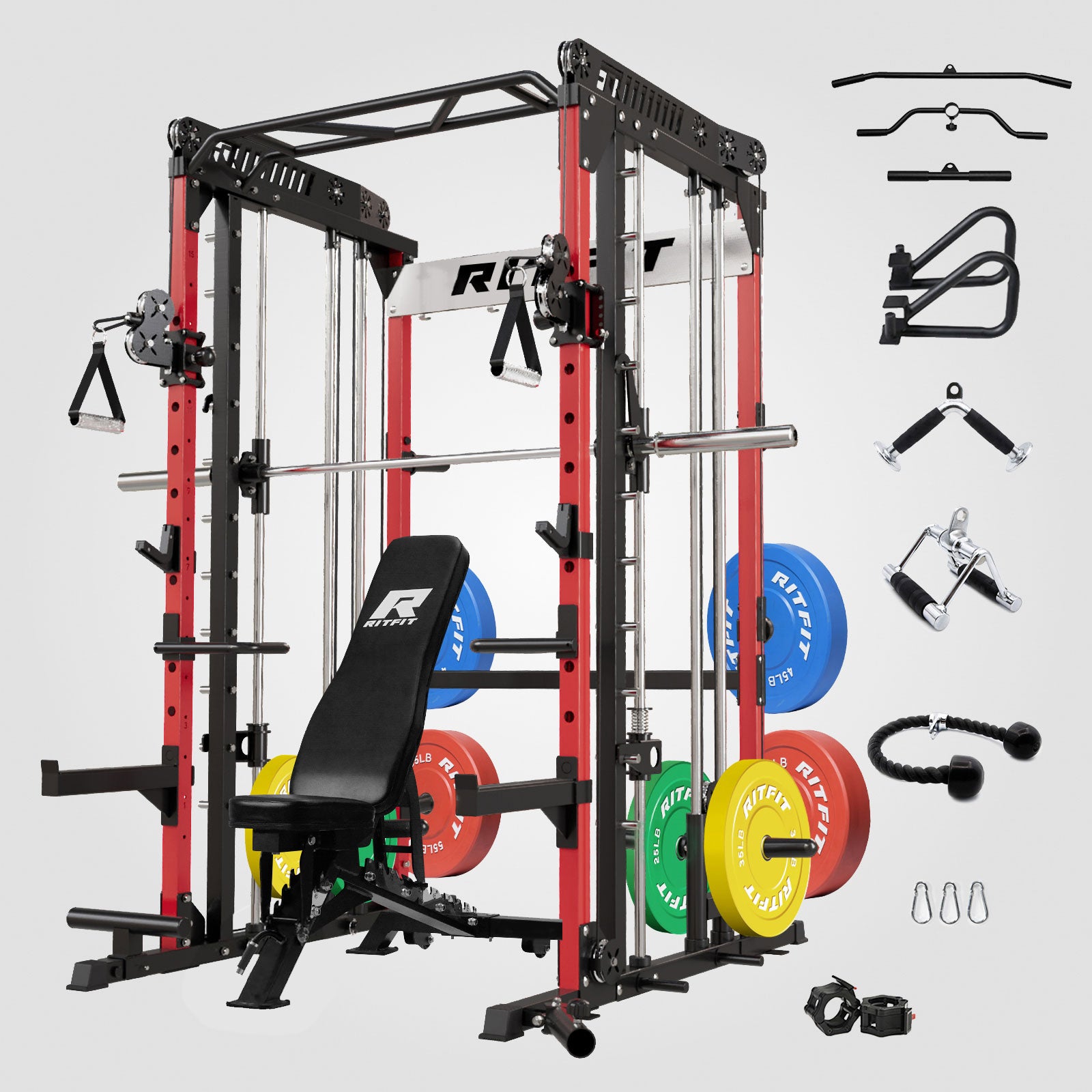
A Smith machine with a lat pulldown attachment gives home gym users a practical way to train vertical pulling without needing a separate lat tower. It combines space efficiency, cable resistance, and a more stable setup for solo training.
More useful for home gym layouts
A multifunctional machine can reduce clutter and replace multiple standalone stations in one footprint. If you are comparing options, the RitFit Smith Machine collection and this Smith machine with cable system guide show why cable integration matters in limited space.
Easier vertical pulling progression
A pulldown is easier to load and scale than a full pull up, which makes it valuable for beginners and for lifters building toward stronger bodyweight pulling. Recent lat pulldown training research also supports its transfer value for improving pull up endurance over time.[5]
Better control for technique work
A good cable setup lets you focus on shoulder depression, elbow path, and controlled range of motion without fighting balance. That makes it a strong option when your goal is cleaner back training, not just heavier loading.
What Muscles Does a Smith Machine Lat Pulldown Work?
A Smith machine lat pulldown mainly trains the latissimus dorsi, but it also involves the upper back, rear shoulder, and elbow flexors. EMG work on traditional lat focused pulling variations shows that grip and arm position can shift emphasis, yet the movement remains a back dominant vertical pull rather than a completely different exercise.[1]
- Primary mover: The latissimus dorsi drives shoulder adduction and extension, which is why this exercise is a staple for back width and upper back strength.
- Secondary muscles: The biceps brachii, brachialis, rear deltoids, rhomboids, and mid to lower trapezius help complete the pull and stabilize the shoulder complex.
- Support muscles: Your trunk helps hold posture while your lower body anchors you against the pull of the cable.
If your goal is broader back development, this exercise pairs naturally with these Smith machine back workouts. If your goal is equipment selection, a machine such as the RitFit M1 Smith Machine gives a more complete cable based home setup.
Proper Smith Machine Lat Pulldown Setup
Proper setup matters because a pulldown only feels right when the cable path, seat height, and body support all work together. You need a high pulley or lat attachment, a lat bar or suitable handle, and enough lower body bracing to stay stable under load.
- Machine compatibility: Use a Smith machine that includes a true high pulley or a dedicated lat pulldown system. If you need compatible add ons, these lat pulldown attachments and this RitFit M1 vs M2 comparison can help narrow the right configuration.
- Seat position: Set the seat or bench so you can reach the bar with full arm extension without losing posture. Your feet should stay planted and your chest should stay upright from start to finish.
- Thigh support: Lock your thighs under pads or use a secure lower body setup that prevents you from rising off the seat. This is essential when the weight gets heavy enough to pull your hips upward.
- Grip choice: Start with a pronated grip slightly wider than shoulder width. This usually gives a strong balance of comfort, shoulder position, and lat involvement.
- Load selection: Choose a weight you can pull to the upper chest with control and without swinging. Clean mechanics matter more than chasing heavier numbers too early.
Step by Step: How to Do a Lat Pulldown on a Smith Machine
Proper execution matters because this exercise works best when the lats drive the motion instead of momentum or arm dominance. Use these steps to create a smooth vertical pull with stable posture and consistent tension.
- Step 1: Lock in your base. Sit down, plant your feet, and secure your thighs under the pads or support point. Your torso should feel stable before you grab the bar.
- Step 2: Set your grip and shoulders. Take an overhand grip slightly wider than shoulder width, then let your ribs stay stacked and pull your shoulders down away from your ears. This helps you start with better scapular control instead of shrugging into the pull.
- Step 3: Pull with your elbows. Drive your elbows down and slightly back while bringing the bar toward your upper chest. Keep your chest tall and allow only a small natural lean so the pull stays vertical instead of turning into a row.
- Step 4: Pause and squeeze. Stop briefly at the bottom when the bar reaches the upper chest area. That pause helps you feel the lats, mid back, and shoulder blades working together rather than bouncing through the hardest part.
- Step 5: Return with control. Let the bar rise smoothly until your arms are fully extended and your lats feel a full stretch. Controlled eccentric work supports training quality, but making every lowering phase extremely slow is not automatically better for hypertrophy in every case.[2]
Common Errors to Avoid
- Leaning back too far: A small lean is normal, but a big lean changes the movement into a hybrid row. If your torso keeps rocking, the load is probably too heavy.
- Pulling behind the neck: Pulling to the upper chest is the safer and more practical option for most lifters. Forcing a behind the neck path can place the shoulder in a more stressful position, especially when mobility is limited.
- Shrugging at the start: Starting the rep with elevated shoulders shifts tension away from the lats and can make the neck feel cramped. Think shoulders down first, then elbows down.
- Gripping too wide: An extra wide grip often reduces usable range of motion and can make the movement feel awkward rather than stronger. Most lifters grow faster from a repeatable middle ground than from chasing an exaggerated grip.
- Using no lower body support: If your hips lift off the seat, your pulldown becomes unstable and inconsistent. Secure support is one of the main differences between a good home setup and a frustrating one.
Alternatives and Variations
Reverse grip lat pulldown
A supinated grip can make the movement feel stronger through the arms and lower lats for some lifters. It is useful when you want variety, but it is not automatically better than a standard overhand grip.
Single arm cable pulldown
A single arm setup can improve side to side awareness and make it easier to adjust elbow path. It is especially helpful when one side tends to dominate the pull.
Multi grip attachment pulldown
A neutral or angled grip can feel more shoulder friendly for some home gym users. If you want more handle options, this multi grip lat pull down bar is a practical upgrade.
No pulley alternatives
If your machine does not have a high pulley, use pull ups, assisted pull ups, band pulldowns, or rack chins instead. You can also learn more from this related guide on pull ups on a Smith machine.
Guidelines for Better Progress
The best results come from repeatable technique, progressive loading, and enough weekly volume to keep improving. Current evidence still supports moderate hypertrophy rep ranges, practical volume targets, and steady progression as the most reliable base for muscle growth.[3]
- Use 3 to 4 working sets: This is enough for most home gym users to practice good reps and accumulate meaningful back volume. Add more only when recovery and performance still look strong.
- Stay in the 8 to 12 rep range for hypertrophy: This range is usually a strong balance of tension, control, and repeatability. Heavier or lighter work can still help, but this is the easiest place to build consistency.
- Train the movement 1 to 2 times per week: Most lifters make good progress with one focused back day or two weekly pulling exposures. Recovery, grip fatigue, and total pulling volume from the rest of your plan still matter.
- Progress only when form stays stable: Add weight when your full stretch, upper chest finish, and controlled return all stay intact. If your body starts swinging, keep the load where it is.
- Respect shoulder feedback: Shoulder and upper extremity overuse problems are more likely when technique is forced through pain or repeated with poor positioning. If your shoulder feels pinchy, reduce load, adjust grip, and clean up the path before you continue.[4]
FAQs
Can every Smith machine be used for a Smith machine lat pulldown?
No. A Smith machine lat pulldown only works if your setup includes a high pulley, a lat bar, and enough body support to keep you stable. The Smith bar alone does not create the same vertical cable path, so equipment compatibility comes first.
What grip works best for a Smith machine lat pulldown?
Most lifters do best with a pronated grip slightly wider than shoulder width for a Smith machine lat pulldown. This position usually balances comfort, range of motion, and lat focus without forcing an extra wide path that can reduce control or irritate the shoulders.
Do you need thigh support for a Smith machine lat pulldown?
Yes. Thigh support matters on a Smith machine lat pulldown because it helps keep your hips down and your torso stable as the load increases. Without solid support, you may get pulled upward, shorten the range of motion, and lose tension where you want it most.
Is a Smith machine lat pulldown good for beginners?
Yes. A Smith machine lat pulldown can be very beginner friendly because the cable path is easy to learn and the setup is more stable than many bodyweight pulling options. It lets new lifters practice shoulder depression, elbow path, and back tension with manageable loads.
What can you do if your Smith machine has no lat pulldown attachment?
No. You cannot perform a true Smith machine lat pulldown without a high pulley or dedicated attachment. Your best alternatives are pull ups, band pulldowns, rack chins, or other vertical pulling movements that train similar back and arm patterns with the equipment you already have.
How many reps should you do for a Smith machine lat pulldown?
For muscle gain, most people do well with 3 to 4 sets of 8 to 12 reps on a Smith machine lat pulldown. If your goal is technique practice, use lighter loads and cleaner reps first, then add weight only when you can control the full stretch and return.
Final Thoughts
A Smith machine lat pulldown is a strong home gym movement when your setup includes a real high pulley, stable lower body support, and the right handle. Focus on clean setup, a smooth pull to the upper chest, and a controlled return, then progress the load only when the rep still looks the same.
Disclaimer: This article is for general education only and is not medical advice. Stop the exercise if you feel sharp pain, numbness, dizziness, or joint discomfort, and consult a qualified clinician or physical therapist if you have a current shoulder, neck, elbow, wrist, or upper back issue.
References
- Lehman GJ, Buchan DD, Lundy A, Myers N, Nalborczyk A. Variations in muscle activation levels during traditional latissimus dorsi weight training exercises: an experimental study. Dyn Med. 2004;3(1):4. doi:10.1186/1476-5918-3-4
- Azevedo PHSM, de Salles BF, Benincasa CA, et al. Effect of different eccentric tempos on hypertrophy and muscle strength in resistance trained men. Int J Environ Res Public Health. 2022;19(9):5484. doi:10.3390/ijerph19095484
- Bernárdez-Vázquez R, Raya-González J, Castillo D, Beato M. Resistance training variables for optimization of muscle hypertrophy: an umbrella review. Front Sports Act Living. 2022;4:949021. doi:10.3389/fspor.2022.949021
- Golshani K, Cinque ME, O'Halloran P, Softness K, Keeling L, Macdonell JR. Upper extremity weightlifting injuries: diagnosis and management. J Orthop. 2017;15(1):24-27. doi:10.1016/j.jor.2017.11.005
- Li Q, Yan J, Qiao M, Quan J, Chen Y, Gong M, Niu W, Wang L. Eight-week lat pull-down resistance training with joint instability leads to superior pull-up endurance performance and reduced antagonist coactivation in recreationally active male college students. Eur J Sport Sci. 2025;25(1):e12243. doi:10.1002/ejsc.12243