Prone leg curls on a leg extension curl machine are the most effective way to build strong, balanced hamstrings at home. The RitFit PLC01 Leg Extension Curl Machine combines both functions, so you can target the posterior chain without a separate machine, and this guide walks you through setup and the movement.
Follow the steps below to flatten the backrest, align the machine cam with your knees, and set the roller pad correctly. You will also learn ideal rep ranges, the most common form mistakes, and how to program prone leg curls.
Quick Answer: To do a prone leg curl on a leg extension curl machine, lie face down with the backrest flat, align your knee joint with the machine cam, and set the roller pad just above your heels. Drive your heels toward your glutes, pause at the top, then lower under control for two to three seconds.
Key Takeaways
- Set up first: Flatten the backrest, align your knee with the cam, and place the roller pad just above the heel to make prone leg curls safe and effective.
- Axis alignment: The machine pivot point must line up directly with your knee joint to avoid shear force on the joint.
- Foot position: Dorsiflexion, pulling your toes toward your shins, recruits the calves, while plantarflexion, pointed toes, isolates the hamstrings harder.
- Control the tempo: Lower the weight for two to three seconds to maximize muscle growth and reduce injury risk.
- Program smart: Use 3 to 4 sets of 10 to 15 repetitions and avoid very heavy low-rep loads in this open chain position.
Why Should You Train Your Posterior Chain?
Your hamstrings power knee flexion and protect the knee from injury, but squats and leg presses train them only lightly. A low hamstring-to-quadriceps (H:Q) strength ratio is a primary risk factor for non-contact ACL injuries, so dedicated curl work is essential.
When you perform a prone leg curl, you primarily target three distinct muscles that work together to bend your knee:
- Biceps femoris
- Semitendinosus
- Semimembranosus
You also recruit your gastrocnemius, or calf muscles, as synergists to help complete the movement. Building a strong squat is great, but if your quadriceps are significantly stronger than your hamstrings, you create a muscle imbalance.
Clinical studies demonstrate that a low H:Q strength ratio is a primary risk factor for non-contact ACL injuries[1]. Strengthening the hamstrings helps balance this ratio, and a strong hamstring acts like a natural brake for your knee joint to help protect ligaments like the ACL during sports and daily activities.
If you care about how your legs look, the prone leg curl is essential because it builds the "hamstring sweep" visible from the side and back. It gives the leg a three-dimensional look that squats alone cannot achieve.
"It is my opinion that a weak posterior chain and weak glutes in particular are largely responsible for the alarming number of low back pain in the U.S. Anything that strengthens the posterior chain might lead to less low back pain and injury."
Bret Contreras, PhD, PhD in Sports Science, known as The Glute Guy, Contreras Strength Institute
How Do You Set Up the Machine for Prone Leg Curls?
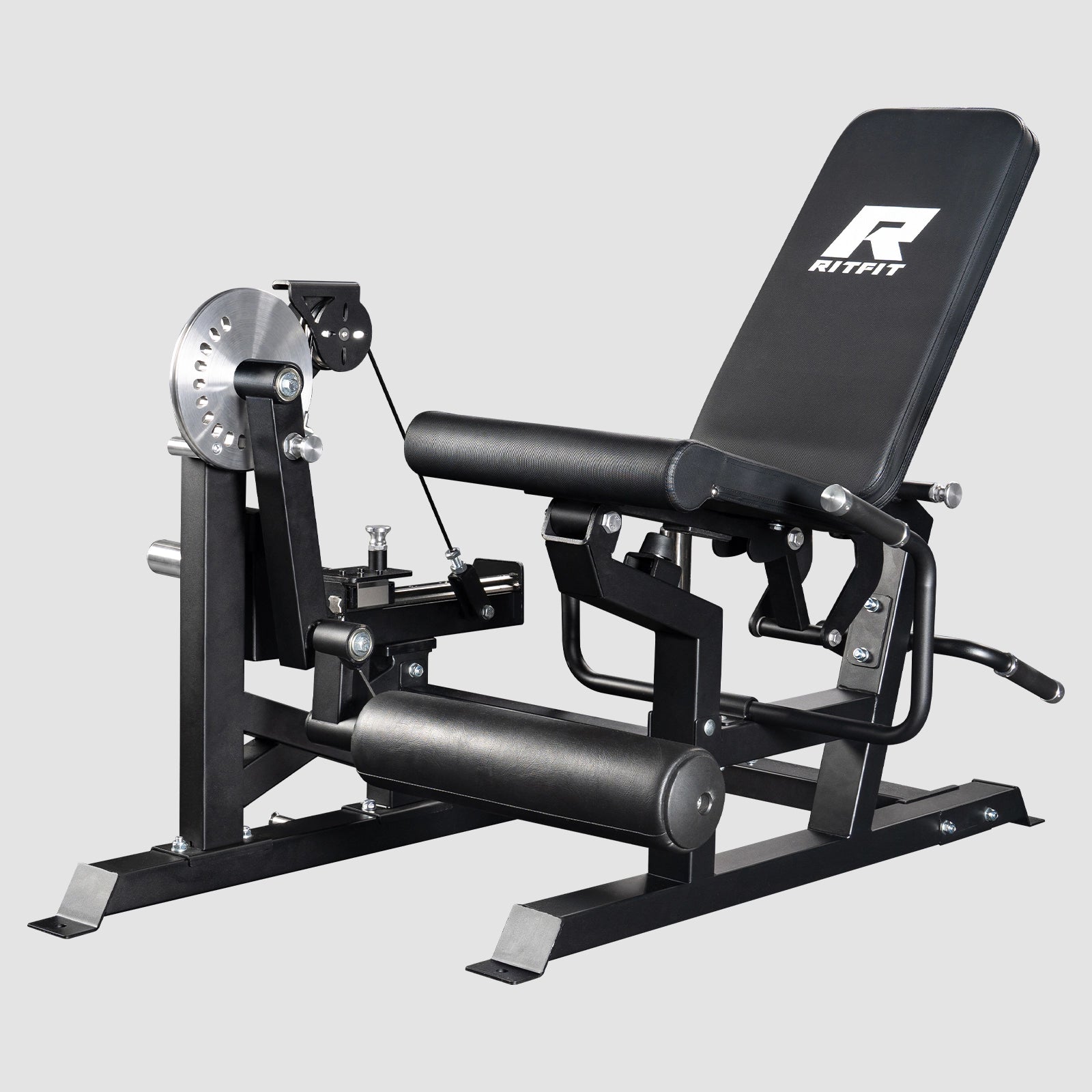
Convert the dual-function machine from extension to curl mode by flattening the backrest, aligning the cam with your knees, raising the start angle, and placing the roller pad on your lower leg. Skip any of these steps and you will feel stress on your lower back or knees instead of your hamstrings.
Step 1: Adjust the backrest. On a standard combination unit like the RitFit PLC01 set, the backrest is adjustable, and for a lying leg curl you need to be in a prone position, which means lying flat on your stomach.
- Locate the adjustment pin for the back pad.
- Lower the backrest all the way down until it is flat.
- Ensure it locks securely into place so it provides a stable platform for your torso.
Step 2: Align the axis of rotation. Every machine has a pivot point or a cam where the weight arm rotates, so look for the bolt or heavy-duty joint that the arm swings from.
- The Rule: This mechanical axis of rotation must align directly with your own knee joint.
- When you lie down, your knees should be right next to this pivot point.
- If your knees are too far forward or too far back, you will create shear force on the knee joint.
- Adjust your body position on the pad until the center of your knee lines up perfectly with the center of the machine cam.
Step 3: Set the sundial and starting angle. The rotating plate, often called a sundial, determines where the movement begins, and for leg curls you need the arm to start higher up.
- Pull the pop pin on the cam.
- Move the arm to a high position so that when you lie down your legs are almost fully straight.
- You want your legs extended but not hyperextended, with a very slight bend in the knee at the starting position to maintain tension.
Step 4: Adjust the roller pad. The final piece of the puzzle is the ankle pad, which should rest comfortably on the back of your leg.
- Situate the roller pad so it rests comfortably on the back of your leg.
- Correct Placement: It should sit right on the Achilles tendon area just above the heel but below the calf muscle belly.
- If the pad is too high on your calves, the lever arm is too short, and the movement will feel awkward.
- If the pad is on your heels, it might slip off during the movement.
How Do You Perform a Prone Leg Curl with Correct Form?
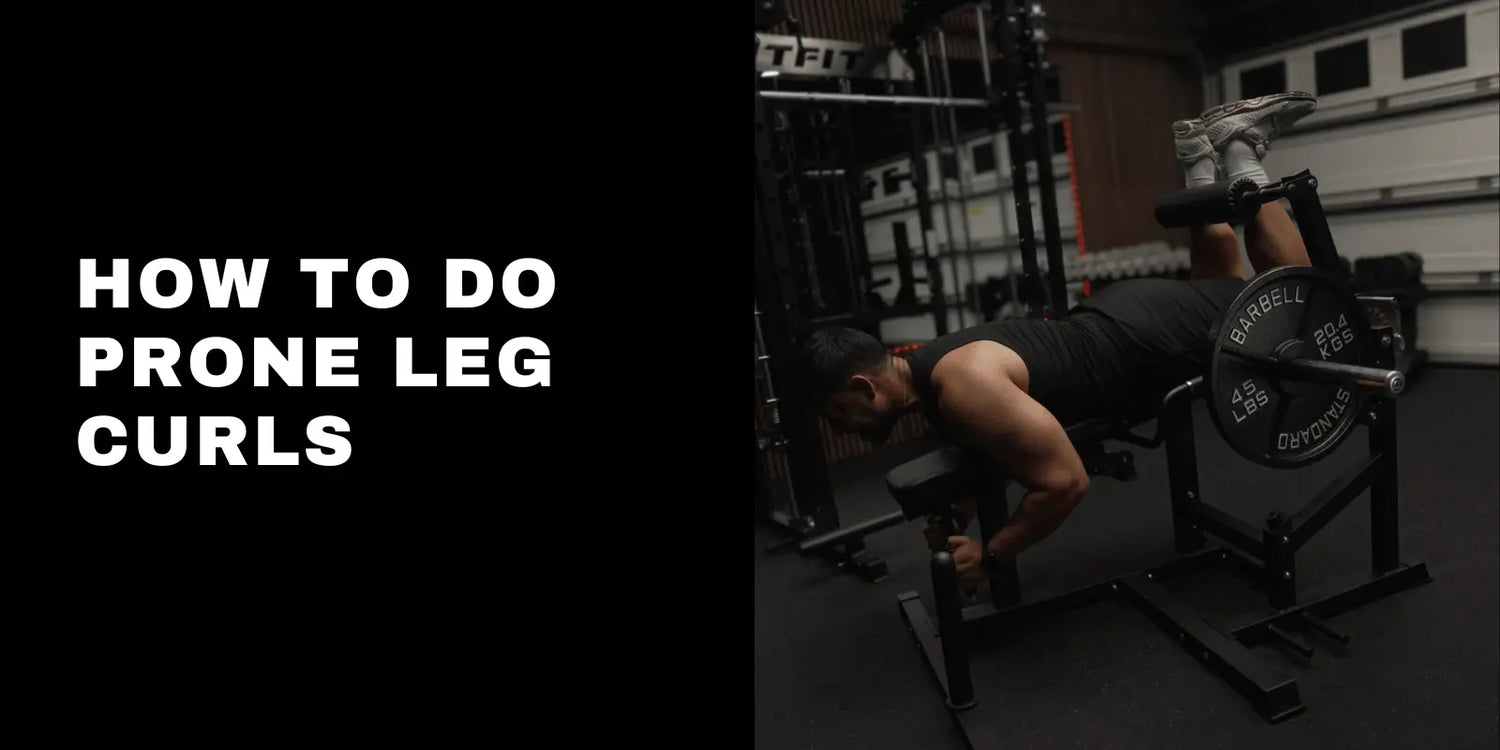
Lie face down with your chest on the pad, knees just off the edge and aligned with the pivot point, then curl the pad toward your glutes using only knee flexion. Exhale as you lift, pause for one second at the top, and inhale while lowering under control for two to three seconds.
The Starting Position: Lie face down on the machine with your chest flat against the pad, and reach forward or to the sides to grasp the handles firmly for stability. Grip them tight to create tension in your upper body, which helps stabilize your torso.
- Crucial Alignment: Ensure your knees are just off the edge of the bench pad and aligned with the pivot point.
The Concentric Phase: This is the lifting portion of the exercise, where the roller pad moves toward your glutes.
- Take a deep breath and brace your core.
- Exhale as you drive your heels up toward your glutes.
- Visualize pulling with the back of your thighs.
- Continue curling until the roller pad comes close to touching your buttocks or as far as your range of motion allows.
- Peak Contraction: At the very top of the movement, hold the weight for one full second and squeeze your hamstrings hard.
The Eccentric Phase: Do not let gravity take over here, because the lowering phase is where a lot of muscle tissue breakdown and growth potential occurs.
- Inhale as you slowly lower the weight back to the starting position.
- Control the tempo, aiming for a count of two or three seconds on the way down.
- Stop just before the weight stack touches down to keep constant tension on the muscle.
- Repeat for your desired number of repetitions.
What Are the Most Common Mistakes and How Do You Fix Them?
The four most common prone leg curl mistakes are hip hiking, using momentum, incorrect foot position, and hyperextending the neck. Fix them by pressing your hips into the pad, starting from a dead stop, matching foot position to your goal, and keeping your neck neutral.
Hip Hiking: This is the most common error, and it happens when the weight gets heavy and people instinctively lift their hips off the pad as they curl.
- The Risk: It shortens the range of motion and shifts the tension from your hamstrings to your lower back, which can lead to lower back pain.
- The Fix: Drive your hips and pelvis down into the pad throughout the entire movement, because your hips should be glued to the bench, and if they rise up the weight is likely too heavy.
Using Momentum: If you are swinging your legs to get the weight moving, you are cheating yourself.
- The Risk: Swinging creates inertial forces that can strain the hamstring tendon or the knee joint and takes the work away from the muscle belly.
- The Fix: Initiate the movement smoothly from a dead stop and do not jerk the weight.
Incorrect Foot Position: Your foot position changes how the muscle works.
- Dorsiflexion: Pulling your toes toward your shins stretches the calf muscles, making them help more in the movement, and this is the standard way to do the exercise.
- Plantarflexion: Pointing your toes like a ballerina disengages the calves and forces the hamstrings to work much harder, but you will likely need to use less weight.
Hyperextending the Neck: Many people try to look up or watch themselves in a mirror while lying face down.
- The Risk: This puts unnecessary strain on the cervical spine, or neck.
- The Fix: Keep your neck neutral and look straight down at the floor or the machine frame.
How Should You Program Prone Leg Curls?
Use 3 to 4 sets of 10 to 15 repetitions for hypertrophy, or up to 20 reps for muscular endurance, because the prone leg curl is a single-joint isolation movement. Avoid extremely heavy loads for 1 to 5 reps, which place high shear force on the knee in this open chain position.
Unilateral Training: One of the best features of using a machine is the ability to train one leg at a time, which helps fix strength or size asymmetries.
- Perform all reps on your weaker leg first.
- Match that number of reps with your stronger leg.
- This ensures you do not worsen the asymmetry.
Workout Placement: You can place this exercise at different points in your workout depending on your goals.
- As a Warm-Up: Light leg curls are a great way to warm up before heavy squats because they get blood flowing to the knee joint.
- As a Finisher: After your heavy compound movements, do these at the end of your leg workout to really tire out your hamstrings.
- Pre-Exhaustion: Do these right before squats to wear out your hamstrings so your quads have to work harder during the squat.
Pair the prone leg curl with other posterior chain work on a RitFit leg machine, and add a leg press machine to your home gym for a complete lower body setup. Consider the RitFit 3-in-1 Leg Press and Hack Squat Machine BLP01 or the full leg workout package to pair with your curls.
FAQs About Prone Leg Curls
How do you set up a leg extension curl machine for prone leg curls?
Flatten the backrest, then pull the pop pin on the cam and move the arm to a high starting position so your legs are almost fully straight. Align your knee joint with the machine pivot point and place the roller pad on the Achilles area just above your heel but below the calf belly.
Can you do prone leg curls if you have bad knees?
Yes, prone leg curls are generally a safe, low-impact option for knee-friendly training because the machine supports your body weight.
Start light, keep your hips pressed into the pad, and stop the rep before the knee passes a comfortable range.
Consult a doctor if you feel sharp pain.
What muscles does the prone leg curl work?
The prone leg curl primarily works the hamstrings, specifically the biceps femoris, semitendinosus, and semimembranosus, which perform knee flexion. Your gastrocnemius calf muscles assist as synergists, and keeping your toes pulled toward your shins increases calf involvement while pointing them disengages the calves.
How heavy should you go on prone leg curls?
Choose a weight you can curl smoothly for the full rep range without lifting your hips or swinging the load. For hypertrophy use 3 to 4 sets of 10 to 15 reps, and avoid very heavy loads for 1 to 5 reps because they create high shear force on the knee in this open chain position.
How often should you do prone leg curls?
Most lifters can train prone leg curls two to three times per week as part of a full leg day, with at least 48 hours between sessions. Treat the hamstrings like any other muscle group and allow them to recover, since hamstring training frequency matters more for balance than for volume.
What is the difference between prone leg curls and seated leg curls?
Prone leg curls, performed face down, bias the hamstring through a long range of motion with the hip flexed, which emphasizes the lower hamstring.
Seated leg curls, performed upright, keep the hip flexed at a fixed angle and load the muscle through a slightly different curve.
Both build hamstring strength and you can alternate them.
Conclusion
The prone leg curl is a fundamental movement for building a complete and resilient lower body, and a dual-function machine like the RitFit PLC01 makes it possible at home. Align your knee with the cam, keep your hips pressed into the pad, and control the weight on the way down.
Start your first set today and check the RitFit sale page for the best deal on your leg machine. Pair these curls with a leg press routine and you will build strong, balanced legs.
Disclaimer
Always consult a qualified medical professional before starting a new exercise program, especially if you have a history of knee, hamstring, or back injury. Perform all exercises with controlled form, and stop immediately if you feel sharp pain, because incorrect use of home fitness equipment can cause injury.
References
1. Taketomi S, Kawaguchi K, Mizutani Y, Takei S, Yamagami R, Kono K, Murakami R, Kage T, Arakawa T, Fujiwara S, Tanaka S, Ogata T. Lower hamstring to quadriceps muscle strength ratio and lower body weight as factors associated with noncontact anterior cruciate ligament injury in male American football players: A prospective cohort study. Asia Pac J Sports Med Arthrosc Rehabil Technol. 2023 Dec 15;35:43-47. doi: 10.1016/j.asmart.2023.11.006. PMID: 38187929; PMCID: PMC10770439.