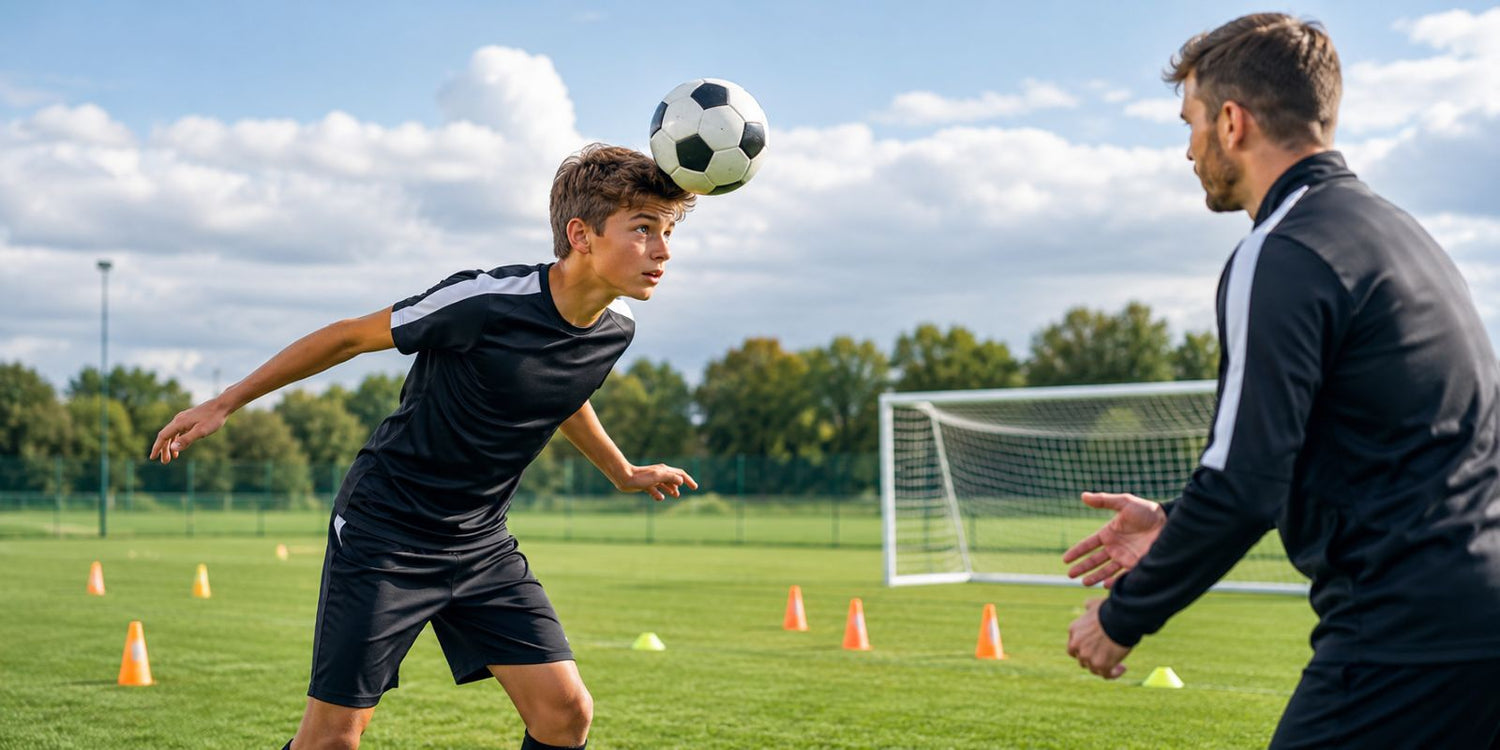
Learning how to head a soccer ball safely starts with proper forehead contact, open eyes, a firm neck, and controlled practice volume. This beginner guide explains the technique, drills, common mistakes, safety signs, and strength work that help players build confidence without rushing high impact repetitions.
Key Takeaways
- Use the forehead as the contact point, not the top of the head, face, or side of the skull.
- Keep your eyes open, jaw closed, neck firm, and core engaged before contact.
- Beginners should start with soft balls, short tosses, low speed, and limited repetitions.
- Youth players should follow local soccer association heading rules before practicing headers.
- Stop immediately if heading causes headache, dizziness, nausea, blurred vision, confusion, or balance problems.
Table of Contents
- What Is a Soccer Ball Header?
- Why Heading Matters in Soccer
- Is Heading a Soccer Ball Safe for Beginners?
- How to Head a Soccer Ball Properly
- Types of Soccer Ball Headers
- Beginner Soccer Ball Heading Drills
- Timing and Positioning
- Common Heading Mistakes
- Strength Exercises That Support Better Heading
- When to Stop Heading Practice
What Is a Soccer Ball Header?
A soccer ball header is a controlled technique where a player uses the forehead to redirect, clear, pass, or shoot the ball. The skill matters because high balls, crosses, corners, and aerial duels appear in nearly every level of the game.
The safest basic goal is not to let the ball hit you passively. You should move toward the ball, use the right contact point, and guide the ball with your body shape.
Why Heading Matters in Soccer
Heading matters because it helps players defend crosses, finish scoring chances, win aerial duels, and control high passes. A player who can head the ball with confidence has more options when the ball leaves the ground.
- Defensive clearances: A strong header can move the ball away from the goal area and reduce pressure.
- Attacking chances: A well timed header can turn a cross, corner, or set piece into a direct shot.
- Midfield control: A controlled header can redirect the ball to a teammate and help retain possession.
- Game confidence: Good technique reduces fear because the player knows where and how contact should happen.
Is Heading a Soccer Ball Safe for Beginners?
Heading can be practiced more safely when beginners use correct technique, low impact progressions, and strict volume limits. Pediatric soccer concussion research shows that soccer related head injuries can occur through headers, player contact, field contact, and goal post contact, so safety must be treated as part of the skill, not an afterthought.[1]
For youth players, parents and coaches should follow local rules before adding heading to practice. Many youth soccer organizations restrict or delay heading for younger age groups, and those rules should always come before a general online guide.
How to Head a Soccer Ball Properly
To head a soccer ball properly, watch the ball, use your forehead, keep your neck firm, engage your core, and move through the ball at contact. A systematic review of soccer head impacts found that ball speed, impact conditions, technique, and player factors can influence head acceleration, which is why controlled technique matters.[2]
Step 1: Watch the Ball
Keep your eyes open and track the ball from the moment it leaves the passer or crosser. Closing your eyes makes timing, contact point, and direction much harder to control.
Step 2: Use Your Forehead
Make contact with the firm, flat area between your eyebrows and hairline. Avoid the crown, face, temple, and side of the head because those contact points reduce control and may increase discomfort.
Step 3: Set Your Neck and Core
Brace your neck and tighten your core before the ball arrives. A relaxed head and torso make the contact feel less controlled and can reduce accuracy.
Step 4: Attack the Ball
Move toward the ball instead of waiting for it to hit you. This gives you more control over timing, power, and direction.
Step 5: Direct the Ball
Use your body angle, forehead contact, and neck motion to guide the ball toward the target. For beginners, accuracy is more important than power.
Types of Soccer Ball Headers
The main types of soccer ball headers are defensive headers, attacking headers, glancing headers, and diving headers. Beginners should master standing and jumping headers before attempting advanced or risky techniques.
- Defensive header: Strike the lower half of the ball to send it high and away from danger.
- Attacking header: Strike through the upper half of the ball and aim downward toward the corners of the goal.
- Glancing header: Redirect the ball with a lighter touch by turning the forehead toward the target.
- Diving header: Use only after mastering basic heading because it adds landing risk and requires a safe surface.
Beginner Soccer Ball Heading Drills
Beginner heading drills should teach comfort, timing, contact point, and direction before adding power. Use a soft ball or lightly served ball first, then progress only when the player can keep the eyes open and control the contact.
Ball Familiarity Drill
Place a soft ball against your forehead to learn the correct contact point before heading a moving ball. This reduces fear and gives the player a clear physical reference.
Self Toss Header
Toss the ball slightly upward and head it back into your hands. Keep the movement slow and stop if the player begins blinking, flinching, or losing form.
Partner Toss Header
Stand close to a partner and head gentle underhand tosses back to their hands. The purpose is clean contact, not distance.
Directional Header
Ask a partner to toss the ball while you aim toward a cone, small goal, or open space. This drill teaches control and prevents beginners from treating every header as a power movement.
Jumping Header
Use a gentle toss that requires a small jump and meet the ball near the peak of the jump. Start without an opponent because contact pressure changes timing and landing mechanics.
Four Week Beginner Progression
A four week heading progression should build contact confidence before game like heading. Keep total repetitions low and prioritize form quality over fatigue.
| Week | Focus | Practice Goal |
|---|---|---|
| Week 1 | Forehead contact | Use soft ball familiarity and self toss drills. |
| Week 2 | Partner control | Return gentle tosses with eyes open and stable posture. |
| Week 3 | Direction | Head the ball toward clear targets at short range. |
| Week 4 | Timing | Add small jumps and low pressure movement. |
Timing and Positioning
Timing is the difference between a controlled header and an awkward collision with the ball. Research on heading kinematics suggests that standing, jumping, and running approaches can create different head acceleration patterns, so beginners should learn each progression slowly.[3]
- Read the server: Watch the passer or crosser before the ball is kicked so you can anticipate the flight.
- Move early: Use small steps to get into the ball path before jumping or leaning.
- Jump at the right moment: Meet the ball near the peak of the jump instead of rising late or falling early.
- Protect landing space: Practice without contact first so the player can land balanced and stable.
How to Win Aerial Duels
Winning aerial duels depends on positioning, timing, balance, and commitment. Beginners should learn the movement pattern without physical contact before competing against another player.
- Get goal side or ball side: Position yourself where you can reach the ball before the opponent.
- Use your arms for balance: Keep your arms active for stability, not pushing or holding.
- Commit to the ball: A hesitant header often leads to poor contact and lower control.
- Land safely: Bend the knees and regain balance before reacting to the next play.
Common Heading Mistakes
The most common heading mistakes are closing the eyes, using the wrong contact point, waiting for the ball, relaxing the neck, and jumping too early. These errors reduce control and can make the skill feel more intimidating than it needs to be.
- Closing the eyes: Start with slow self tosses and focus on watching the ball all the way to contact.
- Using the crown: Tuck the chin slightly and lean into the ball so the forehead becomes the natural contact point.
- Waiting passively: Step into the ball and make active contact with the forehead.
- Relaxing the neck: Brace before contact and use a short controlled neck motion.
- Jumping too early: Wait until the ball starts dropping into your contact zone before leaving the ground.
Strength Exercises That Support Better Heading
Strength training cannot replace safe technique, but it can support posture, jumping, neck control, and landing mechanics. One laboratory study found that neck strength imbalance was associated with increased head acceleration during low velocity heading in experienced collegiate players.[4]
For home training, soccer players can build a basic strength foundation with controlled neck isometrics, planks, squats, box jumps, and single leg balance work. A simple setup can include home dumbbells, a stable plyo box, an adjustable weight bench, and protective gym flooring mats.
- Neck isometric holds: Press gently against the hand in front, back, and side directions while keeping the head still.
- Planks: Build trunk stiffness so the body stays stable during jumps and contact.
- Box jumps: Develop lower body power for reaching high balls with better timing.
- Single leg hops: Improve balance and landing control for game situations.
- Medicine ball rotations: Train controlled torso movement for redirecting headers.
Players who want compact home strength tools can also use RitFit Hex Rubber Dumbbells, the RitFit Classic 3 in 1 Plyo Box, or the RitFit GATOR Adjustable Weight Bench for general athletic conditioning. These links support related strength work without turning a soccer technique guide into a product sales page.
When to Stop Heading Practice
Stop heading practice immediately if a player feels headache, dizziness, nausea, blurred vision, confusion, balance trouble, unusual fatigue, or any symptom after head contact. A prospective adolescent soccer study found that adding neuromuscular neck exercises to an injury reduction program had potential to reduce possible concussive events, but it does not remove the need for symptom monitoring and medical judgment.[5]
Do not return to heading practice the same day after concerning symptoms. A qualified medical professional should guide any return to sport after suspected concussion or significant head impact.
Frequently Asked Questions
How do you head a soccer ball safely?
Use your forehead, keep your eyes open, brace your neck, and move toward the ball. Start with soft balls and gentle tosses before adding jumping or crosses. Safety depends on correct technique, low repetitions, proper supervision, and stopping immediately if symptoms appear.
What part of the head should touch the soccer ball?
The forehead should touch the soccer ball during a header. This area gives the best combination of control, firmness, and accuracy. Avoid the crown, face, temple, and side of the head because they reduce control and may make contact uncomfortable.
Can beginners practice soccer ball headers alone?
Yes. Beginners can practice alone with soft self toss headers and wall rebounds at low speed. Solo practice should focus on contact point, open eyes, and control. Avoid hard serves, high repetition sessions, or jumping headers until basic technique feels natural.
Is heading a soccer ball supposed to hurt?
No. A properly coached header should not cause sharp pain, headache, dizziness, confusion, or vision changes. Mild impact sensation can happen, but pain or symptoms after contact are warning signs. Stop practice and seek appropriate medical guidance if symptoms appear.
How often should beginners practice soccer ball headers?
Beginners should practice heading sparingly and focus on quality instead of volume. Short sessions with low repetitions are safer for learning form. Youth players should follow local association rules, and adult beginners should avoid repeated high impact drills in one session.
What is the easiest soccer ball heading drill for beginners?
The easiest drill is a soft self toss header. Hold the ball above the forehead, toss it slightly upward, and head it back into the hands. This teaches contact point, eye control, and neck bracing before adding partner tosses or movement.
How do you make a soccer ball header more powerful?
Generate power by timing your movement, bracing the core, setting the neck, and attacking the ball. Do not rely only on neck motion. Leg drive, trunk stability, and clean forehead contact create a stronger header with better control and less wasted movement.
Should youth players practice soccer ball heading?
Conclusion
Learning how to head a soccer ball safely is about control, not bravery. Start with the forehead contact point, keep the eyes open, brace the neck and core, use low repetition drills, and build timing before adding crosses or pressure.
Beginners should never rush heading volume. Good coaching, safe progressions, symptom awareness, and respect for youth rules make heading a more confident and responsible soccer skill.
Disclaimer: This article is for general educational purposes only and is not medical advice. Soccer heading practice may not be appropriate for every player, especially youth athletes or players with prior head injury history. Follow local soccer association rules and consult a qualified medical professional after any suspected concussion or concerning symptom.
References
- Sullivan GR, Lin EA, Hoffer A, Richardson M, Chhabra A. Pediatric concussion injuries in soccer: emergency department trends in the United States from 2012 to 2023. Orthop J Sports Med. 2024;12(12):23259671241303180. doi:10.1177/23259671241303180
- Basinas I, McElvenny DM, Pearce N, Gallo V, Cherrie JW. A systematic review of head impacts and acceleration associated with soccer. Int J Environ Res Public Health. 2022;19(9):5488. doi:10.3390/ijerph19095488
- Becker S, Berger J, Ludwig O, Günther D, Kelm J, Fröhlich M. Heading in soccer: does kinematics of the head neck torso alignment influence head acceleration. J Hum Kinet. 2021;77(1):71-80. doi:10.2478/hukin-2021-0012
- Dezman ZDW, Ledet EH, Kerr HA. Neck strength imbalance correlates with increased head acceleration in soccer heading. Sports Health. 2013;5(4):320-326. doi:10.1177/1941738113480935
- Peek K, Versteegh T, Veith S, Whalan M, Edwards S, McKay M, et al. Injury reduction programs containing neuromuscular neck exercises and the incidence of soccer related head and neck injuries. J Athl Train. 2023;58(6):519-527. doi:10.4085/1062-6050-0340.22