








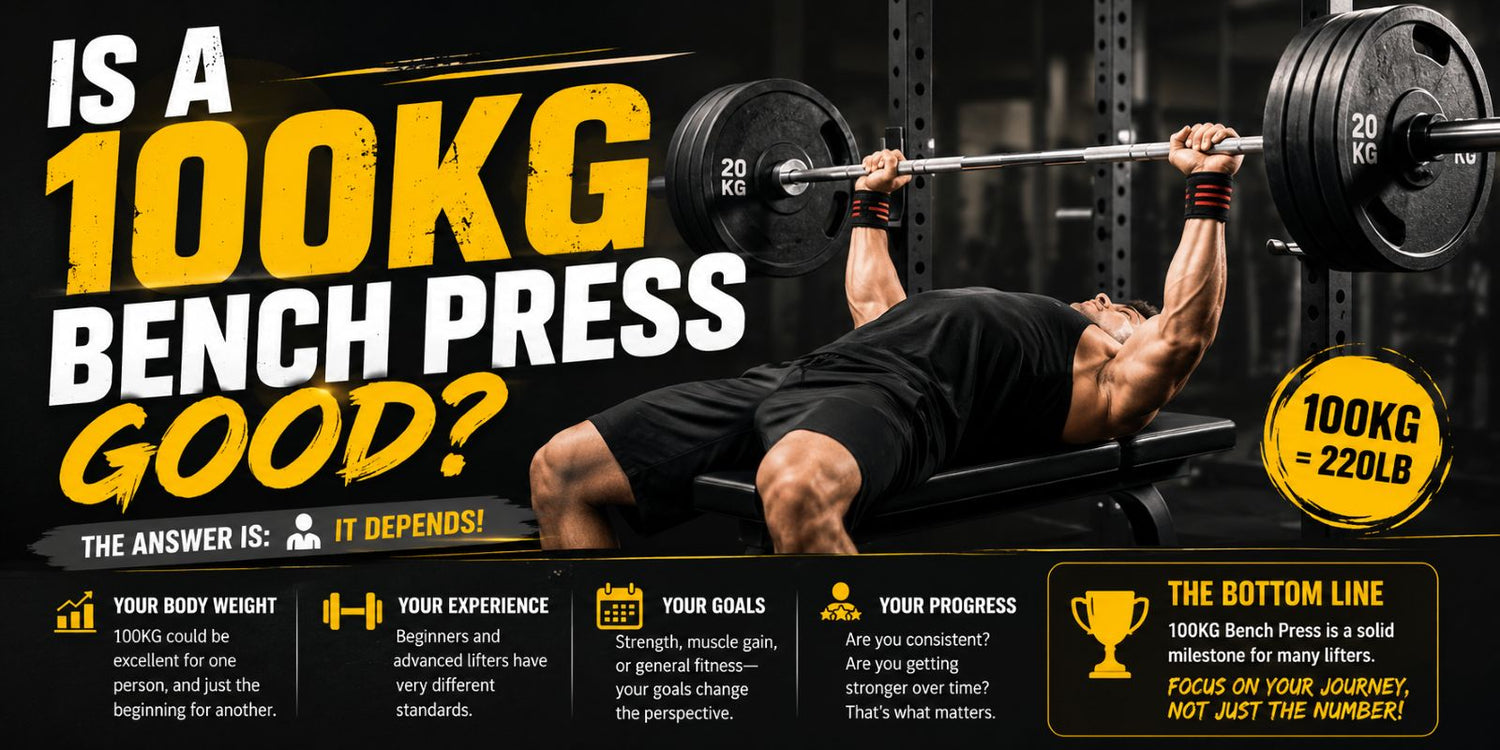
A 100kg (220 lb) bench press is a strong milestone for most lifters, but its real meaning depends on your bodyweight, sex, training history, and rep quality. For many men, it sits around intermediate strength levels, while for most women, it is an advanced to elite level bench press.
This guide breaks down 100kg bench press standards by bodyweight, male and female strength levels, form quality, realistic timelines, and safe home gym setup so you can judge your own progress honestly.
Quick Answer: A 100kg bench press is good for most lifters when performed with full range of motion and controlled technique. It is a strong intermediate milestone for average-weight men and an advanced to elite level lift for most women. The same weight means more at lower bodyweights.
Key Takeaways
- A 100kg bench press is a real strength milestone: It is not a beginner lift when performed with full range of motion and controlled technique.
- Bodyweight changes the meaning: 100kg is much more impressive for a 65kg lifter than for a 100kg lifter.
- For many men, it is around intermediate: It becomes more advanced when the lifter is lighter, younger in training age, or using strict paused form.
- For most women, it is elite: A clean 100kg bench press usually requires years of structured training and strong upper body development.
- Safety matters as much as the number: Heavy bench training should use a stable bench, proper bar path, and a spotter or safety catches.
Is a 100kg Bench Press Good?
Yes, a 100kg bench press is good because it shows meaningful upper body strength, technical skill, and consistent training. It becomes more impressive when the rep is controlled, touches the chest without bouncing, and reaches lockout without help.
The better question is not only whether 100kg is good, but whether 100kg is good for your bodyweight and training level. A 70kg lifter pressing 100kg is moving about 1.43 times bodyweight, while a 100kg lifter pressing 100kg is moving exactly bodyweight. A quality adjustable weight bench is the foundation for consistent bench press training at home.
What Does a 100kg Bench Press Mean by Bodyweight?
A 100kg bench press becomes more impressive as your bodyweight gets lower. Use the table below as a practical context guide, not as an official competition ranking.
| Bodyweight | 100kg Bench Ratio | Practical Meaning |
|---|---|---|
| 60kg | 1.67 x bodyweight | Very strong for recreational lifters |
| 70kg | 1.43 x bodyweight | Strong to advanced for many male lifters |
| 80kg | 1.25 x bodyweight | Strong intermediate milestone |
| 90kg | 1.11 x bodyweight | Solid intermediate benchmark |
| 100kg | 1.00 x bodyweight | Respectable strength goal |
Bodyweight ratio changes the meaning of the same absolute weight. Lower bodyweight lifters get more relative strength credit for a 100kg bench.
How Does a 100kg Bench Press Compare to Strength Standards?
Bench press standards are best understood as ranges because databases use different populations, age groups, and reporting methods. Treat the numbers below as practical training targets for a strict 1 rep max.
Men's Bench Press Standards
For men, 100kg is often around intermediate for average bodyweights, but it becomes much stronger when the lifter weighs under 80kg.
| Male Bodyweight | Good Milestone | Strong Benchmark | Very Strong Benchmark |
|---|---|---|---|
| 60kg | 60kg | 75kg | 90kg+ |
| 70kg | 70kg | 87.5kg | 105kg+ |
| 80kg | 80kg | 100kg | 120kg+ |
| 90kg | 90kg | 112.5kg | 135kg+ |
| 100kg | 100kg | 125kg | 150kg+ |
A 100kg bench press for an 80kg male lifter is roughly a 1.25x bodyweight press, which aligns with intermediate strength levels in most databases.
Women's Bench Press Standards
For women, a 100kg bench press is an extremely high level lift in most recreational and strength training settings.
| Female Bodyweight | Solid Milestone | Strong Benchmark | Elite Level Target |
|---|---|---|---|
| 50kg | 25kg | 37.5kg | 62.5kg+ |
| 60kg | 30kg | 45kg | 75kg+ |
| 70kg | 35kg | 52.5kg | 87.5kg+ |
| 80kg | 40kg | 60kg | 100kg+ |
| 90kg | 45kg | 67.5kg | 112.5kg+ |
For most female bodyweight categories, 100kg sits at or above the elite threshold in strength standard databases.
How Rare Is a 100kg Bench Press?
A 100kg bench press is common enough to be a known gym milestone, but it is not common among people who do not train seriously. It is much safer to describe it as a strong trained lifter milestone than to claim a precise population percentage.
Among people who track strength training, 100kg may sit near the middle of male bench press standards in some databases. Among the general population, the number is likely far less common because most adults do not train, test, or practice the barbell bench press.
Does a 100kg Bench Press Count If You Bounce the Bar?
A 100kg bench press is most meaningful when the rep uses a controlled descent, full range of motion, stable chest contact, and a clean lockout. Bouncing the bar off the chest makes the lift harder to compare because it changes the movement and can increase injury risk.
A strict touch and go rep is acceptable for general gym tracking if it stays controlled. A paused rep is usually the cleaner standard when you want a more honest strength comparison. Learn more about proper bench press form to make every rep count.
Is 100kg for One Rep Different From 100kg for Reps?
Yes, 100kg for one rep and 100kg for multiple reps are very different achievements. If you can bench 100kg for 5 controlled reps, your estimated 1 rep max is likely well above 100kg.
This is why you should track both max strength and working set strength. A single heavy rep shows peak strength, while repeated clean reps show better repeatability, control, and training base.
How Long Does It Take to Bench Press 100kg?
Many male lifters need 1 to 3 years of consistent training to reach a clean 100kg bench press. Lighter lifters, older beginners, and people with long arms may need longer, while heavier beginners or former athletes may progress faster.
For most female lifters, 100kg is a long term elite strength goal rather than a typical beginner milestone. The timeline depends on bodyweight, training age, programming quality, nutrition, recovery, and injury history.
| Starting Point | Typical Path Toward 100kg | Main Limiting Factor |
|---|---|---|
| New beginner | Often several years | Technique, muscle mass, consistency |
| Can bench 60kg | Often 12 to 24 months | Progressive overload and volume |
| Can bench 80kg | Often 6 to 18 months | Programming, recovery, weak points |
| Can bench 90kg | Often 3 to 12 months | Technique refinement and confidence |
Timelines are estimates based on consistent training with a structured program. Individual results vary significantly.
How to Train Toward a 100kg Bench Press
The fastest realistic path to 100kg is consistent training, better technique, enough weekly pressing volume, and smart recovery. Heavy loading is especially useful for maximal strength, while hypertrophy can be developed across a wider range of loads when effort and volume are appropriate.[1]
- Bench 2 to 3 times per week: Use one heavier day, one volume day, and one technique or variation day if recovery allows.
- Progress in small jumps: Add 1.25kg to 2.5kg when your reps are clean instead of forcing large jumps too early.
- Use enough volume: Most lifters need repeated quality sets, not only max attempts, to build the chest, shoulders, and triceps.
- Train close to failure carefully: Hard sets can build strength, but frequent failed reps can create fatigue and reduce technical quality.
- Recover like strength matters: Sleep, protein, calories, and shoulder health directly affect bench press progress.
Master Your Bench Press Setup
A stronger bench press starts before the bar leaves the rack because your setup creates stability. Keep your shoulder blades pulled back, feet planted, wrists stacked, and grip consistent.
Using a quality bench with a stable frame makes setup consistency easier. The RitFit GATOR 1600LB Adjustable Weight Bench supports flat, incline, and decline pressing for a dedicated strength training setup.
Use Progressive Overload
Progressive overload means gradually increasing the training demand over time. Weekly training frequency alone is not magic, but spreading quality volume across the week can help lifters practice more often without turning every session into a max test.[2]
Train the Muscles That Support Your Bench
The bench press is driven mainly by the chest, shoulders, and triceps, but the upper back and lats help create a stable pressing base. Rows, pulldowns, close grip bench press, push ups, and dumbbell pressing can all support a stronger barbell bench.
Common Mistakes That Stop Lifters From Reaching 100kg
Most lifters stall short of 100kg because of repeatable mistakes that slow progress more than they help it. Fixing these patterns usually unlocks the next strength gains faster than adding more work.
- Maxing out too often: Testing your 1 rep max every week usually creates more fatigue than progress.
- Ignoring technique: Loose shoulders, unstable feet, bent wrists, and inconsistent bar path can make the same weight feel heavier.
- Skipping upper back work: A stronger upper back helps create a stable base and better control during the descent.
- Training chest only: Your triceps and front delts often become limiting factors before your chest does.
- Eating too little: It is difficult to build a bigger bench if calories, protein, and recovery are always too low.
- Using advanced methods too soon: Drop sets, cluster sets, and other advanced methods can help trained lifters, but evidence is not strong enough to make them necessary for everyone.[4]
Heavy bench training also benefits from a rack that lets you set safety catches at the correct height. Explore power rack packages for safe bench press training if you want a rack based setup for squats, bench press, and pull ups.
What Comes After a 100kg Bench Press?
After 100kg, the best next goal depends on your bodyweight and training purpose. Some lifters should aim for 100kg for reps, while others should target 1.25 x bodyweight, 1.5 x bodyweight, or a clean paused competition style bench.
- 100kg for 3 reps: A strong next step after your first single.
- 100kg for 5 reps: A major working set milestone.
- 1.25 x bodyweight: A practical strength goal for many male lifters.
- 1.5 x bodyweight: A very strong benchmark for recreational lifters.
- Paused 100kg bench: A stricter and more comparable version of the milestone.
For lifters who want a specific rack example, the RitFit P3 1200lbs Power Cage with Smooth Cable System can support a broader home strength setup. You can also build your pressing foundation with barbells and weight plates for progressive overload.
A Smith machine for controlled home gym training can be useful for certain lifters, especially when training alone. It should not replace proper form, smart loading, and correctly set safety stops.
FAQs About 100kg Bench Press
Is a 100kg bench press good for a man?
Yes.
A 100kg bench press is good for many men, especially when performed with full range of motion and controlled form.
For average male bodyweights, it is often around intermediate, but it becomes much more impressive for lighter lifters.
Is a 100kg bench press good for a woman?
Yes.
A 100kg bench press is exceptional for most women and usually reflects advanced to elite upper body strength.
It normally requires years of structured training, enough muscle mass, strong technique, and consistent exposure to heavy pressing.
How long does it take to bench press 100kg?
Most lifters need months or years to bench press 100kg, not weeks. A common path for male lifters is 1 to 3 years of consistent training, but bodyweight, genetics, nutrition, recovery, coaching, and injury history can change the timeline.
What bodyweight makes a 100kg bench press impressive?
A 100kg bench press becomes more impressive as bodyweight decreases. It is very strong for a 60kg or 70kg lifter, a strong intermediate milestone for an 80kg lifter, and a respectable bodyweight bench for a 100kg lifter.
Can beginners bench press 100kg naturally?
Some heavier beginners with athletic backgrounds may reach 100kg quickly, but most true beginners will not. Natural lifters can build toward it with progressive overload, good bench technique, enough food, proper recovery, and patient strength programming.
Should I test my one rep max to know if I can bench 100kg?
Not always. You can estimate your one rep max from safer heavy sets of 3 to 5 reps. If you test 100kg directly, use a spotter, properly set safety catches, and stop if your setup or bar path breaks down.
What is the best bench press setup for a home gym?
A stable bench, a quality barbell, enough weight plates, and a rack with properly positioned safety catches create the safest home gym environment for bench press training. An adjustable bench that supports both flat and incline work adds more versatility to your setup.
Does age affect how fast you can bench press 100kg?
Yes, age can affect the timeline.
Younger lifters in their 20s often build strength faster due to higher recovery capacity and hormone levels.
Lifters over 40 may need more structured programming, longer recovery between sessions, and more attention to shoulder health.
Conclusion
A 100kg bench press is good, but the real answer depends on bodyweight, sex, training age, and rep quality. For many men, it is a strong intermediate milestone, while for most women, it is an advanced to elite level lift.
Use 100kg as a meaningful goal, not a final identity. Build it through consistent training, controlled reps, smart loading, and a safe bench press setup. Browse RitFit sales and packages to find the right equipment for your home gym bench press journey.
Disclaimer
This article is for general educational purposes only and is not medical, rehabilitation, or individualized training advice. Heavy bench pressing can involve injury risk, especially without proper technique, supervision, or safety equipment, so consult a qualified coach or healthcare professional if you have shoulder, chest, elbow, wrist, or cardiovascular concerns before attempting maximal lifts.
References
1. Schoenfeld BJ, Grgic J, Van Every DW, Plotkin DL. Loading recommendations for muscle strength, hypertrophy, and local endurance: a re-examination of the repetition continuum. Sports (Basel). 2021;9(2):32. doi:10.3390/sports9020032. PMCID: PMC7927075
2. Ralston GW, Kilgore L, Wyatt FB, Buchan D, Baker JS. Weekly training frequency effects on strength gain: a meta-analysis. Sports Med Open. 2018;4(1):36. doi:10.1186/s40798-018-0149-9. PMCID: PMC6097329
3. Serafim TT, de Oliveira ES, Maffulli N, Migliorini F, Okubo R. Which resistance training is safest to practice? A systematic review. J Orthop Surg Res. 2023;18(1):296. doi:10.1186/s13018-023-03781-x. PMCID: PMC10158100
4. Krzysztofik M, Wilk M, Wojdala G, Golas A. Maximizing muscle hypertrophy: a systematic review of advanced resistance training techniques and methods. Int J Environ Res Public Health. 2019;16(24):4897. doi:10.3390/ijerph16244897. PMCID: PMC6946240





