








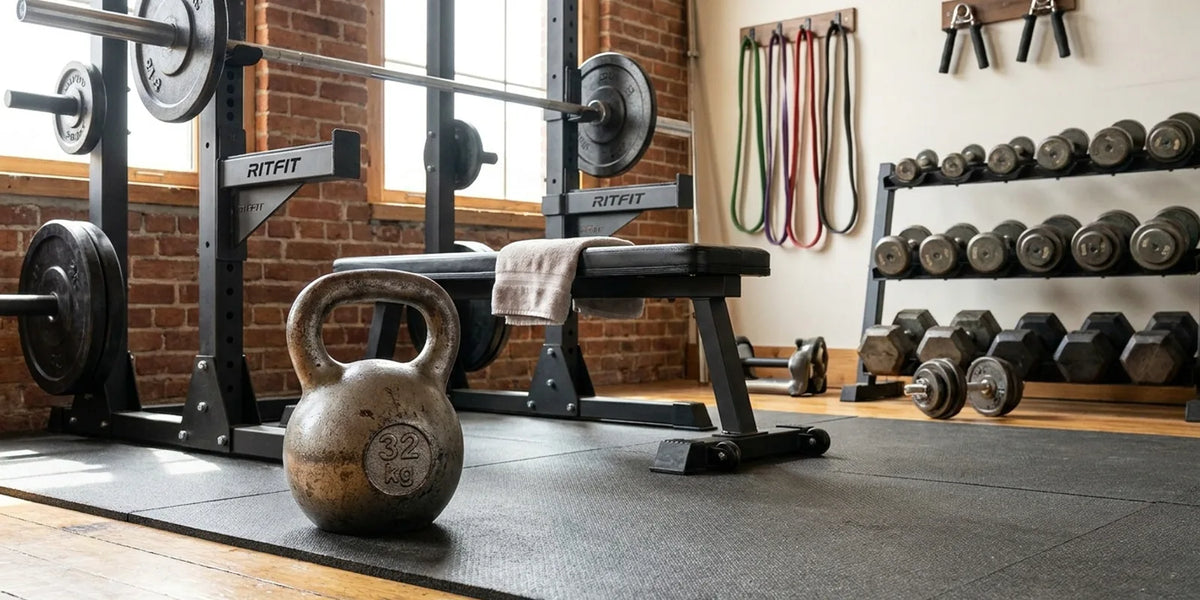
A 32 kg kettlebell is best for experienced lifters who already control 24 kg swings, goblet squats, and hinge movements with clean form. At about 70.5 lb, it can build serious posterior chain power, grip strength, and full body conditioning, but it is not a beginner weight.
This guide explains who should use a 32 kg kettlebell, how to train safely, which exercises fit this weight, and how to pair it with a practical home gym setup.
Key Takeaways
- A 32 kg kettlebell weighs about 70.5 lb and belongs in the advanced training category.
- You should master 24 kg swings, deadlifts, goblet squats, and loaded carries before moving up.
- The best 32 kg kettlebell exercises include two hand swings, goblet squats, dead stop deadlifts, cleans, presses, and carries.
- Heavy kettlebell training can improve power, grip strength, posterior chain strength, work capacity, and time efficient conditioning.
- Safety matters more than volume, stop each set before grip, spine position, or shoulder control breaks down.
Table of Contents
- What Is a 32 kg Kettlebell?
- Is a 32 kg Kettlebell Too Heavy?
- Who Should Use a 32 kg Kettlebell?
- Benefits of Training with a 32 kg Kettlebell
- Best 32 kg Kettlebell Exercises
- Safety Tips for Heavy Kettlebell Training
- Six Week 32 kg Kettlebell Program
- How to Use a 32 kg Kettlebell in a Home Gym
- Common Mistakes with a 32 kg Kettlebell
What Is a 32 kg Kettlebell?
A 32 kg kettlebell is a heavy strength and conditioning tool that weighs about 70.5 lb. It is often used for advanced swings, squats, carries, cleans, and presses.
How Heavy Is 32 kg in Real Training?
32 kg feels different from the same weight on a dumbbell or barbell because the kettlebell mass sits away from your hand. That offset center of mass increases the demand on grip, core stability, shoulder control, and hip timing.
- In pounds: 32 kg equals about 70.5 lb.
- Compared with a plate: It is heavier than a standard 45 lb Olympic plate.
- Compared with a beginner kettlebell: It is roughly double the common 16 kg starting weight for many men.
- Compared with daily life: It feels manageable from the floor but demanding when swung, cleaned, pressed, or carried.
Where 32 kg Fits in Kettlebell Progression
The 32 kg kettlebell sits near the top of practical single bell training for most home gym users. It is usually introduced after the lifter has built reliable technique with 16 kg, 20 kg, 24 kg, and often 28 kg.
- Beginner range: 8 kg to 16 kg, depending on body size, training age, and movement quality.
- Intermediate range: 16 kg to 24 kg for swings, squats, carries, and basic cleans.
- Advanced range: 24 kg to 32 kg for heavier ballistic training and strength endurance.
- Elite range: 32 kg and above for demanding single arm work, double kettlebell work, and sport style training.
Is a 32 kg Kettlebell Too Heavy?
A 32 kg kettlebell is too heavy if you cannot maintain a neutral spine, strong grip, and controlled hip hinge under lighter loads. It is appropriate only when your technique stays stable before fatigue, during fatigue, and after repeated sets.
Simple Readiness Test
You are probably ready for 32 kg if 24 kg feels powerful, controlled, and repeatable across several basic movements. You are not ready if your lower back, shoulders, wrists, or grip fail before your target muscles do.
- Two hand swing: You can perform 5 sets of 15 to 20 reps with 24 kg without back rounding.
- Goblet squat: You can squat 24 kg through full depth with a tall chest and stable knees.
- Dead stop deadlift: You can lift 24 kg from the floor without losing spine position.
- Loaded carry: You can carry 24 kg per side or one heavier bell without grip panic.
- Training history: You have at least 6 to 12 months of consistent kettlebell practice.
Who Should Use a 32 kg Kettlebell?
A 32 kg kettlebell is for lifters who have already developed strength, coordination, and respect for heavy ballistic movement. It is not a shortcut to better results, it is a tool that rewards strong fundamentals.
The Right Candidate
The right user can hinge from the hips, brace the trunk, keep the shoulders packed, and stop a set before form breaks down. This person usually trains for strength, power, conditioning, grip endurance, or compact home gym performance.
- Advanced home gym user: You want a single compact tool for heavy swings, squats, carries, and cleans.
- Strength athlete: You want conditioning that supports deadlifts, squats, pulls, and loaded carries.
- Sport focused lifter: You want hip power, trunk stiffness, and repeatable force production.
- Minimal equipment trainee: You want one heavy bell that can challenge the full body in short sessions.
Who Should Wait?
You should wait if your swing still looks like a front raise, your grip opens early, or your lower back feels sore after sessions. A lighter kettlebell will build better long term progress than a heavy bell used with poor mechanics.
- Less than 6 months of training: Spend more time with lighter loads before jumping to 32 kg.
- Back discomfort: Fix hinge mechanics before adding ballistic load.
- Shoulder instability: Avoid heavy cleans, presses, snatches, and get ups until overhead control improves.
- Grip limitation: Build carries, dead hangs, rows, and lighter swings before chasing heavier reps.
32 kg vs 24 kg vs 28 kg Kettlebell
The best kettlebell weight depends on your current movement quality, not your ego. A 24 kg bell is often the main training weight, a 28 kg bell is a bridge, and a 32 kg bell is a true advanced load.
| Kettlebell Weight | Best For | Use It When |
|---|---|---|
| 24 kg | Skill building, volume swings, goblet squats, carries | You are building consistent technique and work capacity |
| 28 kg | Transition loading, heavier swings, strength endurance | 24 kg feels controlled but 32 kg still feels rushed |
| 32 kg | Heavy swings, strength focused squats, loaded carries, advanced cleans | You can control 24 kg and 28 kg without form breakdown |
Benefits of Training with a 32 kg Kettlebell
A 32 kg kettlebell can improve strength, power, conditioning, grip, and trunk control when used with sound progression. The benefit comes from heavy load plus coordinated movement, not from the number on the bell alone.
1. Explosive Hip Power
Heavy swings train forceful hip extension through the glutes, hamstrings, and spinal erectors. EMG and movement analysis of kettlebell swings supports their role as a hip dominant movement with meaningful trunk and posterior chain demand.[1]
2. Functional Full Body Strength
The 32 kg kettlebell connects the lower body, trunk, grip, and shoulders in one compact tool. A scoping review of kettlebell literature found promising applications, while also noting that clinical prescription still needs more high quality research.[2]
3. Conditioning Without Traditional Cardio
Heavy swings and complexes can create a strong cardiovascular and metabolic demand in short workouts. Kettlebell exercise has been discussed as a practical method for improving aerobic power and muscle strength when programmed appropriately.[3]
4. Grip Strength and Carryover
A 32 kg bell challenges the hands, forearms, lats, and trunk during swings, carries, cleans, and rack holds. Handgrip strength is also widely studied as a useful general health indicator, which makes grip focused training valuable beyond gym performance.[4]
5. Compact Home Gym Efficiency
One heavy kettlebell can support short, dense workouts in a garage, spare room, or basement gym. For safer heavy training, pair it with stable space, clear flooring, and enough room for swings, carries, and controlled set down.
Best 32 kg Kettlebell Exercises
The best 32 kg kettlebell exercises are the ones you can perform with control and repeatability. Start with two hand work and carries before moving into single arm ballistic or overhead movements.
Two Hand Swing
The two hand swing is the best first movement for a 32 kg kettlebell because it trains hip power without requiring overhead control. Keep the arms relaxed, drive through the hips, and stop when the bell no longer floats naturally.
- Setup: Place the bell slightly in front of your feet and hinge to reach the handle.
- Execution: Hike the bell back, snap the hips forward, and let the bell rise to chest height.
- Common error: Do not lift the bell with your arms or lean back at the top.
- Programming: Use 3 to 5 sets of 10 to 20 reps with 60 to 90 seconds of rest.
Goblet Squat
The 32 kg goblet squat is a serious lower body and trunk exercise. Keep the bell close to the chest, brace hard, and squat only as deep as you can control.
- Setup: Hold the horns or body of the kettlebell close to your sternum.
- Execution: Sit between the hips, keep the chest tall, and drive through the full foot.
- Common error: Do not let the elbows pull you forward or the knees collapse inward.
- Programming: Use 3 to 4 sets of 6 to 12 reps.
Dead Stop Deadlift
The dead stop deadlift teaches the hinge pattern required for safer swings. Reset each rep from the floor so the hips, lats, and core learn tension before speed.
- Setup: Place the bell between the feet and grip the handle with a flat back.
- Execution: Brace, pull the shoulders down, and stand tall without overextending.
- Common error: Do not squat the bell up or round the lower back.
- Programming: Use 3 to 4 sets of 5 to 8 reps.
Farmer Carry and Suitcase Carry
Loaded carries are among the safest and most useful ways to use a 32 kg kettlebell. They build grip, trunk stiffness, posture, and real world carrying strength.
- Farmer carry: Use one bell per hand when available or carry one heavy bell in both hands.
- Suitcase carry: Hold one bell at your side and resist leaning.
- Common error: Do not rush the walk or let the shoulder hang loose.
- Programming: Use 3 to 5 carries of 20 to 40 seconds.
Single Arm Clean
The single arm clean moves the bell into the rack position and should be trained only after lighter cleans feel smooth. Keep the bell close to the body and guide it around the forearm rather than letting it crash.
- Setup: Start from a hinge with the bell between or slightly in front of the feet.
- Execution: Drive the hips, keep the elbow close, and catch the bell softly in the rack.
- Common error: Do not curl the bell or let it slam the wrist.
- Programming: Use 3 to 4 sets of 3 to 5 reps per side.
Single Arm Press
A 32 kg kettlebell press is a major strength milestone. Attempt it only if your rack position, wrist alignment, rib position, and overhead lockout are already stable with lighter bells.
- Setup: Start from a strong rack with the forearm vertical and the wrist neutral.
- Execution: Brace the core, squeeze the glutes, and press without leaning back.
- Common error: Do not turn the press into a side bend or lower back extension.
- Programming: Use 3 to 5 sets of 2 to 5 reps per side.
Turkish Get Up
The Turkish get up with 32 kg is advanced and should not be rushed. Master the pattern with lighter bells before attempting a load that can create serious risk if control is lost overhead.
- Setup: Start lying on your back with the bell locked out above the shoulder.
- Execution: Move slowly from roll to elbow, hand, bridge, kneeling, and standing.
- Common error: Do not chase the 32 kg get up before the 16 kg and 24 kg versions are smooth.
- Programming: Use low volume, such as 1 to 2 reps per side, only with excellent control.
Safety Tips for Heavy Kettlebell Training
Heavy kettlebell training is safe only when load, space, technique, and fatigue are managed together. A supervised hardstyle kettlebell trial in insufficiently active older adults reported high compliance, improved grip strength, and only non serious adverse events, but the program used progression and supervision.[5]
Warm Up Before Heavy Ballistics
Warm up before using a 32 kg kettlebell because cold joints and rushed hinges increase risk. Use hip hinges, glute bridges, bodyweight squats, shoulder circles, and lighter swings before the first heavy set.
Stop Before Form Fails
End the set as soon as your grip opens, spine rounds, shoulders rise, or timing slows. With 32 kg, one sloppy rep can create more risk than several good reps create benefit.
Use the Right Training Surface
Train on a stable surface that protects the floor and gives your feet traction. Heavy bells pair well with rubber high density gym flooring mats because safe set downs matter during heavy sessions.
Respect Overhead Movements
Presses, snatches, and get ups require more control than swings and squats. Do not train these movements with 32 kg until the same pattern looks clean with lighter loads.
Six Week 32 kg Kettlebell Program
This six week plan introduces the 32 kg kettlebell through controlled volume before adding intensity. Train three days per week and keep at least one rest day between heavy sessions.
Weeks 1 and 2, Foundation
The goal is to own the hinge, squat, carry, and set down. Keep every rep clean and stop each set with energy still available.
- Dead stop deadlift: 3 sets of 8 reps.
- Two hand swing: 3 sets of 10 reps.
- Goblet squat: 3 sets of 8 reps.
- Suitcase carry: 3 rounds of 30 seconds per side.
Weeks 3 and 4, Volume
The goal is to build repeatable power and introduce controlled single arm work. Keep cleans crisp and use a lighter bell for get up practice if needed.
- Two hand swing: 4 sets of 15 reps.
- Goblet squat: 4 sets of 10 reps.
- Single arm clean: 3 sets of 4 reps per side.
- Farmer carry: 4 rounds of 30 to 40 seconds.
Weeks 5 and 6, Strength and Conditioning
The goal is to combine power, strength, and density without losing form. Use longer rest periods when power output drops.
- Two hand swing: 5 sets of 15 to 20 reps.
- Clean and press: 4 sets of 3 reps per side if pressing is safe.
- Goblet squat: 4 sets of 12 reps.
- Loaded carry: 4 rounds of 40 seconds.
How to Use a 32 kg Kettlebell in a Home Gym
A 32 kg kettlebell works best as part of a balanced home gym rather than as your only tool forever. Use it for ballistic power and conditioning, then use racks, benches, barbells, and plates for more precise progressive loading.
Build Around Safe Space First
Your first priority is open floor space for swings, carries, and safe set downs. A heavy bell should never compete with clutter, loose flooring, or fragile surfaces.
Pair Kettlebells with Rack Training
Kettlebell swings complement squats, bench press, rows, and pull movements performed in a rack. A RitFit P3 power cage with smooth cable system can anchor heavier strength work while the kettlebell handles conditioning.
Use a Smith Machine for Controlled Strength Work
A Smith machine can support controlled pressing, squatting, and accessory work when you train alone at home. The RitFit M1 Smith Machine with cable crossover system pairs well with kettlebell conditioning for full body strength sessions.
Add a Bench for More Exercise Variety
An adjustable bench expands your training options with presses, rows, split squats, hip thrusts, and accessory work. The RitFit GATOR adjustable weight bench is a useful companion when kettlebell work is part of a larger home gym routine.
Use Barbells and Plates for Progressive Overload
A kettlebell jumps in large weight increments, while barbell training allows smaller and more precise progress. Add a 20 kg Olympic barbell and high grade color bumper plates when you want structured strength progression beyond kettlebell jumps.
Choose Lighter Kettlebells for Skill Work
You still need lighter bells for warm ups, snatch practice, get up skill, and technical refinement. The RitFit neoprene coated cast iron kettlebell set can support beginner skill practice before heavier training.
Cast Iron vs Competition 32 kg Kettlebell
Choose a cast iron kettlebell for general fitness and a competition kettlebell for sport style consistency. Both can work well, but the handle feel, bell size, and training purpose are different.
- Cast iron kettlebell: The bell gets larger as weight increases, and it is common for general strength training.
- Competition kettlebell: The bell size stays consistent across weights, which helps sport lifters repeat the same rack and overhead positions.
- Best for swings: Either style can work if the handle is comfortable and the base sits flat.
- Best for cleans and snatches: Competition bells often feel more consistent across long term progressions.
Common Mistakes with a 32 kg Kettlebell
The biggest mistakes happen when lifters treat 32 kg like a lighter practice bell. Heavy kettlebell training demands stricter setup, cleaner reps, and earlier stopping points.
Using the Arms Instead of the Hips
The swing should be powered by hip extension, not by a shoulder raise. If your shoulders fatigue before your glutes and hamstrings, reduce the load and rebuild the hinge.
Training Through Pain
Sharp pain, nerve symptoms, joint pinching, or repeated back soreness are signs to stop. Heavy kettlebells reward patience, not tolerance for bad signals.
Skipping Lighter Practice
A lighter bell still matters even after you own a 32 kg kettlebell. Use lighter loads for warm ups, skill practice, snatches, get ups, and recovery days.
Doing Too Much Too Soon
The jump to 32 kg should happen exercise by exercise. Being ready to deadlift it does not mean you are ready to snatch it, press it, or perform a Turkish get up with it.
FAQs
Is a 32 kg kettlebell too heavy for beginners?
Yes. A 32 kg kettlebell is too heavy for most beginners because it requires strong hinge mechanics, grip strength, and trunk control. Start with a lighter bell, master swings, squats, deadlifts, and carries, then progress only when your form stays stable across repeated sets.
How much does a 32 kg kettlebell weigh in pounds?
A 32 kg kettlebell weighs about 70.5 lb. That may sound moderate compared with barbell lifts, but the offset shape makes swings, cleans, presses, and get ups feel much harder than lifting the same number on a straight bar or dumbbell.
What exercises are best with a 32 kg kettlebell?
The best exercises are two hand swings, goblet squats, dead stop deadlifts, suitcase carries, farmer carries, and controlled cleans. Advanced lifters may add presses, snatches, and Turkish get ups, but only after proving clean technique with lighter kettlebells first.
Can a 32 kg kettlebell build muscle?
Yes. A 32 kg kettlebell can build muscle when you use progressive volume, controlled tempo, and enough weekly recovery. It works especially well for glutes, hamstrings, forearms, upper back, and core, but barbell and machine work still help provide more precise loading.
Should I choose a 28 kg or 32 kg kettlebell?
Choose 28 kg if 24 kg still challenges your swing volume, grip, or clean technique. Choose 32 kg if 28 kg feels controlled for swings, squats, carries, and basic cleans. The better choice is the weight that lets you train hard without losing position.
Do I need two 32 kg kettlebells?
No. One 32 kg kettlebell is enough for most home gym users because it supports swings, goblet squats, single arm cleans, presses, and carries. Two bells are useful for advanced double kettlebell work, but they require much higher strength and technical control.
How often should I train with a 32 kg kettlebell?
Most lifters should train with a 32 kg kettlebell two to three times per week. Heavy swings, squats, cleans, and carries create high fatigue, so recovery days matter. Use lighter kettlebells between heavy sessions for mobility, technique, and low intensity conditioning.
What should I pair with a 32 kg kettlebell in a home gym?
Pair a 32 kg kettlebell with rubber flooring, open swing space, a power rack, an adjustable bench, a barbell, and bumper plates. This setup lets you combine explosive conditioning with progressive strength work, while also making heavy set downs safer and more controlled.
Conclusion
A 32 kg kettlebell is a powerful training milestone for lifters who already own the basics. Use it for heavy swings, squats, carries, cleans, and advanced strength conditioning, but keep technique, recovery, and safe space ahead of ego.
For a complete home gym, pair heavy kettlebell work with protective flooring, a rack, an adjustable bench, and progressive barbell loading. That combination gives you compact conditioning and structured strength in one training space.
Disclaimer: This article is for general educational purposes only and is not medical advice. Heavy kettlebell training can increase injury risk if performed with poor technique, fatigue, or unsuitable equipment. If you are new to kettlebells, returning from injury, or unsure about form, consult a qualified coach or healthcare professional before using a 32 kg kettlebell.
References
- Van Gelder LH Hoogenboom BJ Alonzo B Briggs D Hatzel B. EMG analysis and sagittal plane kinematics of the two handed and single handed kettlebell swing, a descriptive study. Int J Sports Phys Ther. 2015;10(6):811 826.
- Meigh NJ Keogh JWL Schram B Hing WA. Kettlebell training in clinical practice, a scoping review. BMC Sports Sci Med Rehabil. 2019;11:19. doi:10.1186/s13102 019 0130 z.
- Vancini RL Andrade MS Rufo Tavares W Zimerer C Nikolaidis PT de Lira CAB. Kettlebell exercise as an alternative to improve aerobic power and muscle strength. J Hum Kinet. 2019;66:5 6. doi:10.2478/hukin 2018 0062.
- Soysal P Hurst C Demurtas J Firth J Howden R Yang L et al. Handgrip strength and health outcomes, umbrella review of systematic reviews with meta analyses of observational studies. J Sport Health Sci. 2021;10(3):290 295. doi:10.1016/j.jshs.2020.06.009.
- Meigh NJ Keogh JWL Schram B Hing W Rathbone EN. Effects of supervised high intensity hardstyle kettlebell training on grip strength and health related physical fitness in insufficiently active older adults, the BELL pragmatic controlled trial. BMC Geriatr. 2022;22(1):354. doi:10.1186/s12877 022 02958 z.





