








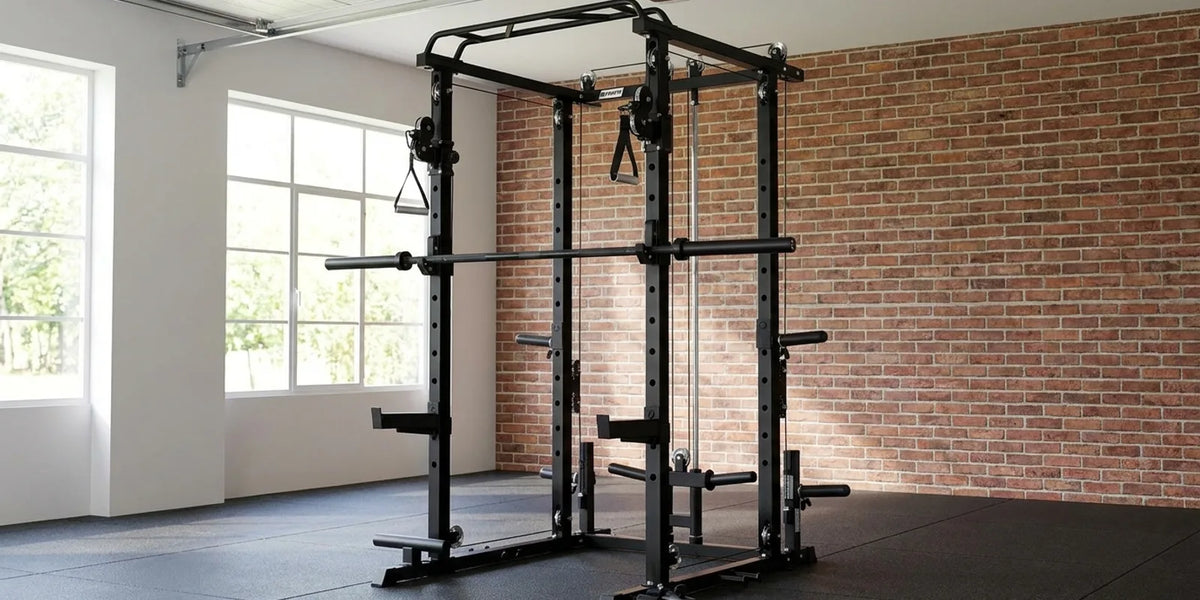
Jammer arms are lever-style attachments that clamp onto a power rack upright and pivot on rollers, turning a basic rack into a pressing, rowing, and explosive power station. This guide explains how they mount, what exercises they unlock, and how to confirm they fit your rack.
You will get a measurement checklist, a decision guide for who benefits most, common setup mistakes, and clear safety stop conditions so you can decide whether jammer arms belong in your home gym.
Table of Contents
- What Are Jammer Arms for a Power Rack?
- How Do Jammer Arms Mount and Move on the Rack?
- Which Exercises Can You Do With Jammer Arms?
- Who Should Add Jammer Arms?
- Will Jammer Arms Fit Your Power Rack?
- What Are the Common Mistakes and When Should You Stop?
- Are Jammer Arms Worth It Versus Other Attachments?
Key Takeaways
- What they are: Jammer arms are pivoting lever attachments that bolt to a rack upright and simulate machine-style pressing and rowing.
- Fitment first: Check upright tube size, hole diameter, and hole spacing before buying, since most designs are brand and profile specific.
- Best uses: Standing presses, Viking presses, explosive push presses, single-arm work, and rows that build upper-body power.
- Who benefits: Lifters wanting explosive and athletic pressing without buying standalone machines for a home gym.
- Safety: Lock the clamp fully, engage the safety pin, start light, and stop if the arm shifts or joints hurt.
What Are Jammer Arms for a Power Rack?
Jammer arms are lever-style attachments that clamp to a power rack upright and pivot up and down on rollers, letting you press or row a loaded arm through a fixed arc. They convert a static rack into a machine-like station for pushing and pulling movements without separate equipment.
- Lever design: A long steel arm rides on roller plates that travel along the upright, with a weight horn at one end for plates.
- Versus spotter arms: Spotter arms are fixed horizontal catches for the barbell, while jammer arms move and are loaded for pressing.
- Versus J-cups: J-cups simply hold a resting barbell, whereas jammer arms are the moving resistance itself.
Browse compatible hardware through the RitFit rack attachments collection to see how these pieces extend a rack.
How Do Jammer Arms Mount and Move on the Rack?
Jammer arms mount by clamping a roller carriage around a single upright and locking it with a pin or bolt, so the arm pivots while the carriage slides vertically for height adjustment. Once set, the arm follows a guided arc as you press or row.
- Clamp and rollers: Plastic-coated rollers grip the post so the unit glides without scratching, then a locking pin fixes the working height.
- Loading: Plates slide onto a weight horn, usually rated to a set maximum, so resistance scales like a plate-loaded machine.
- Single upright: Many jammer arms attach to one post and work unilaterally, which adds a core and anti-rotation demand.
Pair the attachment with a sturdy frame like the M3 Power Rack with cable crossover for a stable mounting surface.
Which Exercises Can You Do With Jammer Arms?
Jammer arms support standing presses, Viking presses, explosive push presses, single-arm presses, and rowing movements. Because the arm follows a fixed arc, you can drive load explosively and train pressing patterns that are hard to load safely with free weights alone.
Use them to extend the movement library you already build inside a rack, as covered in our guide to power rack exercises.
Standing Jammer and Viking Press
The standing jammer or Viking press drives the loaded arm up and forward from chest height, building shoulders, triceps, and upper chest while your legs and core stabilize the effort.
Explosive Push Press and Throws
The fixed arc makes jammer arms well suited to explosive push presses where you generate force from the legs and finish through the arms.
- Power focus: In one 8-week trial of bench-press throws against constant, inertial, and combined loads, average power rose about 26.3% and maximum power about 25.2%, larger than the roughly 7.2% gain in 1RM strength, and the gains were resistance specific.[1]
- Technique: Start light, move with speed, and control the arm rather than chasing maximum plates.
"Start light. You're not grinding here; you're moving with speed and precision. This is about explosive movements and control, not max bar weight."
Jeff Cavaliere, MSPT, CSCS, Athlean-X, Athlean-X
Single-Arm Press and Rows
Single-arm jammer work loads one side at a time, forcing your core to resist rotation while you press or row through the guided path.
- Balanced training: One study found that both unstable and traditional resistance training improved strength and power with no significant difference between conditions in untrained men, so controlled guided work still builds capacity.[2]
- Carryover: Unilateral pressing helps address side-to-side imbalances common with two-arm barbell lifts.
Who Should Add Jammer Arms?
Jammer arms suit home and garage lifters who want explosive pressing and machine-style movements without buying standalone machines. They reward those training for athletic power and pressing variety more than lifters focused only on barbell squat and bench.
- Power and athletic goals: Choose jammer arms if you want explosive push press and Viking press work in a compact footprint.
- Variety seekers: A systematic review and meta-analysis found that advanced resistance training systems can be used effectively without compromising hypertrophy and may offer a moderate advantage for maximal strength.[3]
- Skip if minimal: If you only train the main barbell lifts, simpler add-ons may serve you better first.
If you are still choosing a frame, compare options in our best all-in-one power rack guide or a budget power rack with pulley system.
Will Jammer Arms Fit Your Power Rack?
Jammer arms fit only racks that match their clamp size, so you must measure your upright before buying. Confirm the tube profile, the hole diameter, and the hole spacing, because most designs are made for a specific rack family.
- Measure the upright: Common profiles are 2x2, 2x3, and 3x3 inch tubing, so measure the outside width of one post.
- Check hole size: Hardware is typically 5/8 inch or 1 inch, so the clamp pin must match your rack holes.
- Confirm hole spacing: Westside 1 inch spacing differs from 2 inch spacing, which affects clamp seating and height steps.
- Verify brand fit: Brand-specific arms may only fit that brand, so confirm compatibility before ordering.
If you are unsure whether you own a full cage, our power rack vs squat rack guide helps you identify the rack type and its attachment options.
What Are the Common Mistakes and When Should You Stop?
The most common mistakes are loading too heavy too soon and failing to lock the clamp fully. Set up carefully, brace your core, and treat the safety pin and load rating as non-negotiable limits.
- Skipping the lock check: Always confirm the clamp pin and safety pin are fully engaged before loading any plates.
- Going too heavy: Start with light plates to learn the arc, then add load only when the movement stays controlled.
- Ignoring the rating: Keep total load within the weight horn rating to protect the attachment and the post.
- Poor bracing: Set your feet, brace your core, and avoid leaning into the arm with a rounded back.
Stop immediately if: the attachment shifts on the upright, you feel sharp shoulder or elbow pain, or the arm path feels unstable under load. For movement ideas done safely, see our power rack exercise posters.
Are Jammer Arms Worth It Versus Other Attachments?
Jammer arms are worth it if explosive pressing and machine-style movements matter to your training, since they unlock pressing, rowing, and power work in one piece. They cost more than simple add-ons, so weigh that against how often you will press explosively.
| Attachment | Main use | Best for |
|---|---|---|
| Jammer arms | Explosive press, Viking press, rows | Athletic power and pressing variety |
| Dip bars | Bodyweight dips | Simple low-cost chest and triceps work |
| Cable pulley | Lat pulldown, rows, push downs | Constant-tension isolation |
Compare more options in our roundup of the best power rack attachments, or browse complete kits in the power rack package and racks packages collections.
FAQs About Jammer Arms for a Power Rack
What are jammer arms for a power rack?
Jammer arms are lever-style attachments that clamp onto a power rack upright and pivot up and down on rollers. You load a weight horn on one end and press or row the other, simulating machine movements like a Viking press. They turn a basic rack into a versatile pressing and pushing station.
Do jammer arms fit any power rack?
No. Jammer arms are sized for specific upright profiles, usually 2x2, 2x3, or 3x3 inch tubing, and a matching hole diameter such as 5/8 or 1 inch. Measure your upright width, hole spacing, and hardware size before buying. Brand-specific designs may only fit that brand rack, so confirm compatibility first.
What exercises can you do with jammer arms?
Jammer arms support standing presses, Viking presses, explosive push presses, single-arm presses, and rowing movements. Because the arm follows a fixed arc, you can press explosively and even use a controlled release at the top. They are popular for building upper-body power, core stability, and athletic pressing patterns in a home gym.
Are jammer arms worth it compared to other rack attachments?
If you want explosive pressing and machine-style movements without buying separate equipment, jammer arms add strong value. They cost more than simple attachments like dip bars but unlock pressing, rowing, and power work. For lifters focused only on barbell squats and bench, simpler attachments may be a better first purchase.
Are jammer arms safe to use at home?
Yes, when set up correctly. Make sure the clamp is fully locked on the upright, the safety pin is engaged, and the weight horn load stays within the rated limit. Start with light weight to learn the arc, keep your core braced, and stop immediately if you feel joint pain or the attachment shifts on the post.
Conclusion
Jammer arms turn a static power rack into a pressing and power station that supports Viking presses, explosive push presses, and single-arm work. Measure your upright and confirm fitment before you buy.
Start light, lock every clamp, and add load only when the arc stays controlled. If explosive and athletic pressing fits your goals, jammer arms are a strong addition to a home rack.
Disclaimer
This article is for general educational purposes only and does not replace professional fitness, medical, or equipment-safety advice. Consult a qualified trainer or healthcare provider and follow the manufacturer instructions before using any rack attachment.
References
1. Đurić S, Knezevic OM, Sember V, et al. Effects of Resistance Training With Constant, Inertial, and Combined Loads on Muscle Power and Strength Output. Frontiers in Physiology. 2021;12:709263. https://pmc.ncbi.nlm.nih.gov/articles/PMC8656280/
2. Maté-Muñoz JL, Monroy AJ, Jodra Jiménez P, Garnacho-Castaño MV. Effects of instability versus traditional resistance training on strength, power and velocity in untrained men. Journal of Sports Science and Medicine. 2014;13(3):460-8. https://pmc.ncbi.nlm.nih.gov/articles/PMC4126279/
3. Tsartsapakis I, Zafeiroudi A, Kouthouris C. Effects of Advanced Resistance Training Systems on Muscle Hypertrophy and Strength in Recreationally Trained Adults: A Systematic Review and Meta-Analysis. Journal of Functional Morphology and Kinesiology. 2026;11(1). https://pmc.ncbi.nlm.nih.gov/articles/PMC12922048/





