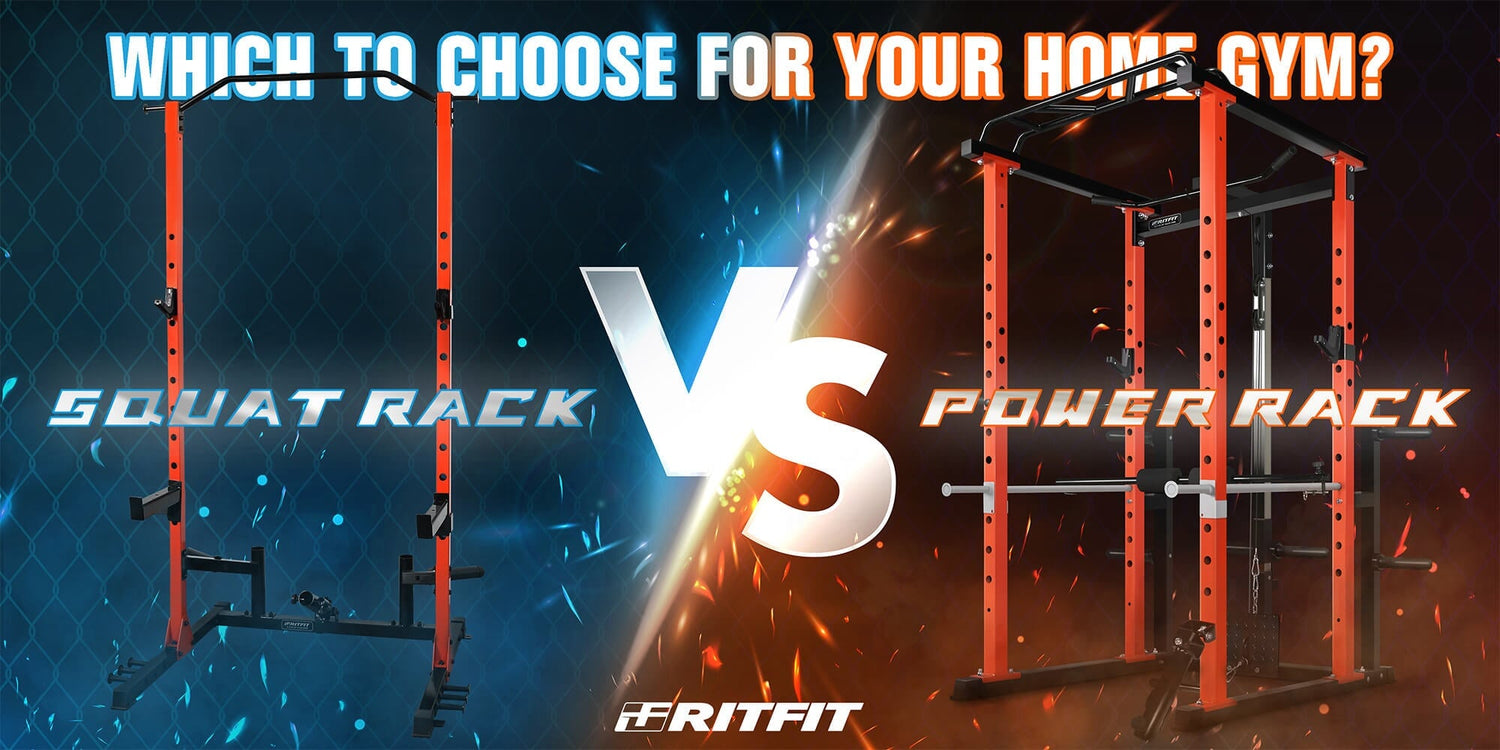
A power rack is the safer, more versatile choice for most home gym owners who lift alone, train heavy, or plan to expand their setup. A squat rack is still the smarter pick when floor space, ceiling height, or budget is limited and your main lifts are squats, presses, and bench work.
This guide compares power racks and squat racks across safety, space, price, stability, durability, and attachment compatibility, then gives a simple decision rule so you can choose the right rack for your home gym.
Quick Answer: Choose a power rack if you lift alone, want enclosed safety bars for failed reps, and expect to add pull ups, dips, or attachments later. Choose a squat rack when your space and budget are tight and training is mostly squats, presses, and basic barbell work, because most home gym owners benefit more from a power rack.
Key Takeaways
- Best overall choice: A power rack usually wins for home gym owners who train alone and want stronger safety coverage plus more exercise variety.
- Best compact choice: A squat rack fits small spaces and tighter budgets when your main lifts are squats, presses, and simple barbell work.
- Best for solo lifting: Enclosed safety bars and spotter arms in a power rack protect failed squats and bench presses better than an open stand.
- Best long term value: A power rack can grow into pull ups, dips, landmine work, cable attachments, and plate storage over time.
- Best decision rule: Pick a squat rack for simple training, and pick a power rack when you want a safer all in one strength station.
What Is a Power Rack?
A power rack, also called a full rack or power cage, is a four post steel frame that supports barbell exercises inside a controlled lifting area. Most models include adjustable J hooks, safety bars, and a pull up bar.
The main advantage of a power rack is safety coverage. Adjustable safety bars or spotter arms can catch the bar if a lift fails, which matters most for home gym users who train without a spotter.
Power racks also offer more upgrade potential than most squat racks. Many models support dip bars, landmine attachments, plate storage, cable systems, and other rack attachments.
For a compact option that still gives a full cage, consider the RitFit Power Cage with its integrated pull up bar and safety system.
What Is a Squat Rack?
A squat rack, also called a squat stand, is a compact open frame that holds a barbell at adjustable heights for squats, presses, and bench work. It uses less floor space and usually costs less than a full power cage.
The main advantage of a squat rack is simplicity. It is easier to move, cheaper to buy, and fits smaller rooms than most full racks.
A squat rack can still be safe when it has a stable base and compatible spotter arms. However, it offers fewer enclosed safety points than a cage, so setup quality matters more.
If you are weighing floor plans, the squat rack dimensions guide helps you compare footprints before you buy.
How Do a Power Rack and a Squat Rack Compare?
The biggest difference is that a power rack forms an enclosed lifting station with more safety points, while a squat rack is a more open and compact barbell stand. Your best choice depends on how heavy you lift, how much space you have, and whether you train alone.
| Factor | Power Rack | Squat Rack |
|---|---|---|
| Safety | Full cage and safety bars give more protection | Depends on spotter arms and base quality |
| Space | Needs more floor space and ceiling clearance | More compact and easier to place |
| Training variety | Squats, bench, pull ups, dips, attachments | Best for squats, presses, basic barbell work |
| Budget | Higher upfront cost | Usually more affordable |
| Stability | Wider frame and four post base | Stable when base is wide or anchored |
| Long term value | Better for attachments and full systems | Better for simple setups |
Comparison reflects typical home gym models. Always check the product page for exact dimensions, weight capacity, and attachment compatibility.
Which Rack Is Safer for Solo Lifting?
A power rack is usually safer for solo lifting because enclosed safety bars can catch a failed squat or bench press at a set height. A squat rack can still be safe with compatible spotter arms, but it offers fewer enclosed safety points.
Resistance training safety depends on more than the rack alone. A systematic review found that training method, exercise selection, and proper setup all influence injury risk, so the rack you choose should give reliable protection for failed lifts.[1]
Set the safeties before your working sets whenever you train alone. The bar should clear your body in a failed bench press and stop below your deepest controlled squat position.
Which Rack Is Better for Strength and Training Variety?
Both rack types build strength when you train consistently with progressive overload, because the rack itself does not add load. A systematic review found no clear direct difference in strength, hypertrophy, and jump performance between free weight and machine based training when programs were matched.[2]
A power rack does not automatically make training better. It simply gives more safety options, more setup flexibility, and more room for progressive barbell training.
A power rack usually supports more exercises because it works as a squat station, bench station, pull up station, and attachment base. A squat rack is better for lifters who mainly want squats, presses, and simple barbell training.
"The squat and bench press are the two lifts most people care about most, and they both require a rack. If you want to get strong, you need a rack."
Greg Nuckols, MA, Strength Researcher and Coach, Stronger By Science
Who Should Buy a Power Rack?
Buy a power rack if you train alone, lift heavy, want pull ups and dips, or plan to add attachments over time. It is the better long term strength station for most home gym owners.
- Solo lifters: Choose a power rack if you bench press or squat without a spotter.
- Heavy lifters: Choose a power rack if failed reps are a realistic part of your training.
- Full body users: Choose a power rack if you want pull ups, dips, rows, presses, and attachment based movements.
- Upgrade focused buyers: Choose a power rack if you want to build around power rack packages and compatible accessories.
For a stronger base with cable training potential, the RitFit P3 1200lbs Power Cage is a popular starting point. See the power rack exercises guide for full body movement ideas.
Power Rack Pros and Cons
- Pros: Stronger safety coverage, better solo bench and squat protection, more attachments, includes a pull up bar.
- Cons: Higher upfront cost, needs more floor space and ceiling clearance, harder to move once assembled.
Who Should Buy a Squat Rack?
Buy a squat rack if your space and budget are limited and your main lifts are squats, presses, and basic barbell work. It is the lighter, cheaper, easier to move option for a home gym.
- Small space users: Choose a squat rack if your home gym is in a compact garage, apartment, or shared room.
- Budget focused buyers: Choose a squat rack if you want the lowest practical entry point for barbell training.
- Basic barbell lifters: Choose a squat rack if you do not need pull ups, dips, cable work, or major attachments.
- Flexible layout users: Choose a squat rack if you need equipment that is easier to reposition or store.
A compact option like the RitFit Multi Functional Folding Squat Rack PMW02 works well when space efficiency matters. Check the best squat rack for small spaces guide for more layout ideas.
Squat Rack Pros and Cons
- Pros: Smaller footprint, lower cost, simple setup, easier to move and store.
- Cons: Fewer enclosed safety points, less attachment compatibility, may feel less stable on heavy lifts if the base is narrow.
How Do You Choose the Right Rack for Your Home Gym?
Choose the rack that fits your safety needs first, then compare space, budget, and future upgrades. A rack is the center of your strength setup, not just a place to hold a barbell.
- Measure your room: Check floor space, ceiling height, walking clearance, and plate loading space before comparing models.
- Define your main lifts: Choose based on the exercises you actually perform most often, not the longest feature list.
- Plan for failed reps: Heavy squats and bench presses need reliable safeties, especially when you train alone.
- Compare setup and fit: Read the how to use a squat rack guide and the Smith machine vs power rack comparison before you decide.
Safety Notes for Squats and Bench Presses
A biomechanical review of the squat found that technique, stance, depth, trunk position, and load management influence joint demands, which makes setup and safety planning important for every rack type.[3]
Bench press setup also matters because grip width, elbow position, and bar path can change shoulder loading. A study found that bench press technique variations can affect musculoskeletal shoulder load and potential injury risk, so use controlled form and suitable safeties.[4]
If you train alone, set the safeties before your working sets. The bar should clear your body in a failed bench press and stop below your deepest controlled squat position.
Power Rack or Squat Rack: Final Buying Rule
Choose a power rack if safety, versatility, and future upgrades matter more than saving space. Choose a squat rack if compact size, lower cost, and simple barbell training matter more than full cage protection.
FAQs About Power Rack vs Squat Rack
Is a power rack safer than a squat rack?
Yes.
A power rack is usually safer because the full cage gives you more safety points for failed squats and bench presses.
A squat rack can still be safe when it has strong spotter arms, proper bar height, stable footing, and careful loading.
Set your safeties before working sets when you lift without a spotter.
Can you bench press in a squat rack?
Yes.
You can bench press in many squat racks if the J hooks adjust low enough and the rack supports spotter arms.
For heavy solo bench pressing, a full power rack is usually safer because it gives more controlled protection around the bar path.
Which is better for a small home gym, power rack or squat rack?
A squat rack is usually better for a small home gym because it needs less floor space and is easier to move. A power rack can still work in compact spaces if you have enough ceiling height and want one station for squats, bench press, pull ups, and attachments.
Should beginners buy a power rack or squat rack?
Beginners should buy a power rack if they train alone and want more safety while learning barbell lifts. A squat rack is a good beginner choice when the goal is simple training, lighter loads, lower cost, and a compact setup with proper spotter arms.
Does a power rack need to be bolted down?
No. Not every power rack needs to be bolted down, but anchoring can improve stability for heavy lifts, pull ups, and attachment work. Always follow the product manual, load rating, and floor recommendations, especially if the rack is light or used with dynamic movements.
What exercises can you do with a power rack?
A power rack can support squats, bench presses, overhead presses, rack pulls, pull ups, rows, dips, and landmine work. With compatible attachments, it can also support cable rows, lat pulldowns, banded movements, and more complete full body strength training sessions.
How much floor space does a power rack need?
A power rack usually needs more floor space than a squat rack, with room for plate loading and walking clearance on every side.
Check ceiling height as well, because pull ups and overhead presses need clearance above the frame.
Measure your room before you buy.
Conclusion
For most home gym owners, a power rack is the better long term choice because it offers stronger safety coverage, better stability, and more upgrade potential. A squat rack still makes sense if your space or budget is limited and your main goal is simple barbell training.
If you lift alone, plan to bench press heavy, or want pull ups and attachments, choose a power rack first. Start with the rack that matches your current space and safety needs, and visit RitFit sales to compare bundles for your setup.
Disclaimer
This article is for general fitness equipment education only and does not replace advice from a certified trainer, medical professional, or product manual. Always follow the manufacturer instructions, inspect rack hardware before lifting, use proper safeties, and choose loads that match your experience, technique, and training environment.
References
1. Serafim TT, de Oliveira ES, Maffulli N, Migliorini F, Okubo R. Which resistance training is safest to practice? A systematic review. J Orthop Surg Res. 2023;18(1):296. doi:10.1186/s13018-023-03781-x. PMCID: PMC10099898
2. Haugen ME, Vårvik FT, Larsen S, Haugen AS, van den Tillaar R, Bjørnsen T. Effect of free-weight vs. machine-based strength training on maximal strength, hypertrophy and jump performance - a systematic review and meta-analysis. BMC Sports Sci Med Rehabil. 2023;15(1):103. doi:10.1186/s13102-023-00713-4. PMCID: PMC10426227
3. Straub RK, Powers CM. A Biomechanical Review of the Squat Exercise: Implications for Clinical Practice. Int J Sports Phys Ther. 2024;19(4):490-501. doi:10.26603/001c.94600. PMCID: PMC10987311
4. Noteboom L, Belli I, Hoozemans MJM, Seth A, Veeger HEJ, Van Der Helm FCT. Effects of bench press technique variations on musculoskeletal shoulder loads and potential injury risk. Front Physiol. 2024;15:1393235. doi:10.3389/fphys.2024.1393235. PMCID: PMC11224528