








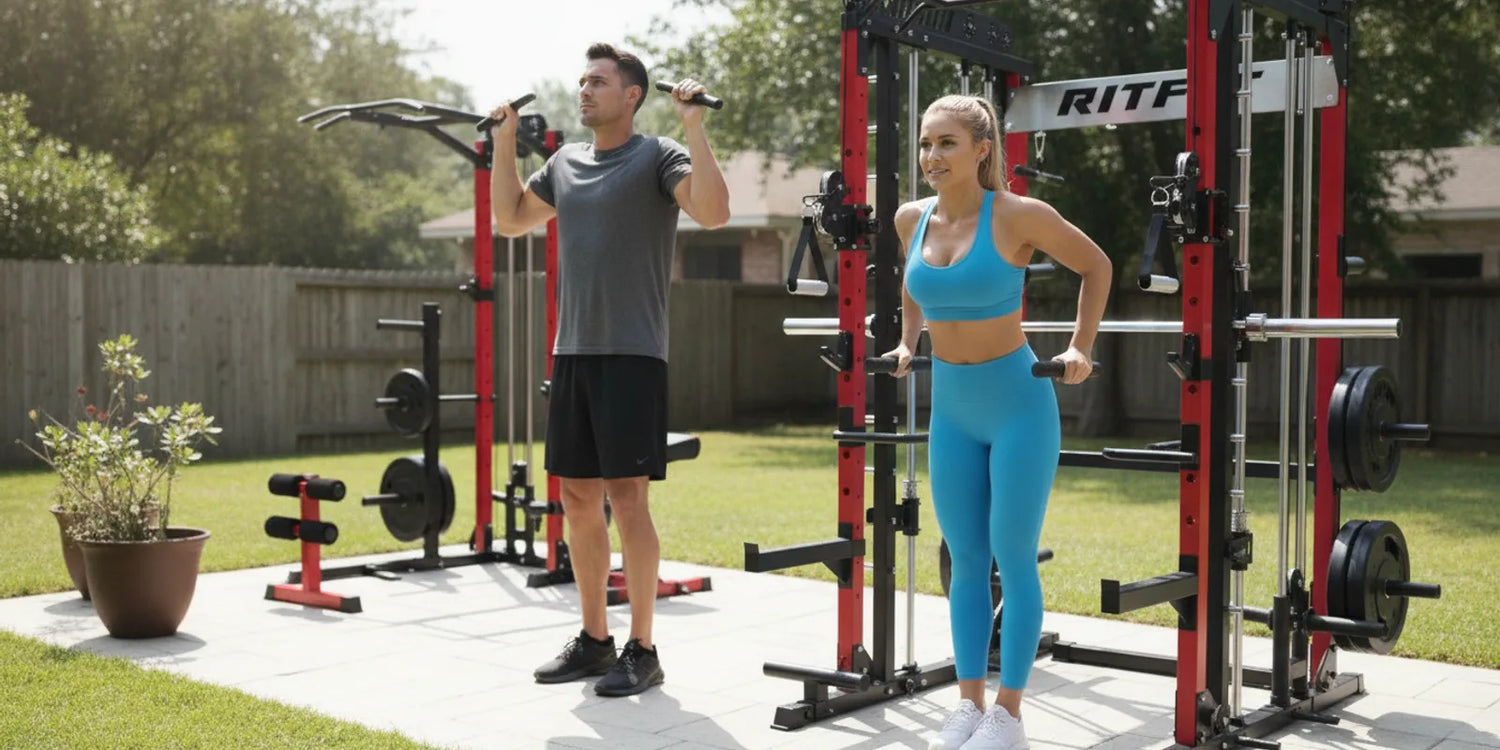
Setting up outdoor gym equipment for home gives you a permanent training space in your own backyard, with fresh air, no gym fees, and the freedom to train on your schedule. The right equipment, materials, and weatherproofing strategy determine whether your setup lasts a season or a decade.
This guide covers everything homeowners need to choose durable outdoor gym equipment, plan their space, protect it from the elements, and build out a setup from a budget starter kit to a full-strength training system.
Quick Answer: The best outdoor gym equipment for home starts with a weather-resistant power rack or squat stand, rubber-coated weight plates, a pull-up bar, and kettlebells. Choose powder-coated steel frames and lay rubber tiles or rooftop pavers as flooring, and a basic setup fits in roughly 10 by 10 feet for year-round strength and conditioning training.
Key Takeaways
- Start with weather-resistant basics: A powder-coated power rack, rubber-coated plates, and a pull-up bar cover the majority of strength and conditioning needs outdoors.
- Space planning is critical: A minimalist outdoor gym fits in roughly 6 by 6 feet, while a full strength setup needs at least 10 by 10 feet with additional clearance around each piece of equipment.
- Flooring prevents equipment damage: Interlocking rubber tiles or 2-inch rubber rooftop pavers are the most durable outdoor gym flooring options, draining water and resisting UV degradation.
- Commercial-grade materials last outdoors: Equipment with powder-coated steel frames, stainless steel hardware, and sealed bearing systems significantly outlasts consumer-grade alternatives in outdoor environments.
- Outdoor resistance training produces real gains: A 2024 randomized controlled trial found that 8 weeks of twice-weekly outdoor resistance training significantly improved lean mass and muscle strength in middle-aged adults.[2]
Why Set Up Outdoor Gym Equipment at Home?
Outdoor gym equipment for home lets you train in your own backyard, year-round, without gym memberships or travel time. A systematic review found outdoor gyms serve as an effective environmental strategy for promoting physical activity across diverse population groups.[1]
A 2024 randomized controlled trial confirmed that 8 weeks of twice-weekly resistance training using outdoor fitness equipment significantly improved lean mass and maximal muscle strength in middle-aged and older adults.[2]
- No membership fees: A one-time equipment investment replaces ongoing gym costs, typically paying for itself within one to two years for regular trainers.
- Train on your schedule: No wait times, no open hours, no commute. Your outdoor gym is available at 6 a.m. or 9 p.m. regardless of the season.
- Fresh air and natural light: Outdoor training environments have been linked to improved mood and motivation compared to indoor settings, making it easier to stay consistent.
- Full customization: You choose the equipment, layout, and training zones based on your goals, whether that is heavy strength work, conditioning circuits, or mobility-focused sessions.
- Expandable over time: Starting with a power rack and barbell gives you a solid foundation that you can extend with additional equipment as your training evolves and your budget allows.
As Jeff Cavaliere, MSPT, CSCS, explains, taking workouts outdoors is a powerful way to break training plateaus and keep athletes engaged with their programs. Read our complete guide to home gym equipment for beginners if you are still deciding between an indoor and outdoor setup.
How Much Space Do You Need for an Outdoor Home Gym?
An outdoor home gym requires a minimum of around 6 by 6 feet for a minimalist setup and at least 10 by 10 feet for a full strength training station with a power rack, bench, and barbell. Budget an extra 2-3 feet of clearance on each side of your heaviest piece to ensure safe, unrestricted movement around the equipment.
- Minimalist setup (around 6x6 ft): Kettlebells, resistance bands, a jump rope, and a pull-up bar. Sufficient for conditioning, mobility, and bodyweight strength work. Stores easily under a cover or in a small bin when not in use.
- Standard strength setup (around 10x10 ft): A power rack or squat stand, an adjustable bench, a barbell, and rubber weight plates. Covers compound movements including squats, presses, deadlifts, and pull-ups.
- Full multi-functional system (around 12x15 ft or larger): Adds a cable crossover system, dip station, conditioning tools like battle ropes, and dedicated stretching space. Suitable for serious strength athletes training five or more days per week.
- Surface level matters: Choose a flat, stable area. Slight slopes allow water drainage but anything over 2 degrees of grade can affect barbell stability and equipment anchoring.
- Zoning and permits: Check local zoning ordinances before installing permanent structures like concrete pads or overhead shade structures. Freestanding equipment on rubber flooring typically does not require a permit.
- Sun and shade orientation: Position your gym to avoid direct sun during peak training hours. East-facing setups get morning sun and afternoon shade, which works well for most climates.
Watch how one enthusiast planned and built a dedicated backyard gym shed to maximize space and equipment density:
What Is the Best Outdoor Gym Equipment for Home, by Goal?
The best outdoor gym equipment for home depends on your primary training goal, whether that is building strength, improving conditioning, or both. One study found outdoor fitness equipment improved cardiorespiratory endurance with 5-day-per-week training and muscle strength with 2-day-per-week sessions.[3]
Strength Training Foundation
A power rack or squat stand is the backbone of any outdoor strength setup, enabling squats, presses, rows, and pull-ups from a single piece of equipment.
- Power rack or squat stand: Choose one with powder-coated steel uprights, adjustable J-hooks, and integrated pull-up bars. Anchor bolts are recommended for permanent outdoor installation on concrete. Review the differences in our power rack vs squat rack comparison.
- Olympic barbell: Stainless steel barbells require virtually no maintenance outdoors. Standard chrome barbells will pit and rust within one season of regular outdoor exposure.
- Rubber-coated or bumper plates: Rubber-coated plates resist moisture, UV damage, and temperature fluctuations better than bare iron. Store plates on a vertical tree rack to keep them off the ground and prevent flat-spot damage.
- Adjustable bench: Look for commercial-grade benches with powder-coated frames and vinyl or synthetic upholstery that resists moisture. A multi-angle adjustable bench adds incline, flat, and decline pressing without requiring multiple pieces.
Upper Body and Bodyweight
Pull-up bars and dip stations require minimal space, need no weight loading, and handle outdoor exposure well when built from galvanized or powder-coated steel.
- Pull-up bar: Wall-mounted or freestanding pull-up bars support pull-ups, chin-ups, hanging leg raises, and ring-based training. Freestanding units can move with your layout as your gym expands.
- Dip station: Parallel dip bars target triceps, chest, and shoulders and double as push-up support handles for bodyweight progressions.
- Gymnastic rings: Rings attach to any overhead bar and add push-ups, rows, dips, and ring muscle-ups. They store in a bag and tolerate outdoor weather without any special maintenance.
Conditioning and Cardio
Conditioning tools are compact, weather-resistant, and versatile, making them ideal additions to any outdoor setup regardless of budget or space.
- Kettlebells: Cast iron kettlebells with protective powder coating handle outdoor use well. A set of 3-5 weights covers swings, presses, carries, and Turkish get-ups for full-body conditioning.
- Jump rope: A jump rope is the most space-efficient cardio tool available for an outdoor gym. High-intensity jump rope intervals deliver a strong cardiovascular training effect in under 15 minutes.
- Battle ropes: Anchor battle ropes to a post, tree, or rack base. They require no special weatherproofing beyond coiling and storing under a cover between sessions.
- Resistance bands: Latex or fabric resistance bands are lightweight, portable, and useful for warm-ups, accessory work, and assistance training on pull-ups and dips.
Flexibility and Recovery
Recovery tools complete the outdoor gym setup without requiring significant space or special weatherproofing.
- Outdoor yoga mat: A thick rubber or cork yoga mat provides cushioning for stretching, mobility work, and floor-based core training. Store flat under the rack or rolled up in a weatherproof bin.
- Foam roller: A high-density foam roller supports muscle recovery and myofascial release after strength sessions. Keep it stored in a covered bin to prevent UV degradation of the foam.
For a focused look at getting started without overspending, explore our guide to minimum home gym equipment essentials or our list of the best home gym equipment under $500.
Which RitFit Equipment Works Best Outdoors?
RitFit builds its strength equipment with commercial-grade powder-coated steel and heavy-duty hardware that holds up well in outdoor environments. The table below shows how to match your budget and training goals to the right RitFit setup tier.
| Budget Tier | Recommended Equipment | Material Notes | Weatherproofing Priority |
|---|---|---|---|
| Starter ($500-$1,000) | Pull-up bar, dip station, kettlebells (2-3 sizes), resistance bands, jump rope | All-weather cast iron, rubber-coated | Store indoors or under weatherproof cover when not in use |
| Mid-range ($1,000-$2,000) | RitFit P3 Power Cage Home Gym Package with adjustable bench and rubber bumper plates | Powder-coated steel frame, rubber-coated plates | Equipment cover for cage frame, plates stored on tree rack |
| Full Build ($2,000+) | RitFit multi-functional system with cable crossover, full plate set, and conditioning tools | Commercial-grade powder-coated steel, sealed bearings | Pergola or shade structure, marine-grade covers for cable system |
Equipment tiers are illustrative planning guides based on typical budget ranges. Actual prices vary by configuration and promotion.
- Starter tier: The best entry point for outdoor training combines bodyweight stations with free weights. A pull-up bar and a set of three to five kettlebells cover strength, conditioning, and mobility with minimal weatherproofing requirements.
- Mid-range tier: The RitFit P3 Power Cage is built with a 1,200 lb weight capacity and a powder-coated steel frame that handles outdoor use with proper covering. Pair it with rubber bumper plates and an adjustable bench for a full compound strength setup. See our best all-in-one power rack guide for a detailed breakdown of configurations.
- Full build tier: A multi-functional cable system adds rows, lat pulldowns, tricep pushdowns, and cable flyes to your outdoor setup. Cable systems require more weatherproofing attention, particularly for the cable housing and pulleys. Budget for a marine-grade cover and an overhead shade structure to protect the investment long-term.
- Upgradability: RitFit's modular design means you can start with a power cage and add cable attachments, plate storage, and accessory bars over time without replacing the core frame. This makes the mid-range tier a smart anchor investment for a growing outdoor gym.
For specific budget-to-gear recommendations, see our guide to what equipment you need for a home gym.
How Do You Choose Weather-Resistant Outdoor Gym Equipment?
Weather-resistant outdoor gym equipment requires powder-coated steel frames, stainless steel hardware, and sealed or maintenance-free bearing systems. Industry installation guides consistently recommend commercial-grade equipment for outdoor setups, noting that the cost premium is offset by dramatically longer lifespan compared to consumer-grade alternatives.
- Powder-coated steel frames: Powder coating creates a thick, durable barrier against moisture and oxidation. Look for multi-stage coating processes on racks and cable systems rather than single-coat spray-on finishes.
- Stainless steel hardware: Bolts, nuts, and J-hook pins in stainless steel resist rust and corrosion indefinitely. Zinc-plated or standard steel hardware will corrode within one to two outdoor seasons in humid climates.
- Galvanized metal components: Galvanized steel adds a zinc-bonded protective layer ideal for pull-up bars and dip stations that see direct weather exposure without covers.
- Rubber-coated weight plates: Rubber coating protects the plate surface and prevents moisture from seeping into the iron core. Bare iron plates rust within weeks of outdoor exposure in high-humidity regions.
- Marine-grade or synthetic upholstery: Bench pads and seat cushions made from marine-grade vinyl resist UV fading, moisture absorption, and mildew growth. Standard vinyl upholstery deteriorates within one season outdoors.
- Sealed bearing systems: Cable pulleys and barbell sleeves with sealed or shielded bearings keep moisture and grit out of the bearing races. Open bearing systems require frequent regreasing outdoors.
What to Avoid
Chrome finishes, open bearing systems, and standard cardio machines deteriorate quickly in outdoor conditions and are not worth the investment for permanent outdoor setups.
- Chrome-plated surfaces: Chrome oxidizes and pits under repeated moisture exposure. It looks clean indoors but fails outdoors within one to two seasons.
- Standard consumer treadmills or ellipticals: Consumer-grade cardio machines are not rated for outdoor use. Electronics, drive belts, and bearing systems corrode and fail quickly without climate-controlled storage.
- Unsealed cable systems: Cable housing, pulleys, and ferrules on consumer-grade cable machines are not designed to handle rain or humidity without frequent maintenance cycles.
For more on choosing a capable strength foundation for your outdoor setup, visit the RitFit Home Gym Guide for complete configuration recommendations.
What Flooring Is Best for an Outdoor Home Gym?
Rubber tiles and rubber rooftop pavers are the most practical outdoor gym flooring options, absorbing impact and draining water efficiently while resisting UV degradation. Fitness installation guides recommend 2-inch rubber rooftop pavers as the most durable flooring choice for setups that include heavy equipment like power racks and barbells.
- Interlocking rubber tiles: Affordable, modular, and easy to install on existing concrete, pavers, or compacted gravel. Available in 3/4-inch and 1-inch thickness for different impact protection levels. Clean with a hose and mild soap.
- 2-inch rubber rooftop pavers: The most durable outdoor gym flooring option. Thick enough to absorb barbell drops and heavy equipment weight. Drain water through gaps and resist UV and temperature extremes better than thinner tiles.
- Artificial turf: Ideal for agility drills, sled pushes, bodyweight circuits, and mobility work. Provides a softer training surface and a cleaner aesthetic for residential backyards. Install with a drainage base layer to prevent moisture buildup underneath.
- Concrete pads: Permanent, maximally stable, and the best anchor base for bolting down heavy power racks. A 4-inch concrete pad poured over a gravel drainage base is the standard foundation for serious outdoor strength setups. Layer rubber tiles or mats on top for impact absorption.
- Gravel or wood chips: Budget-friendly and naturally draining. Suitable for bodyweight-only setups or as a base layer under rubber mats. Not recommended as the sole surface under heavy equipment because of stability concerns.
If you are planning a small backyard or patio setup, our guide to small home gym equipment essentials covers compact flooring and layout options.
How Do You Weatherproof and Maintain an Outdoor Home Gym?
Weatherproofing an outdoor home gym involves using equipment covers, providing shade or shelter, and completing a brief annual maintenance routine. These steps protect your investment year-round without requiring daily effort or special equipment.
Equipment Covers
Marine-grade vinyl covers provide the best protection against moisture and UV damage for racks, benches, and cable systems.
- Custom-fitted rack covers: Fitted covers for power cages and squat racks shield uprights, J-hooks, and crossmembers from direct rain. Most outdoor-rated covers include venting panels to prevent moisture buildup underneath.
- Bench covers: Waterproof bench pad covers protect vinyl upholstery from UV fading, bird droppings, and moisture saturation. Pull the cover on after every session for maximum protection.
- Plate storage off the ground: Store rubber plates on a vertical storage tree rather than flat on the ground. Plates left flat on soil or wet concrete accumulate moisture on the iron core, accelerating rust even through rubber coating.
Shade and Shelter
A pergola, shade sail, or retractable awning extends usable workout hours and reduces direct UV exposure on equipment surfaces and upholstery.
- Shade sails: The lowest-cost shade solution. UV-blocking shade sails mount on posts or existing structures and reduce equipment surface temperatures by 15-20 degrees Fahrenheit in direct summer sun.
- Pergola with roof panels: Provides partial rain protection and more permanent shade than a sail. Allows airflow while blocking direct rain in light to moderate precipitation.
- Retractable awnings: Offer full weather protection when extended and fold away completely when not needed. Best for setups adjacent to the house with an exterior wall available for mounting.
Annual Maintenance Routine
A once-a-year inspection and touch-up routine is all most commercial-grade outdoor gym equipment requires to stay in safe, rust-free condition.
- Inspect and tighten all bolts and J-hook pins: Outdoor temperature cycling and equipment vibration loosen hardware over time. Torque all structural bolts to spec once per year before the primary training season.
- Touch up coating chips: Apply cold galvanizing compound or rust-inhibiting spray to any spots where powder coating has chipped, before moisture reaches the underlying steel.
- Lubricate cable pulleys and barbell sleeves: Use a light machine oil or dry lubricant on pulley bearings and sleeve rotation points to prevent surface corrosion and maintain smooth rotation.
- Check rubber flooring stability: Inspect interlocking tile connections and reset any tiles that have shifted from equipment loading or temperature expansion.
"Something I love to do with my athletes to mix things up, and keep them on their toes, is take their workouts OUTDOORS."
Jeff Cavaliere, MSPT, CSCS, Physical Therapist and Strength Coach, Athlean-X
What Are the Most Common Mistakes When Building an Outdoor Home Gym?
The most common mistakes when building an outdoor home gym are using indoor-rated equipment outdoors, skipping proper flooring and anchoring, and underestimating local climate demands on the equipment. Avoiding these errors from the start saves significant cost and frustration over time.
- Buying indoor equipment for outdoor use: Consumer-grade gym equipment with standard steel hardware, chrome finishes, and non-sealed bearings fails rapidly outdoors. The cost difference between commercial-grade and consumer-grade outdoor equipment is offset within one to two seasons by avoided replacement costs.
- Skipping flooring entirely: Training on bare soil or grass causes equipment legs to sink and shift under load. Bare concrete without rubber matting causes joint stress and makes barbell drops dangerous. Always lay rubber tiles or mats before setting up heavy equipment.
- Not anchoring heavy equipment: Freestanding power racks and squat stands can tip under heavy load or during barbell drops without floor anchoring. Follow the manufacturer's anchoring specifications precisely, especially for outdoor installations where there is no surrounding wall structure for lateral support.
- Ignoring local climate requirements: A coastal setup in a high-humidity salt-air environment requires marine-grade stainless steel hardware. A high-altitude setup with snow loading and freeze-thaw cycles requires different anchoring and covering strategies than a mild Southern California backyard.
- Overbuying equipment before establishing training habits: Start with a focused starter kit and add equipment after three to six months of consistent use. Buying a full commercial system upfront before confirming your outdoor training routine is practical is the most common money-wasting mistake.
- Not checking zoning requirements: Some local zoning codes restrict permanent outdoor structures, roofing, or anchored pads in residential yards. Check with your municipality before pouring a concrete pad or erecting a pergola over your gym.
For senior-specific equipment recommendations, our guide to best home gym equipment for seniors covers lower-impact options that also work well in outdoor setups.
FAQs About Outdoor Gym Equipment for Home
What is the best outdoor gym equipment for a small backyard?
For a small backyard, start with a pull-up bar, a set of kettlebells, and resistance bands, which take up minimal space and cover strength, conditioning, and mobility. If you have roughly 8 by 8 feet of level surface, a compact squat stand with a barbell and rubber bumper plates provides a full strength foundation without requiring a large footprint.
How do I protect outdoor gym equipment from rust and weather damage?
Choose equipment with powder-coated steel frames and stainless steel hardware, which resist moisture and corrosion far better than chrome or unsealed metal. Cover racks and benches with marine-grade vinyl covers when not in use, store plates off the ground on a storage tree, and perform a quick annual inspection to tighten bolts and touch up any coating chips.
What flooring is best for an outdoor home gym?
Interlocking rubber tiles or 2-inch rubber rooftop pavers absorb impact and drain water efficiently, making them the most practical outdoor gym flooring. For a softer surface suited to bodyweight work, artificial turf is a good alternative, while a concrete pad provides the most stable base for permanently anchored equipment.
Can you leave gym equipment outside permanently?
Commercial-grade equipment with powder-coated steel, galvanized hardware, and sealed bearings can remain outdoors long-term with proper care. Use equipment covers during extreme weather and apply rust-inhibiting spray to exposed metal surfaces once a year to extend the lifespan of your setup.
How much space do I need for an outdoor home gym?
A minimalist outdoor gym with kettlebells, resistance bands, and a pull-up bar fits in as little as 6 by 6 feet. A full strength setup with a power rack, bench, and barbell needs at least 10 by 10 feet, plus 2-3 feet of clearance on each side for safe, unrestricted movement.
What outdoor gym equipment should I buy first?
Start with the most versatile piece that fits your primary goal, whether that is a power cage for strength or kettlebells for conditioning. A power cage paired with a barbell and rubber plates delivers the widest compound movement range, while kettlebells, a jump rope, and resistance bands cover conditioning needs at a fraction of the cost.
Conclusion
Outdoor gym equipment for home delivers year-round training capability in your own backyard when you choose the right materials, protect your investment with proper covers and flooring, and build your setup around your actual training habits. Start with a weather-resistant foundation, whether that is a compact kettlebell station or a full power cage setup, and expand as your training evolves.
Browse RitFit power rack packages to find a commercial-grade starting point for your outdoor gym build.
Disclaimer
The information in this article is intended for general fitness and equipment planning purposes only and does not constitute professional structural, legal, or medical advice. Consult a qualified contractor or local authority regarding permits and anchoring requirements, and speak with a healthcare professional before beginning any new exercise program.
Save on your next RitFit order
Tap the button to copy your code, then paste it at checkout.
References
1. Lee JLC, Lo TLT, Ho RTH. Understanding Outdoor Gyms in Public Open Spaces: A Systematic Review and Integrative Synthesis of Qualitative and Quantitative Evidence. Int J Environ Res Public Health. 2018;15(4). doi:10.3390/ijerph15040590 https://pmc.ncbi.nlm.nih.gov/articles/PMC5923632/
2. Marcos-Pardo PJ, Espeso-Garcia A, Vaquero-Cristobal R, Abelleira-Lamela T, Gonzalez-Galvez N. The Effect of Resistance Training with Outdoor Fitness Equipment on the Body Composition, Physical Fitness, and Physical Health of Middle-Aged and Older Adults: A Randomized Controlled Trial. Healthcare (Basel). 2024;12(7). doi:10.3390/healthcare12070726 https://pmc.ncbi.nlm.nih.gov/articles/PMC11011249/
3. Chow HW, Chang KT, Fang IY. Evaluation of the Effectiveness of Outdoor Fitness Equipment Intervention in Achieving Fitness Goals for Seniors. Int J Environ Res Public Health. 2021;18(23). doi:10.3390/ijerph182312508 https://pmc.ncbi.nlm.nih.gov/articles/PMC8657271/





