PT for knee refers to physical therapy style exercises that strengthen the muscles supporting your knee joint, mainly the quadriceps, hamstrings, glutes, and calves. This guide gives desk workers a simple, equipment light routine to keep knees strong and resilient.
It is built for prevention and general strengthening, not injury treatment. If you have pain, swelling, or a diagnosed condition, stop and consult a licensed physical therapist or doctor first.
Table of Contents
- Why Do Your Knees Feel Stiff When You Sit All Day?
- Which Muscles Does a PT Want You to Strengthen?
- What Does a PT Style Home Knee Routine Look Like?
- How Do You Progress From Floor Work to Weight Bearing?
- How Often Should Desk Workers Train Their Knees?
- When Should You Add Resistance Bands or Ankle Weights?
- What Common Mistakes Should You Avoid?
- When Should You Stop and See a Professional?
- How Do You Fit Knee Work Into a Desk Bound Day?
Key Takeaways
- Strong quads protect the knee: Building the quadriceps and surrounding muscles helps the joint absorb load and stay stable through daily movement.
- Start with no equipment: Quad sets, straight leg raises, heel slides, and wall sits build a foundation using only your body weight and the floor.
- Train 3 to 5 times per week: Short, low impact sessions of about ten to fifteen minutes fit easily into a workday as movement snacks.
- Add resistance only after clean form: Light bands or an ankle weight around five pounds come after you master the bodyweight version pain free.
- Pain is a stop signal: Mild stiffness eases with movement, but sharp pain, swelling, or instability means stop and see a licensed professional.
Why Do Your Knees Feel Stiff When You Sit All Day?
Sitting for hours keeps your knees bent and your supporting muscles inactive, which leaves the joint feeling stiff and achy when you finally stand. Prolonged sitting reduces blood flow and lets the quadriceps and glutes weaken over time.
That weakening matters because the muscles around the knee are its shock absorbers. A study reported that greater quadriceps strength was linked with less knee pain and better physical function, underlining why strong supporting muscles keep daily movement comfortable.[1]
- Reduced circulation: Long static sitting limits movement that normally lubricates and nourishes the joint.
- Muscle deconditioning: Quads and glutes that rarely contract gradually lose the strength that stabilizes the knee.
The good news is that this pattern is reversible with consistent, low impact strengthening you can do at home. You can explore more home exercises for stronger knee joints alongside this routine.
Which Muscles Does a PT Want You to Strengthen?
A physical therapist focuses on the quadriceps, hamstrings, glutes, and calves, because these muscles work together to stabilize and protect the knee. The quadriceps are the priority since they control the kneecap and absorb impact during walking and stairs.
Prioritizing the quads has a preventive payoff. A study found that greater knee extensor strength was associated with a lower risk of developing symptomatic knee osteoarthritis, which supports keeping these muscles strong as a long term protective habit.[2]
- Quadriceps: Front thigh muscles that stabilize the kneecap and cushion load.
- Hamstrings and glutes: Back chain muscles that balance the quads and control the hip, easing strain on the knee.
- Calves: Lower leg muscles that support landing and push off during everyday steps.
Balanced strengthening across all four groups is more protective than training the quads alone. A simple set of leg strengthening exercises can round out a knee focused plan.
What Does a PT Style Home Knee Routine Look Like?
A PT style home knee routine starts with gentle isometric and non weight bearing moves, then layers in standing work as strength improves. The foundation is quad sets and straight leg raises, which build the muscles around the knee without heavily loading the joint.
This staged approach is well supported. In one trial, a five week program of isometric quadriceps work and straight leg raises performed five days a week improved strength, pain, and function.[3]
Quad Sets (Isometric Starter)
Sit or lie with your leg straight, then tighten your thigh muscle and press the back of your knee toward the floor, holding 5 to 10 seconds for 2 to 3 sets of 10 reps.
Straight Leg Raises
Lie on your back with one knee bent and the other leg straight, tighten the thigh, then lift the straight leg 6 to 12 inches and lower it slowly for 2 to 3 sets of 10 to 15 reps.
Heel Slides and Hamstring Curls
Slide your heel toward your hips and back to restore range of motion, then add standing hamstring curls to balance the back of the leg.
Standing Calf Raises and Wall Sits
Rise onto your toes for calf raises, then hold a shallow wall sit only as deep as stays pain free to build endurance in the supporting muscles.
- Form first: Move slowly and keep the joint pain free rather than chasing high reps.
- Low impact swaps: Heel slides and wall sits replace deeper squats when the knee feels sensitive.
How Do You Progress From Floor Work to Weight Bearing?
You progress by mastering the floor based isometrics first, then gradually adding standing, weight bearing moves like mini squats and step downs. The rule is simple, advance only when the current exercise feels controlled and pain free.
Weight bearing work teaches the knee to handle real life load through a fuller range of motion. Keep early standing moves shallow and slow, since control matters far more than depth or speed.
- Stage one: Quad sets and straight leg raises to wake up the muscles.
- Stage two: Wall sits and standing calf raises to add gentle loading.
- Stage three: Mini squats and step downs within a pain free range.
The short demonstration below shows how foot position during squatting shifts emphasis between the quads and glutes, useful once you reach the standing stage.
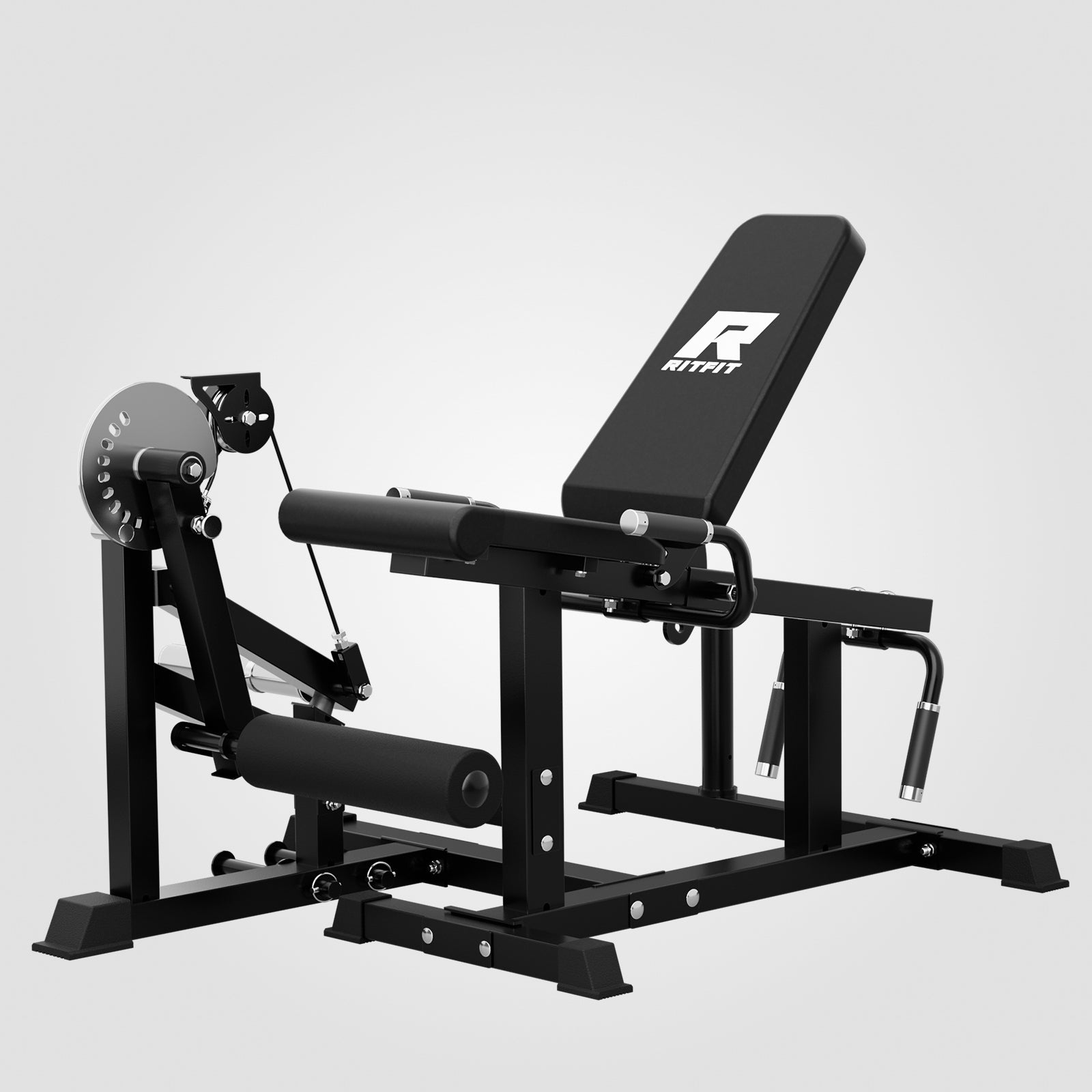
For a more advanced, machine based path to isolated quad strength, a tool like the Mustang Pro Leg Extension Curl Machine targets the muscles that stabilize the knee.
How Often Should Desk Workers Train Their Knees?
Desk workers should train their knees three to five times per week, with short sessions of about ten to fifteen minutes. Because the foundational moves are low impact, you can spread them through the day rather than doing them all at once.
Consistency and variety matter more than intensity for joint health and long term resilience.
"A holistic training strategy also helps maintain connective tissue health and prevent injuries. By varying your workouts, you reduce the risk of overuse injuries and promote overall athletic longevity."
Andy Galpin, PhD, Professor of Exercise Science and Human Performance, CSU Fullerton
- Listen to recovery: If a session leaves your knee sore the next day, reduce volume and build back gradually.
- Stay regular: Frequent short sessions beat occasional long ones for joint health.
When Should You Add Resistance Bands or Ankle Weights?
Add light resistance only after you can complete 2 to 3 sets of the bodyweight version with clean, pain free form and good control. Starting too heavy too soon is the fastest way to aggravate a sensitive knee.
Begin small, such as a light band or an ankle weight around five pounds, then progress slowly over several weeks as strength improves.
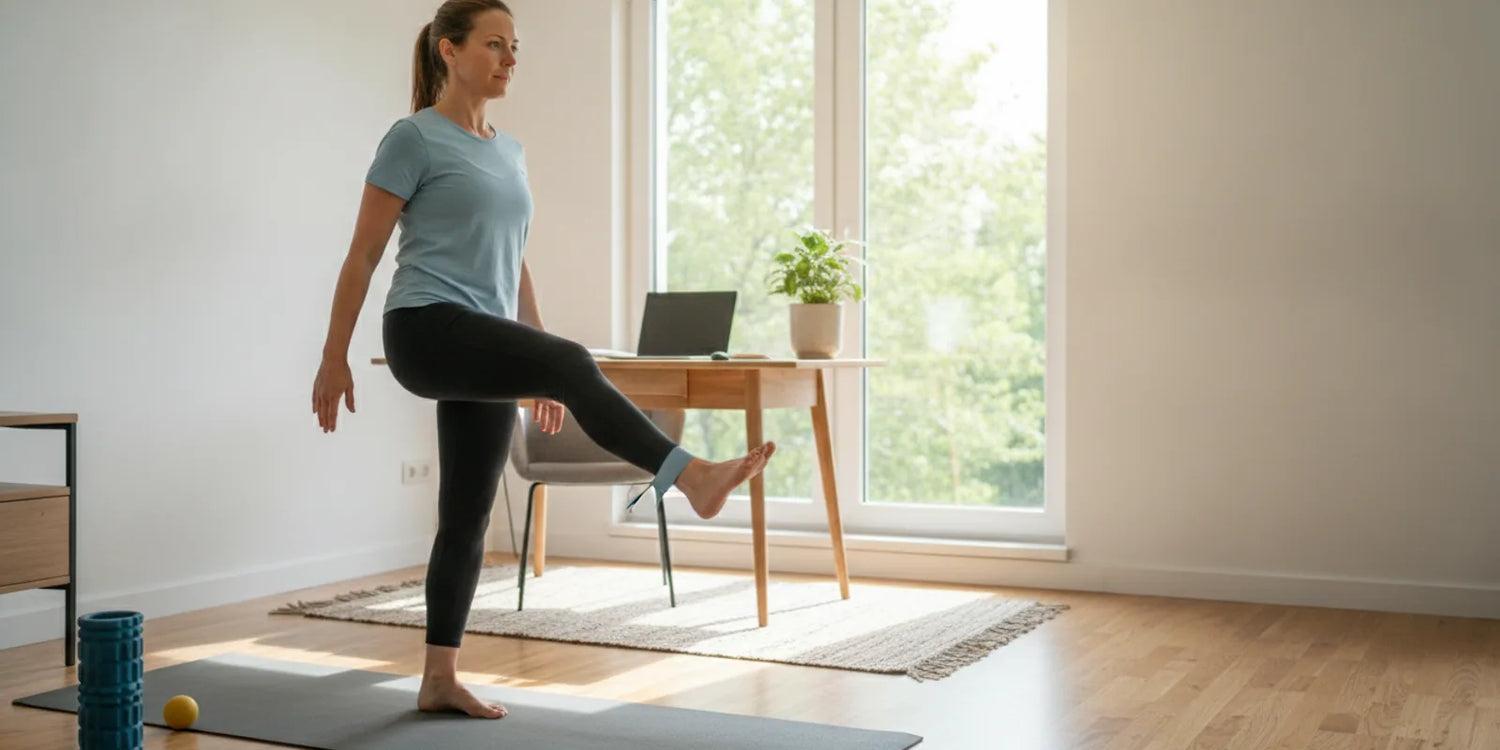
- Bands: A light loop adds smooth, joint friendly tension to straight leg raises and standing kicks. Try these resistance band exercises you can do at home to start.
- Ankle weights: Begin around five pounds and build toward roughly ten pounds for leg raises.
- Back off if needed: If load brings back pain or breaks your form, return to bodyweight and rebuild.
You can browse resistance bands and ankle and exercise weights when you are ready to add gentle load.
What Common Mistakes Should You Avoid?
The most common mistake is pushing into pain in the belief that it speeds progress, when it usually sets you back. Other frequent errors include skipping the warm up and progressing load too quickly.
Slow, controlled reps with full attention to form deliver better results than rushed, heavy sets.
- Training through sharp pain: Discomfort is a signal to stop, not to push harder.
- Going too deep too soon: A smaller pain free range beats a deep painful one.
- Adding weight prematurely: Master bodyweight control before loading the joint.
Supportive gear can help during higher load days, and you can read about knee sleeves and when to wear them for added comfort.
When Should You Stop and See a Professional?
Stop exercising and see a licensed professional if you have sharp pain, noticeable swelling, locking, giving way, or pain that does not improve with rest. These signs point to issues that need a proper evaluation.
This routine is for general strengthening and prevention, not for diagnosing or treating injuries or disease.
- Red flags: Swelling, instability, locking, or pain that lingers after rest.
- Better safe than sorry: A physical therapist can tailor a plan to your specific knee.
For prevention focused support, you might also review how knee braces help prevent issues and whether patellar straps for knee support suit your needs.
How Do You Fit Knee Work Into a Desk Bound Day?
You fit knee work into a desk bound day by turning the foundational moves into short movement snacks between tasks. A set of seated quad sets or a few sit to stands from your chair takes under two minutes.
Spreading small bouts through the day keeps the supporting muscles active without needing a dedicated workout block.
- Hourly resets: Stand up and do 10 chair squats or sit to stands every hour or two.
- Under the desk: Seated quad sets and ankle pumps require no equipment and no space.
- Walk breaks: A short walk to refill water keeps the joint moving and lubricated.
FAQs About PT for Knee
Can I strengthen my knees at home without any equipment?
Yes, most PT style knee work needs no equipment at all. Foundational moves like quad sets, straight leg raises, heel slides, and wall sits use only your body weight and the floor. Once these feel easy, you can add light resistance bands or ankle weights, but the early stages rely on careful form and consistency rather than gear.
How often should a desk worker do knee strengthening exercises?
For general strengthening and prevention, most people do well training their knees three to five times per week, with sessions of roughly ten to fifteen minutes. Because the moves are low impact, you can spread them through the day as movement snacks. If a session leaves your knee sore the next day, reduce volume and build back gradually.
Are quad sets and straight leg raises safe if my knee feels stiff?
Yes, they are commonly used early stage moves because they build the muscles around the knee without bending or loading the joint heavily. Mild stiffness usually eases as you warm up and move. Sharp pain, swelling, or instability is different, and that is your signal to stop and check in with a licensed physical therapist or doctor.
When should I add resistance bands or ankle weights to my knee routine?
Add light resistance only after you can complete two to three sets of the bodyweight version with clean, pain free form. Start small, such as a light band or an ankle weight around five pounds, and progress slowly over weeks. If load brings back pain or breaks your form, drop back to bodyweight and rebuild before loading again.
Will strengthening my quadriceps really help my knees?
Research links stronger quadriceps with a lower risk of developing symptomatic knee problems and with less pain and better function in people who already have knee issues. Strong quads help the knee absorb shock and stay stable through daily movement like walking, stairs, and standing. That is why nearly every PT style knee program centers on quadriceps and surrounding muscles.
Conclusion
Strong supporting muscles are the simplest way to keep your knees comfortable through a desk bound life. Start with quad sets and straight leg raises, train three to five times per week, and progress only when each move feels controlled and pain free.
Begin today with two short movement snacks at your desk, then add light bands or ankle weights once the bodyweight basics feel easy.
Disclaimer
This article is for general education and prevention only and is not medical advice or a treatment plan for any injury or condition. If you have pain, swelling, or a diagnosed knee problem, stop and consult a licensed physical therapist or doctor before exercising.
References
1. Amin S, Baker K, Niu J, et al. Quadriceps strength and the risk of cartilage loss and symptom progression in knee osteoarthritis. Arthritis and Rheumatism. 2009;60(1):189-98. https://pmc.ncbi.nlm.nih.gov/articles/PMC3653642/
2. Segal NA, Glass NA, Felson DT, et al. Effect of quadriceps strength and proprioception on risk for knee osteoarthritis. Medicine and Science in Sports and Exercise. 2010;42(11):2081-8. https://pmc.ncbi.nlm.nih.gov/articles/PMC2921020/
3. Anwer S, Alghadir A. Effect of isometric quadriceps exercise on muscle strength, pain, and function in patients with knee osteoarthritis. Journal of Physical Therapy Science. 2014;26(5):745-748. https://pmc.ncbi.nlm.nih.gov/articles/PMC4047243/