Resistance band exercises anywhere let you keep a full strength routine going at home, in a hotel, or in a crowded gym. A single band takes up almost no space, packs flat in a bag, and needs only a few feet of floor or a door anchor to work.
Bands come in tube, loop, and therapy styles that span light to heavy resistance, so you can match the load to your level. This guide covers six effective moves, the right rep ranges, and a sample workout you can finish in under 20 minutes.
Quick Answer: Resistance band exercises anywhere build strength with one lightweight tool and no bulky equipment. You can train legs, glutes, core, and upper body in a hotel room or a living room corner. Most moves need only a door anchor and a few feet of clear floor space.
Key Takeaways
- Portable: A band weighs ounces and folds flat, so you can train in a hotel, a living room, or an office without a rack or machine.
- Full body: Front squats, bridges, lateral walks, crunches, and band push-ups cover legs, glutes, core, and upper body in one session.
- Scalable: Tube, loop, and therapy bands span light to heavy resistance, so you can progress without buying more plates.
- Reps: Aim for 8 to 25 reps for 2 to 3 sets per exercise, using a heavier band for strength and a lighter band for endurance.
- Safety: Inspect your band for tears before each session and anchor it securely before every set.
Why Are Resistance Band Exercises Good for Training Anywhere?
Resistance band exercises anywhere work because a band creates constant tension while needing almost no space or setup. You can anchor it to a door, a pole, or your own body, so the same tool trains your legs, glutes, back, chest, and core in a hotel room or a living room.
- Lightweight and packable: Bands weigh a few ounces and fold flat, so they travel in a carry-on or a backpack.
- Gentle on joints: Band tension builds as you stretch, which makes these moves suitable for beginners and rehabilitation.
- Easy to progress: Start light to learn a move, then step up to a heavier band as the final reps feel easy.
For a broad range of tools, browse the RitFit Resistance Bands collection to match a set to your goal. To understand the general benefits, read our guide to what resistance bands help with.
How Do You Choose the Right Resistance Band for Your Level?
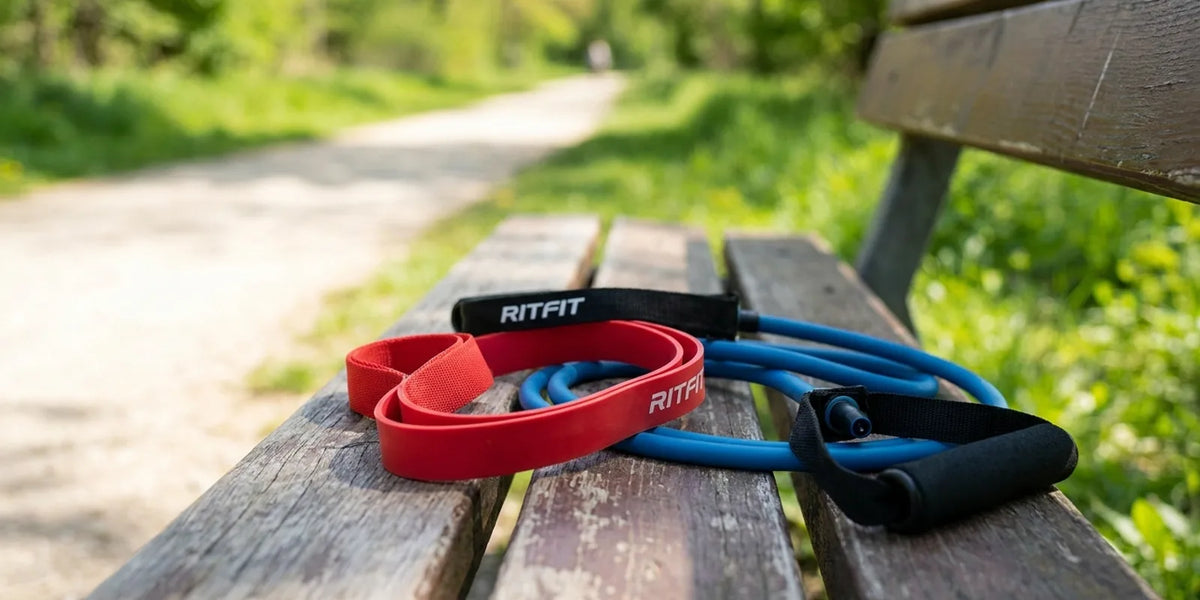
Choose a band based on the move and the tension that lets you finish the target reps with clean form. Tube bands with handles suit presses and pulls, loop bands suit lower body work, and flat therapy bands work well for rehabilitation and mobility.
- Tube bands with handles: Best for front squats, presses, and rows, especially when anchored to a door.
- Loop bands: These giant rubber bands stay in place around the legs for glute bridges and lateral walks.
- Therapy bands: Flat and easy to cut to length, these are ideal for gentle progressions and rehab work.
When in doubt, a fitness professional can help determine which band is right for you based on your fitness level and your specific plan. For step by step guidance, see our article on 9 resistance band exercises you can do at home and avoid the common resistance bands mistakes.
What Are the Best Resistance Band Exercises for a Full-Body Workout?
The best resistance band exercises anywhere are the front squat, glute bridge, lateral band walk, kneeling crunch, reverse crunch, and band push-up. These six moves cover legs, glutes, core, and upper body with just a band and a few feet of floor.
Front Squat
Stand on the band with feet slightly wider than shoulder width and hold a handle in each hand. Bring the top of the band over your shoulders, then sit straight down with chest up and abs firm before rising back up for 8 to 12 reps.
Glute Bridge
Tie a band around your legs just above the knees and lie on your back with feet on the floor and knees bent to 90 degrees. Rise your hips until your shoulders, hips, and knees align, contracting your glutes for 15 to 20 reps.
Lateral Band Walk
Step into a loop band or tie a therapy band around your lower legs just above the ankles, with feet shoulder width apart. From a half squat, step sideways with the band taut, taking 8 to 10 steps before heading back the other way.
Kneeling Crunch
Attach the band to a high anchor such as the top of a door and kneel down, grabbing each side. Extend the elbows at shoulder level and crunch down toward your hips while contracting your abs for 10 to 12 reps.
Reverse Crunch
Anchor the band on a low support and lie on your back with knees bent to 90 degrees. Wrap the band around the tops of both feet and pull your knees toward your shoulders for 12 to 15 reps with your back flat.
Band Push-Up
Get into plank position with the band draped across your upper back and loop the ends around your thumbs. Push straight up until your arms fully extend, then lower your chest to the floor for 5 to 20 reps depending on your strength.
For more lower body ideas, try our stretch band exercises for legs. To spread the work across the whole body, follow the pattern in resistance band workouts for all body parts.
"I want people doing progressive resistance training two to three times per week with weights, machines or bands, because strong muscles create strong bones."
Susan Bukata, MD, Chair, Department of Orthopedic Surgery, UC San Diego
How Many Reps and Sets Should You Do With Resistance Bands?
For most resistance band exercises, aim for 8 to 25 reps for 2 to 3 sets per exercise. Use a lighter band with higher reps while you learn a move, and step up to a heavier band with lower reps once you want more strength work.
- Strength focus: Use a heavier band for 8 to 12 reps and rest 60 to 90 seconds between sets.
- Endurance focus: Use a lighter band for 15 to 25 reps with shorter rest periods.
- Progression rule: Add a rep, a set, or a heavier band only when the final reps feel smooth and easy.
Consistency matters more than a perfect number, so pick a range you can repeat two or three times per week. For the muscle building side, see can you gain muscle with resistance bands.
How Do You Build a Sample Resistance Band Workout Anywhere?
Build a sample workout by pairing one lower body move, one core move, and one upper body move, then repeat the circuit two or three times. The routine below needs only a band, a door anchor, and about five feet of clear floor.
- Front Squat: 3 sets of 12 reps.
- Glute Bridge: 3 sets of 20 reps.
- Lateral Band Walk: 3 sets of 10 steps each way.
- Kneeling Crunch: 3 sets of 12 reps.
- Reverse Crunch: 3 sets of 15 reps.
- Band Push-Up: 2 sets of as many reps as possible with good form.
Warm up for a few minutes, keep each rep controlled, and rest as needed between sets. For more lower body work, add leg exercises or the low impact options in exercises for elderly.
FAQs About Resistance Band Exercises
Can you do resistance band exercises anywhere?
Yes, you can do resistance band exercises anywhere because a band is small, light, and needs no power outlet.
You can train in a hotel room, a living room, a hotel gym, or a park.
Most moves need only a door anchor or a few feet of clear floor.
How many reps should you do with resistance bands?
For most resistance band exercises, aim for 8 to 25 reps for 2 to 3 sets per exercise.
Use a heavier band for 8 to 12 reps when you want strength and a lighter band for 15 to 25 reps when you want endurance.
Stop a set when your form starts to break.
What is the best resistance band type for beginners?
Loop bands are a common starting point because they stay in place around the legs for squats, bridges, and walks.
Tube bands with handles suit presses and pulls, while flat therapy bands work for rehabilitation.
Start with a light or medium band and move up as each move feels easy.
Do resistance bands build muscle?
Yes, resistance bands build muscle when you use enough tension and progress over time.
Bands create the most resistance near the end of a stretch and recruit the same muscle fibers as free weights.
Train with progressive resistance two to three times per week for the best results.
How do you anchor a resistance band to a door?
Use a door anchor that slides over the edge of a closed door and clips to your tube band.
Place the anchor at chest height for rows, at waist height for presses, or near the top for kneeling crunches.
Always close the door fully and check the anchor before each set.
Are resistance band exercises safe for seniors?
Resistance band exercises are generally safe for older adults because the load is easy to control and joints stay protected.
Start with a light therapy or loop band and finish 8 to 15 reps with slow, steady form.
Stop if you feel sharp pain and ask a doctor or physical therapist before starting.
How often should you train with resistance bands?
Train with resistance bands two to three times per week with a rest day between sessions so muscles can recover.
On other days you can add walking or mobility work.
This schedule supports strength gains without overtaxing joints or tendons.
Conclusion
Resistance band exercises anywhere keep your training consistent when you travel, work from home, or skip the gym. Pick a band that suits your level, run the six moves above for 8 to 25 reps, and repeat the sample circuit two or three times a week.
Start with the moves that feel comfortable and add tension only as they get easy. For more help choosing gear or planning a program, visit our RitFit sales page.
Disclaimer
This article is for educational purposes only and does not replace professional medical advice. Consult a doctor before starting a new exercise program, especially if you have an injury or a medical condition, and always inspect your bands for wear before each session.