








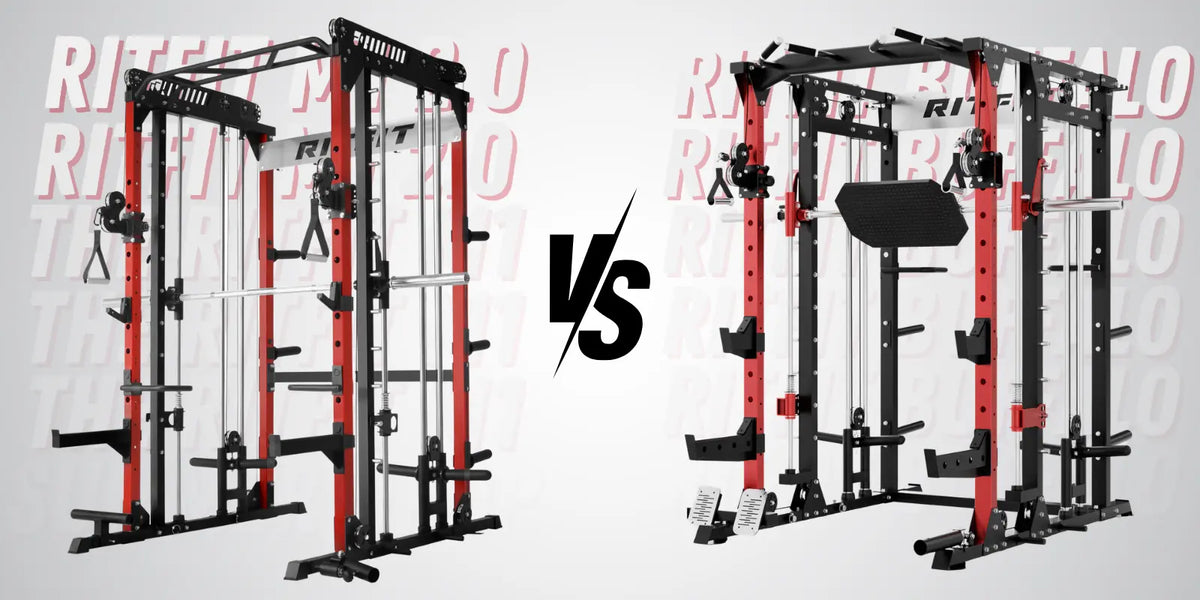
The RitFit M1 PRO is the better choice for buyers who prioritize price and floor efficiency, while the RitFit Buffalo is better for buyers who want a heavier frame and more included lower body capability.
This comparison uses current manufacturer specifications and separates measurable differences from buyer recommendations, so you can evaluate space, capacity, cables, attachments, and long term fit before purchasing.
Quick Answer: Choose the RitFit M1 PRO for a lower starting price, a 20.9 square foot listed footprint, and higher listed cable carriage capacity. Choose the RitFit Buffalo for 2 by 3 inch 13 gauge uprights, a heavier 478 pound frame, 1,800 pound maximum capacity, and an included modular vertical leg press.
Key Takeaways
- Best value: The M1 PRO has the lower listed base price and the smaller manufacturer listed footprint.
- Heavier structure: The Buffalo uses 2 by 3 inch 13 gauge uprights and weighs 478 pounds.
- Same Smith capacity: Both machines list a 352 pound Smith system capacity.
- Cable difference: The M1 PRO lists 420 pounds of single side cable capacity, while Buffalo lists 310 pounds per side.
- Lower body advantage: Buffalo includes a modular vertical leg press attachment in its base configuration.
Which Is Better, the RitFit M1 PRO or Buffalo?
The M1 PRO is the more practical recommendation for a first all in one home gym, while Buffalo is the stronger recommendation for buyers who already know they want a heavier frame and vertical leg press training. Both combine Smith work, rack exercises, cable movements, pull ups, dips, and plate storage in one station.
Choose the RitFit M1 PRO Smith machine when budget, floor planning, and cable loading matter most. Choose the RitFit Buffalo Smith machine when included attachments and frame specifications justify the additional space and cost.
RitFit M1 PRO vs Buffalo Comparison Chart
The specification table shows that neither machine wins every category. M1 PRO leads on listed price, footprint, cable capacity, and plate storage count, while Buffalo leads on frame weight, upright size, overall capacity, safety arm capacity, and included leg press capability.
| Category | RitFit M1 PRO | RitFit Buffalo |
|---|---|---|
| Listed base price | $1,299.99 | $1,899.99 |
| Overall dimensions | 79.1 in L, 68.1 in W, 85.3 in H | 79 in L, 68 in W, 83 in H |
| Manufacturer listed footprint | 20.9 sq ft | 38.1 sq ft |
| Rack weight | 339 lb | 478 lb |
| Upright construction | 2 in by 2 in, 14 gauge steel | 2 in by 3 in, 13 gauge steel |
| Maximum listed capacity | 1,600 lb | 1,800 lb |
| Smith capacity | 352 lb | 352 lb |
| Smith bar weight | 33 lb | 30.75 lb |
| Smith height settings | 11 | 9 |
| Pulley ratio | 2 to 1 | 2 to 1 |
| Listed cable capacity | 420 lb per side | 310 lb per side |
| Safety arm capacity | 575 lb | 1,300 lb |
| Plate storage bars | 6 | 4 |
| Vertical leg press | Not included | Modular attachment included |
| Best fit | Value focused and floor conscious buyers | Feature focused buyers prioritizing frame and leg training |
Manufacturer published specifications reviewed July 15, 2026. Prices, configurations, promotions, and package contents can change, so confirm the selected variant and included attachments on the product page before ordering.
RitFit M1 PRO Overview
The M1 PRO is the better fit for buyers who want broad training coverage without moving immediately into Buffalo pricing and floor requirements. Its listed 1,600 pound frame capacity, 352 pound Smith capacity, dual adjustable cables, rack functions, and six storage bars cover the main needs of many garage and basement gyms.
- Space planning: The listed footprint is 20.9 square feet, although owners still need working clearance for loading plates, moving a bench, and using cable attachments.
- Cable training: The 2 to 1 system lists 420 pounds of capacity per side and 15 cable adjustment positions.
- Smith training: The linear bearing system lists a 33 pound bar, 352 pound capacity, and 11 height settings.
- Storage: Six Olympic plate storage bars support a compact equipment ecosystem around the rack.
Research comparing machine and free weight resistance training found similar average hypertrophy outcomes, while strength gains tended to favor the mode used for testing.[1] The M1 PRO supports both modes, which is useful when a household wants guided Smith exercises and conventional rack work in the same station.
"Another genius addition to the M1 is the landmine attachment to easily perform T-bar rows, squats, or presses."
Lexa Stahl, Fitness Creator & Home Gym Reviewer, RitFit M1 PRO Review: From Blah to Beautiful Home Gym
"Love the fact I can easily go into my garage to get a quick workout instead of driving to a gym. Saves a lot of time. Able to do alot of different workouts with this Smith Machine. Overall happy with the product and customer service."
Jose A., Verified Buyer, RitFit M1 PRO Smith Machine Home Gym Package Comprehensive All-In-One Workout System
RitFit Buffalo Overview
The Buffalo is the better fit for buyers who want more structural capacity and lower body variety from the base machine. Its 478 pound rack, 2 by 3 inch 13 gauge uprights, 1,800 pound maximum capacity, and modular vertical leg press distinguish it from the M1 PRO.
- Frame: Buffalo uses larger and thicker listed uprights than M1 PRO and has the higher overall stated capacity.
- Lower body training: The included modular vertical leg press expands the exercise menu beyond Smith squats, lunges, Romanian deadlifts, and cable movements.
- Safety hardware: The listed safety arm capacity is 1,300 pounds, compared with 575 pounds on M1 PRO.
- Cable training: The dual cable system uses a 2 to 1 ratio and lists 310 pounds of capacity per side.
Hypertrophy can be developed across a broad range of loads when sets are performed with sufficient effort, while heavier loading remains especially relevant to maximal strength goals.[2] Buffalo adds exercise options, but programming quality, movement control, and progression still determine results.
"For $1,800, this machine delivers a combination of build quality, stability, and versatility that is rare at this price. The BUFFALO is not a machine that excels at one thing. It is a platform that lets you program an entire training week without ever stepping off the frame."
BJ Nelson, Head of Field Testing, The Iron Clinic, RitFit Buffalo Smith Machine Review, The Iron Clinic
"The buffalo machine is so smooth and gets the job done every time. It has literally changed my life for the better."
Grant S., Verified Buyer, RitFit BUFFALO Smith Machine Home Gym Package with Lat Pull Down and Cable Crossover
What Are the Key Differences Between the RitFit M1 PRO and Buffalo?
The most important differences are not the shared Smith and cable functions, but the frame specifications, floor planning, cable capacities, included lower body attachment, and total purchase commitment. Buyers should compare the exact base machine or package rather than mixing single machine pricing with package features.
Price and Value
The M1 PRO has the lower listed base price, so it is the clearer value choice when Smith, rack, cable, pull up, dip, and storage functions already meet your plan. Buffalo earns its higher price through a heavier frame, thicker uprights, higher overall capacity, stronger listed safety arms, and the included modular leg press.
Space and Ceiling Fit
M1 PRO is listed at 20.9 square feet and 85.3 inches high, while Buffalo is listed at 38.1 square feet and 83 inches high. Buffalo is slightly shorter but requires the larger stated floor area, so a low ceiling does not automatically mean it is the easier machine to place.
Smith Machine Performance
Both machines list the same 352 pound Smith capacity, which means Buffalo does not have a higher published Smith load rating. M1 PRO lists 11 bar settings and a 33 pound Smith bar, while Buffalo lists 9 settings and a 30.75 pound Smith bar.
Cable System
Both machines use a 2 to 1 pulley ratio, but M1 PRO lists 420 pounds of cable capacity per side compared with 310 pounds for Buffalo. Buyers should also consider adjustment height, cable travel, attachment clearance, and whether plate loading or an optional stack better matches their training pace.
Lower Body Training
Buffalo has the clear lower body feature advantage because its modular vertical leg press is included. M1 PRO remains capable for Smith squats, split squats, lunges, Romanian deadlifts, calf raises, cable pull throughs, and belt squat variations when compatible attachments and safe setups are used.
Workout Efficiency
An all in one station can reduce exercise transition time because the rack, Smith bar, cables, and attachments remain in one training zone. Reviews of time efficient resistance training support prioritizing multi joint exercises and practical programming when limited time is a major barrier.[3]
Explore the broader RitFit Smith machine range when neither machine matches your ceiling, budget, or preferred attachment system. A comparison should include the entire product ecosystem, not only the base rack.
Who Should Choose the RitFit M1 PRO?
Choose the M1 PRO when your priority is getting the shared core functions at a lower listed price and with a smaller stated footprint. It is especially suitable for buyers building their first serious all in one home gym around Smith training, cable accessories, and conventional barbell work.
- You have tighter floor limits: The manufacturer listed footprint is substantially smaller than Buffalo.
- You value cable capacity: The listed single side capacity is higher than Buffalo.
- You want more plate storage: M1 PRO includes six storage bars instead of four.
- You do not require a vertical leg press: Your lower body program already centers on squats, lunges, hinges, and cable work.
- You prefer a lower entry price: You can add a bench, plates, or selected attachments as your training develops.
Pair the machine with a suitable option from the RitFit weight benches collection and confirm that the bench can move through flat and incline positions inside your available working area.
Who Should Choose the RitFit Buffalo?
Choose Buffalo when you want the stronger published frame specifications and will regularly use the included vertical leg press. It is the more logical long term centerpiece when the larger footprint and higher purchase cost prevent future spending on separate lower body equipment.
- You prioritize frame specifications: Buffalo is heavier and uses 2 by 3 inch 13 gauge uprights.
- You need higher listed overall capacity: Buffalo lists 1,800 pounds compared with 1,600 pounds for M1 PRO.
- You want stronger listed safety arms: Buffalo publishes a 1,300 pound rating.
- You want more lower body variety: The modular vertical leg press is included.
- You accept lower cable capacity: The listed 310 pounds per side still exceeds many home cable training needs.
Review the RitFit strength machines collection if a dedicated leg press, hack squat, or other single purpose machine would fit your training better than choosing Buffalo primarily for one attachment.
How We Compared the RitFit M1 PRO and Buffalo
We compared the current base machines using manufacturer published dimensions, construction, load ratings, cable systems, included attachments, prices, and intended training use. Recommendations were then matched to common buyer decisions involving room size, budget, exercise selection, loading speed, and future expansion.
Editorial disclosure: RitFit sells both machines discussed in this article. This comparison is based on published specifications and product configurations, not independent laboratory testing, and promotional prices may change after the review date.
- Configuration control: Base machine claims were kept separate from weight stack and home gym package claims.
- Measurable evidence: Capacity, dimensions, weight, upright size, pulley ratio, and attachment differences were prioritized over subjective language.
- Buyer relevance: Every recommendation connects a specification to a practical space, budget, or training decision.
- Safety context: Manufacturer ratings were not treated as recommendations to train at maximum capacity.
Resistance training programs consistently improve strength and hypertrophy compared with no resistance training, but no single prescription is best for every outcome or lifter.[4] The most useful machine is therefore the one that supports safe, repeatable training within your actual room and program.
Use compatible loading equipment from the RitFit barbells and weight plates collection, and verify plate diameter, sleeve clearance, storage capacity, and floor protection before completing the setup.
FAQs About RitFit M1 PRO vs Buffalo
Which is better, RitFit M1 PRO or RitFit Buffalo?
The RitFit M1 PRO is better for lower cost, smaller floor planning, and higher listed cable carriage capacity. The RitFit Buffalo is better for buyers who want a heavier frame, thicker uprights, higher overall frame capacity, and a modular vertical leg press attachment included with the base machine.
How much space do the RitFit M1 PRO and Buffalo need?
The M1 PRO has the smaller manufacturer listed footprint at 20.9 square feet, while the Buffalo is listed at 38.1 square feet. Measure ceiling height, wall clearance, plate loading space, bench travel, and room for Smith bar sleeves before choosing either machine for a garage, basement, or spare room.
Is the RitFit Buffalo better for leg training than the M1 PRO?
Yes. The Buffalo offers more built in lower body variety because its base configuration includes a modular vertical leg press attachment, while both machines support Smith squats, lunges, Romanian deadlifts, and cable leg work without requiring several separate strength stations.
Does the RitFit M1 PRO have a stronger cable system than Buffalo?
The M1 PRO has the higher manufacturer listed single side cable capacity, at 420 pounds compared with 310 pounds for Buffalo. Both use a 2 to 1 pulley ratio, so the felt resistance is reduced relative to the loaded weight, and actual exercise suitability still depends on cable travel, setup, and attachment position.
Should I add a weight stack to the M1 PRO or Buffalo?
Choose a weight stack when faster resistance changes and shared workouts matter more than the lowest purchase cost. Plate loaded carriages remain effective and may suit owners who already have Olympic plates, while a stack reduces repeated plate changes during supersets, partner training, and short sessions with frequent exercise transitions.
Can beginners safely use the RitFit M1 PRO or Buffalo?
Yes. Beginners can use either machine when they learn the safety catches, J hooks, spotter arms, cable settings, and Smith bar stops, then start with controlled repetitions, secure every attachment, keep the area clear, and follow the product manual for assembly, inspection, loading, and maintenance.
What should I measure before buying a RitFit Smith machine?
Measure ceiling height, usable floor area, door width, delivery path, wall clearance, plate sleeve clearance, and the space needed for a bench at full incline. Also confirm that you can reach cable positions comfortably and load plates without moving the machine, because listed footprint alone does not represent the complete working area.
Which RitFit Smith machine is better for long term ownership?
The better long term choice is the machine that matches your permanent space, preferred exercises, and realistic upgrade plan. Choose M1 PRO for efficient core functions and lower initial cost, or choose Buffalo when the thicker frame, higher overall capacity, vertical leg press, and broader included attachment set will remain useful for years.
Conclusion
The M1 PRO is the better choice for value, a smaller listed footprint, higher published cable capacity, and six plate storage bars. Buffalo is the better choice for a heavier frame, thicker uprights, higher overall and safety arm capacities, and an included modular vertical leg press.
Measure the complete working area, choose the exact base or package configuration, then compare current options in the RitFit Smith machine collection before ordering.
Disclaimer
This article provides general product comparison and educational information, not medical, rehabilitation, engineering, or individualized training advice. Confirm current specifications and included parts, follow the product manual, inspect every connection before use, set safety catches correctly, and consult a qualified professional when exercise selection or physical limitations require individual guidance.
References
1. Haugen ME, Vårvik FT, Larsen S, Haugen AS, van den Tillaar R, Bjørnsen T. Effect of free-weight vs. machine-based strength training on maximal strength, hypertrophy and jump performance: a systematic review and meta-analysis. BMC Sports Sci Med Rehabil. 2023;15(1):103. doi:10.1186/s13102-023-00713-4. PMCID: PMC10426227
2. Schoenfeld BJ, Grgic J, Van Every DW, Plotkin DL. Loading recommendations for muscle strength, hypertrophy, and local endurance: a re-examination of the repetition continuum. Sports (Basel). 2021;9(2):32. doi:10.3390/sports9020032. PMCID: PMC7927075
3. Iversen VM, Norum M, Schoenfeld BJ, Fimland MS. No time to lift? Designing time-efficient training programs for strength and hypertrophy: a narrative review. Sports Med. 2021;51(10):2079-2095. doi:10.1007/s40279-021-01490-1. PMCID: PMC8449772
4. Currier BS, Mcleod JC, Banfield L, et al. Resistance training prescription for muscle strength and hypertrophy in healthy adults: a systematic review and Bayesian network meta-analysis. Br J Sports Med. 2023;57(18):1211-1220. doi:10.1136/bjsports-2023-106807. PMCID: PMC10579494





