








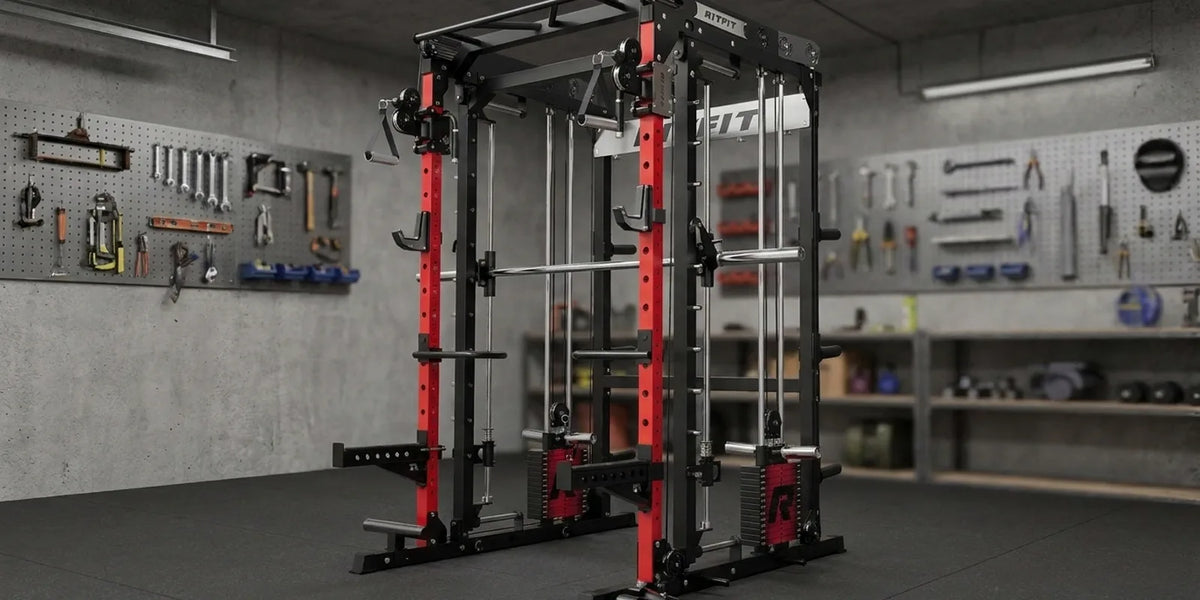
This RitFit M2 Pro 3D review looks at the 3D Smith version of RitFit's modular M2 rack through the experience of Michael from Jungle Gym Reviews, who trained on it for months before publishing his breakdown. His take separates the lifts the 3D bar path actually improves from the ones it makes worse.
Sections below cover the 3D mechanism, frame, cables, the three M2 configurations, and who should skip the premium. Prices appear twice: the promotional figure from his March 21, 2026 video and the RitFit listing checked November 17, 2026.
Quick Answer: According to Michael of Jungle Gym Reviews, the RitFit M2 Pro 3D is a complete all in one rack whose 3D Smith helps bench press, incline press, and rows but feels worse for squats and overhead presses, so he would not pay the extra money for the 3D feature alone. Buy it for the dual stacks and the full setup instead.
Key Takeaways
- Hybrid bar path: The 3D Smith adds a second rail set so the bar can travel forward and back as well as up and down, which moves it closer to a free weight path.
- Mixed results by lift: Bench press, incline press, and bent over rows felt better to Michael, while squats and overhead presses felt worse.
- Entry level frame class: The rack uses 2.4 by 2.4 inch uprights with 1 inch holes and 13 gauge steel, and its attachments do not cross over to 3 by 3 inch racks.
- Strong cables with cheap rollers: The dual 154 lb stacks feel smooth with a fast snapback, but the pulleys and rollers are the least refined parts of the machine.
- Price gap is small, value gap is not: The 3D version cost about $263 more than the standard Smith version at the promotional prices Michael quoted in his March 21, 2026 video, yet the feature only pays off for press and row focused training.
What Does the 3D Smith Machine Actually Change?
Michael explains that the 3D Smith machine adds a second rail set so the bar can travel forward, backward, up, and down instead of only vertically. That extra travel lets the bar arc during a press or drift back at the top of a row, which sits closer to a free bar path than a fixed Smith groove.
A spring loaded pin at the carriage releases the bar onto the front to back rails, and Michael walks through the unlock and relock sequence on camera. With the pin engaged, the machine behaves like a conventional Smith and the bar tracks straight up and down again.
- Second rail set: The carriage rides on a front to back rail in addition to the vertical guides, which is the entire mechanical difference.
- Spring pin control: A pull and twist on the pin decides whether the bar stays locked to the vertical path or floats on the 3D rails.
- Shared platform: The frame, cable stations, weight stacks, and attachment points are the same hardware used on the standard Smith version.
That shared platform matters for buyers, because the 3D carriage is an upgrade to one station rather than a separate machine. Everything else on the rack still has to earn its place in your garage.
Which Exercises Feel Better on the 3D Smith Machine?
Bench press, incline press, and bent over rows gained the most from the 3D path in Michael's training. Squats and overhead presses felt worse to him, so the feature is a trade rather than a straight upgrade.
On flat and incline pressing, the bar can travel in a slight arc instead of a locked vertical line, and he describes a stronger pump and a more natural groove at the same load. The 3D setting is doing real work there, because the path follows the shoulder rather than fighting it.
Bent over rows picked up a different benefit, since the bar can drift back past the vertical line at the top for roughly 1 to 2 extra inches of travel. That extra range is something a fixed Smith cannot offer.
- Best fit: Flat bench press, incline press, and bent over rows, where a small arc or extra horizontal travel matches the movement.
- Weak fit: Back squats felt awkward to him on the 3D path, and he did not like overhead pressing on it at all.
- Position dependent: The same machine can feel natural in one station and clumsy in another, so test the lifts you train most before committing.
His summary is blunt in a useful way, because he says 3D does not make every exercise better and he would not buy this machine just for the 3D Smith. That line should sit in front of any buyer who assumes the newer design wins everywhere.
Build Quality and Footprint of the 3D Smith Rack
The 3D Smith rack uses 2.4 by 2.4 inch uprights with 1 inch holes and 13 gauge steel. That is a lighter frame class than the 3 by 3 inch racks most attachment ecosystems are built around.
Every attachment on the machine, including the J hooks, the spotter arms, and the handles, is made for this upright size, so third party 3 by 3 accessories will not fit. Buyers who plan to collect attachments over several years should weigh that lock in before ordering.
Footprint matters as much as steel here, because the built in plate storage pushes the rack further off the wall and eats into the open floor you need for a bench. Michael measures the machine in the video and the numbers land close to a compact rack rather than a full commercial footprint.
- Base width: About 48 inches across the feet, which fits a single garage bay with room to load plates.
- Depth: Roughly 6 feet front to back before you add bench space or a walk around zone.
- Height: About 86 to 87 inches overall, and about 87.5 inches once the lat pulldown bracket is installed.
- Smith bar: About 79 inches, with the top lock position low enough that he bumps his head while loading plates.
The frame also carries a front landmine, a low row footplate, and rear storage positions, which keeps most accessories on the machine instead of the floor. That is a real convenience in a shared garage, even if it costs wall clearance.
How Smooth Are the Cables and the Lat Pulldown Add-On?
Michael says the cables feel smoother than the price suggests, with a fast snapback on the eccentric, but he calls the pulleys and rollers the least refined parts of the machine. That mix of a good pull and cheap hardware is his honest summary of this cable system.
Michael expected a budget feel and instead found cable tension that tracked close to machines costing considerably more. He credits the two 154 lb stacks and the 2 to 1 ratio, which puts the 11 lb top plate closer to 5.5 lb of resistance at the handle and keeps small jumps usable.
The trade-off shows up in the details, because some rollers barely turn and he already found scuffs along parts of the cable path after months of use. He treats that as an expected compromise at this price rather than a failure, and it does not change the snapback he likes.
- Stack setup: Two 154 lb stacks, an 11 lb top plate, a 2 to 1 ratio, and a tilted weight horn on top for adding plates.
- Pull feel: Smooth through the stroke with a slight vibration you can feel in the handle, plus a quick return on the negative.
- Lat pulldown add-on: The LPM2 bracket and ASM2 seat improve the line of pull and range of motion, but friction rises noticeably in that position.
That friction is the one cable complaint he repeats, and it only appears in the lat pulldown setup rather than in standard cable work. Anyone who plans to train pulldowns and high rows as a main lift should factor it into the decision.
What Trade-Offs and Safety Details Should You Know?
Michael points to visible front to back and side to side play in the Smith bar, and the lock rotation runs about 40 degrees against roughly 20 degrees on most Smith machines. Both details change how the bar behaves under load in a home setting.
At 135 lb he can feel the load shift left and right, so the bar needs a small amount of balancing instead of tracking on its own. That is workable for a patient lifter and annoying for anyone who wants a locked in groove.
The larger rotation angle matters more than it sounds, because the wrist and shoulder travel further before the bar fully locks or releases. If you are used to a short twist, the longer sweep takes a few sessions to trust.
- Bar play: Front to back and side to side movement is visible even before plates go on, and it becomes more obvious as the load climbs.
- Long lock sweep: About 40 degrees of rotation to lock or unlock, which is roughly double the motion on most Smith machines.
- Head clearance: The top lock position sits low enough that he hits his head while loading plates, so plan plate changes around it.
- Safety blocks: The stops are generic rather than fitted, and they take contact from plates during work sets.
None of this makes the rack unsafe for solo training, but it does ask for more attention than a tight commercial style Smith. Treat the first few sessions as a setup period and set the stops where you actually fail a rep.
M2 Pro 3D vs M2 Pro vs M2 3D: Which Configuration Is Worth It?
The M2 Pro 3D adds the 3D Smith carriage to the dual stack M2 Pro. In Michael's video published March 21, 2026, that step cost about $263 at the promotional prices he quoted. On the RitFit listing checked November 17, 2026, the gap is about $260, because the 3D version is $2,359.99 against $2,099.99 for the standard stack model. The frame, cables, stacks, and attachment set are otherwise the same machine.
| Configuration | Smith type | Cable resistance | Price in Michael's video (published March 21, 2026) | Current price (checked November 17, 2026) | Best for |
|---|---|---|---|---|---|
| M2 3D | 3D Smith with front to back rails | Plate loaded cable system, no stacks | $1,936 | $1,599.99 | Lifters who want the 3D bar path at the lowest price |
| M2 Pro | Standard Smith | Dual 154 lb weight stacks | $2,465 | $2,099.99 | Cable focused training without the 3D premium |
| M2 Pro 3D | 3D Smith with front to back rails | Dual 154 lb weight stacks | $2,728 | $2,359.99 | Buyers who want both stacks and the 3D bar path |
The video price column shows the promotional figures Michael quoted in his review published March 21, 2026. The current price column shows what the RitFit product page listed for each M2 variant when checked on November 17, 2026. RitFit changes pricing often, so confirm the current price on the product page before ordering.
The bigger jump sits between the M2 3D and the M2 Pro, because that step buys the second weight stack and turns the rack into a cable station as well as a Smith. Anyone who trains cables every session gets more from that upgrade than from the 3D carriage.
Choosing between the two stack versions comes down to whether the 3D path helps the lifts you actually train, since the price difference is small relative to the machine.
Is the 3D Smith Rack Worth the Money for a Home Gym?
For most home gym buyers the 3D Smith alone does not justify the price, and Michael says he would not buy the machine just for that feature. The rack earns its keep as a complete package, not as a novelty bar path.
His longer term view is that a 3 by 3 inch rack with 5/8 or 1 inch holes buys a much wider attachment ecosystem, even though that path often lands between $3,000 and $4,000 before a Smith machine is included. That is a statement about compatibility and future shopping, not about frame strength.
- Buy it if: You want one frame for Smith work, dual stack cables, and lat pulldowns, and your main lifts are presses and rows.
- Skip it if: Squats and overhead presses dominate your week, since those were the movements he liked least on the 3D path.
- Consider the standard M2 Pro if: You want the same stacks and cable stations and can live without the front to back carriage.
- Consider a 3 by 3 rack if: You plan to collect attachments across brands and accept a higher total cost.
Warranty Coverage for These Power Cages
RitFit covers the M2 frame and structural welds for life and the parts for 1 year under its power cage warranty schedule. The three configurations share that coverage because they are listed as one power cage family.
| Model | Category | Frame | Parts | Pads and Upholstery |
|---|---|---|---|---|
| M2 3D, M2 Pro, M2 Pro 3D | Power cage | Lifetime on frame and structural welds | 1 year | 1 year, covered as parts and non-structural components |
| LPM2 and ASM2 attachments | Power cage attachments | Not covered as structural frame | 1 year | 1 year, covered as parts |
Coverage is per the current RitFit warranty page and applies to the original purchaser from the order date in the lower 48 states, with cosmetic wear, shipping damage, and labor handled under separate terms.
Keep your order confirmation, because claims require proof of purchase and a description of the defect. Frames and welds are the only components with lifetime coverage, and attachments follow the shorter parts window.
FAQs About the RitFit M2 Pro 3D
Is the 3D Smith machine better than a standard Smith machine?
The 3D Smith machine is better for some lifts and worse for others. Michael from Jungle Gym Reviews found that bench press, incline press, and bent over rows feel more natural because the bar can travel forward and back, while squats felt awkward and overhead presses felt worse. It changes the bar path rather than improving every movement.
How much does the RitFit M2 Pro 3D cost?
The price depends on when you buy. In his video published March 21, 2026, Michael quoted a promotional price of $2,728 for the M2 Pro 3D, with the M2 Pro at $2,465 and the M2 3D at $1,936. On the RitFit product page checked November 17, 2026, the same three variants listed at $2,359.99, $2,099.99, and $1,599.99. RitFit runs frequent promotions, so confirm the current price before ordering.
How much space does the RitFit M2 Pro 3D need?
The rack measures about 48 inches wide across the base feet and roughly 6 feet front to back. Total height lands around 86 to 87 inches, and the optional lat pulldown bracket pushes it to about 87.5 inches. Measure your ceiling and leave room to load plates on both sides before ordering.
Can I use other brand attachments on the M2 Pro 3D?
No. The M2 series uses 2.4 by 2.4 inch uprights with 1 inch holes, and the J hooks, spotter arms, and handles are made for this rack. They do not cross over to the 3 by 3 inch uprights that most attachment ecosystems are built around, so plan your accessory purchases with that limit in mind.
How much resistance do the two weight stacks provide?
The M2 Pro 3D includes two 154 lb weight stacks, each with an 11 lb top plate. Because the cable runs a 2 to 1 ratio, the top plate feels closer to 5.5 lb at the handle. A tilted weight horn on top of each stack lets you add plates for heavier cable work.
Is the lat pulldown attachment worth buying?
Michael says the LPM2 attachment gives you a much better line of pull for pulldowns and high rows, but he also noted that cable friction rises noticeably once the attachment is installed, so the pull feels less smooth than a straight cable movement on the same machine. It is a useful add on with a real trade-off.
Conclusion
The RitFit M2 Pro 3D is a complete home gym in one footprint, and the 3D Smith is a real design change rather than a marketing label. It still only helps some lifts, and Michael's honest take is that the feature alone does not justify the price.
Match the machine to the training you actually do instead of the badge on the carriage, then confirm the current promotion before you commit.
Disclaimer
This article is for general information only and is not medical, safety, or professional training advice. Product prices, specifications, and availability change often, so confirm current details with RitFit before purchasing, and consult a qualified professional before starting a new training program.





