








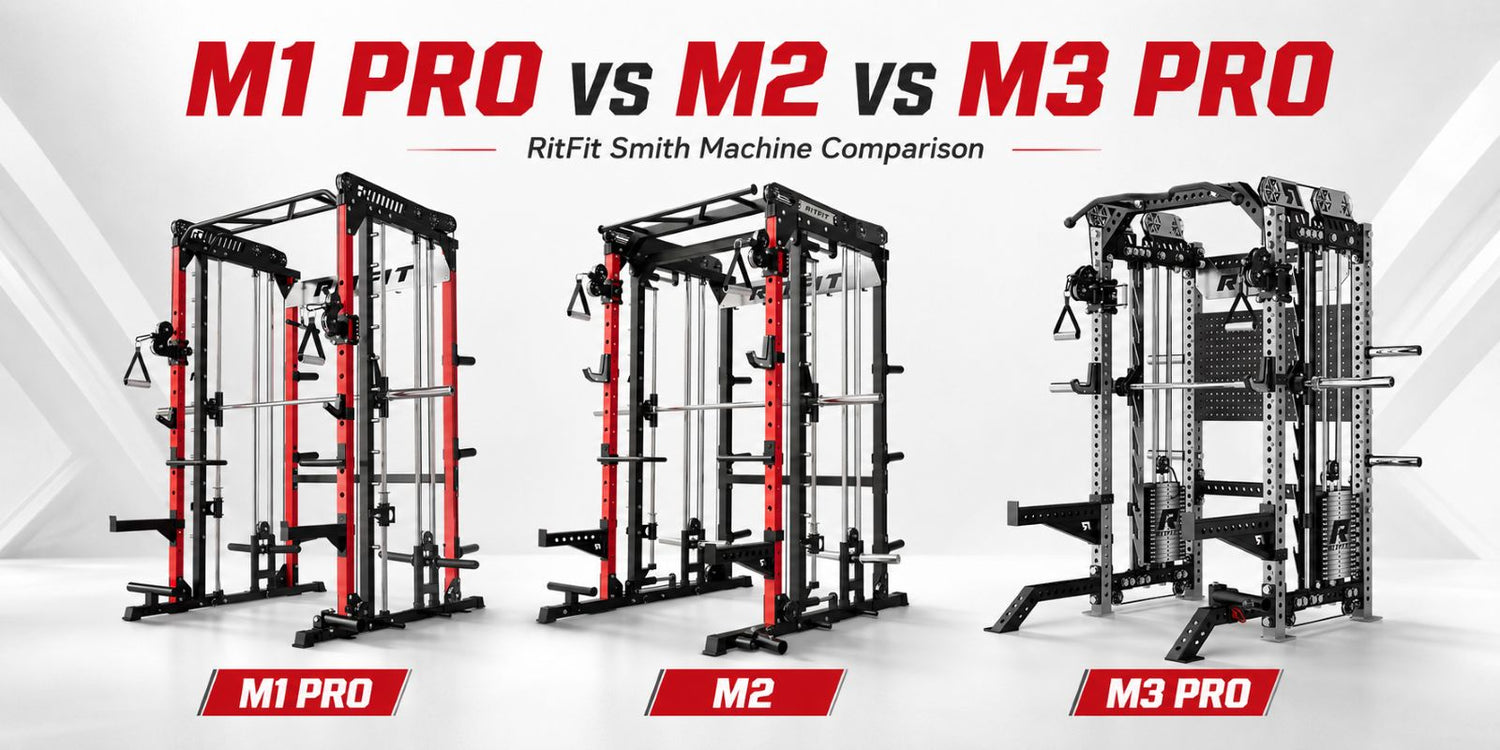
RitFit's M3 PRO, M2, and M1 PRO Smith machines each solve a different home gym problem. Choose the M1 PRO for value and compact all-in-one training, the M2 for modular upgrades and an available 3D Smith path, or the M3 PRO for the strongest frame and built-in selectorized cable workflow.
Your best choice depends on room size, ceiling clearance, cable preference, planned attachments, delivery access, and how permanent the installation will be. Here M1 refers to the current M1 PRO platform, while M2 specifications vary by configuration, so confirm the exact live package before purchasing.
Quick Answer: The RitFit M3 PRO is the strongest and most cable-convenient, the M2 is the most modular with an available 3D Smith path, and the M1 PRO is the best value for compact all-in-one training. Most home gym owners should start with the M1 PRO or standard M2 and choose the M3 PRO only for a permanent premium setup.
Key Takeaways
- M1 PRO (Best Value): A fixed Smith system, power rack functions, and a two-to-one cable system in a listed 20.9 square foot footprint.
- M2 (Best Upgrade Path): Multiple configurations and the only model here with an available Smith bar that moves both vertically and horizontally.
- M3 PRO (Strongest Construction): 3 inch by 3 inch, 11 gauge Q235 steel with a 2500 pound frame rating.
- M3 PRO (Shortest but Hardest to Move): A listed 84 inch height and a 1093.5 pound assembled rack weight.
- Working Space Matters: Allow room for a bench, plate loading, cable movement, Smith sleeves, and safe access beyond the listed footprint.
Quick Verdict
The M1 PRO is the best starting point for most value focused home gym owners, the M2 is best for buyers who expect their system to evolve, and the M3 PRO is best for a permanent premium setup. None is automatically superior because each model solves a different combination of budget, movement, cable, and space needs.
- Best Overall Value: The RitFit M1 PRO covers the core Smith, rack, and cable functions with the lowest ownership barrier of the three.
- Best Modular Platform: The RitFit M2 offers multiple configurations, dedicated attachments, and an available 3D Smith system.
- Best Heavy Duty Station: The RitFit M3 PRO combines the strongest published frame with dual 180 pound cable stacks and dense adjustment spacing.
RitFit M3 PRO vs M2 vs M1 Comparison Table
The table below uses current official technical specifications rather than promotional claims, so you can compare the three RitFit Smith machines side by side.
| Decision Factor | RitFit M1 PRO | RitFit M2 | RitFit M3 PRO |
|---|---|---|---|
| Best fit | Value focused buyers and first serious home gyms | Buyers who want modular growth or 3D Smith movement | Frequent lifters building a permanent premium station |
| Frame material | 2 inch by 2 inch, 14 gauge steel | 2.36 inch by 2.36 inch, 14 gauge steel | 3 inch by 3 inch, 11 gauge Q235 steel |
| Published frame rating | 1600 pounds | 2000 pounds | 2500 pounds |
| Listed dimensions | 79.1 inches long, 68.1 inches wide, 85.3 inches high | 78.7 inches long, 68.75 inches wide, 86.14 inches high | 86.5 inches long, 60.4 inches wide, 84 inches high |
| Listed footprint | 20.9 square feet | 22.8 square feet | 21.5 square feet |
| Smith bar weight | 33 pounds | 33 pounds | Confirm current product documentation |
| Smith movement | Fixed vertical linear bearing path | Fixed vertical or 3D path by version | Fixed vertical standard Smith path |
| Smith positions | 11 | 11 standard or 10 on 3D versions | 10 |
| Cable ratio | Two to one | Two to one | Two to one |
| Cable loading | Plate loaded, optional 264 pound total stack system | Package dependent, optional 286 pound total stack attachment | Current configuration lists 180 pounds per side |
| Cable adjustment positions | 15 | 16 listed in the technical overview | 29 |
| Installation demand | Lowest of the three | Moderate and configuration dependent | Highest due to weight, freight, and relocation limits |
Package contents, colors, prices, and optional attachments can change, so review each linked product page before checkout.
Capacity note: Manufacturer ratings describe equipment limits under stated test conditions, not recommended training loads. Dynamic exercise loading, static loading, attachment leverage, floor stability, and user technique are not interchangeable.
Which RitFit Smith Machine Has the Strongest Frame?
The M3 PRO has the strongest published frame, while the M1 PRO and M2 reduce material and total ownership demands. A stronger specification is valuable only when your loading, attachment use, training frequency, and expected service life justify it.
RitFit M1 PRO Frame
The M1 PRO uses 2 inch by 2 inch, 14 gauge steel with a published 1600 pound frame rating. Its 4.33 inch upright hole spacing is less precise than the M3 PRO, but the frame supports the main demands of a multipurpose household strength station for squats, presses, and rows.
RitFit M2 Frame
The M2 increases upright dimensions to 2.36 inches by 2.36 inches and carries a published 2000 pound maximum rating. It is the middle option for buyers who want more structural capacity and a broader attachment path without accepting the M3 PRO installation burden.
RitFit M3 PRO Frame
The M3 PRO uses uniform 3 inch by 3 inch, 11 gauge Q235 steel with 35 one inch holes per side and 2 inch spacing. Its 2500 pound frame rating and 650 pound static rating for each J hook and safety arm make it the most substantial platform in this comparison.
Buyers planning future attachments should also review the RitFit Smith machine attachment guide. Upright dimensions, pin size, hole spacing, and attachment clearance must all match before installation.
Should You Choose a Fixed or 3D Smith Bar Path?
The M1 PRO and M3 PRO use a fixed vertical Smith path, while selected M2 versions add horizontal travel. Fixed movement can simplify setup and repeatability, while 3D movement allows more individual bar path adjustment and requires more active control.
Fixed Smith Movement
A fixed path suits lifters who want consistent squats, presses, rows, calf raises, lunges, and hip thrusts with mechanical stops nearby. It does not remove the need for correct setup, controlled repetitions, and properly positioned catches.
3D Smith Movement
The M2 3D system permits vertical and horizontal bar travel, creating more freedom than a standard Smith machine without becoming a fully unrestricted barbell. Read the 3D Smith machine guide before paying for this feature.
Research does not show a universal hypertrophy advantage for machines or free weights, while strength improvements tend to favor the movement used during training and testing.[1] One randomized trial in novice men also reported useful improvements with machine, free weight, and combined programs, so equipment selection should reflect goals, skill, and adherence rather than a claim that one method always wins.[2]
"The smith machine is great because it's going to take a lot of the pressure out of your shoulders because it's supporting itself and you can do a little bit more weight on here. So it can help you break some barriers too, and also if you don't have a spotter you can utilize the tabs, put that right here so if you drop it it'll just bounce and then you won't hurt yourself."
Jeff Cavaliere, MSPT, CSCS, Physical Therapist and Strength Coach, former Head Physical Therapist for the NY Mets, Athlean-X
How Do the Cable Systems and Weight Stacks Compare?
All three platforms use a two to one pulley ratio, which increases cable travel and reduces theoretical handle resistance relative to loaded mass. Read what pulley ratio means before comparing stack labels directly.
M1 PRO Cable System
The M1 PRO begins as a plate loaded system and supports an optional 264 pound total selectorized stack attachment. This approach lowers the initial buying barrier and lets owners add faster pin changes later.
M2 Cable System
The M2 cable package depends on the chosen configuration, and the compatible WSM2 attachment contains 143 pounds per side plus plate loading capacity. Buyers should compare the exact package instead of assuming every M2 includes the same resistance hardware.
M3 PRO Cable System
The M3 PRO technical page lists 180 pounds per side, 16 aluminum pulleys, and 29 trolley adjustment positions. It is the strongest workflow choice for households that value quick changes, supersets, bilateral cable work, and frequent accessory training.
A large evidence synthesis found that resistance training prescriptions generally outperform no training for strength and hypertrophy, while higher loads ranked most favorably for maximal strength.[3] The practical question is whether the selected cable and Smith system lets you progress the exercises you will perform consistently.
Browse the full cable machine collection to compare related home gym options.
How Much Space and Assembly Does Each Smith Machine Need?
The M3 PRO is the shortest model at 84 inches, but its lower height does not make it the easiest machine to place. Its listed assembled weight is 1093.5 pounds, so delivery access, flooring, assembly help, and future relocation require advance planning.
- Measure usable width: Include Smith sleeves, plates, cable handles, attachment movement, and walking access.
- Measure usable depth: Include bench travel, rowing positions, spotter arms, and room to load plates.
- Measure the lowest overhead point: Include garage doors, tracks, lights, beams, fans, and finished ceiling panels.
- Map the delivery route: Check gates, stairs, hallways, turns, doorway width, and the final assembly area.
- Review the floor: Heavy equipment may require professional evaluation when installed above grade or on an uncertain structure.
Use the home gym size guide to plan a complete training zone rather than matching the machine footprint to the room dimensions. Leave enough overhead space to use the pull up bar safely and enough lateral space to load the Smith sleeves.
Which Smith Machine Fits Your Training Goals Best?
Your ideal model depends on how you train, how much space you have, and how often you expect to progress. Match the machine to your specific situation instead of the longest feature list.
Choose the RitFit M1 PRO If
The M1 PRO is best for buyers who want the core all-in-one experience without paying for the M3 PRO frame and integrated cable hardware.
- Budget: You want the lowest buying barrier of the three platforms.
- Space: You need the smallest listed footprint in this comparison.
- Training: A fixed vertical Smith path fits your exercise plan.
- Loading: You already own Olympic plates or can add the optional stack later.
- Ownership: You want less permanent installation demand.
So the Smith machine attachment definitely adds some really nice and welcome versatility to the M1 powerhouse of a rack. It's built well, it has a load capacity of 575lbs, it has a safety system that you can set up underneath the Smith barbell to make sure you don't get pinned, and it makes your work feel really smooth and really nice.
Alec Enkiri, Strength Coach and Competitive Athlete, Enkiri Elite Fitness, RitFit M1 Multi Functional Smith Machine Review
Choose the RitFit M2 If
The M2 is best for committed lifters who want configuration choice, dedicated attachments, or the available 3D Smith path.
- Movement: Horizontal Smith travel matters to your preferred lifts.
- Expansion: You expect to add compatible attachments over time.
- Capacity: You want a higher published rating than the M1 PRO.
- Customization: You are willing to compare multiple packages carefully.
- Time horizon: You want a platform that can evolve for several years.
The RitFit M2 Pro 3D delivers on its central claim. The 3D Smith machine is not a marketing angle. Approximately six inches of front to back bar travel in ten adjustable positions, locking to a fixed path in two seconds, changes how barbell movements train in a way you can feel across a full 60 day testing period.
The Iron Clinic, Independent Home Gym Reviewer, Iron Clinic Gym, RitFit M2 Pro 3D Review
Choose the RitFit M3 PRO If
The M3 PRO is best for frequent lifters who want a heavy permanent structure and fast selectorized cable changes from the start.
- Construction: You want 3 inch by 3 inch, 11 gauge uprights.
- Cables: You want 180 pounds per side and 29 adjustment positions.
- Frequency: Faster cable transitions improve your weekly training flow.
- Location: You have a permanent ground level or professionally approved installation area.
- Budget: You can justify the premium through regular use.
I built my home gym around the M3 because it means I can train everything, in one place, any time I need to.
Marco Reus, Professional Footballer, LA Galaxy, RitFit M3 Compact Home Gym with Power Rack and Cable Crossover
How to Choose the Right Model
Eliminate any model that fails your space, movement, loading, or delivery requirements before comparing extra features. This keeps a premium specification from distracting you from a poor practical fit.
- Measure the full working area: Record floor width, floor depth, ceiling height, doorway width, stairs, and bench movement.
- Choose the Smith movement: Select M1 PRO or M3 PRO for a fixed vertical path, or a compatible M2 3D version when horizontal travel is essential.
- Choose the cable workflow: Select plate loading for lower entry cost, or selectorized stacks for faster changes and shared household use.
- Set a realistic training ceiling: Consider current loads, expected progression, training frequency, exercise selection, and the number of users.
- Confirm the exact live package: Review attachments, stack configuration, shipping method, warranty, return terms, and current price before checkout.
Higher weekly training volume can support greater muscle growth in trained lifters, which makes exercise access and setup efficiency meaningful when they help you complete planned work.[4] Buy the system that supports your repeatable program, not the system with the longest feature list.
How Do You Maintain a RitFit Smith Machine Long Term?
All three machines require routine inspection, cleaning, and hardware checks. Cable wear, pulley alignment, guide surfaces, bolts, catches, J hooks, and attachment pins should be reviewed before problems affect training safety.
- Before each session: Check cables, carabiners, selector pins, safety arms, and Smith catches.
- Monthly: Inspect fasteners, pulleys, guide rails, storage horns, and attachment contact points.
- After movement: Relevel the frame and confirm all hardware is tightened to the manual specification.
- After damage: Stop using the affected function until the component has been inspected or replaced.
Review the Smith machine safety guide before heavy solo sessions. The machine provides mechanical supports, but safe training still depends on correct setup, controlled loading, and appropriate exercise technique.
Compare the Current RitFit Models
Review the live configuration, package contents, shipping details, and current pricing before ordering.
FAQs About RitFit Smith Machines
Which RitFit Smith machine is best for most home gyms?
The M1 PRO is the best fit for most value focused home gyms. It provides Smith training, rack work, cable exercises, pull ups, storage, and attachment options while requiring less budget and installation commitment than the M3 PRO, although buyers wanting 3D movement should compare the M2.
What is the biggest difference between the RitFit M3 PRO and M2?
The M3 PRO prioritizes heavy construction and integrated cable convenience, while the M2 prioritizes modularity and movement choice. The M3 PRO uses 3 inch, 11 gauge uprights with 180 pound stacks per side, while selected M2 versions provide a Smith bar that travels vertically and horizontally.
Is the RitFit M3 PRO better than the M1 PRO?
No. The M3 PRO is stronger and more convenient for frequent cable training, but the M1 PRO may be the better purchase for budget, space, and relocation, so choose the M3 PRO only when its heavier frame and built in stacks solve real needs rather than because its specifications are higher.
Can the RitFit M2 use a weight stack?
Yes. Compatible M2 and M2 3D configurations can use the WSM2 weight stack attachment, which provides 143 pounds of selectorized weight per side and retains plate loading capacity, but buyers must confirm compatibility with the exact M2 version and package listed on the product page.
Which RitFit model is best for a low ceiling?
The M3 PRO has the lowest listed rack height at 84 inches. The M1 PRO is listed at 85.3 inches and the M2 at 86.14 inches, but every installation still needs extra clearance for assembly, pull ups, overhead obstructions, floor protection, and safe movement above the frame.
How much working space do these Smith machines need?
Plan for more space than the listed machine footprint. Your layout must include Smith sleeves, weight plates, cable handles, a bench, spotter arms, attachment movement, loading access, and a clear walking path, so measuring only rack length and width can produce an unsafe or frustrating setup.
Does a two to one pulley ratio make the cable weight lighter?
Yes. A two to one pulley ratio generally provides about half the loaded mass as theoretical handle resistance while doubling cable travel, although friction, cable routing, attachment weight, and manufacturing variation affect the exact feel, so compare exercise performance rather than judging the system only by the stack label.
Should beginners choose the M1 PRO, M2, or M3 PRO?
Most beginners should start by comparing the M1 PRO with the standard M2. The M1 PRO simplifies value and ownership, while the M2 offers a stronger upgrade path, and the M3 PRO makes sense only when the buyer has the space, budget, delivery access, and training frequency to justify it.
Conclusion
The M1 PRO is the strongest value choice, the M2 is the strongest modular choice, and the M3 PRO is the strongest permanent premium choice. Measure the complete working area, select the Smith path, decide between plate loading and stacks, review the exact package, and buy only the capacity and convenience your weekly training will use.
Still deciding which RitFit Smith machine fits your space and budget? Review current pricing and live configurations on the RitFit sales page or browse the Smith Machine collection before you order.
Disclaimer
This manufacturer comparison uses official specifications available on June 15, 2026 and does not represent independent laboratory testing, while product configurations, package contents, prices, availability, shipping, warranty terms, and technical details can change. Follow the current manual, inspect equipment before use, train within your ability, and consult an appropriate professional when flooring, installation, health, or exercise safety is uncertain.
References
1. Haugen ME, Vårvik FT, Larsen S, Haugen AS, van den Tillaar R, Bjørnsen T. Effect of free-weight vs machine-based strength training on maximal strength, hypertrophy and jump performance: a systematic review and meta-analysis. BMC Sports Science, Medicine and Rehabilitation. 2023;15(1):103. doi:10.1186/s13102-023-00713-4 PMCID: PMC10426227
2. Aerenhouts D, D'Hondt E. Using machines or free weights for resistance training in novice males? A randomized parallel trial. International Journal of Environmental Research and Public Health. 2020;17(21):7848. doi:10.3390/ijerph17217848 PMCID: PMC7662789
3. Currier BS, McLeod JC, Banfield L, et al. Resistance training prescription for muscle strength and hypertrophy in healthy adults: a systematic review and Bayesian network meta-analysis. British Journal of Sports Medicine. 2023;57(18):1211-1220. doi:10.1136/bjsports-2023-106807 PMCID: PMC10579494
4. Schoenfeld BJ, Contreras B, Krieger J, et al. Resistance training volume enhances muscle hypertrophy but not strength in trained men. Medicine & Science in Sports & Exercise. 2019;51(1):94-103. doi:10.1249/MSS.0000000000001764 PMCID: PMC6303131





