Smith machine squats and barbell squats are both effective lower body exercises, but they serve different training goals. Barbell squats build more free weight control and total body stability, while Smith machine squats offer a guided bar path that can feel easier to manage during solo home gym training.
The best choice depends on your goal, experience level, mobility, equipment setup, and whether you train alone. This guide compares both squat styles so you can choose the right option for strength, muscle growth, safety, and home gym consistency.
Key Takeaways
- Best overall strength carryover: Barbell squats usually win because you must control balance, bar path, bracing, and full body coordination.
- Best guided option for solo training: Smith machine squats can feel more controlled because the bar moves on a fixed track with built in lockout points.
- Best for targeted leg volume: Smith machine squats make it easier to maintain consistent lower body tension when balance is not the main limiter.
- Best for athletic skill: Barbell squats better train free weight stability, trunk control, and natural movement adjustments.
- Best choice for home gyms: The right answer depends on space, safety setup, training experience, and whether you have a spotter.
Smith Machine Squat vs Barbell Squat: Quick Answer
A barbell squat is usually better for building maximal free weight strength and whole body coordination. A Smith machine squat is usually better for guided control, easier setup, and lower body volume when you train without a spotter.
Neither exercise is automatically superior for every lifter. The better squat is the one that matches your goal, lets you use good form, and allows steady progression without forcing your body into painful positions.
Smith Machine Squat vs Barbell Squat: Quick Comparison
| Factor | Smith Machine Squat | Barbell Squat |
|---|---|---|
| Bar path | Fixed and guided | Freely controlled by the lifter |
| Balance demand | Lower | Higher |
| Stabilizer demand | Reduced because the machine guides the bar | Higher because the lifter controls the bar in space |
| Quad focus | Often easier to bias with foot placement | Strong, but depends on stance, torso angle, and mobility |
| Glute and hamstring demand | Can be strong with the right stance | Usually strong due to hip control and free weight stabilization |
| Core demand | Moderate | High |
| Learning curve | Easier for many beginners | More technical |
| Solo training | Convenient with proper lockout use | Best inside a power rack with safety arms |
| Best for | Controlled leg volume and home gym consistency | Free weight strength and athletic carryover |
What Is a Smith Machine Squat?
A Smith machine squat is a squat performed with a bar that moves along fixed rails. This guided path reduces the need to balance the bar, which can make the lift feel more controlled for beginners and solo home gym users.
The fixed track can help you focus on leg drive, depth, tempo, and foot placement. It also means your setup matters because your body must fit the machine path instead of freely adjusting the bar path.
What Is a Barbell Squat?
A barbell squat is a free weight squat where the lifter controls the bar path without a guided rail. This makes the movement more demanding for balance, bracing, hip control, ankle mobility, and trunk stability.
The barbell squat is widely used for strength training because it requires coordinated effort from the lower body and trunk. Research on squat biomechanics shows that trunk angle, depth, stance, and joint positioning can change hip and knee loading demands.[1]
Key Differences Between Smith Machine Squats and Barbell Squats
Bar Path
The Smith machine uses a fixed bar path, while the barbell squat requires you to create and control your own bar path. This is the most important difference because it changes balance demand, joint positioning, and how much your stabilizer muscles must work.
Stability Demand
Barbell squats demand more stability because your body must control the bar in multiple directions. Training research comparing different stability requirements suggests that exercise stability can influence strength adaptations and task specificity.[2]
Muscle Tension
Smith machine squats can make it easier to keep continuous tension on the legs because balance is less distracting. For muscle growth, resistance training should create enough mechanical tension and training stimulus while still allowing recoverable volume.[3]
Strength Skill
Barbell squats usually carry over better to free weight strength because the movement itself is a skill. You must coordinate foot pressure, bracing, bar position, torso angle, and controlled depth without machine guidance.
Safety Setup
A Smith machine can be practical for solo lifters because the bar can be locked into hooks during the movement. A barbell squat can also be safe when performed in a power rack with properly set safety arms.
Muscles Worked: Smith Machine Squat vs Barbell Squat
Both squat variations train the quadriceps, glutes, hamstrings, adductors, calves, spinal erectors, and core. The difference is not whether they train the legs, but how much balance, stabilization, and joint freedom each version requires.
- Quadriceps: Both exercises train the quads strongly, especially when the knees travel forward under control and depth is consistent.
- Glutes: Barbell squats often challenge the glutes through hip control, while Smith machine squats can also emphasize glutes with a slightly adjusted stance.
- Hamstrings: Barbell squats usually create more natural stabilization demand, but hamstring involvement still depends on squat depth, stance, and torso angle.
- Core: Barbell squats generally require more trunk bracing because the bar is not guided by rails.
- Adductors: Both variations involve the inner thigh muscles, especially with deeper squats and wider stances.
For more lower body exercise ideas, read the RitFit guide to Smith machine leg workouts. You can also compare more machine based leg training options in the RitFit strength machines collection.
Which Squat Is Better for Your Goal?
For Building Muscle
Both can build muscle when you train with enough effort, range of motion, and progressive overload. Smith machine squats may be useful when balance limits your leg volume before your quads or glutes are fully challenged.
For Building Strength
Barbell squats are usually better if your goal is free weight strength because they train the exact skill of controlling a loaded bar. Smith machine squats can still build lower body strength, but the skill transfer is more specific to the machine path.
For Beginners
Smith machine squats may feel easier for beginners because the guided bar path removes part of the balance challenge. Beginners should still learn foot placement, depth control, bracing, and how to exit the movement safely.
For Bodybuilding
Smith machine squats can be useful for bodybuilding because they allow controlled tempo and focused leg tension. Barbell squats remain valuable for lifters who want a bigger free weight base and more total body demand.
For Athletic Carryover
Barbell squats are usually more relevant for athletic carryover because they require balance, coordination, and trunk control. Smith machine squats can still support leg strength, but they should not be the only lower body movement for athletes.
Is the Smith Machine Squat Safer Than the Barbell Squat?
A Smith machine squat is not automatically safer, but it can be easier to manage during solo home training. Safety depends on setup, load selection, range of motion, lockout use, joint comfort, and whether the movement matches your body structure.
Traditional resistance training can be practiced with a relatively favorable safety profile when programming, supervision, and technique are appropriate.[5] The practical goal is not to chase the safest looking exercise, but to create a setup you can perform consistently with control.
Smith Machine Squat Form Tips
Good Smith machine squat form starts with matching your stance to the machine path. Your feet should let your knees and hips bend naturally without forcing your lower back or knees into discomfort.
- Start light: Use a light load first so you can learn the machine path before adding weight.
- Set your feet carefully: Place your feet where your knees track comfortably and your torso stays controlled.
- Brace before each rep: Keep your ribs down, core tight, and upper back stable before unlocking the bar.
- Control the descent: Lower with intent instead of dropping into the bottom position.
- Use the lockout points: Practice rotating the bar into the hooks before heavy sets so you know how to stop safely.
For more technique support, read the RitFit guide on whether it is safer to squat in a Smith machine. You can also review Smith machine squat exercise variations for more training options.
Barbell Squat Form Tips
Good barbell squat form starts with a stable rack setup and a controlled unrack. Your stance, brace, bar position, and depth should support a strong path without pain or loss of balance.
- Use a rack with safeties: Set safety arms just below your lowest controlled squat depth.
- Brace hard: Create pressure through your trunk before each rep to keep your torso stable.
- Keep the bar balanced: The bar should stay over your mid foot through the lift.
- Control knee tracking: Let your knees follow your toes without collapsing inward.
- Progress gradually: Add weight only when depth, control, and bracing stay consistent.
If you want a free weight focused setup, explore RitFit rack packages and RitFit barbells and weight plates. A strong rack, barbell, and safety setup can make barbell squatting more practical at home.
Which Squat Is Better for a Home Gym?
The better home gym choice is the squat setup you can perform safely, consistently, and progressively. A Smith machine is attractive for solo lifters who want guided squats, while a rack and barbell setup is better for lifters who prioritize free weight strength.
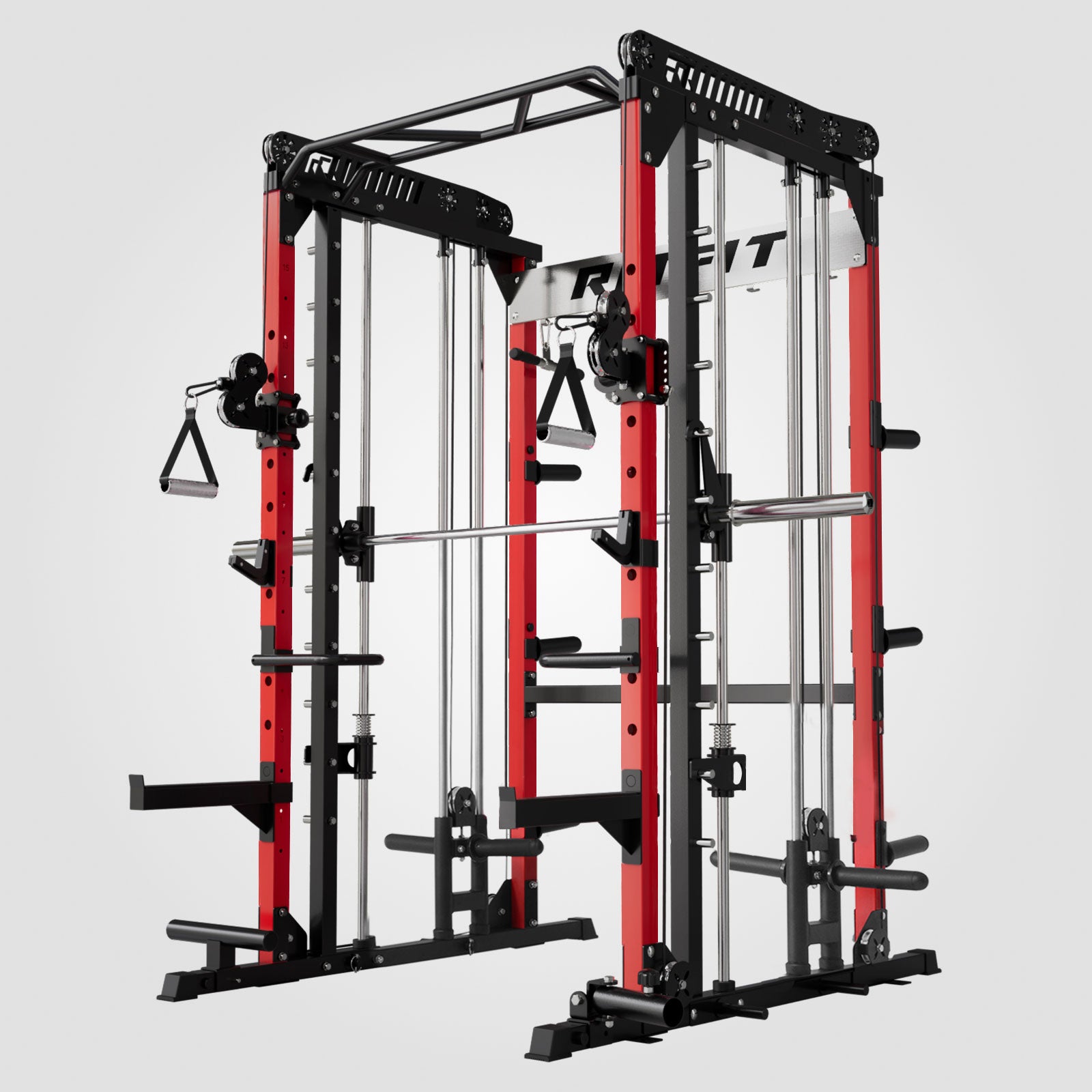
If you want one machine that supports guided squats plus broader strength training, explore the RitFit Smith machines for home gyms. For a complete all in one option, compare the RitFit M1 PRO Smith Machine Home Gym Package.
Common Mistakes to Avoid
- Assuming one squat is always better: The right choice depends on your goal, body, and equipment setup.
- Using too much weight too soon: Heavy loading without control increases the chance of poor movement and failed reps.
- Ignoring safety setup: Smith hooks and rack safety arms only help when they are set and practiced correctly.
- Forcing foot placement: Your stance should feel strong and controlled, not painful or locked into an unnatural pattern.
- Skipping free weight skill: Smith machine training is useful, but barbell skill still matters if your goal is free weight strength.
Final Recommendation: Smith Machine Squat or Barbell Squat?
Choose the barbell squat if your main goal is free weight strength, powerlifting skill, athletic carryover, or total body coordination. Choose the Smith machine squat if your main goal is guided leg training, solo home workouts, controlled volume, or a more predictable setup.
Many home gym lifters can benefit from using both. Barbell squats can build free weight skill, while Smith machine squats can add controlled leg volume without making balance the limiting factor.
Frequently Asked Questions
What is the main difference between a Smith machine squat and a barbell squat?
The main difference is bar control. A Smith machine squat uses a guided rail path, while a barbell squat requires you to control the bar freely. This changes balance demand, core involvement, stabilizer use, and how naturally your body can adjust during each rep.
Is the Smith machine squat easier than the barbell squat?
Yes. The Smith machine squat is often easier to learn because the bar path is fixed and balance demand is lower. This can help beginners focus on depth, tempo, and leg drive, but it does not remove the need for correct stance, bracing, and controlled loading.
Can Smith machine squats build muscle?
Yes. Smith machine squats can build muscle when you train with good range of motion, enough effort, and progressive overload. They are useful for controlled leg volume because the guided bar path lets many lifters focus more on quad and glute tension.
Are barbell squats better for strength?
Yes. Barbell squats are usually better for free weight strength because they train balance, bracing, bar path, and total body coordination. Smith machine squats can still build leg strength, but the strength skill is more specific to the guided machine movement.
Is the Smith machine squat bad for your knees?
No. A Smith machine squat is not automatically bad for your knees. Knee comfort depends on stance, depth, load, control, mobility, and how the fixed path matches your body. Stop if pain appears, reduce load, and adjust foot placement before continuing.
Should beginners start with Smith machine squats or barbell squats?
Beginners can start with either option, but Smith machine squats may feel more approachable for solo training. Barbell squats are better for learning free weight skill. The best beginner path is to learn control first, then progress toward the squat style that matches the goal.
Can Smith machine squats replace barbell squats?
Yes. Smith machine squats can replace barbell squats for general leg muscle training, especially in a home gym. They are not a perfect replacement for powerlifting, athletic carryover, or free weight skill because the fixed path reduces balance and stabilization demands.
Which squat is better for a home gym?
The better home gym squat depends on your setup. Choose a Smith machine if you train alone and want guided control. Choose a barbell squat setup if you have a rack, safety arms, enough space, and want stronger free weight skill development.
Conclusion
Smith machine squats and barbell squats are both worth using, but they are not the same tool. Use barbell squats for free weight strength and total body coordination, and use Smith machine squats for guided control, focused leg volume, and practical solo training.
The smartest home gym plan is not about choosing one forever. It is about matching the squat variation to your goal, equipment, safety setup, and ability to progress with clean form.
Disclaimer
This article is for general fitness education only and is not medical advice. If you have knee, hip, back, balance, or mobility concerns, consult a qualified health or fitness professional before changing your squat technique or loading strategy.
References
- Straub RK, Powers CM. A Biomechanical Review of the Squat Exercise: Implications for Clinical Practice. Int J Sports Phys Ther. 2024;19(4):490 to 501. doi:10.26603/001c.94600
- Saeterbakken AH, Olsen A, Behm DG, Bardstu HB, Andersen V. The short and long term effects of resistance training with different stability requirements. PLoS One. 2019;14(4):e0214302. doi:10.1371/journal.pone.0214302
- Krzysztofik M, Wilk M, Wojdala G, Golas A. Maximizing Muscle Hypertrophy: A Systematic Review of Advanced Resistance Training Techniques and Methods. Int J Environ Res Public Health. 2019;16(24):4897. doi:10.3390/ijerph16244897
- van den Tillaar R, Kristiansen EL, Larsen S. Is the Occurrence of the Sticking Region in Maximum Smith Machine Squats the Result of Diminishing Potentiation and Co Contraction of the Prime Movers among Recreationally Resistance Trained Males? Int J Environ Res Public Health. 2021;18(3):1366. doi:10.3390/ijerph18031366
- Serafim TT, de Oliveira ES, Maffulli N, Migliorini F, Okubo R. Which resistance training is safest to practice? A systematic review. J Orthop Surg Res. 2023;18(1):296. doi:10.1186/s13018 023 03781 x