








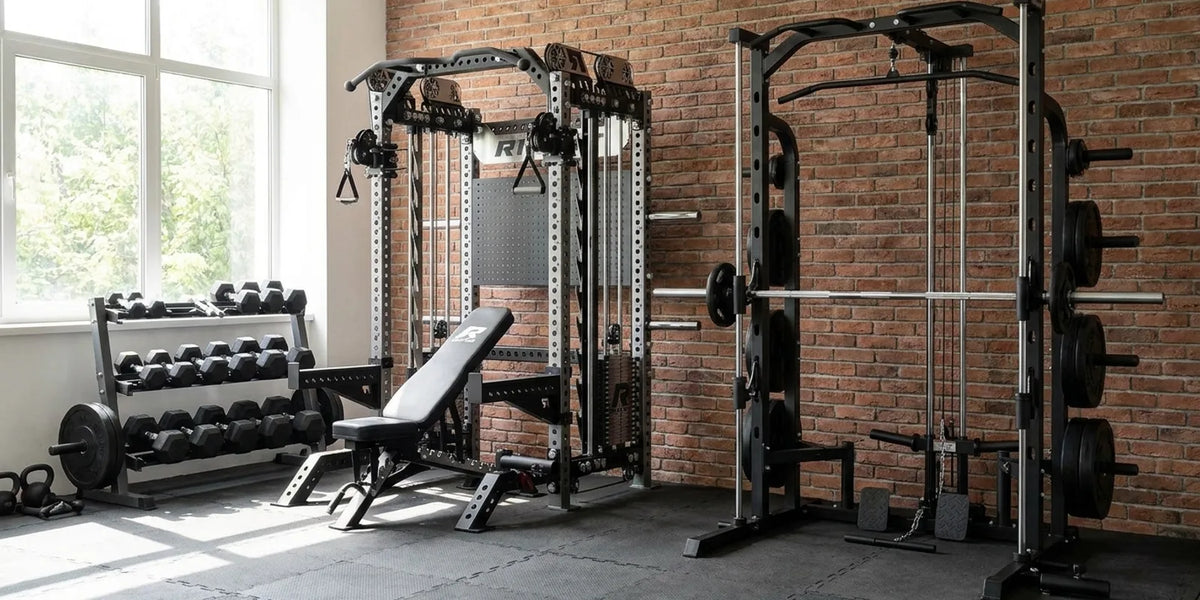
Smith machine vs functional trainer is the comparison most home gym builders run into, and the answer depends on one question: do you want the bar guided, or do you want cables that move freely? Both machines train the same muscles, but they solve different problems in a garage, basement or spare room.
This guide compares what each machine can and cannot do, what the training evidence says, and which type fits your ceiling and floor space. Recommendations stay inside the RitFit line so you can match a machine type to the way you train.
Quick Answer: A Smith machine is the better first machine if you train alone and want heavy squats, presses and rows with a guided bar path, while a functional trainer suits lifters who want free path cable work, single side training and a small footprint. If you want both in one frame, a cable equipped Smith machine covers both jobs.
Key Takeaways
- Type first: A Smith machine guides the bar on fixed rails for heavy squats, presses and rows, while a functional trainer uses cables for free path and single side work.
- Similar outcomes: Direct comparisons of 13 studies with 1,016 participants reported no difference between free weight and machine training for muscle size or maximal strength.
- Specificity matters: Strength gains follow the modality you train, so pick the machine that matches the lift you want to improve.
- Measure the room first: The RitFit Buffalo Wild stands 85.2 inches tall with a 28.9 sq ft footprint, and verified buyers report compact Smith machines fitting under 8 foot ceilings.
- One frame can cover both: A cable equipped Smith machine carries the guided bar and the cable station together, which usually costs less than two separate machines.
What Is the Difference Between a Smith Machine and a Functional Trainer?
A Smith machine guides a barbell on a fixed steel path, while a functional trainer pulls cables through free handles. That single design choice decides which lifts feel natural, how much weight you can handle alone, and how much floor space the frame demands.
- Bar or handle path: The Smith bar rides on rails and hooks into the uprights, while a functional trainer runs two independent pulleys that follow your hands.
- Load source: A Smith machine is loaded with plates on a barbell, and a functional trainer uses a weight stack or a plate loaded cable carriage.
- Resistance through the range: Barbell resistance shifts with your leverage, while cable tension stays more even across the range of motion.
- Training alone: The Smith bar can be hooked at set heights, while cable handles simply release when you stop pulling.
- Best lifts: Guided squats, bench presses and rows on one side, cable fly, unilateral row and kickback work on the other.
| Design point | Smith machine | Functional trainer |
|---|---|---|
| Movement path | Fixed rail path for the bar | Free path for each handle |
| Load | Plate loaded barbell | Weight stack or plate loaded cable |
| Top end resistance | Set by frame capacity and plates | Set by the stack or cable rating |
| Space demand | Frame plus room for the bar | Two uprights plus room for the cables |
| Typical use | Heavy squats, presses and rows | Rotational, single side and high rep work |
Comparison based on how each machine type is built and loaded, not on one specific model.
If heavy guided work is the plan, start with the Smith machine range. If free path cable work comes first, compare the functional training equipment lineup.
What Can a Smith Machine Do That a Functional Trainer Cannot?
A Smith machine holds a barbell on hooks, so you can rack it at any height without a spotter. A functional trainer cannot match that, because its resistance comes from cables and a stack instead of a plate loaded bar.
- Heavy guided compound lifts: Squats, bench presses and overhead presses keep a repeatable bar path, which makes a heavy set easier to repeat week to week.
- Bar hook positions: The RitFit Buffalo Wild Smith Machine offers 12 adjustable positions on each side, so the bar can be parked at the height that matches your setup.
- Spotter arms and J-hooks: Safety arms catch a missed rep, which matters most when you train alone in a garage or a basement.
- Frame capacity: That same frame is rated for 2,200 lb of structural load, so the steel is not the limit on a heavy squat.
- Barbell feel: Loading real plates onto a bar keeps the movement closer to the lifts you would do in a commercial gym.
The tradeoff is the fixed path: you cannot change the angle mid set or move through a diagonal pattern. The RitFit PSR05 2.0 Multifunctional Smith Machine shows the compact version of this setup, and the RitFit M3 Power Rack Cable Crossover Smith Machine shows the heavy frame version.
What Can a Functional Trainer Do That a Smith Machine Cannot?
A functional trainer moves each handle anywhere, so rotational, diagonal and single side work stay available. The guided Smith bar locks one path, which rules those free paths out.
- Independent pulleys: Each side runs its own cable, so you can train one arm or one leg at a time and address a strength gap on the weaker side.
- Pulley height: Moving the pulley up or down changes the line of pull, so one station covers high pulls, mid rows and low kickbacks.
- Even tension: Cable resistance stays steady through the range of motion, which suits high rep work and controlled positions.
- Attachment variety: Handles, ropes and bars multiply the exercise list without adding floor space.
- Two lifters at once: With a dual cable system, two people can train on the same frame at the same time.
The honest limit is load, because a cable station tops out well below a loaded barbell, so it supports heavy lifting rather than replacing it. See the cable machine range and the RitFit M1 Smith Machine with cable crossover for frames that carry both setups.
Does the Machine You Train On Change Your Results?
Machine type matters far less than the training work you do. A 2023 meta-analysis of 13 studies with 1,016 participants found no difference between free weight and machine based training for hypertrophy or maximal strength in direct comparisons, while reporting that strength gains stayed specific to the modality trained.[1]
- Movement pattern: In one 8 week study, 120 male participants who trained squats improved squat jump and countermovement jump performance while the leg press group did not, which points to the trained pattern driving the transfer.[2]
- Beginners: One 10 week trial with 36 novice male lifters found similar gains in muscle size, strength and functional ability whether they trained on machines, on free weights, or changed over from machines to free weights partway through.[3]
- Practical read: Choose the machine that matches the lift you want to improve, then build the rest of your plan around your joints, your space and the way you train.
This does not make machine choice irrelevant, because the choice should follow your goal and your constraints rather than a ranking of machines. If the goal is a heavy barbell squat, train the barbell squat, and if the goal is shoulder friendly volume, cable work earns its place.
Which One Fits Your Room and Ceiling Height?
Measure the ceiling before you compare machines, because frame height decides what you can actually buy. The RitFit Buffalo Wild stands 85.2 inches tall with a 28.9 sq ft footprint, which fits most garages but not every basement.
- Clearance above the frame: Leave a few inches above the tallest point for pull-ups and for lifting the bar on and off the hooks.
- Bar travel: A guided bar needs working room in front of the frame, while a cable station needs room for the handles to travel.
- Low ceilings: Verified buyers of the RitFit PSR05 2.0 report the rack fitting in a room with 8 foot ceilings, which is the situation that rules out taller frames.
- Shared space: A two person garage gym needs clearance on both sides, so budget extra width even when the footprint number looks small.
- Delivery day: Check door width, stair turns and box count before the freight truck arrives, because these frames ship on a pallet.
Owners also report that the Smith bar glides on a bearing system while the lat pulldown carriage needs around 20 pounds of load before it moves smoothly. That kind of detail is worth reading in verified buyer reviews before you commit to a frame.
"Solid all in one rack. The pulleys and smith machine are so smooth. Ample room to store attachments and barbells. Time consuming assembly but easy"
Khristian P. Verified Buyer, RitFit M1 PRO Multi-Functional Smith Machine with Cable Crossover System and Squat Rack for Home Gym
Which Machine Type Fits Your Buyer Profile?
Match the machine type to the lifts you want to be strong at, not to the longest feature list. The matrix below splits the decision by how you train, and every option stays inside the RitFit line.
| Your situation | Machine type to buy | Why it fits |
|---|---|---|
| You train alone and want heavy squats, presses and rows | Smith machine | The bar hooks at set heights and spotter arms catch a missed rep. |
| You have a small room and want variety and single side work | Functional trainer or dual cable system | Two pulleys cover more exercises per square foot than one bar path. |
| Two people share the same garage | Dual cable system | Independent cables let both lifters work at the same time. |
| You want heavy barbell work and cable work on one frame | Cable equipped Smith machine, such as the RitFit M2 Modular Home Gym Smith Machine | One frame carries the guided bar and the cable station. |
| Your ceiling is under about 8 feet | The shortest compact frame in the lineup | Frame height limits the purchase before price does. |
Decision matrix limited to RitFit machine types and frames, sorted by how you train rather than by model number.
If two rows describe you, weight the answer toward the lift you most want to improve this year. The machine type you will actually use beats the type that covers the most features on paper.
Is It Worth Paying More for a Machine That Does Both?
One frame with both a guided bar and cables usually costs less than two separate machines. Whether the premium is worth it depends on how often you would use the second modality and how much floor space you would give up.
- Value: A single frame covers a guided bar station and a cable station, so you pay once for steel, freight and assembly instead of twice.
- Upgrade path: Model specific attachments such as lat pulldown and leg hold down bundles extend the same frame later, which spreads the cost over a longer period.
- Load style: Some models ship with a weight stack and others take plates, so decide how you want to load the cables before you buy.
- When to skip it: If you only ever squat and press, a simpler guided frame covers your training and leaves more budget for plates.
- When to pay up: If two people train in the same garage, or you rotate between heavy compounds and cable volume, the combined frame earns its space.
Parts of the RitFit line already work this way, with the M2, the M1 and the Buffalo Wild combining a guided bar and a cable station on one frame. Check the attachment fit list for the exact model before ordering any accessory, because most add-ons are built for a single frame.
"The RITFIT M2 3D Pro is a solid budget-friendly all-in-one home gym that works as a half-rack, a dual-cable functional trainer, lat-pulldown / low row machine, and perhaps the most unique feature: A 3D smith machine that can be used in 3D mode or as a standard fixed smith machine."
Eugene, Home Gym Equipment Reviewer, RITFIT M2 3D Pro Modular Home Gym Review - Good value?
The review below walks through a combined frame in detail, including how the 3D Smith bar behaves under load.
FAQs About Smith Machine vs Functional Trainer
Can a functional trainer replace a Smith machine?
No. A functional trainer pulls from cables with handles that travel freely, so it cannot carry a loaded barbell for heavy squats or bench presses. A Smith machine guides the bar and lets you hook it at set heights, which is what makes training alone near failure realistic.
Is a Smith machine as effective as free weights?
Training evidence points to similar outcomes for muscle size and strength when the workload is matched. What changes is transfer, because strength gains show up best in the movement style you practice, so a guided squat builds a strong guided squat more than it builds a heavy free weight squat.
Which builds more muscle, a Smith machine or a functional trainer?
Both build muscle, because growth responds to progressive overload rather than to the machine type. A functional trainer makes high repetition, low joint stress work and single side training easier to program, while a Smith machine makes heavy squats, presses and rows easier to load and safer to finish alone.
Do I need both a Smith machine and a functional trainer?
No, you do not need two separate machines if floor space or budget is limited. Several RitFit setups pair a guided Smith bar with a dual cable system on one frame, so heavy compound lifts and cable work share a footprint, and the money saved can go into plates and attachments.
How much ceiling height do these machines need?
Plan for clearance above the tallest point of the frame plus room to move the bar or the handles. The RitFit Buffalo Wild stands 85.2 inches tall, and verified buyers report fitting a compact Smith machine under 8 foot ceilings, so measure your lowest beam before ordering.
Are these machines safe to use alone at home?
A Smith machine is the easier one to train alone on, because the bar hooks into the uprights at set heights and spotter arms catch a missed rep. A functional trainer is also solo friendly since the handles move freely and you can let go, though heavy cable work still needs a controlled setup.
Which machine type should a first time buyer choose?
A first time buyer who trains alone should choose a guided Smith machine, because the bar hooks at set heights and the spotter arms make solo sets safer. A buyer who already trains with cables or works in a very small room gets more from a functional trainer.
Conclusion
A Smith machine and a functional trainer both build muscle, so the choice comes down to how you train. Pick the guided bar if heavy compound lifts performed alone matter most, and pick the cable station if free path variety and single side work matter most, while a cable equipped RitFit frame covers both on one footprint.
Measure your ceiling and floor space before you order, then check the current RitFit discount guide for ways to put the savings into plates and attachments.
Disclaimer
This article is for general information about strength equipment and does not provide medical advice or a personalized training plan. Consult a qualified professional before starting a new training program, especially if you have an injury or a health condition.
References
1. Haugen ME, Vårvik FT, Larsen S, Haugen AS, van den Tillaar R, Bjørnsen T. Effect of free-weight vs. machine-based strength training on maximal strength, hypertrophy and jump performance - a systematic review and meta-analysis. BMC Sports Sci Med Rehabil. 2023;15(1):103. doi:10.1186/s13102-023-00713-4. PMCID: PMC10426227
2. Wirth K, Keiner M, Hartmann H, Sander A, Mickel C. Effect of 8 weeks of free-weight and machine-based strength training on strength and power performance. J Hum Kinet. 2016;53:201-210. doi:10.1515/hukin-2016-0023. PMCID: PMC5260589
3. Aerenhouts D, D'Hondt E. Using Machines or Free Weights for Resistance Training in Novice Males? A Randomized Parallel Trial. Int J Environ Res Public Health. 2020;17(21). doi:10.3390/ijerph17217848. PMCID: PMC7662789





