A squat harness for cable machine leg work is the attachment that moves the load off your grip and your spine and onto your hips, so your legs and glutes take the set. Wearable cable attachments do the same job for the ankle, thigh, and wrist, which is why they matter when a limb gives out before the muscle does.
This guide covers what each one does, how to judge padding, stitching, hardware, and load rating, and how to check fit before you order.
Quick Answer: A squat harness for cable machine training attaches the load to your hips, while ankle straps, thigh straps, and wrist cuffs attach it to a limb, so you can train legs and glutes when grip or spinal loading is the limiting factor. Choose by padding, ring size, closure quality, and load rating.
Key Takeaways
- Wearable means hands free: ankle straps, thigh straps, wrist cuffs, and squat harnesses all move the pull onto your body instead of into your palm.
- Placement changes the result: a six exercise comparison in 15 trained women rated cable kickbacks above the leg curl and the Nordic hamstring exercise for gluteus maximus activation.
- The strap is the weak link: padding, stitching, ring width, and closure overlap decide how long the attachment survives under a cable stack.
- Fit comes before brand: measure the limb, the strap overlap, and the ring opening your clip will use.
- Handles still have a job: when your grip holds, a double D handle or a straight bar gives better control than any cuff.
What Counts as a Wearable Cable Attachment?
A wearable cable attachment is any connector that straps to your body instead of into your hands. Ankle straps, thigh straps, wrist cuffs, and squat harnesses all fit that description.
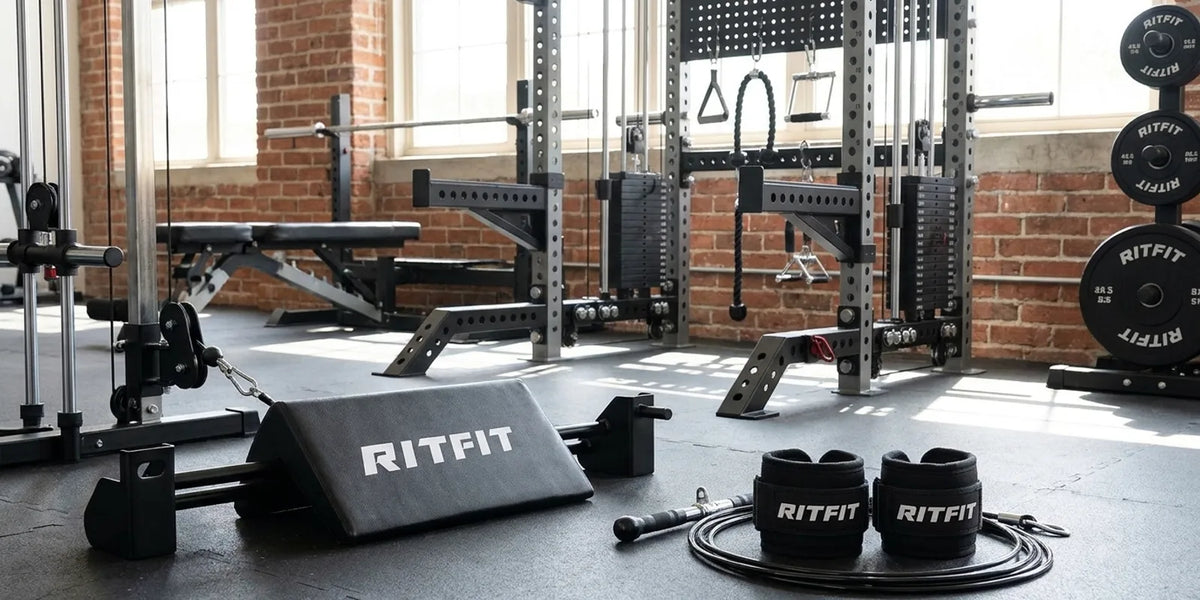
- Ankle strap: a padded cuff with a D-ring that clips to a low pulley for kickbacks, hip extension, and hamstring work.
- Thigh strap: a wider band that wraps the upper leg for hip abduction and adduction sets.
- Wrist cuff: a padded wrist wrap with a ring, used when your grip fails before your arms do.
- Squat harness or belt squat attachment: a hip belt that links to a cable or chain so you squat without a bar across your back.
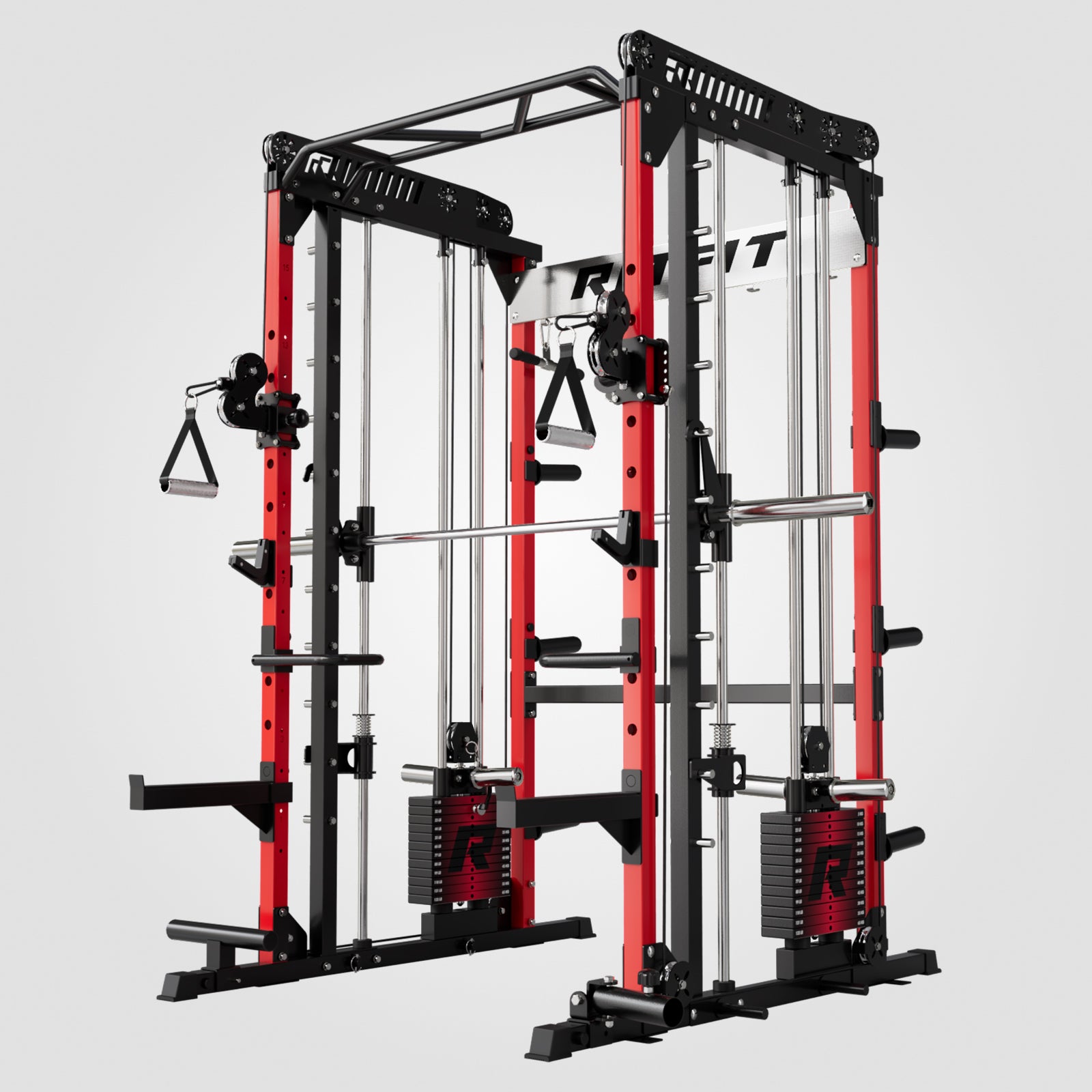
Most home setups start with one cable station and grow from there. The RitFit cable machine collection covers the machines, and the RitFit safe cable machine attachments cover the hand held side of the same system.
Buy the accessory for the problem you actually have. If your hands quit first, a wrist cuff solves it, and if your lower back quits first, a harness does.
How Do Ankle Straps Change Glute and Hamstring Training?
Ankle straps change glute and hamstring training by keeping the cable line below the knee for the whole set. A bare cable end cannot stay on your ankle through a full range of motion.
A six exercise comparison tested 15 resistance-trained women at 75% of estimated 1RM using electromyography. Cable kickbacks were among the movements that produced significantly greater gluteus maximus activation than the leg curl and the Nordic hamstring exercise.[1]
Resistance level and attachment point matter just as much as the exercise choice. In one trial, the stiffest band positioned around the forefeet raised gluteus maximus activity by 68% and gluteus medius activity by 83% compared with squatting with no band at all.[2]
- Cable kickbacks: clip in at ankle height and drive the leg back, so the cuff carries load through hip extension rather than through your hands.
- Standing hip extension: keep the torso quiet and let the hip travel, which is the pattern a cable holds better than a machine pad.
- Hip abduction with a thigh strap: move the band above the knee when you want the pull to sit higher on the leg.
Keep working weight inside the range where the cuff does not rotate or pinch. A strap that slides under load is telling you the tension has outgrown the padding.
Why Do Wrist Cuffs Beat Handles When Grip Fails First?
Wrist cuffs beat handles when your grip fails before the target muscle does. The padded wrap moves the pull to the wrist, so your forearms stop setting the ceiling on the set.
Wrist cuffs for cable machine work clip into the same carabiner as any handle, usually on a high pulley for face pulls and pull-throughs or a low pulley for curl variations. The cuff spreads force across the wrist, so the ring does not dig into the joint.
- Better for: high-rep pulling, curl variations, and any set where your hands quit first.
- Worse for: heavy rows and pulldowns, where a fixed handle gives more control of the path.
- Middle ground: a RitFit lat pulldown attachment keeps the load in your hands but changes the grip angle.
Wrist cuffs and handles are not competing products. Most lifters end up owning both and switching by load.
How Do You Load Legs Hard Without Loading Your Spine?
You load legs hard without loading the spine by hanging the resistance from your hips instead of your shoulders. A squat harness or belt squat attachment does exactly that on a cable or chain.
The RitFit AT03 belt squat attachment fits 2x2, 2x3, and 3x3 racks and links a hip belt to a chain, so the load hangs between your legs on the way down. That makes it the closest cable-side answer to a squat harness for home setups.
- Use it when: a barbell back squat irritates your lower back or you train alone without a spotter.
- Use it for: high-volume squat work, tempo reps, and drop sets you want to end on your own terms.
- Skip it when: the goal for the day is maximal spinal loading, which a belt squat cannot provide.
"Squats are my favorite exercise, but a lot of people can't do them because of various lower-back issues. In that case, the leg press is also a really good exercise for building the thigh. It baffles me that so many people don't think the leg press is useful. It's such a simple movement that works so well."
John Meadows, IFBB Pro Bodybuilder and Coach, Mountain Dog Diet, Mountain Dog Training for Legs, Muscle & Fitness
How Do You Choose Padding, Stitching, and Hardware That Last?
Padding, stitching, and hardware decide how long a wearable attachment lasts, so judge those three before color or price. A strap that slips costs more than a padded one that holds.
- Padding: neoprene dries fast and stays put, while synthetic shearling feels softer against thin ankles. One equipment guide notes that mesh backed padding helps sweat dry between sets.
- Stitching: double stitched nylon is the usual durability marker, and single stitching at the ring is the first thing to fail.
- Closure: a hook-and-loop closure needs at least 2 inches of overlap to hold under tension, and a double loop helps smaller ankles secure the slack.
- Hardware: look for a welded steel D-ring wide enough for your clip, not a bent wire loop that opens under load.
- Load rating: the strap is usually the limit rather than the machine, so match the rating to the cable stack you actually pull.
Value sits in the middle of the range, not at the bottom. A mid priced strap with welded hardware outlasts two cheap ones.
Does the RitFit P3 Power Cage Fit These Attachments?
The RitFit P3 Power Cage with a smooth cable system is rated to 1200 lb and runs aluminum pulleys, so the machine runs out of attachment options long before it runs out of capacity. Match the cuff rating to the load you actually pull rather than to that 1200 lb number.
"Definitely worth the price for what you get. Assembly was easy. I did it by myself. Took around 2 1/2 hours. Will definitely be ordering more equipment from RitFit!"
Darwin, Verified Buyer, RitFit P3 Power Cage 1200lbs with Smooth Cable System & Aluminum Pulleys
How Do You Check Fit and Sizing Before You Order?
Check fit before you order by measuring the limb and the ring opening your clip will use. Wrong numbers turn a working cuff into a strap that rotates on every rep.
- Step 1: measure the circumference of your ankle or thigh at the exact spot the strap will sit, then add room for 2 to 3 inches of closure overlap.
- Step 2: measure the inner width of the ring and compare it with your carabiner, which usually needs around 1 to 1.5 inches of opening.
- Step 3: check the lowest pulley height on your cable station, because a cuff you cannot reach from the low pulley is a cuff you will not use.
One trial of resisted side stepping in women found gluteus maximus activity in the concentric phase rose 45.3% when the band moved from the knees to the ankles, and only 17.8% more when it moved from the ankles to the feet.[3] Where the cuff sits changes the moment arm and therefore what the set trains.
Fit problems show up as rotation, pinching, or a closure that creeps open mid set. Fix those three before you add a single plate.
When Is a Double D Handle or Straight Bar the Better Choice?
A double d handle or straight bar wins when your grip holds and you want control of the joint angle. Wearable attachments trade that control for reach.
A double d handle attachment gives you two independent handles and a neutral grip, which suits rows, face pulls, and pulldowns. A double hook straight bar cable attachment locks the width, which is what you want for pressing and curl variations where the elbows stay in one path.
A curl assist chest plate works on the same principle for the arms. The plate braces against your chest and anchors the cable, so your biceps carry the load instead of your lower back or your grip.
- Choose a handle when: the target muscle sits above the wrist and can already hold the weight.
- Choose a cuff when: the hand, ankle, or spine quits first, which is the case this guide covers.
- Keep both in the drawer: the RitFit cable machine handles and the RitFit exercise handles for cable machine cover most of the grip positions you will need.
Attachment variety is the cheapest way to add exercise options to a small home gym. One pulley plus several attachments beats a second machine for most garages.
5 Common Mistakes That Break Wearable Cable Attachments
Most wearable cable attachments fail from handling mistakes rather than from load. Five habits shorten their working life.
- Never cleaning the closure: grit and lint cut the holding power of a hook-and-loop closure, so rinse the strap and let it air dry.
- Overloading a padded cuff: if the ring deforms or the strap rotates, the load is past what the padding was built to carry.
- Leaving the strap clipped in: stored cable tension keeps the closure under load between sessions.
- Ignoring the machine rating: the cable system sets the ceiling, so never exceed the capacity listed for the machine.
- Hot water and direct sun: heat breaks down neoprene, elastic, and the backing behind the padding.
When Should You Stop the Set?
Stop the set when the cuff rotates on the limb, when the closure creeps open, or when the ring starts to bend, because each signal means the strap has left its working range.
- Rotating cuff: reduce the load or reposition before the next rep.
- Creeping closure: take the strap off and clear the closure instead of pushing through the set.
- Bent ring or frayed stitching: retire the attachment rather than risk a sudden release under tension.
- Pinching or numbness in the limb: end the set and loosen the strap immediately.
Do Cable Attachments Replace Machine Leg Training?
Cable attachments do not replace machine leg training, because machines hold ranges a cable cannot. The two cover different jobs in the same week.
A cuff and cable set gives you free path hip extension, kickbacks, and abduction with steady tension from a low pulley. A leg press or a hack squat holds the torso in place and lets you push heavy with both legs, which is the easier way to add total load.
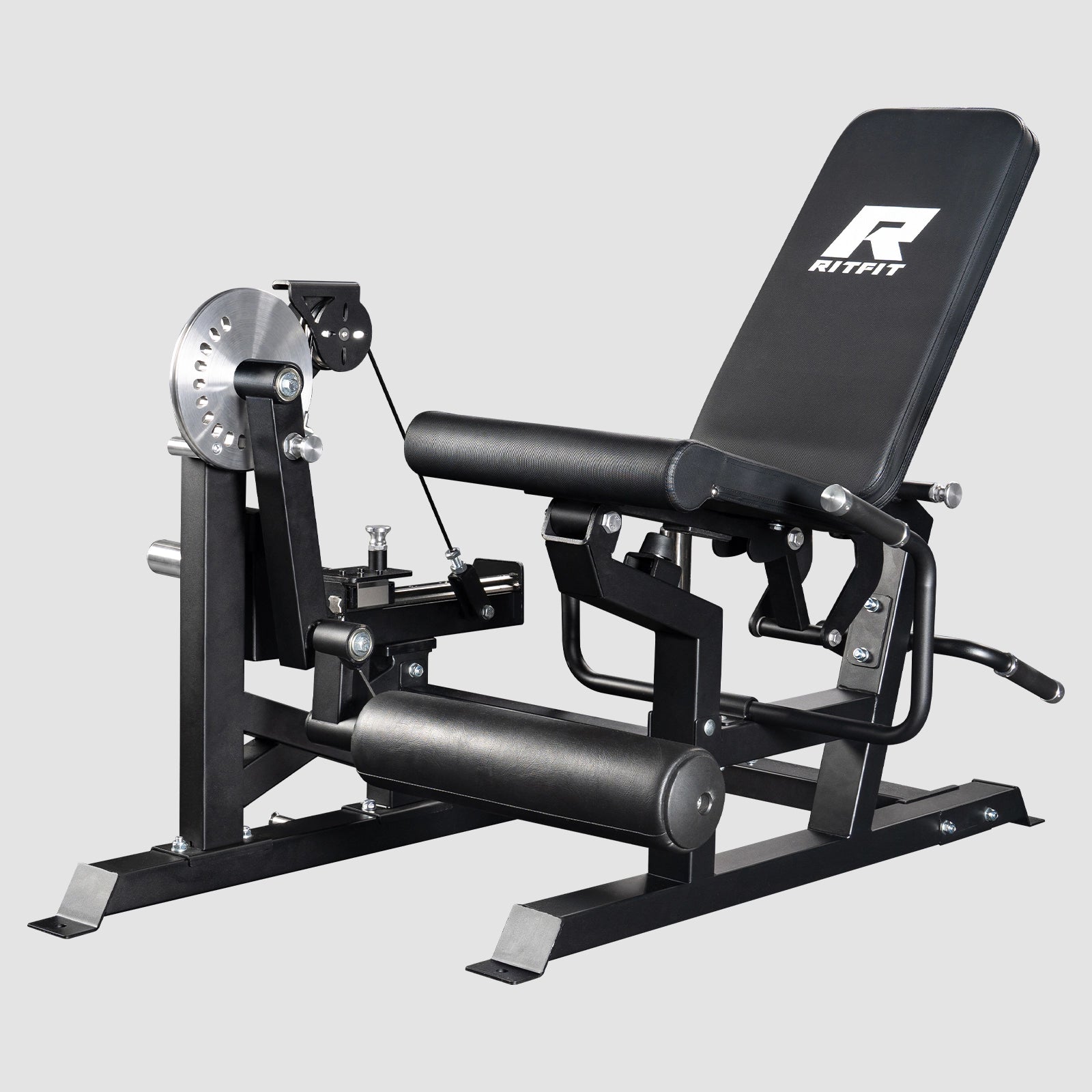
If your space allows one machine next to a cable station, the RitFit BLP01 3 in 1 leg press and hack squat machine covers both patterns. Rack owners can add the RitFit AT02A hack squat rack attachment instead and keep a single footprint.
FAQs About Cable Squat Harnesses and Wrist Cuffs
What is a squat harness for cable machine leg training used for?
A squat harness for cable machine work moves the load to your hips and pelvis so your legs and glutes take it instead of your spine or your grip. Belt squat attachments and harness style connections let you train knee and hip extension when a barbell on your back is uncomfortable.
Do wrist cuffs for cable machine exercises replace regular handles?
Wrist cuffs for cable machine pulling replace a handle only when grip is the limiting factor. They wrap the wrist with a padded cuff and a ring, so the pulling force reaches your arms without your fingers failing first. For heavy rows and pulldowns a hand held handle still gives better control.
Can you do cable kickbacks without ankle straps?
No. Cable kickbacks need the cable attached below the knee, and a bare cable end will not stay on your ankle through a full set. An ankle strap or a padded cuff spreads the load over the lower leg and keeps the cable from cutting in. A thigh strap does the same job for hip abduction work.
What size D-ring should a cable attachment have?
Match the D-ring opening to your carabiner rather than to the cable itself. Most cable machine clips need roughly 1 to 1.5 inches of opening, so measure the ring inner width before you buy. A ring that is too small binds the clip, while an oversized ring twists under load.
How much weight can ankle straps hold?
Most padded ankle straps are built for cable stacks and light plates rather than heavy barbell loading. Treat the strap as the weakest link and keep cable kickbacks and hip extension work in a range where the cuff does not slide or pinch. Stop adding load when the strap rotates on your ankle.
Are double D handle attachments better for back work?
A double D handle attachment gives you a neutral grip that many lifters find easier on the shoulders than a straight bar, so it suits rows, face pulls, and pulldowns. A double hook straight bar cable attachment holds a fixed width and works better for pressing. Pick the handle that matches the joint angle you want.
Conclusion
Wearable cable attachments solve one narrow problem: the limb or the spine gives out before the muscle does. Match the attachment to the limb you are strapping, then check padding, stitching, ring width, closure overlap, and load rating before you buy.
Start with the piece that matches your weakest link, keep a double D handle or straight bar for the days your grip holds, and raise the load only when the strap stops sliding. If you are building a home setup from scratch, read the RitFit discount guide before you check out.
Disclaimer
This article covers general strength training equipment and technique, not medical advice, and it does not diagnose or treat any condition. Consult a qualified professional before starting a new training program, especially if you have a back, joint, or wrist concern.
References
1. Stevens BM, Nichols BR, Doty HI, Korak JA. Muscle Activation Patterns of the Proximal Medial and Distal Biceps Femoris and Gluteus Maximus Among 6 Hip Extension and Knee Flexion Exercises in Trained Women. Int J Exerc Sci. 2022;15(1):1179-1189. doi:10.70252/DWMB8342. PMCID: PMC9362892
2. Martins EC, Steffen LB, Gomes D, Herzog W, Haupenthal A, de Brito Fontana H. Looped Elastic Resistance during Squats: How Do Band Position and Stiffness Affect Hip Myoelectric Activity?. J Funct Morphol Kinesiol. 2022;7(3). doi:10.3390/jfmk7030060. PMCID: PMC9396979
3. Lewis CL, Foley HD, Lee TS, Berry JW. Hip-Muscle Activity in Men and Women During Resisted Side Stepping With Different Band Positions. J Athl Train. 2018;53(11):1071-1081. doi:10.4085/1062-6050-46-16. PMCID: PMC6333220