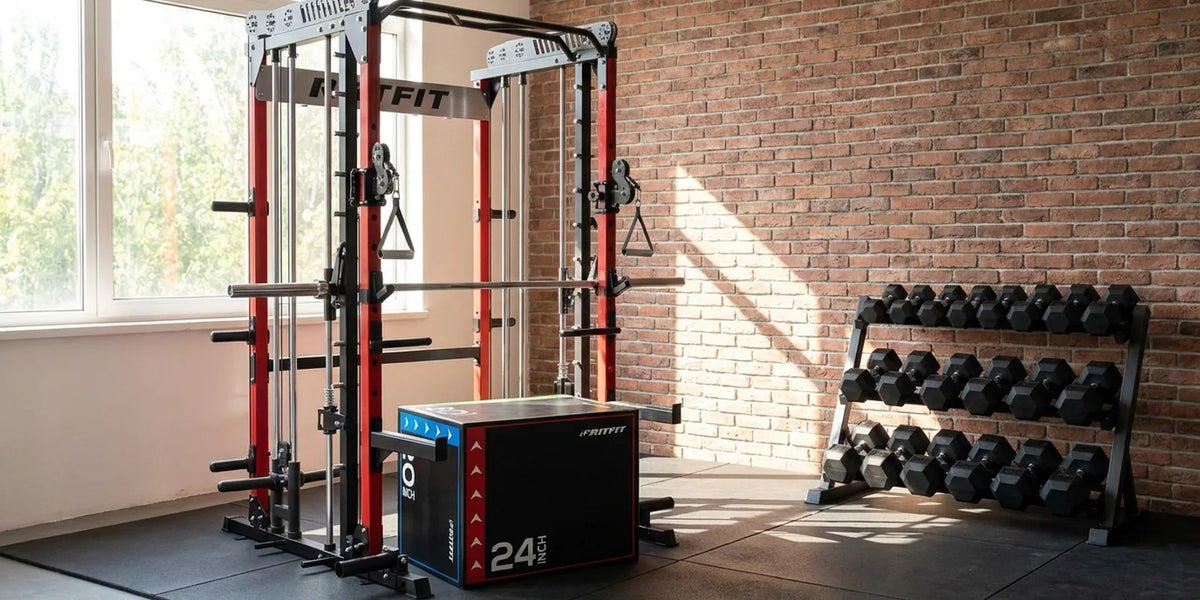
Smith machine step ups are done by setting a box inside the rack, resting the bar across your upper back, and driving up through one foot at a time. The guided bar takes balance out of the equation so your quads and glutes do the work.
This guide covers box height, bar setup, and step-up form for glute and quad focus, plus loading, common mistakes, and clear stop rules. It suits home gym owners training alone in a garage or a shared family gym.
Quick Answer: To do smith machine step ups, set a box so your working knee sits near 90 degrees at the top, unrack the bar across your upper back, and drive through the front heel to full lockout. Keep the back leg as a kickstand, lower under control, and add load only when every rep on both legs looks the same.
Key Takeaways
- Muscles worked: The quads and glutes lead every rep, with the hamstrings, calves, and hip stabilizers supporting the single-leg step-up pattern.
- Box height: Pick a platform where the working knee sits near 90 degrees at the top so hips and knees share the load.
- Glute bias: A soft forward lean and a heel drive push effort toward the gluteus maximus, while an upright posture favors the quads.
- Loading: Start with the empty bar and add weight only when every rep on both legs looks the same.
- Stop rules: Knee or hip pain means end the set, lower the box, and drop the load before trying again.
Work the Quads, Glutes, and Supporting Muscles
Smith machine step ups train the quadriceps and gluteus maximus as the prime movers, with the hamstrings, calves, and hip stabilizers supporting each rep.
One EMG study found single-leg step-ups to about tibial height produced peak quadriceps activation of 207% MVIC, the maximum voluntary isometric contraction standard, with maximum knee flexion of 101 degrees in healthy young adults [1]. A systematic review of 23 studies found the lateral step-up ranks among the highest gluteus maximus activators at 79-113% MVIC [2].
- Quadriceps: The front thigh extends the knee on every drive upward, and the single-leg step-up keeps that demand high through a full range of motion.
- Gluteus maximus: The hip extensors finish each rep at the top, and step-up variations rank among the best bodyweight options for glute activity.
- Supporting muscles: One fitness magazine guide notes the hamstrings, calves, and balance all chip in while the working leg stays a closed kinetic chain from foot to hip.
- Balance demand: Coordination improves as one leg stabilizes the body, and the guided bar lowers the balance tax so the target muscles stay the limiting factor.
Posture and foot placement decide which of these muscles finishes the rep, so small setup changes steer the movement toward glutes or quads. Exact activation varies with box height and tempo, so treat the study values as reference points rather than guarantees.
See Why the Smith Machine Suits Step-Ups
The smith machine suits step-ups because the bar rides a fixed vertical path while you balance on one leg, and the hooks let you rack it at any height. That combination keeps the load on the working leg instead of on staying upright. Lifters who train step ups with a smith machine can push hard sets safely in a garage gym where nobody is spotting.
- Fixed bar path: The rail keeps the load vertical so the working leg controls the rep without drifting forward or sideways.
- Instant racking: A short twist re-hooks the bar at the top or bottom, which matters most when you train alone.
- Repeatable reps: The bar follows the same line every time, so differences between legs show up clearly and progress is easy to track.
The same logic applies to heavy leg work in general, and experienced lifters lean on the frame for exactly this reason.
"Next, I do Smith machine squats for the quads and glutes. Here I get as deep as I can and explode out of the hole. Doing these on the Smith allows me to push my last set to failure without worrying about dumping the bar."
Jeff Nippard, Science-Based Natural Bodybuilder and Powerlifter, JeffNippard.com, Jeff Nippard's Science-Backed Leg Workout for Massive Quads (Men's Health UK)
Set Up the Smith Machine, Box, and Bar
Set the box before the bar so your working knee lands near 90 degrees with the foot flat on top, then position the bar across your upper back. One guide suggests choosing a platform where the knee forms about a 90-degree angle at the top of the movement. Choosing box height for step-ups starts with that knee angle and adjusts from there.
- Box height: Stand on the box and look for a knee angle near 90 degrees at the top, lowering the platform if the hips rise first.
- Bar height: Set the bar so you unrack it from mid to upper back height with one controlled step, never from a deep squat.
- Hook position: Confirm where the bar locks out at the top and leave room to finish each rep before the bar meets the stops.
- Foot placement: The working foot sits fully on the box under the bar line, with the heel heavy from the first inch.
Match Box Height to Your Bar Lockout Range
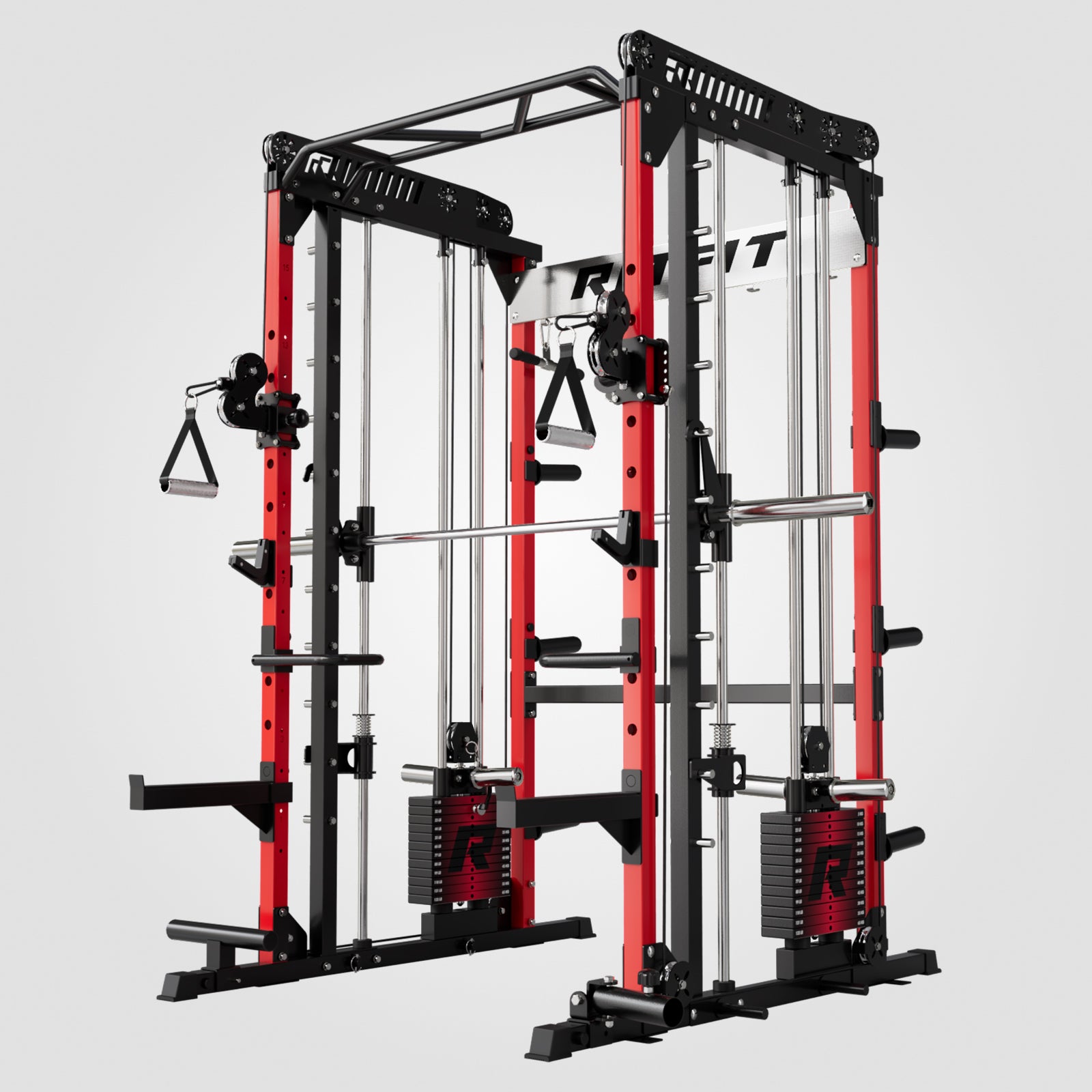
Every smith machine locks the bar out within a fixed travel range, so a box that is too tall turns each rep into a partial press before the leg finishes. Whatever frame you own, check its hook and stop positions first, and on a guided frame like the RitFit M1 PRO make sure the top of your step finishes just under full extension.
Lifters comparing frames for this setup can browse the Smith Machine collection, and the Multifunctional Smith Machine offers the same guided platform in a different footprint.
Execute the Correct Step-Up Form, Step by Step
A clean smith machine step-up moves in five steps, from stance to lockout, with the front leg doing nearly all the work. Keep the tempo slow enough that the back foot never jumps in to help.
- Step 1: Set the stance. Plant the whole working foot on the box, heel heavy, with the working knee tracking over the laces.
- Step 2: Unrack the bar. Stand tall, rotate the bar out of the hooks, and settle most of your weight onto the front leg before you move.
- Step 3: Lower under control. Bend both knees until the front thigh is about parallel to the floor and the back knee hovers just above the ground.
- Step 4: Drive through the heel. Push the box away through the front foot until the working leg is straight, keeping the torso quiet.
- Step 5: Reset and switch. Finish every rep on one leg before switching sides, so both legs get the same training load.
Knee mechanics stay predictable when you own the descent, because the tibiofemoral joint contact points glide from posterior to anterior as the knee extends through the rep. A biomechanical imaging study of 21 healthy adults found this motion pattern is similar in both knee compartments during a step-up [3].
Trainers often recommend treating the back leg like a kickstand, there for balance rather than power, which keeps clean step-up form honest from the first rep to the last.
Bias the Step-Up Toward Glutes or Quads
Smith machine step ups for glutes work best with a soft forward lean and a drive through the front heel, while an upright posture shifts effort toward the quadriceps. Small changes in hip angle decide whether the hip extensors or the knee extensors finish the rep. Test both styles with bodyweight before you add plates.
- Glute emphasis: Lean the torso slightly forward, reach the back knee low, and push the floor away through the heel so the gluteus maximus finishes hip extension.
- Quad emphasis: Stay tall, keep the shin vertical, and drive through the midfoot so the knee extensors own the lockout.
- Lateral option: A lateral step-up onto the box shifts demand toward the knee extensors and ankle plantar flexors, which suits lifters chasing quad and calf focus.
One biomechanics study in older adults found the forward step-up placed greater demand on the hip extensors, while the lateral step-up shifted demand toward the knee extensors and ankle plantar flexors [4]. That ranking came from 21 participants with a mean age of 74.7 years, so treat it as a direction rather than a rule for every lifter.
Load, Progress, and Program Your Step-Ups
Start smith machine step ups with the empty bar and add load only when every rep on both legs looks the same. Most lifters do well with 2 to 4 sets of 6 to 12 reps per leg, twice a week, leaving at least two days between hard sessions. Add a plate when all sets finish clean and the last rep still looks like the first.
- Weight selection: Treat the bar as your baseline and earn plates with clean reps, because a heavy box step-up punishes sloppy form quickly.
- Progression: Add reps first, then load, then range of motion by raising the box height in small steps.
- Frequency: Twice weekly fits most home gym schedules, either as the main lower body movement or after squats as accessory work.
- When to add weight: Move up a plate when every set completes with matching reps on both sides and no heel lift.
Substitute Movements When Step-Ups Are Not Available
If the box or the smith machine is taken, the split squat, Bulgarian split squat, and reverse lunge train the same single-leg pattern with free weights or bodyweight, and hip thrust work covers glute focus on days when stepping bothers the knees.
Lifters building from scratch can start with the RitFit Home Gym Package M1 Smith Machine, which bundles the machine, bar, and plates. Larger builds step up to the M3 Power Rack Cable Crossover Smith Machine, while the Cable Machine lineup covers glute finishers and the RitFit Home Gym Package PSR05 Smith Machine gives budget builds a second smith machine route.
"Super nice machine, small foot print, big features!"
Brent B. Verified Buyer, RitFit PSR05 2.0 Multifunctional Smith Machine Power Rack with LAT-Pull Down System
Avoid These Common Mistakes
Most step-up mistakes come from letting the box or the back leg do the work, and they show up as knee strain or stalled progress. Fixing them early keeps the load on the quads and glutes where it belongs.
- Box too high: A platform above hip height turns the set into a hip flexor stretch and pushes the knee past what you control.
- Back-leg push-off: If the rear foot jumps the rep up, the working leg loses most of its training effect.
- Heel lift: A rising heel shifts load into the knee, so keep the heel heavy through the full range.
- Rushing the descent: Dropping fast borrows stretch reflex instead of muscle, and it hides form breakdown until the knee complains.
- Loading too soon: Plates added before reps are clean magnify every mistake, especially in a shared family gym where younger lifters copy what they see.
Know When to Stop and Scale Back
Stop the set the moment knee, hip, or back pain appears, because sharp or growing pain is a signal to end the session rather than push through. Scale back by lowering the box height, dropping the load, or switching to a split squat before you test the movement again. Pain that returns session after session means unloaded practice only until a qualified professional clears the movement.
- Sharp pain: End the set immediately and recheck box height and foot placement before another attempt.
- Dull knee ache: Lower the box, shorten the range, and cut the load for the next session.
- Form breakdown: When the hips shift or the heel lifts rep to rep, stop while the reps are still clean.
FAQs About Smith Machine Step-Ups
Are smith machine step-ups good for glutes?
Yes. Smith machine step-ups load the glutes and quads through a full single-leg range of motion, and one systematic review found lateral step-ups rank among the highest gluteus maximus activators, reaching 79 to 113 percent of maximum voluntary contraction across 23 studies.
What box height should you use for step-ups?
Start with a box that puts your working knee at about a 90 degree angle when your foot is flat on top. For most adults that lands between 16 and 24 inches. Lower the box if your hips rise first, and raise it only when you control the full descent.
How much weight should you use for smith machine step-ups?
Begin with just the bar or a light plate load and master clean reps first. A useful rule is to add load only when every rep on both legs looks the same. Most lifters keep working sets in the 6 to 12 rep range before adding weight.
Are smith machine step-ups easier than regular step-ups?
No. The guided bar removes some balance demand, but the working leg still does the same job. One EMG study found single-leg step-ups produced peak quadriceps activation near 207 percent of maximum voluntary contraction, so the muscle challenge stays high even with the bar stabilizing your torso.
How often should you do smith machine step-ups?
Two sessions per week is a solid start for most home gym lifters, with 2 to 4 sets of 6 to 12 reps per leg. Leave at least two days between hard sessions, and progress by cleaning up your reps before you add plates.
What should you do if step-ups hurt your knees?
Stop the set and lower the box height. Knee discomfort on step-ups usually comes from a platform that is too high, a heel that lifts, or weight added too soon. If pain keeps showing up across sessions, pause loaded step-ups and check with a qualified professional.
Conclusion
Smith machine step ups reward a setup that locks in, a box that fits your knee angle, and reps that look the same on both legs. Master the bodyweight pattern first, then let clean reps decide when the plates go on.
When you are ready to load the movement, build the rest of your leg day around it and check the RitFit discount guide before you buy plates or a box.
Disclaimer
This article provides general fitness information and is not medical advice or a rehabilitation program. Stop any exercise that causes pain and consult a qualified professional before starting a new training program.
References
1. Beutler AI, Cooper LW, Kirkendall DT, Garrett WE Jr. Electromyographic Analysis of Single-Leg, Closed Chain Exercises: Implications for Rehabilitation After Anterior Cruciate Ligament Reconstruction. J Athl Train. 2002;37(1):13-18. PMCID: PMC164302
2. Macadam P, Cronin J, Contreras B. AN EXAMINATION OF THE GLUTEAL MUSCLE ACTIVITY ASSOCIATED WITH DYNAMIC HIP ABDUCTION AND HIP EXTERNAL ROTATION EXERCISE: A SYSTEMATIC REVIEW. Int J Sports Phys Ther. 2015;10(5):573-91. PMCID: PMC4595911
3. Li JS, Hosseini A, Cancre L, Ryan N, Rubash HE, Li G. Kinematic characteristics of the tibiofemoral joint during a step-up activity. Gait Posture. 2013;38(4):712-6. doi:10.1016/j.gaitpost.2013.03.004. PMCID: PMC3722253
4. Wang MY, Flanagan S, Song JE, Greendale GA, Salem GJ. Lower-extremity biomechanics during forward and lateral stepping activities in older adults. Clin Biomech (Bristol). 2003;18(3):214-21. doi:10.1016/s0268-0033(02)00204-8. PMCID: PMC3460801