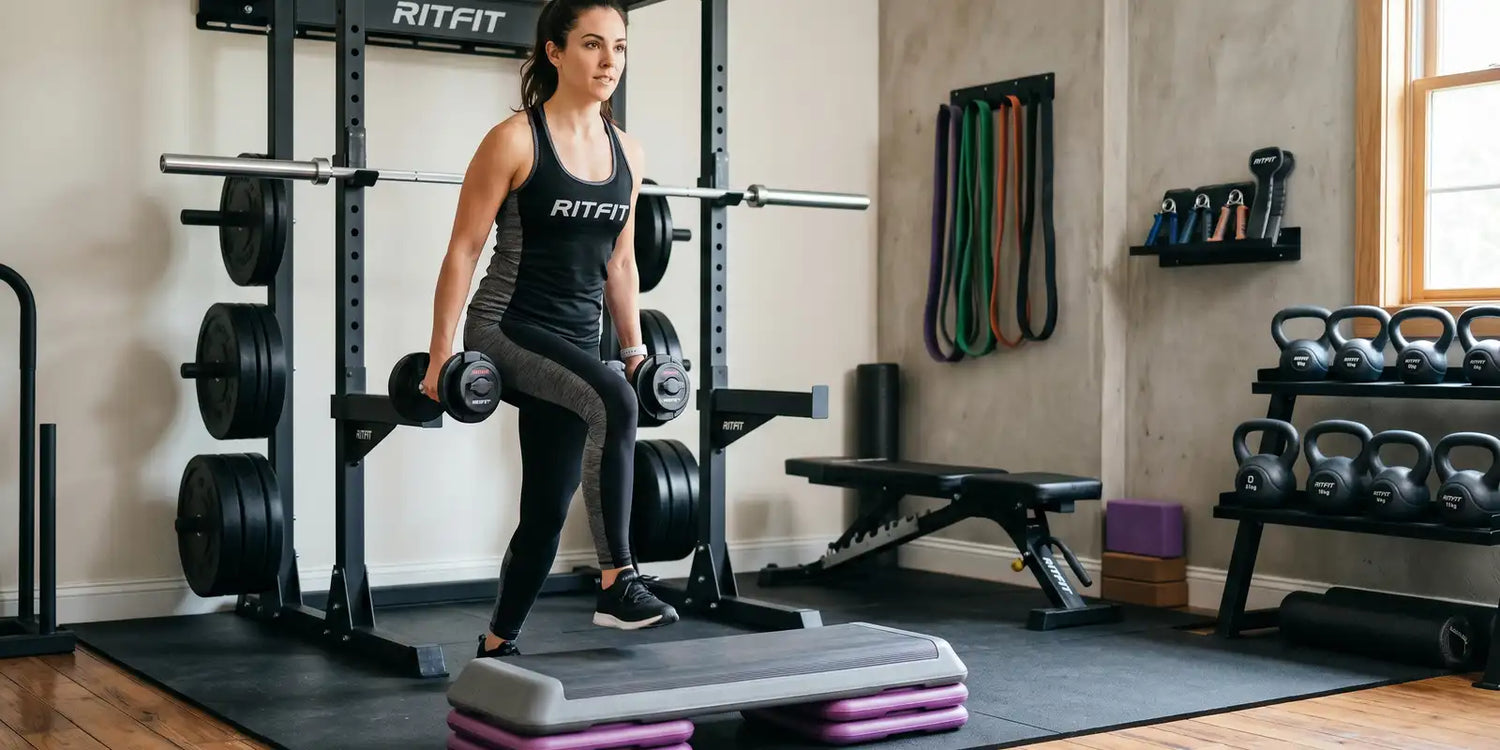
Stepping exercise is a rhythmic, low-impact cardio workout performed on a raised platform that challenges your cardiovascular system while keeping joint stress minimal. Whether you call it step aerobics or a stepping board workout, the movements are simple enough for beginners and effective enough to produce real results.
This guide covers what muscles stepping works, the benefits supported by research, how to perform the three foundational moves, and a ready-to-use 20-minute beginner plan you can start at home today.
Table of Contents
Key Takeaways
- Low-Impact Cardio: Stepping delivers aerobic calorie burn without sharp joint stress, making it accessible for beginners, older adults, and people with knee or ankle sensitivity.
- Muscles Targeted: Each session works your calves, quads, hamstrings, inner thighs, glutes, and core simultaneously, with optional upper-body engagement.
- Calorie Burn: One fitness resource estimates a 45-minute moderate session burns around 348 to 599 kcal, depending on body weight.
- Bone Health: As a weight-bearing exercise, stepping applies mechanical load that supports bone density alongside cardiovascular fitness.
- Three Moves Cover the Basics: The basic step, V-step, and knee lift give you the complete foundation to build any stepping routine from scratch.
What Is Stepping Exercise?
Stepping exercise, commonly known as step aerobics, involves repeatedly stepping up and down on a raised platform in rhythmic patterns. Platform height typically ranges from 4 to 12 inches, and adjusting that height directly controls how demanding each session becomes.
Step Aerobics vs. Other Cardio
Unlike running, stepping is classified as low-impact because at least one foot contacts the platform or floor at all times, limiting impact forces on the knees and ankles. Unlike cycling, stepping is also weight-bearing, which provides ongoing mechanical loading that supports bone density over time.
Muscles Worked During Stepping Exercise
Stepping recruits multiple lower-body muscle groups in coordinated, rhythmic patterns, making it an efficient whole-lower-body conditioning workout. Adding arm movements or light hand weights during the session brings the upper body into play as well.
Lower Body
Stepping primarily targets the calves, quadriceps, hamstrings, inner thighs, and glutes through repeated contractions during each step-up and step-down cycle. Rounding out your program with dedicated grip strengthening exercises adds a complementary upper-body element to an otherwise lower-body-focused routine.
Core and Upper Body Engagement
Your core activates continuously throughout each rep to maintain posture and balance on the platform. Adding light exercise weights or exaggerated arm swings recruits the shoulders and upper back, expanding stepping into a full-body conditioning session.
Benefits of Stepping Exercise
Regular stepping delivers cardiovascular, skeletal, and cognitive benefits in a single workout format. The low-impact design makes those benefits sustainable long-term without accumulating excessive joint wear.
Cardiovascular Health
Stepping keeps your heart rate elevated throughout the session, directly conditioning the cardiovascular system. A randomized controlled trial found that a stepping exercise program significantly improved blood pressure, physical performance, and quality of life in older adults with Stage 1 hypertension.[1]
Bone Density
As a weight-bearing exercise, stepping applies beneficial mechanical load to your bones with every repetition. One study cited by SELF magazine found that high-impact step aerobics improved bone density more than resistance training alone over a 6-month period.
Calorie Burn and Weight Management
Stepping is among the more calorie-efficient low-impact options for a home gym setup. For a comparison of how it stacks up against other workouts, see our breakdown of what exercise burns the most calories.
Balance, Coordination, and Mood
Coordinating foot patterns on a raised platform continuously challenges proprioception and lower-body balance. A 2022 randomized controlled trial found that a stepping program improved fall-related fitness and increased brain-derived neurotrophic factor (BDNF) levels in older adults, pointing to potential cognitive and mood benefits alongside physical improvements.[2]
How to Do Stepping Exercise: Basic Moves
Three fundamental patterns form the backbone of any stepping routine. Mastering these before adding choreography or increasing platform height protects your joints and builds better movement habits from the start.
Basic Step
Step your right foot onto the platform, follow with your left, then step your right foot back to the floor and your left to meet it. Alternate your lead foot every 8 counts to ensure balanced training on both sides of the body.
V-Step
Step your right foot to the right corner of the platform and your left foot to the left corner, forming a V shape with your feet on the platform. Step down right, then left, to return to the starting position.
Knee Lift
Step up with your right foot and drive your left knee toward your chest at the top of the move, then step back down and repeat on the opposite side. The knee lift raises cardiovascular demand and adds a brief core stabilization challenge to each repetition.
Stepping Exercise Calorie Estimates by Body Weight
Calorie burn during stepping depends primarily on body weight, platform height, and session intensity. The estimates below come from a third-party fitness resource and reflect moderate-intensity stepping at roughly 7 to 8 MET for a 45-minute session.
| Body Weight | Approx. Calories Burned (45 min, moderate) |
|---|---|
| 125 lb / 57 kg | ~348 kcal |
| 155 lb / 70 kg | ~432 kcal |
| 185 lb / 84 kg | ~515 kcal |
| 215 lb / 98 kg | ~599 kcal |
Raising platform height from 4 to 10 inches can push intensity from roughly 5.5 MET to 9 MET, meaningfully increasing calorie expenditure per session.
Beginner 20-Minute Stepping Workout Plan
This structure gives you an effective aerobic session using only the three foundational moves. Rest between phases if needed and use a 4-inch platform height for your first few sessions.
| Phase | Duration | Activity |
|---|---|---|
| Warm-Up | 3 min | Slow basic steps, alternate lead feet, no added choreography |
| Cardio Block 1 | 5 min | Basic step and V-step, alternating every 2 minutes |
| Cardio Block 2 | 5 min | Knee lifts combined with V-step sequences |
| Cardio Block 3 | 5 min | Mix all three moves at your natural pace |
| Cool-Down | 2 min | Slow basic steps followed by standing calf and hip-flexor stretches |
Tips for Getting Started with a Step Platform
A few practical habits established from day one will make your stepping sessions safer and more effective over the long term.
- Choose the right height first: Start with a 4-inch platform and progress to 6 or 8 inches only when you can complete full sessions with correct posture and no knee discomfort.
- Look ahead, not down: Keeping your gaze level protects your neck and maintains natural spinal alignment throughout each move.
- Land your whole foot: Place your entire foot on the platform rather than just your toes to distribute load evenly and reduce Achilles tendon strain.
- Consider surface variation: Research suggests that soft-surface stepping may help increase physical activity participation, particularly for older adults.[3]
- Check your purchasing options: A step platform may qualify under HSA/FSA-eligible fitness equipment benefits, making it a cost-effective investment.
FAQs About Stepping Exercise
What muscles does stepping exercise work?
Stepping works your calves, quadriceps, hamstrings, inner thighs, and glutes with every rep. Your core activates throughout to maintain balance and posture. Adding arm movements or light hand weights also recruits the shoulders and upper back, making stepping an efficient choice for a combined lower-body and cardiovascular training session.
Is stepping exercise good for weight loss?
Yes. One fitness resource estimates that a 45-minute moderate session burns around 348 to 599 kcal depending on body weight. Combined with a calorie-controlled diet, the consistent calorie expenditure from regular stepping supports gradual, sustainable fat loss over time without placing excessive stress on your joints.
Is stepping exercise low-impact?
Yes. Stepping is classified as low-impact because at least one foot stays in contact with the platform or floor at all times, limiting impact forces on your knees and ankles. Despite this, cardiovascular intensity can remain high, making it a practical option for people with joint sensitivity.
How high should a step platform be for beginners?
Start at 4 inches and advance to 6 inches only after completing full sessions with good posture and no knee discomfort. Platform height is the primary lever for controlling intensity, with higher settings increasing calorie burn and muscle demand. Most beginners progress to 6 inches within a few weeks of consistent training.
How often should I do stepping exercise?
Three to four 30-to-45-minute sessions per week is a common starting target, meeting most general aerobic activity recommendations. Beginners can start with two shorter sessions and build gradually. Always include a brief warm-up and cool-down to support joint health and reduce the risk of post-workout soreness.
Can I do stepping exercise at home without a class?
Yes. A basic step platform, an open floor area, and a 20-to-30-minute routine are all you need. Learning the basic step, V-step, and knee lift gives you enough variety to build a complete session independently. Video tutorials can help you maintain correct form without a live instructor present.
Does stepping exercise improve balance?
Yes. A 2022 randomized controlled trial found that a stepping program improved fall-related fitness in older adults. The foot-placement patterns involved in stepping continuously train proprioception and lower-body coordination. Regular stepping can therefore be a practical component of a balance-focused training routine, particularly for older or deconditioned individuals.
Conclusion
Stepping exercise delivers cardiovascular conditioning, calorie burn, and bone support in a low-impact format that suits a wide range of fitness levels. Starting with just a step platform and three basic moves, you can build a consistent aerobic habit entirely at home.
As your fitness improves, raise the platform height, add sessions, or incorporate light weights to keep the challenge progressive. For additional low-impact variety, explore our guide to other low-impact home exercises to pair alongside your stepping routine.
Disclaimer
This article is for informational purposes only and does not constitute medical advice. Consult a qualified healthcare provider before starting any new exercise program, particularly if you have a cardiovascular condition, joint injury, or chronic illness.
The calorie estimates cited are drawn from third-party industry sources and should be treated as general guidance rather than precise clinical targets.
References
- Nithiatthawanon T, et al. The Effects of Stepping Exercise on Blood Pressure, Physical Performance, and Quality of Life in Female Older Adults with Stage 1 Hypertension: a Randomized Controlled Trial. Can Geriatr J. 2023;26(1):144-149. https://pmc.ncbi.nlm.nih.gov/articles/PMC9953505/
- Cha HJ, et al. Square-Stepping Exercise Program Effects on Fall-Related Fitness and Brain-Derived Neurotrophic Factor (BDNF) Levels in Older Adults in Korea: A Randomized Controlled Trial. Int J Environ Res Public Health. 2022;19(12):7033. https://pmc.ncbi.nlm.nih.gov/articles/PMC9222997/
- Author(s) unavailable. Effect of Soft Surface Stepping Exercise on Physical Activity Among Older Adults. PMC. 2025. https://pmc.ncbi.nlm.nih.gov/articles/PMC12046080/