








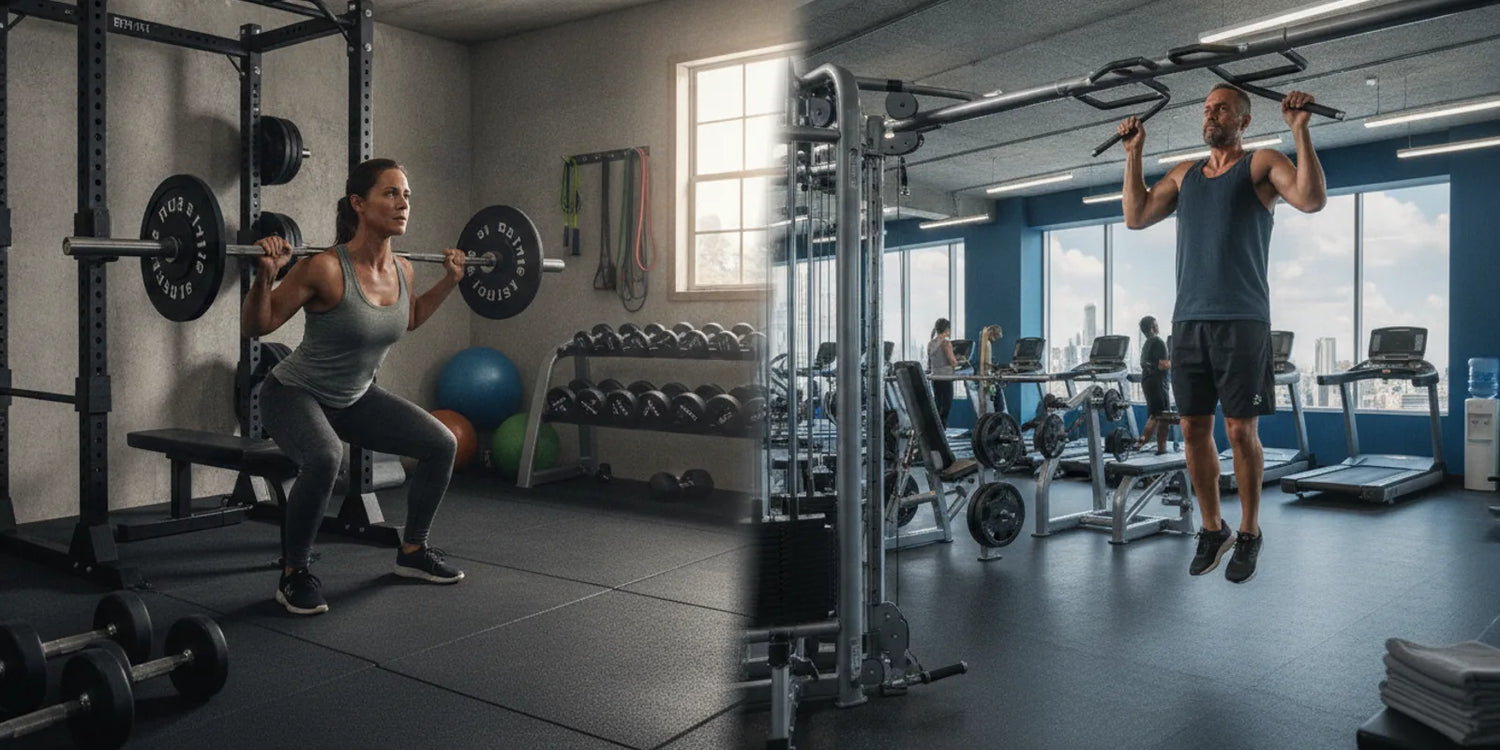
The best gym is not a single address, a brand, or a price tag. It is the setup that removes every obstacle between you and your next workout, delivers the equipment your goals actually require, and keeps working for you month after month without draining your budget.
This guide walks through the full decision: what truly defines gym quality, how the long-term costs of a home gym and a commercial membership stack up, which setup wins for your specific situation, and what equipment builds the most capable home gym for the money.
Quick Answer: The best gym for most barbell-focused adults is a home gym built around a power rack, Olympic barbell, 300 lb of plates, and an adjustable bench. This setup covers every major compound lift, breaks even against a mid-range gym membership in roughly one to two years, and eliminates commute time from day one.
Key Takeaways
- Training quality: A 2024 ACSM overview of 137 systematic reviews confirmed that home-based resistance training significantly improves muscle strength, hypertrophy, and physical function compared to no exercise.[1]
- Break-even point: A $1,000 to $1,500 complete home gym setup typically breaks even against a mid-range gym membership in approximately 11 months, based on real-cost comparisons including commute.
- Space requirement: A power rack needs roughly 8 feet of ceiling height and a 6x8-foot floor footprint, making a single-car garage or 100 to 150 sq ft spare room sufficient.
- Commercial gym advantage: Commercial gyms remain the better choice when you need machine variety costing $5,000 or more to replicate, group classes, or pool access.
- Hybrid approach: Combining a budget home gym with a low-cost commercial membership gives the benefits of both setups for a modest total investment.
What Makes a Gym the Best?
The best gym is the one that consistently matches your training goals, schedule, and budget, rather than any single objective measure of equipment volume or facility size. According to a 2024 ACSM overview of 137 systematic reviews, home-based resistance training significantly improves muscle strength, hypertrophy, power, and physical function compared to no exercise.[1]
Goals, Space, and Budget: The Three Decision Levers
Every gym decision reduces to three variables: what you want to achieve, how much room you have, and how much you are willing to spend over time.
- Training goals: Barbell-based strength programs (squats, deadlifts, bench press, overhead press) can be fully executed in a compact home setup, while sport-specific machines, pools, or group classes require a commercial facility.
- Space: A functional barbell home gym fits in a single-car garage or a room of around 100 to 150 square feet, with a minimum of 8 feet of ceiling clearance for a power rack.
- Budget horizon: The longer you plan to train, the more a one-time home gym investment outperforms recurring monthly fees.
- Motivation style: Self-directed lifters gain the most from home gyms, while those who rely on social accountability or coached classes often stay more consistent at a commercial facility.
"You want to look at what are your fitness goals, so what type of exercise are you wanting to accomplish, and that will narrow your path of what type of equipment do you need to get."
Chris Dempers, ACSM EP-C, Exercise Physiologist, Cleveland Clinic
How Do the Real Costs of a Home Gym vs. a Commercial Gym Compare?
The home gym costs more upfront and a commercial membership costs more over time. One comprehensive cost analysis found that a $1,000 to $1,500 complete home gym setup breaks even against a mid-range membership in approximately 11 months, once commute and ancillary costs are factored in. One equipment cost guide calculated that a $2,000 home gym setup breaks even against a mid-range membership in roughly 31 months.
Real 10-Year Math: Membership Fees vs. Equipment Investment
Commercial memberships typically run $30 to $100 per month.
- Annual price escalation: Industry data suggests average gym membership fees increase 3 to 7 percent per year, meaning a $50 per month membership today could reach approximately $90 per month in 10 years at a 6 percent annual increase.
- 10-year membership total: Even a budget commercial membership lands in the $9,000 to $11,000 range over a decade when compounding increases are included.
- Home gym 10-year cost: A $1,500 complete build plus modest annual maintenance totals a fraction of the equivalent commercial membership cost over the same period.
- Commute cost: Peak-hour crowding at commercial gyms can add 40 to 80 hours per year in waiting time, on top of transit time that is eliminated entirely with a home setup.
| Option | Upfront Cost | Est. 10-Year Total | Break-Even vs. Mid Membership |
|---|---|---|---|
| Foundation home gym (rack, bar, plates, bench) | $1,000 to $1,500 | $2,500 to $3,500 | ~11 months |
| Complete home gym (+ cables, dumbbells, flooring) | $2,000 to $3,500 | $3,500 to $5,000 | ~18 to 31 months |
| Budget commercial membership (~$30/mo) | $0 | $4,500 to $6,000 | N/A |
| Mid-range commercial membership (~$60/mo) | $0 | $9,000 to $11,000 | N/A |
Estimates based on industry cost-analysis guides. Individual results vary by location, membership tier, and usage frequency.
Hidden Costs You Are Probably Not Counting
The sticker price of a gym membership understates the real ongoing cost for most members.
- Commute time: At an average round-trip of 20 minutes, five sessions per week adds over 80 hours per year, time the home gym eliminates entirely.
- Annual enrollment fees: Many commercial gym contracts carry $39 to $99 annual fees beyond the monthly rate.
- Cancellation penalties: Binding contracts at many facilities charge one to three months of fees to cancel early.
- Parking and fuel: Driving to a gym five days a week adds meaningful cost over a full year, particularly in urban areas.
Which Gym Type Is Actually Right for Your Situation?
The right gym type depends on your training style, lifestyle, and budget horizon. According to a 2024 ACSM overview of 137 systematic reviews, home-based resistance training significantly improves muscle strength, hypertrophy, and physical function.[1] This decision matrix maps the most common user profiles to the setup that consistently delivers better results.
Choose a Home Gym If You Match These Criteria
A home gym is the stronger long-term choice for the majority of consistent strength trainees.
- Primary tools are barbells and free weights: Squats, deadlifts, bench press, overhead press, and barbell rows cover the full compound movement pattern, all achievable with a rack, bar, and plates.
- You train consistently without external accountability: Home gyms reward self-directed athletes; motivation has to come from within or from a clear program.
- You have 100 square feet or more of usable space: A single-car garage is sufficient for a complete barbell setup with room to move safely.
- You value time efficiency: Eliminating commute and peak-hour waits recovers 80 to 100 hours per year for most members.
- You plan to train for two or more years: The longer the horizon, the larger the cumulative savings against a recurring membership.
Choose a Commercial Gym If You Match These Criteria
Commercial gyms retain a clear advantage in specific training contexts that home equipment cannot match at a reasonable cost.
- You need machine variety beyond $5,000 to replicate: Hack squats, seated leg curls, cable crossover stacks, and other plate-loaded machines require commercial facilities unless you have substantial dedicated budget.
- Group classes or coaching are central to your consistency: Social training environments and instructor-led formats are difficult to replicate at home.
- Amenities like pools, saunas, or courts matter to your routine: These features cannot be added to a home setup without major construction.
- You rent and move frequently: Moving equipment is costly; a membership transfers with you instantly.
- Your training phase is exploratory: Beginners still discovering which disciplines they enjoy benefit from the variety a commercial gym provides before committing to a specific home setup.
The Hybrid Approach: Best of Both Setups
A hybrid setup pairs a home gym for daily barbell training with a low-cost commercial membership for occasional machine work, classes, or cardio access.
- Cost structure: A foundation home gym plus a $10 to $20 per month budget commercial membership keeps monthly training costs well below a standalone mid-range membership.
- Flexibility: Primary compound work happens at home on your schedule; specialized equipment or social sessions happen at the commercial facility when needed.
- Best for: Intermediate and advanced lifters who want the efficiency of home training without fully giving up machine variety or the occasional group session.
For location-specific commercial gym recommendations, see our guides to 16 Best Gyms In NYC, 15 Best Gyms In Boston, and 15 Best Gyms In Charleston.
What Equipment Does a Complete Home Gym Actually Need?
A complete home gym built around a power rack, Olympic barbell, weight plates, and an adjustable bench covers every major compound lift and supports any evidence-based barbell strength program. A 2023 systematic review and Bayesian network meta-analysis found that higher-load, multiset training at least twice per week produces the highest-ranked outcomes for both strength and hypertrophy in healthy adults.[2]
The Foundation Tier ($500 to $1,500): Power Rack, Barbell, Plates, Bench
The foundation tier delivers a complete barbell training environment for squats, deadlifts, bench press, overhead press, pull-ups, and barbell rows.
- Power rack or squat rack: The structural anchor of the home gym, with safety catches for solo lifting. A quality rack needs roughly 8 feet of ceiling height and a 6x8-foot floor footprint.
- Olympic barbell: A 20 kg (44 lb) Olympic barbell with quality bearings handles all major lifts and is the single most important equipment purchase. Spend 60 to 70 percent of the foundation budget on the bar, rack, and plates.
- Weight plates: 300 lb of Olympic plates covers the load range for most intermediate training programs. RitFit High-Grade Color Bumper Plates protect both floors and bars during heavy loading.
- Adjustable bench: A multi-angle adjustable bench enables incline, flat, and decline pressing variations, maximizing the range of exercises a single piece of equipment supports.
- Rubber flooring: Protects the subfloor from dropped weights and reduces noise; typically adds $100 to $200 to the total build cost.
The Upgrade Tier: Cables, Dumbbells, and Specialty Attachments
The upgrade tier closes most remaining training gaps left by a foundation barbell setup, enabling isolation work, unilateral training, and variety without the cost of individual commercial machines.
- Cable pulley attachment: A rack-mounted cable pulley system enables lat pulldowns, cable rows, tricep pushdowns, and cable flies, replicating the function of multiple standalone cable machines at a fraction of the cost and space.
- Adjustable dumbbells: A set adjustable from 5 to 50 lb or higher replaces an entire dumbbell rack and fits in a small corner. An umbrella review of 14 meta-analyses confirmed that training volume of at least 10 sets per muscle group per week optimally drives hypertrophy, achievable with dumbbells added to barbell programming.[3]
- Specialty bar attachments: Dip bars, landmine attachments, and resistance band pegs slot into standard rack mounting holes, expanding exercise selection without requiring additional floor space.
Space Planning: Minimum Square Footage by Build Tier
Most home lifters underestimate how little space a capable setup actually requires.
- Foundation tier: 100 to 150 sq ft, minimum 8 ft ceiling. A single-car garage or large spare bedroom covers this comfortably.
- Complete tier with dumbbells and cables: 150 to 200 sq ft, same ceiling height. A two-car garage allows full movement around all equipment.
- Critical clearances: Leave at least 3 feet on all sides of the rack for safe bar loading, spotting access, and overhead press walkout room.
- Steel grade: Equipment guides note that commercial-grade racks use 11-gauge steel; quality home racks typically use 11 to 14-gauge steel, which is fully adequate for single-user loads.
For a detailed room-by-room setup walkthrough, see our Home Gym Guide and Home Gym Ideas pages.
How Do You Build the Best Home Gym With RitFit Equipment?
RitFit builds equipment specifically around the home gym use case, with compact footprints, multi-functional designs, and pricing structured to hit the break-even point against a commercial membership within the first year.
RitFit Equipment by Budget and Goal
The right starting point depends on your primary training goal and available floor space.
| User Type | Primary Goal | Recommended Starting Point | Est. Budget |
|---|---|---|---|
| Beginner strength trainee | Build foundational strength | Power rack + barbell + bumper plates + bench | $800 to $1,500 |
| Intermediate lifter | Hypertrophy + compound strength | Foundation tier + cable attachment + adjustable dumbbells | $1,500 to $2,500 |
| Space-limited home gym builder | Full-body training in small footprint | Multi-functional smith machine with integrated cable | $1,200 to $2,200 |
| Advanced home athlete | Competition prep or sport-specific strength | Full power rack system + specialty bars + platform | $2,500 to $4,000 |
Budget ranges are illustrative estimates based on current RitFit product tiers. Actual costs vary by configuration and accessories.
- Power rack with lat pull-down: The RitFit PSR05 Multifunctional Smith Machine Power Rack combines a full power cage with an integrated lat-pull down system, covering squat, press, pull, and cable movements in a single compact unit.
- Truemed-eligible racks: RitFit offers Truemed-eligible gym rack options, allowing eligible buyers to use HSA or FSA funds toward qualifying home gym equipment.
- Athlete-curated setups: Browse complete equipment configurations from RitFit-affiliated athletes including Cathy Ding's Gym and Jake Miller's Gym for real-world setup inspiration at different space and budget levels.
What Are the Most Common Mistakes When Setting Up a Home Gym?
Most home gym mistakes fall into one of three categories: buying too much too fast, buying the wrong tier for the intended use, or underestimating the space requirements of key pieces.
- Buying beginner-tier equipment for intermediate loads: Entry-level racks rated for 250 to 300 lb will show wear within months if you are squatting near that limit regularly. Match the equipment weight capacity to your projected one-year training max, not your current max.
- Overbuying specialized machines before mastering basics: Cable crossovers, leg presses, and hack squats are valuable additions only after a foundation of compound barbell movements is in place. Buy the rack and bar first.
- Skipping flooring: Rubber flooring protects the subfloor, reduces bar bounce on drops, and meaningfully dampens noise in shared-wall or multi-floor homes. It is one of the highest-value additions per dollar in any home gym build.
- Ignoring ceiling height: Overhead press, pull-ups, and band work all require more vertical clearance than simply "fitting" the rack. Measure to the lowest obstruction, not the peak ceiling, and confirm at least 8 feet with a loaded bar overhead.
- Treating every piece as permanent: Build slowly, as one equipment guide advises. Test a configuration for six to eight weeks before adding the next piece. You develop a clearer picture of what you actually use versus what you assumed you would use.
- Not accounting for ventilation: Garages and basements without airflow become uncomfortable in summer and cold enough to affect warm-up in winter. A fan, portable heater, or basic ventilation addition costs little and affects session consistency significantly.
FAQs About the Best Gym
Is a home gym actually better than a commercial gym?
It depends on your training style and budget. For barbell-focused lifters who train consistently, a home gym eliminates commute time and peak-hour waits, and pays for itself in under two years. Commercial gyms remain the better choice if you need machine variety, group classes, or pool access.
How much does it cost to build a complete home gym?
A functional home gym covering all major compound lifts typically runs $1,000 to $1,500 for a power rack, barbell, 300 lb of plates, adjustable bench, and flooring. Premium builds with cable systems and adjustable dumbbells range $2,000 to $3,500, with break-even against a mid-range membership within one to three years.
What is the minimum space needed for a home gym?
A power rack requires roughly 8 feet of ceiling clearance and a 6x8-foot floor footprint. A single-car garage or a spare room of around 100 to 150 square feet is enough for a full barbell setup with room to deadlift and perform overhead presses safely without overcrowding.
What equipment do you need for the best home gym?
The foundation of a best-value home gym is a power rack, Olympic barbell, 300 lb of weight plates, and an adjustable bench, which covers squats, deadlifts, bench press, overhead press, and pull-ups. Adding adjustable dumbbells and a cable attachment closes most remaining training gaps.
Can you build muscle effectively in a home gym?
Yes. A 2024 ACSM overview of 137 systematic reviews confirmed that home-based resistance training significantly improves muscle strength and hypertrophy. Consistent progressive overload and at least 10 sets per muscle group per week, achievable with a basic barbell setup, are the key variables for building muscle at home.[3]
What is a hybrid gym approach?
A hybrid approach combines a budget home gym for daily barbell training with a low-cost commercial membership for occasional machine work, classes, or cardio equipment. This gives you the convenience and cost savings of training at home while retaining access to specialized equipment you cannot easily replicate at home.
Conclusion
The best gym is the one you actually use, structured around your goals, your schedule, and a budget that makes training sustainable for years. For most barbell-based athletes, a home setup built on a power rack, Olympic bar, plates, and a bench covers every major compound lift and removes every commute barrier from day one.
Ready to build? Explore Truemed-eligible rack options or browse complete athlete setups like Lexie Brown's Gym for real-world inspiration.
Disclaimer
This article provides general fitness and equipment information for educational purposes only and does not constitute medical, financial, or professional fitness advice. Consult a qualified fitness professional or physician before beginning any new training program or making significant equipment purchases.
Save on your next RitFit order
Tap the button to copy your code, then paste it at checkout.
References
1. Ralston GW, et al. American College of Sports Medicine Position Stand. Resistance Training Prescription for Muscle Function, Hypertrophy, and Physical Performance in Healthy Adults: An Overview of Reviews. Med Sci Sports Exerc. 2025. PMCID: PMC12965823
2. Bernárdez-Vázquez R, et al. Resistance training prescription for muscle strength and hypertrophy in healthy adults: a systematic review and Bayesian network meta-analysis. Br J Sports Med. 2023. PMCID: PMC10579494
3. Baz-Valle E, et al. Resistance Training Variables for Optimization of Muscle Hypertrophy: An Umbrella Review. Front Sports Act Living. 2022;4:949489. PMCID: PMC9302196





