








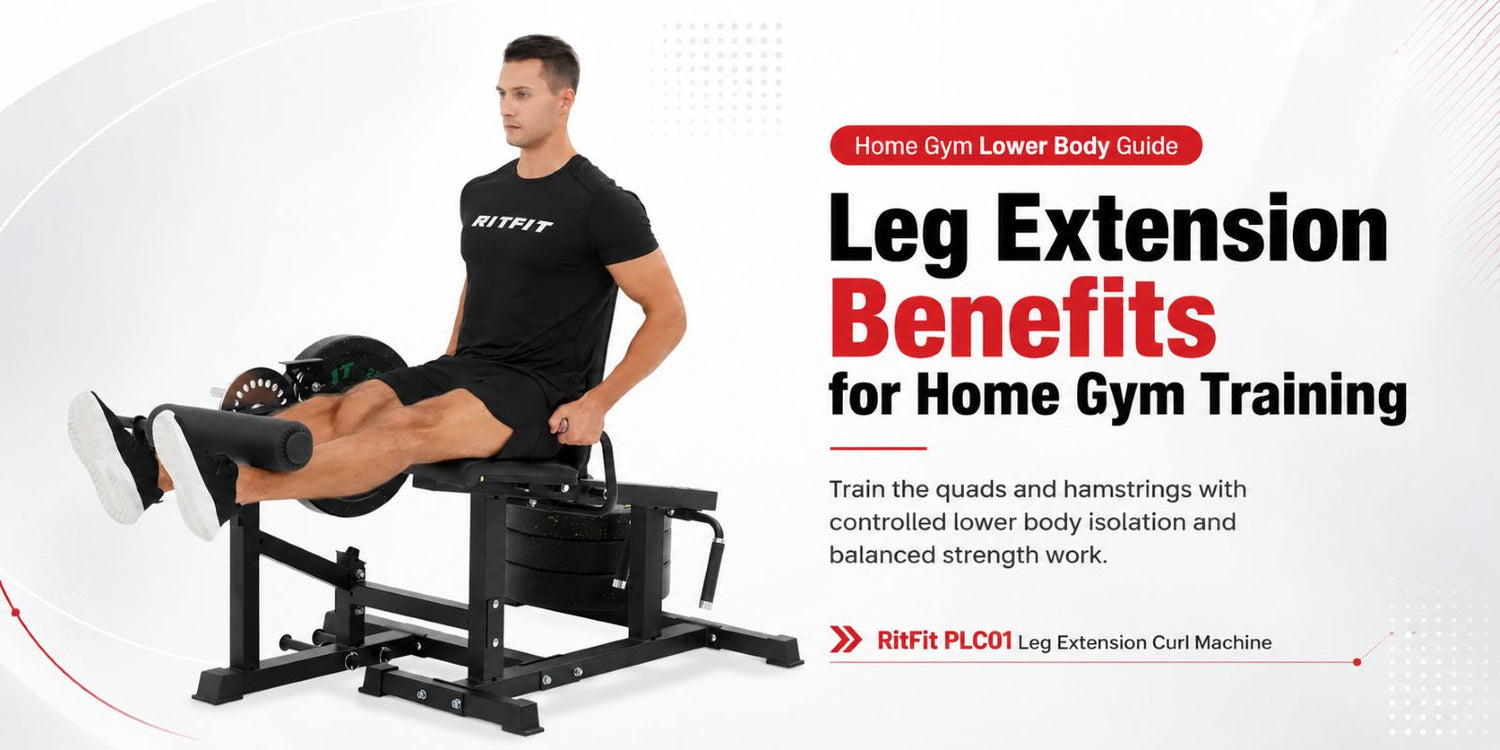
Leg extension benefits go beyond building bigger quads. A well set up leg extension and curl machine helps home gym users train the front and back of the thighs, add controlled lower body volume, and support balanced strength work without relying only on heavy squats or deadlifts.
The PLC01 leg extension machine fits this goal because it combines leg extensions and leg curls in one compact station. This guide covers the benefits, safe setup, and programming tips you need to get started.
Quick Answer: A leg extension and curl machine like the RitFit PLC01 combines quad isolation and hamstring training in one compact station. It helps home gym users build balanced lower body strength through controlled knee extension and flexion without needing separate machines, making it a practical space-saving choice for garage and basement gym setups.
Key Takeaways
- Leg extensions isolate the quads: They train knee extension in a controlled seated position, making them ideal accessory work after compound lifts.
- Leg curls balance the session: They strengthen the hamstrings, which support knee flexion and hip control for more complete lower body development.
- A combo machine saves space: One leg extension curl machine covers two important lower body isolation patterns without taking up extra floor space.
- Setup matters most: Seat position, knee alignment, pad placement, load, and tempo affect comfort and training quality more than the weight on the stack.
- Pain changes the plan: Users with knee pain, surgery history, or hamstring injury should get professional guidance before training hard on these machines.
What Are the Main Leg Extension Benefits for Home Gym Users?
Leg extensions isolate the quadriceps through controlled knee extension in a seated, supported position. This makes them a practical accessory movement for home gym users who want precise quad work without turning every leg session into a heavy barbell day.

Easily Adjustable Resistance
A leg extension machine lets you change resistance quickly to match your current strength and fatigue level. This is helpful for warm up sets, moderate hypertrophy work, drop sets, and controlled higher rep training.
Accessory Work That Supports Main Lifts
Leg extensions can help lifters add quad volume after squats, lunges, or leg presses. They are best used as accessory work, not as a full replacement for compound lower body training.
Joint Friendly Quad Training
Leg extensions train the quadriceps while your torso stays supported. Research on resistance exercise for knee osteoarthritis suggests that well planned resistance training can improve pain and physical function, but people with knee conditions should follow professional guidance.[1]
Controlled Knee Extension Strength
Open chain knee extension exercises can be useful in specific rehabilitation contexts when programmed carefully. A clinical commentary on ACL rehabilitation notes that open kinetic chain knee extension can be used safely when range, timing, and loading are properly managed.[2]
Unilateral Training Option
Single leg extensions help you train one side at a time and notice left to right differences. This is useful when one leg tends to dominate squats, lunges, step ups, or leg presses.
Better Mind Muscle Connection
Leg extensions make it easier to feel the quadriceps working because the movement is simple and targeted. Beginners often benefit from this because it teaches controlled knee extension before more complex lower body patterns.
Who Benefits Most From Leg Extensions
Leg extensions are a strong fit for home gym users, beginners, bodybuilders, and lifters who want precise quad work after compound training. They can also support return to training plans when a qualified professional has approved the load and range of motion.
- Home gym lifters: Use leg extensions when you want quad isolation without setting up a rack or barbell.
- Beginners: Start with light resistance and focus on smooth control before increasing load.
- Strength trainees: Add leg extensions after squats or leg presses to build extra quad volume.
- Joint sensitive users: Use a conservative range of motion and stop if pain feels sharp or localized.
"If maximum quad growth is the goal, do squats and also do exercises such as front squats, leg press, lunges, and leg extensions."
Bret Contreras, PhD, PhD in Sports Science, known as The Glute Guy, Contreras Strength Institute
How to Use a Leg Extension Machine Safely
The safest way to use a leg extension machine is to align your body with the machine before adding challenging resistance. Seat position, knee alignment, pad placement, tempo, and range of motion all affect how the exercise feels and how well it targets the intended muscles.

- Step 1, Adjust the backrest and seat: Sit tall with your lower back supported and your hips against the pad. Your body should not slide forward as the weight gets heavier.
- Step 2, Align the knee with the pivot point: Place the side of your knee close to the machine pivot axis. This helps the movement track smoothly through knee extension.
- Step 3, Set the lower leg pad: Position the pad across the lower shins just above the ankles. Do not place the roller directly on the ankle joint.
- Step 4, Brace and grip lightly: Hold the handles and keep your torso steady. Avoid using your arms to pull your body into the rep.
- Step 5, Move with control: Extend the legs by squeezing the quads, pause briefly near the top, then lower slowly. Do not slam into lockout or let the weight drop.
What Are the Main Leg Curl Benefits for Balanced Lower Body Training?
Leg curls train the hamstrings through knee flexion, directly targeting the back of the thigh. When you combine leg curls with leg extensions, you train the quadriceps and hamstrings more completely than with quad isolation alone, creating a more balanced lower body routine.

Direct Hamstring Strengthening
Leg curls train knee flexion and directly target the hamstrings. Hamstring injury literature highlights the importance of strengthening and appropriate progression for reducing risk and improving return to sport decisions.[3]
More Balanced Lower Body Training
Training only the quadriceps can leave the posterior thigh undertrained. Adding leg curls gives your lower body plan a better front and back balance.
Supported Posterior Chain Work
Leg curls challenge the hamstrings while your torso stays supported. This can be useful when you want posterior chain training without always relying on heavy Romanian deadlifts or good mornings.
Simple Progressive Overload
A leg curl machine makes it easy to track load, reps, and control from week to week. This helps lifters progress gradually instead of guessing whether the hamstrings are actually getting stronger.
Better Carryover to Daily Movement
Stronger hamstrings support walking, stair descent, sprinting, deceleration, and hip control. Even non athletes benefit from training the back of the thigh as part of a complete lower body program.
Who Should Be Cautious With Leg Curls
Be conservative with leg curls if you recently had a hamstring strain, feel sharp cramping, or have been told to avoid loaded knee flexion. In those cases, use professional guidance before increasing load.
Leg Extension vs Leg Curl: What Is the Difference?
Leg extensions and leg curls train opposite sides of the thigh. Using both gives home gym users a clearer way to target knee extension and knee flexion in the same lower body setup, resulting in more complete leg development than either movement alone.
| Exercise | Main Muscles Trained | Main Movement | Best Use |
|---|---|---|---|
| Leg extension | Quadriceps | Knee extension | Quad isolation, accessory volume, controlled knee extension training |
| Leg curl | Hamstrings | Knee flexion | Hamstring isolation, posterior chain support, lower body balance |
For a broader lower body setup, many users pair isolation work with compound equipment from the strength machines collection. This helps connect targeted quad and hamstring work with larger lower body patterns.
How Should You Program Leg Extensions and Leg Curls?
The best way to program leg extensions and leg curls is to match the load and volume to your goal. Machine based resistance training can improve strength and functional capacity in older adults, but the program still needs appropriate exercise choice, load, and progression.[4]
- Beginners: Use 2 to 3 sets of 10 to 12 reps with light to moderate resistance. Leave 2 to 3 reps in reserve and focus on control.
- Muscle growth: Use 3 to 4 sets of 12 to 20 reps with moderate resistance. Pause briefly at the top and lower slowly.
- Strength emphasis: Use 3 to 5 sets of 6 to 8 reps with heavier but controlled resistance. Keep the movement strict and avoid swinging.
- Warm up use: Use 1 to 3 light sets of 15 to 20 reps before larger lower body work. Keep the goal blood flow and control, not fatigue.
- Recovery focused use: Follow a qualified clinician if you are using leg extensions or leg curls after pain or injury. Do not copy advanced programs without context.
General Safety Reminders
Increase resistance gradually and stop if you feel sharp, catching, stabbing, or unusual joint pain. If you are unsure what is safe for your knees or hamstrings, get advice from a qualified healthcare or rehab professional.
Why Does a Leg Extension Curl Machine Make Sense for Home Gyms?
A leg extension curl machine makes sense for home gyms because it combines quad isolation and hamstring isolation in one station. This is especially useful when floor space is limited and you want more lower body variety without buying separate machines.
The PLC01 Leg Extension Curl Machine supports both leg extensions and leg curls, which helps users train the front and back of the thigh in one compact setup. Users building a fuller lower body station can also compare the BLP01 and PLC01 lower body machine set.
Best Fit Users
This type of machine is best for home gym lifters who want targeted quad and hamstring work after compound lifts. It is also useful for garage gym owners who want a clear lower body accessory station.
- For quad focused lifters: Use leg extensions after squats, lunges, or work on a Smith machine.
- For posterior chain balance: Add leg curls alongside hip hinges, deadlifts, and leg press work.
- For fuller leg day setups: Pair isolation work with the GAZELLE PRO leg press and hack squat machine.
- For guided buying help: Read the Best Leg Extension Curl Machine for Home Gyms guide for a deeper PLC01 breakdown.
What Are the Most Common Leg Extension and Leg Curl Mistakes?
The most common mistakes are using too much weight, rushing reps, and ignoring machine setup. Fixing these basics usually improves comfort, control, and training quality without needing to change your entire program.
- Using too much weight: Choose a load you can lift without swinging or lifting your hips off the seat.
- Ignoring knee alignment: Keep the knee close to the pivot point so the movement feels smooth.
- Rushing the lowering phase: Lower the weight slowly to keep tension on the target muscle.
- Forcing range of motion: Use a range that feels strong and controlled, not painful or pinched.
- Training through sharp pain: Stop the set if pain feels sharp, catching, or localized.
FAQs About Leg Extension and Curl Machines
What are the main leg extension benefits for home gym users?
Leg extensions mainly help home gym users isolate the quadriceps with controlled resistance. They are useful for building quad strength, adding accessory work after squats or leg presses, and training one leg at a time when you want better left to right balance.
Are leg extensions bad for your knees?
No.
Leg extensions are not bad for your knees by default.
Setup, load, range of motion, and training history matter most.
If you have knee pain, swelling, recent surgery, or sharp discomfort, get guidance from a qualified healthcare or rehab professional before training hard.
How should beginners set up a leg extension machine?
Beginners should align the knee near the machine pivot point, support the back, and place the lower pad just above the ankles. Start with light resistance, move slowly, and stop if the exercise creates sharp, catching, or localized knee pain.
What is the difference between leg extensions and leg curls?
Leg extensions train knee extension and mainly target the quadriceps.
Leg curls train knee flexion and mainly target the hamstrings.
Using both movements helps balance the front and back of the thigh, especially when they support squats, lunges, and leg presses.
How often should I do leg extensions and leg curls?
Most lifters can train leg extensions and leg curls one to three times per week. Start with two to three controlled sets per movement, then increase volume only when your knees, hamstrings, and overall recovery feel consistent after each lower body session.
Should I do leg extensions before or after squats?
Most lifters should do squats or leg presses first, then use leg extensions as accessory work. This order preserves energy for compound lifts, while still giving the quadriceps focused training after the main lower body movement and reducing unnecessary pre fatigue.
Can a leg extension curl machine replace squats and deadlifts?
No. A leg extension curl machine complements squats and deadlifts, but it does not fully replace them. It targets the quads and hamstrings well, while compound lifts train more joints, balance demands, trunk control, and full body coordination under load.
Is the PLC01 leg extension curl machine good for beginners?
Yes.
The PLC01 is beginner friendly because it combines leg extensions and leg curls in one clear lower body station.
Beginners should still use light resistance, adjust the pads carefully, control each rep, and progress slowly before adding heavier loads.
Conclusion
Leg extensions and leg curls work best as a pair because they train both sides of the thigh. Leg extensions target the quadriceps, leg curls target the hamstrings, and a compact machine like the PLC01 can help home gym users build a more balanced lower body routine without needing extra floor space.
For best results, use these movements alongside squats, lunges, hip hinges, smart progression, and enough recovery. Before you order, check the RitFit discount guide for the latest coupons and bundle deals on RitFit equipment.
Disclaimer
This article is for general educational purposes only and is not medical advice. If you have knee pain, swelling, recent surgery, ligament injury, hamstring strain, or any medical concern, consult a qualified healthcare professional before using a leg extension curl machine or changing your exercise program.
References
1. Vincent KR, Vincent HK. Resistance exercise for knee osteoarthritis. PM R. 2012;4(5 Suppl):S45-S52. doi:10.1016/j.pmrj.2012.01.019. PMCID: PMC3635671
2. Wilk KE, Arrigo CA, Bagwell MS, Finck AN. Considerations with open kinetic chain knee extension exercise following ACL reconstruction. Int J Sports Phys Ther. 2021;16(1):282-284. doi:10.26603/001c.18983. PMCID: PMC8341750
3. Brukner P. Hamstring injuries, prevention and treatment, an update. Br J Sports Med. 2015;49(19):1241-1244. doi:10.1136/bjsports-2014-094427. PMCID: PMC4602251
4. Kirk A, Steele J, Fisher JP. Machine based resistance training improves functional capacity in older adults, a systematic review and meta analysis. J Funct Morphol Kinesiol. 2024;9(4):239. doi:10.3390/jfmk9040239. PMCID: PMC11586963





