








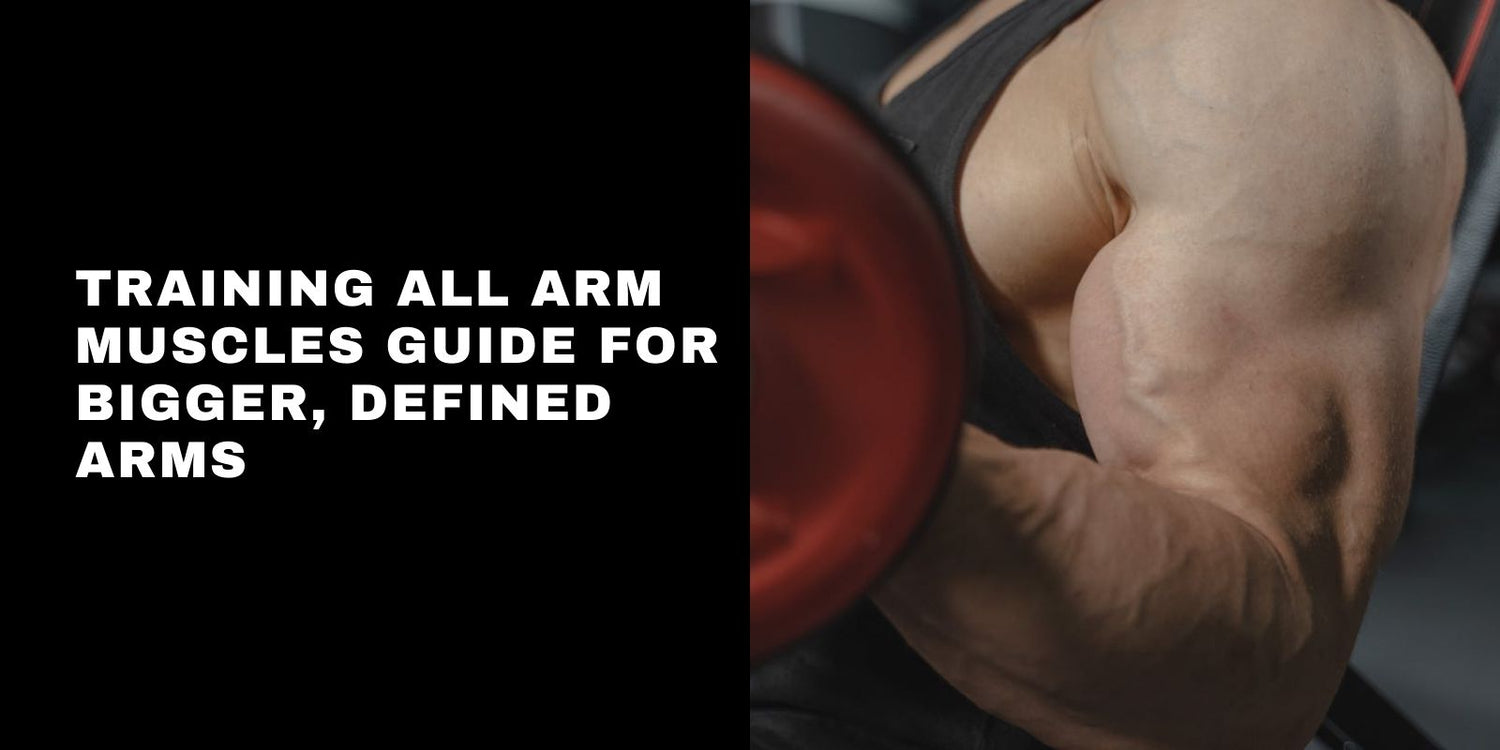
When we talk about "long, muscular arms," we are referring to a physique that balances fullness with definition. It isn't just about circumference; it is about how the muscles tie into the shoulders and forearms, creating a seamless, powerful look. Many trainees struggle because they rely on random, high-repetition curls, hoping for growth.
The reality is that random volume rarely yields consistent results. Effective arm workouts are built on an understanding of anatomy and progressive overload. This guide covers all major arm muscles, biceps, triceps, and forearms—explaining why each must be trained specifically to unlock your full potential.
Key Takeaways
- Long, muscular-looking arms come from balanced development of biceps, triceps, and forearms, not random high-rep curls.
- For most people, building bigger arms usually means prioritizing triceps volume and progressive overload while keeping form strict.
- Train arms 2 to 3 times per week with a mix of heavy sets and moderate pump work, and progress using simple rules like reps first, then load.
- If elbows or wrists get cranky, switch to more joint-friendly grips and cables, and cap intensity at RIR 2 to 3 until symptoms settle.
Arm Anatomy 101: Muscles You Must Train
To maximize your results, you first need to understand the machinery you are working with. Knowing the function of each muscle helps you select the right movements.
Biceps Brachii
The biceps is a two-headed muscle consisting of a long head and a short head. The short head contributes to the inner thickness of the arm, while the long head is responsible for the "peak" seen when flexing. The primary movements here are elbow flexion (bending the arm) and supination (rotating the palm upward).
Brachialis & Brachioradialis
Often neglected, the brachialis sits underneath the biceps. When developed, it pushes the biceps up, adding significant width and thickness to the upper arm. The brachioradialis, located on the forearm, bridges the gap between the upper and lower arm. These are best targeted through flexion with a neutral (hammer) or pronated (overhand) grip.
Triceps Brachii
The triceps comprise three heads: long, lateral, and medial. Because the triceps make up approximately two-thirds of your upper arm's mass, prioritizing them is essential for size. Neglecting the triceps will leave your arms looking small, regardless of how much you curl.
Forearm Muscles
The flexors and extensors of the forearm control grip strength and wrist movement. Well-developed forearms provide a "finished" look to the limb and are crucial for heavy lifting in other compound movements.
Shoulder Tie-ins
While not technically arm muscles, the deltoids (especially the front and lateral heads) frame the arms. Broad shoulders accentuate the separation between the arm and the torso, improving overall aesthetics.
Training Principles for Bigger, Stronger Arms
Randomly lifting weights won't cut it. To see consistent growth in your arm workouts, adhere to these core principles:
- Progressive Overload: consistently challenge your muscles by increasing weight, reps, or sets over time.
- Volume and Frequency: Arms recover relatively quickly. Training them 2–3 times per week allows for sufficient volume without overtraining.
-
Rep Ranges: Use a mix of ranges for complete development.
- Strength: 3–6 reps
- Hypertrophy (Size): 6–15 reps
- Endurance/Pump: 15–25 reps
- Tempo and Control: Focus on the time under tension. Avoid using momentum; control the eccentric (lowering) phase to maximize muscle fiber recruitment.
Effort Target using RIR
Most hypertrophy sets should end with 1 to 3 reps in reserve, meaning you could have done 1 to 3 more clean reps if you had to.
For heavy compounds, stay closer to RIR 2 at first, then tighten to RIR 1 as technique improves.
For isolation work, RIR 1 to 2 is usually enough, and going to failure every set tends to beat up elbows and wrists over time.
Exercise Selection: Complete Arm Workouts by Muscle Group
Biceps-Focused Arm Workouts
Mass Builders (Compounds):
Start with heavy movements. Chin-ups (underhand grip) place a massive load on the biceps. Barbell curls and EZ-bar curls allow you to overload the biceps with heavier weights than dumbbells usually permit.
Shape & Peak / Isolation:
To sculpt the muscle, use isolation movements. Incline dumbbell curls stretch the long head, while concentration curls and preacher curls eliminate body momentum, forcing the biceps to do all the work.
Long vs. Short Head Emphasis:
To target the long head (peak), try incline curls or drag curls where the elbows are behind the body. For the short head (inner thickness), utilize wide-grip curls or preacher curls with elbows in front of the body.
Joint-friendly biceps swaps
If straight bar curls irritate your wrists or elbows, use an EZ-bar, cables, or dumbbells with a neutral or slightly angled grip.
If preacher curls make your elbows flare, reduce the range slightly at the bottom and use slower eccentrics with a lighter load, or switch to cable curls.
Triceps-Focused Arm Workouts
Heavy Compounds:
The foundation of big triceps lies in pressing movements. The close-grip bench press and weighted dips (keeping the torso upright) are superior for loading the triceps heavily.
Isolation & Head Emphasis:
To hit the long head, you must raise your arms overhead; exercises like overhead triceps extensions (using a dumbbell or cable) are ideal. The lateral head is best targeted with pushdowns (rope or bar), while the medial head works hard during reverse-grip extensions.
Forearms & Grip
Don't treat forearms as an afterthought. Incorporate wrist curls and reverse wrist curls to target flexors and extensors. Hammer curls are excellent double-duty exercises, hitting the brachialis and the forearms. For functional size, add farmer’s carries or static dead hangs.
Sample Arm Workout Routines
Beginner Arm Workout (2×/week)
This routine fits well into a simple push–pull split.
- Chin-ups: 3 sets of 6–8 reps
- Barbell Curls: 3 sets of 8–10 reps
- Close-Grip Bench Press: 3 sets of 8–10 reps
- Triceps Cable Pushdowns: 3 sets of 12–15 reps
Intermediate “Arm Day” Workout
A dedicated session focusing purely on arms allows for higher volume and supersets.
- Superset 1: EZ-Bar Curls + Skull Crushers (4 sets of 10 reps)
- Superset 2: Incline DB Curls + Overhead DB Extension (3 sets of 12 reps)
- Superset 3: Hammer Curls + Rope Pushdowns (3 sets of 15 reps)
- Finisher: Wrist Curls (3 sets to failure)
Arm Workouts Within Full-Body Splits
If you train full-body, add 2–4 direct arm exercises at the end of the session. For example, after a back workout, add 3 sets of bicep curls. After a chest workout, add 3 sets of triceps extensions. This keeps volume manageable while ensuring frequent stimulation.
8- to 12-Week Progression Plan
Use this simple progression rule for most exercises.
Choose a rep range, for example, 8 to 12. Keep the same weight until you can hit the top of the range on all sets with the target RIR. Then increase the load by a small step and repeat.
Weeks 1 to 4
Lock technique, keep most sets at RIR 2 to 3, and aim to add 1 rep per set week to week when possible.
Weeks 5 to 8
Add a small amount of volume if recovery is good, usually 2 to 4 extra sets per week total across biceps and triceps.
Keep compounds steady and push isolation work a bit closer to RIR 1.
Weeks 9 to 12
Either maintain volume and focus on load progress, or run a deload week by cutting sets in half while keeping form crisp.
If elbows or wrists feel beat up, choose the deload option and swap one movement per muscle group to reduce repetitive strain.
Technique & Form: Common Mistakes to Avoid
Even the best arm workouts will fail if executed poorly. Watch out for these pitfalls:
- Momentum: Swinging the weight shifts tension away from the target muscle and onto the lower back or shoulders.
- Short Range of Motion: Half-reps result in half-gains. Fully extend and contract the muscle on every rep.
- Biceps Obsession: Remember, the triceps are the key to arm size. Do not neglect them.
- Overtraining: Arms are small muscle groups. Blasting them every day prevents recovery and growth.
- Poor Order: Perform heavy compound movements first before fatiguing the muscles with isolation work.
Two quick form cues that fix most issues
Keep your upper arm still on curls, move only at the elbow, and lower the weight for at least two seconds.
On pushdowns and extensions, lock your shoulders down and back so the triceps, not the shoulders, do the work.
Training for “Longer-Looking” Arms (Aesthetic Strategies)
If your goal is an aesthetically "long" muscle belly, focus on the long head of both the biceps and triceps. Exercises that stretch the muscle under load, such as incline curls and overhead extensions, promote this look. Additionally, building the brachialis pushes the biceps outward, creating the illusion of a wider, more substantial arm. Finally, maintaining a low body fat percentage improves muscle separation, which visually elongates the limbs.
Recovery, Mobility & Injury Prevention
Muscles grow during rest, not during the workout. Ensure you are taking rest days and getting adequate sleep. Elbows and wrists are prone to overuse injuries like tendinitis. Incorporate warm-up drills and wrist mobility work before heavy lifting. If you feel sharp pain in the joints, stop immediately; pushing through joint pain is a fast track to injury, not growth.
Nutrition for Arm Growth
Your arm workouts provide the stimulus, but nutrition provides the building blocks. To gain size, you generally need a slight caloric surplus. Prioritize protein intake (aiming for roughly 1.6 to 2.2 grams per kilogram of body weight) to support muscle repair. Hydration is also critical for muscle function and the "pump" during training. Supplements like creatine can aid performance, but whole foods should be your foundation.
Tracking Progress & Adjusting Your Plan
You cannot improve what you do not measure. Track the weights you lift and the reps you perform. Use a tape measure to track arm circumference every 4–6 weeks; measure flexed and cold for consistency. Take progress photos in good lighting. If progress stalls, adjust your variables: increase the volume slightly, swap exercises, or change your rep tempo.
Conclusion
Building long, muscular arms is a journey of consistency, patience, and smart training. By understanding anatomy, prioritizing the triceps, and adhering to the principles of progressive overload, you can achieve full, balanced development. The days of aimless curling are over. Pick one of the sample arm workouts above, commit to it for 8–12 weeks, and watch your arms transform into powerful, functional tools that command respect.





