








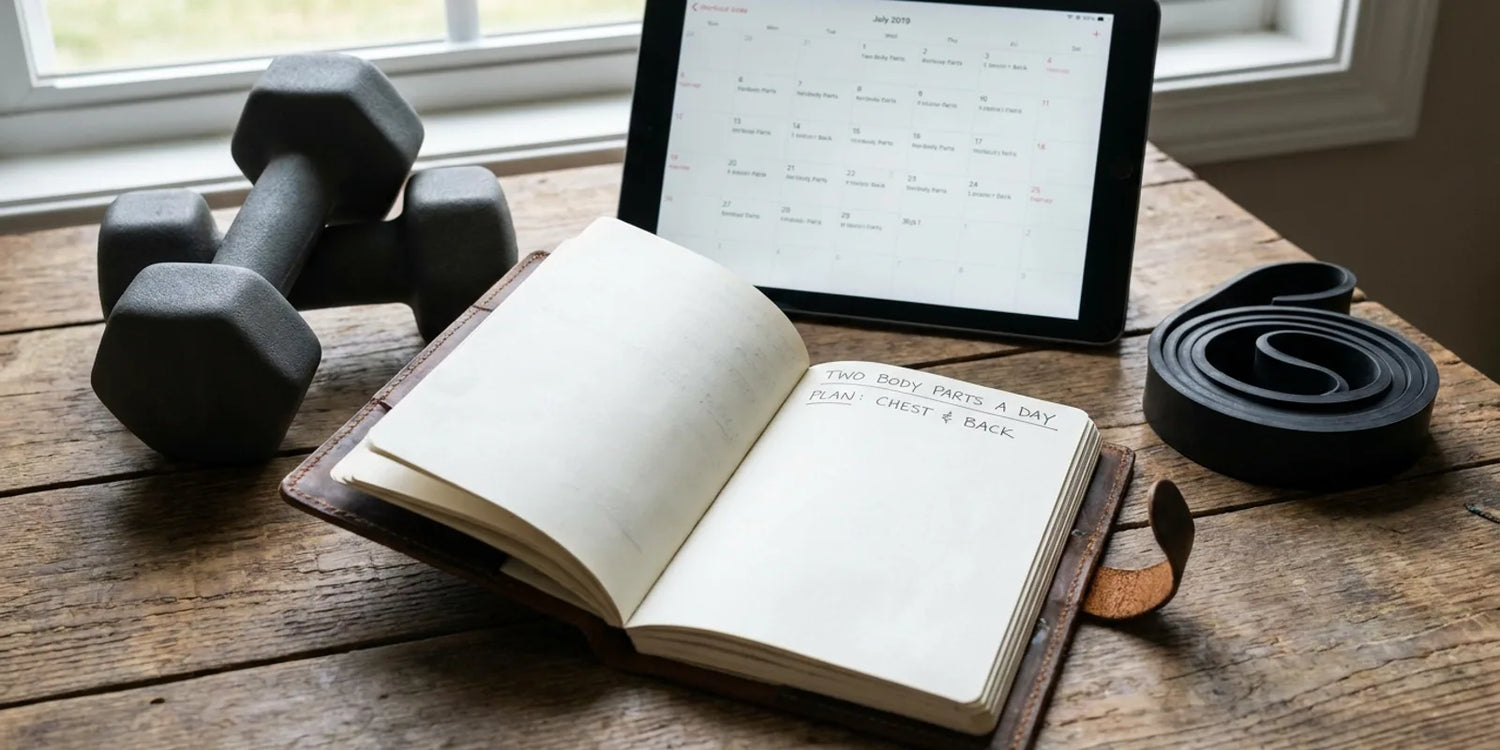
A two body parts a day workout plan for beginners pairs two muscle groups in each session, so you can cover your whole body in three to four workouts per week. Each session stays short and every muscle still gets time to recover.
This guide explains which muscle groups pair well, how many sets and reps to use, how a split compares to full-body training, and how to run the plan at home. The advice is general training information, so check with a professional if you have a health condition.
Quick Answer: A two body parts a day workout plan for beginners pairs two muscle groups in each session, such as chest and triceps, back and biceps, or legs and shoulders. You train three to four days a week and hit each muscle group once or twice weekly. Split and full-body training produce similar results when weekly volume is equal.
Key Takeaways
- Weekly split: A two body parts a day split trains each muscle group once or twice weekly across three to four focused sessions.
- Pairing: Pair muscles that share a workout, such as chest with triceps, back with biceps, or legs with shoulders.
- Volume: Beginners can aim for three to four sets per exercise and about six to ten sets per muscle group per session.
- Evidence: Split and full-body plans can produce similar strength and size gains when weekly volume is equal.
- Home: Bodyweight, dumbbell, band, and bench exercises make the split workable with limited home equipment.
What Is a Two Body Parts a Day Workout Plan?
A two body parts a day workout plan is a split routine where you train two muscle groups in a single session, such as chest and triceps or back and biceps. Each session stays focused and short enough to fit a beginner schedule, and the whole body gets covered across the week.
- Chest and triceps: Pushing movements for the chest also work the triceps, so the pair flows naturally in one session.
- Back and biceps: Pulling movements for the back also involve the biceps, which makes the pairing efficient.
- Legs and shoulders: Legs carry the heavy compound work, and the shoulders add a separate movement that fits the same session.
This structure suits new lifters because it keeps workouts around 45 to 60 minutes and spreads recovery across the week. If you have never followed a structured plan, start with a simple beginner workout plan to learn the basic movements before adding split complexity.
Which Muscle Groups Should You Pair Together?
Pair muscles that share a training session or sit on opposite sides of the same movement, such as chest and triceps, back and biceps, or legs and shoulders. This keeps a balance between pushing and pulling muscles and lets each group recover before its next visit.
| Pairing | Why it works | Sample exercises |
|---|---|---|
| Chest and triceps | Pressing moves the chest and triceps together | Bench press, dumbbell fly, tricep extension |
| Back and biceps | Pulling moves the back and biceps together | Bent over row, lat pulldown, bicep curl |
| Legs and shoulders | Heavy lower body work plus a separate shoulder block | Squat, leg press, shoulder press |
Pairings above follow the push and pull balance of the body. You can also pair a large muscle with a small one, such as legs and calves, to keep sessions efficient.
Avoid pairing two very large groups, such as chest and legs, in the same session because the workout becomes long and the second muscle group is trained with less energy. Order matters too: train the bigger, more demanding muscle first while your energy is fresh, then finish with the smaller muscle.
How Does a Split Compare to Full-Body Training for Beginners?
For beginners, a split and a full-body plan can produce similar results when each muscle group is trained the same number of times per week. The best choice for most new lifters is the schedule they can follow consistently.
A randomized trial in untrained women found that two full-body sessions per week and four upper and lower split sessions per week, with each muscle group trained twice weekly, produced similar gains in strength and muscle mass [1]. A separate trial in untrained subjects found split and full-body routines produced similar gains in strength and muscle thickness when weekly set volume was equal [2].
The practical takeaway is that total weekly volume and consistency matter more than the exact schedule you choose. Full-body training is a fine alternative if you prefer three sessions that cover everything each time.
See how full body circuit training for beginners works if you want a different structure. A two body parts a day split is simply a way to organize the same exercises into shorter, more focused sessions.
How Many Sets and Reps Should Beginners Do per Muscle Group?
Aim for about three to four sets per exercise and roughly six to ten sets per muscle group per session, using a weight that leaves one to three reps in reserve on your last set. This volume supports progress without dragging a beginner session past about an hour.
A study in trained men found equal-volume resistance training performed once or twice a week per muscle group produced similar upper-body strength gains, and once-weekly training increased elbow flexor muscle thickness [3]. For beginners the practical reading is simple: even training a muscle group once a week can support strength and size when volume is adequate.
A split that visits each muscle once or twice weekly is more than enough. For weight selection, pick a load where the last two reps of each set are hard but your form stays clean, and only add weight or reps when you can complete every set with good technique.
Rest about 60 to 90 seconds between sets for most exercises, and up to two to three minutes for heavy leg work.
What Does a Full Week Two Body Parts a Day Plan Look Like?
A simple schedule trains three to four days and rests in between, for example chest and triceps on day one, back and biceps on day two, legs and shoulders on day three, and a rest day after each session. Each muscle group is trained about once or twice per week with room to recover.
| Day | Focus | Sample session |
|---|---|---|
| Monday | Chest and triceps | Bench press, incline dumbbell press, dumbbell fly, tricep extension |
| Tuesday | Back and biceps | Bent over row, lat pulldown, face pull, bicep curl |
| Thursday | Legs and shoulders | Squat, leg press, Romanian deadlift, shoulder press |
| Saturday | Optional fourth day | Calves, core, and light cardio |
Beginners can start with three days and add the fourth day after four to six weeks. Place a rest day between sessions to keep recovery strong.
If you have more time available, a four day schedule like this one can be extended with a 4 day split workout routine. Keep the plan simple at first: master the main lifts, record your weights each week, and add a small amount of load or reps over time.
When you train legs and back at home, a RitFit Olympic barbell clamp helps keep plates secure while you load a barbell for squats and presses.
How Do You Run the Split at Home With Limited Equipment?
You can run a two body parts a day plan at home with bodyweight, dumbbells, bands, or a compact bench because most muscle groups only need a few basic movements. A pair of adjustable dumbbells or a small rack covers most of the plan.
For chest and shoulders, use push-ups and overhead presses. For back and biceps, use rows and curls with a band or a dumbbell.
For legs, use squats, lunges, and glute bridges. These movement patterns are the same ones used in the gym, so the split transfers directly to a home setup.
Add resistance band workouts all body parts for extra variety if bands are all you have. Start with a dumbbell collection that matches your current strength.
Step up to a rubber hex dumbbell set with rack when you want a full range of weights ready to grab. An adjustable weight bench lets you do presses, rows, and supported exercises at the right angle, which keeps the home version of the split close to a gym version.
"If your space is limited, a good set of adjustable dumbbells might be your better option. They will allow you to progress to heavier weight as you get stronger."
Jeff Cavaliere, MSPT, CSCS, Physical Therapist and Strength Coach, Creator of ATHLEAN-X, Athlean-X
FAQs About Two Body Parts a Day Workout Plans for Beginners
Is a two body parts a day split good for beginners?
Yes.
Training two muscle groups per day is a manageable way for beginners to cover the whole body across the week.
Research shows a split and a full-body plan can produce similar results when each muscle group is trained the same number of times, so pick what fits your schedule.
Which two muscle groups should I pair together?
Pair muscles that share a workout or opposite push and pull groups, such as chest and triceps, back and biceps, or legs and shoulders.
This keeps sessions balanced and lets each muscle recover between visits.
Avoid pairing two very large groups that make a session too long.
How many days a week should I do a two body parts split?
A three to four day schedule works well, for example chest and triceps one day, back and biceps the next, then legs and shoulders, with a rest day between or after each training day. Each muscle group ends up trained about once or twice weekly with good recovery.
How many sets should I do per muscle group?
Aim for roughly three to four sets per exercise and about six to ten sets per muscle group per session, using a weight that lets you finish the last reps with good form. Research notes even one session per week per muscle group can support gains when volume is adequate.
Can I do a two body parts split at home with limited equipment?
Yes.
Pair bodyweight and dumbbell or band exercises for each muscle group, for example push-ups and overhead press for chest and shoulders, or rows and bicep curls for back and arms.
A pair of adjustable dumbbells or a compact multi-functional machine can cover most of the plan.
Conclusion
A two body parts a day workout plan for beginners pairs two muscle groups per session, trains three to four days a week, and gives every muscle one or two weekly sessions. Split and full-body training can produce similar strength and size gains when weekly volume is equal, so choose the plan you can follow consistently.
Start by choosing your pairings, writing down your weekly sessions, and adding a little weight or a rep each week. For equipment to begin, check the sales page for bundle offers that keep setup affordable.
Disclaimer
This article provides general fitness information and is not medical advice.
Consult a qualified professional before starting a new training program, especially if you have an injury, a chronic condition, or are returning to exercise after a long break.
Stop any exercise that causes sharp pain and adjust the plan to your ability.
References
1. Pedersen H, Fimland MS, Schoenfeld BJ, et al. A randomized trial on the efficacy of split-body versus full-body resistance training in non-resistance trained women. BMC Sports Sci Med Rehabil. 2022;14(1):87. doi:10.1186/s13102-022-00481-7. PMCID: PMC9107721
2. Evangelista AL, Braz TV, La Scala Teixeira CV, et al. Split or full-body workout routine: which is best to increase muscle strength and hypertrophy?. Einstein (Sao Paulo). 2021;19:eAO5781. doi:10.31744/einstein_journal/2021AO5781. PMCID: PMC8372753
3. Gentil P, Fisher J, Steele J, et al. Effects of equal-volume resistance training with different training frequencies in muscle size and strength in trained men. PeerJ. 2018;6:e5020. doi:10.7717/peerj.5020. PMCID: PMC6016534





