Workout machines and equipment fall into three broad groups: cardio machines, strength machines, and free weights, with multi-function stations now bridging the categories. This guide breaks down every major type so you can match equipment to your goals, space, and budget.
You will learn what each machine does, how much room it needs, and which setup makes sense for a beginner, a small apartment, or a dedicated garage gym. Use the contents list below to jump straight to the category you are shopping for.
Quick Answer: Workout equipment falls into cardio machines like treadmills, bikes, and rowers; strength machines like Smith machines, cables, and leg presses; and free weights like barbells and dumbbells. Each type targets different goals, so the right mix depends on your training focus, available floor space, ceiling height, and budget.
Key Takeaways
- Categories: Workout machines split into cardio machines, strength machines, free weights, and multi-function stations, so start by naming which group matches your goal.
- Cardio: Treadmills, bikes, rowers, and ellipticals vary in impact, footprint, and muscle use, so pick one you enjoy enough to ride or run several times a week.
- Strength: Smith machines, cable stations, and racks add safety with a fixed path, while free weights recruit more stabilizer muscles.
- Space: A treadmill needs roughly 30 to 40 square feet of clear space, while a compact bench and dumbbell setup fits in about 100 square feet with an eight-foot ceiling.
- Budget: Most home gyms start with a bench, dumbbells, and one multi-function machine, then add pieces only when a routine demands them.
What Are the Main Types of Workout Machines and Equipment?
Workout machines and equipment divide into cardio machines, strength machines, free weights, and multi-function stations, and most home gyms draw from all four. Each category answers a different training goal, from raising your heart rate to building muscle and power.
- Cardio machines: treadmills, stationary bikes, ellipticals, rowing machines, and stair climbers raise your heart rate and burn calories.
- Strength machines: Smith machines, cable stations, and leg presses guide your joints through a fixed path so you can build muscle safely.
- Free weights: barbells, dumbbells, and kettlebells let you move naturally and recruit stabilizing muscles on every rep.
- Multi-function stations: all-in-one frames combine pressing, pulling, and cable exercises in a single footprint.
The rest of this guide explains what each category does, how much space it needs, and how to choose a starting setup. If you already know you want to lift, the strength machines section is a good place to begin.
Which Cardio Machine Is Right for You?
Cardio machines all raise your heart rate, but they differ in impact, footprint, and which muscles they work, so the right pick depends on your joints and your space. A treadmill suits runners, while a rower or elliptical offers lower-impact, full-body work.
Treadmills
Treadmills are the most popular cardio machine because walking and running are instinctive and need no coaching. They demand the most floor space, roughly 30 to 40 square feet including the safety zone behind and beside the deck.
Stationary Bikes
Stationary bikes, upright or recumbent, give a low-impact leg workout with a small footprint and a low step-through for easy mounting. Recumbent models are a common choice for riders with knee sensitivity.
Ellipticals
Ellipticals combine a smooth gliding stride with upper-body handlebars for low-impact, full-body cardio. They take up moderate floor space and are gentler on joints than a treadmill.
Rowing Machines
Rowing machines train the legs, back, and arms together while providing serious cardio, and many models fold or store upright. A rower is a strong option when you want whole-body work in a compact footprint.
Stair Climbers and Steppers
Stair climbers and steppers focus on the lower body and burn calories quickly, but they can feel repetitive and put repeated stress on the knees. They suit people who want a short, intense leg-focused session.
Strength Machines or Free Weights: What Is the Difference?
Strength machines guide the weight along a fixed path, while free weights let you control the bar or dumbbell in three dimensions, so machines add stability and free weights add balance demands. Most lifters use both because each has a clear job.
Machines are forgiving for beginners because they reduce the coordination needed, and they isolate specific muscles for bodybuilding-style training. Free weights like a barbell and bench press recruit more stabilizer muscles and translate directly to everyday strength.
- Machines: safer learning curve, easy weight changes, and good for isolation work.
- Free weights: more stabilizer engagement, natural movement, and best for compound lifts.
- Hybrid approach: start with free weights for compound lifts and use machines for accessory isolation.
What Are the Key Strength Machines and How Do They Work?
The main strength machines are Smith machines, cable machines and functional trainers, power racks, and lower-body machines like the leg press, and each solves a different lifting problem. These machines add safety and convenience while letting you load meaningful weight.
Smith Machines
A Smith machine locks the barbell to vertical guide rails, so you can squat and bench press without a spotter. Muscle activity in the pressing muscles rises with intensity toward a one-rep max, and the fixed path keeps the bar stable during heavy sets [1].
Cable Machines and Functional Trainers
Cable machines and functional trainers use pulleys and stacks so you can press, pull, and rotate through a full range of motion. They suit everything from lat pulldowns to cable crossovers in one compact station.
Power Racks and Cages
A power rack or cage holds a free barbell with adjustable safety pins, making heavy squats and bench presses safer without a spotter. Standard Olympic bars are about 7 feet 2 inches long, and most home racks need around 8 feet of ceiling clearance for overhead work, so this is the category to measure first.
RitFit sells a power cage home gym package that bundles the rack, bar, and plates in one order. If you are deciding between a cage and a guided machine, our guide to types of squat machines compares them side by side.
Leg Press and Lower Body Machines
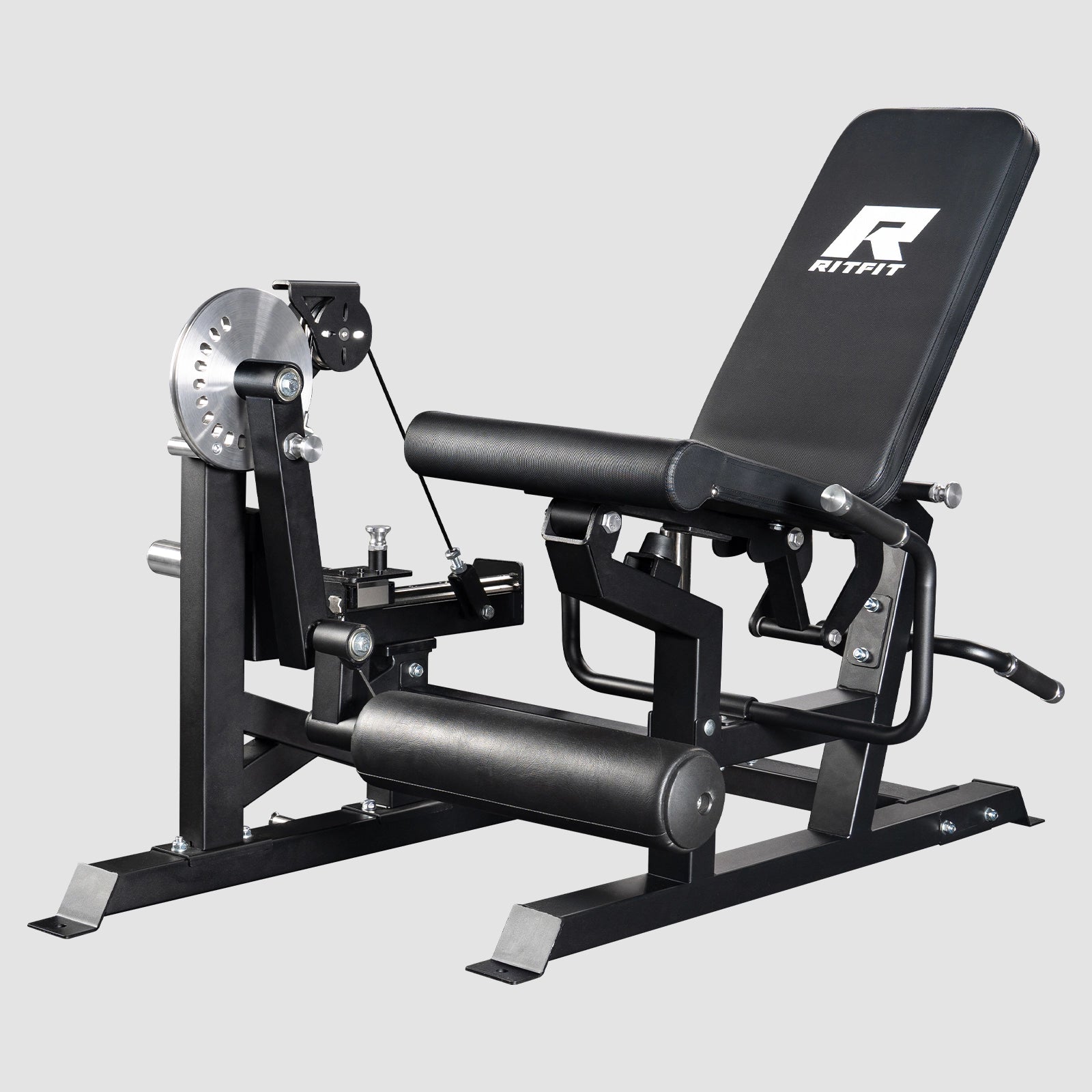
Leg press and hack squat machines let you load the lower body heavily while your back stays supported, which is a good alternative when a barbell squat is limited by mobility. Adjustable-angle models let you shift emphasis between the quads and glutes.
Chest, Lat, and Other Plate-Loaded Machines
Plate-loaded machines, from chest presses to lat pulldown towers, combine a fixed path with the freedom to load any plate size. Bench angle changes which muscles lead, since lower inclines emphasize the upper chest and steeper angles shift load toward the shoulders [2].
Free Weights and Bars: The Foundation of Every Gym
Free weights, from barbells and dumbbells to kettlebells, are the most versatile equipment because they force your muscles to control the load in every direction. A bench and a rack turn these simple tools into a complete strength setup.
Barbells, Dumbbells, and Kettlebells
Barbells carry the heaviest loads for squats, deadlifts, and presses, while dumbbells correct left-right imbalances and kettlebells add explosive, dynamic movement. A standard Olympic barbell measures about 7 feet 2 inches, which is the main dimension to plan around.
Weight Benches and Racks
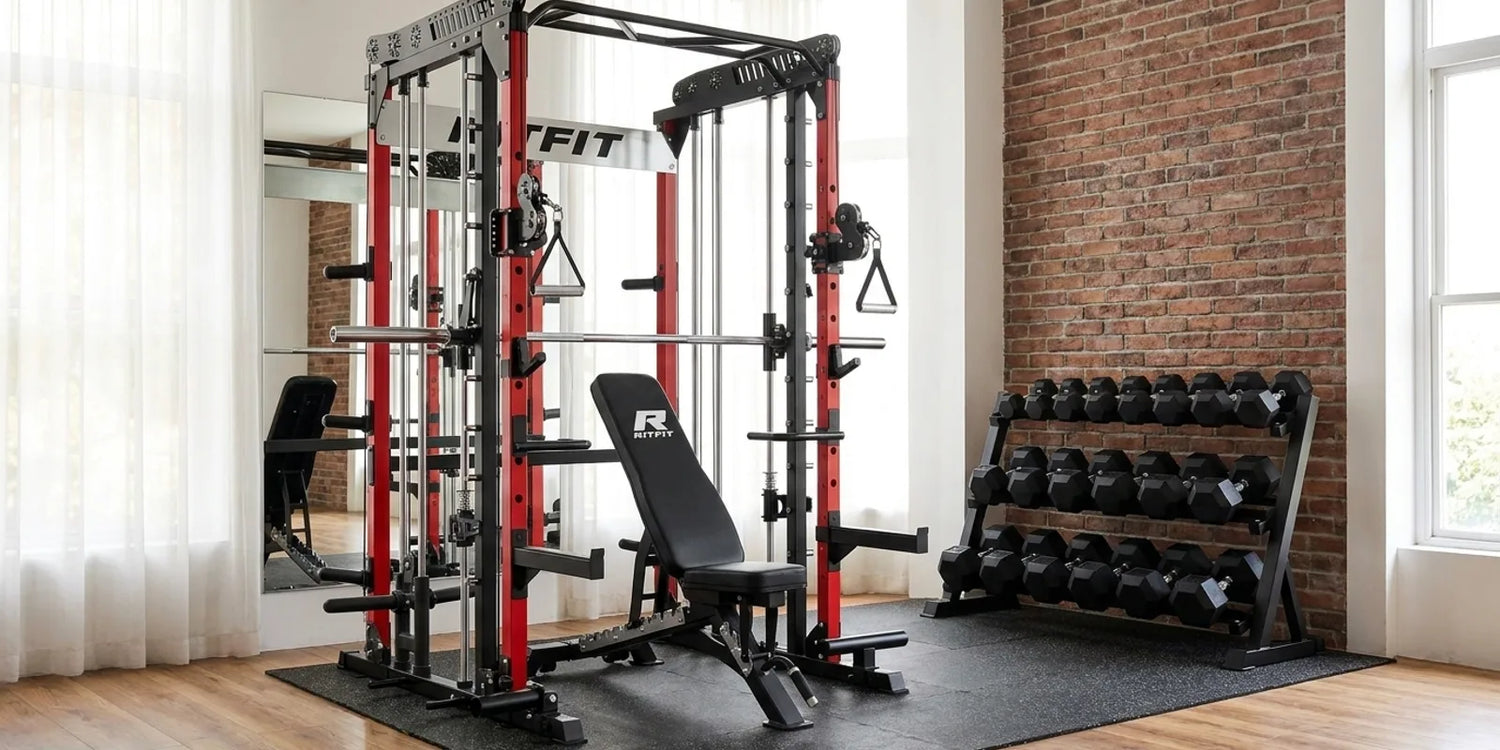
An adjustable bench supports flat, incline, and decline pressing, and a pair of stands or a rack holds the barbell at the right height. Together they cover most upper-body strength work in a small footprint.
Multi-Function and Space-Saving Equipment
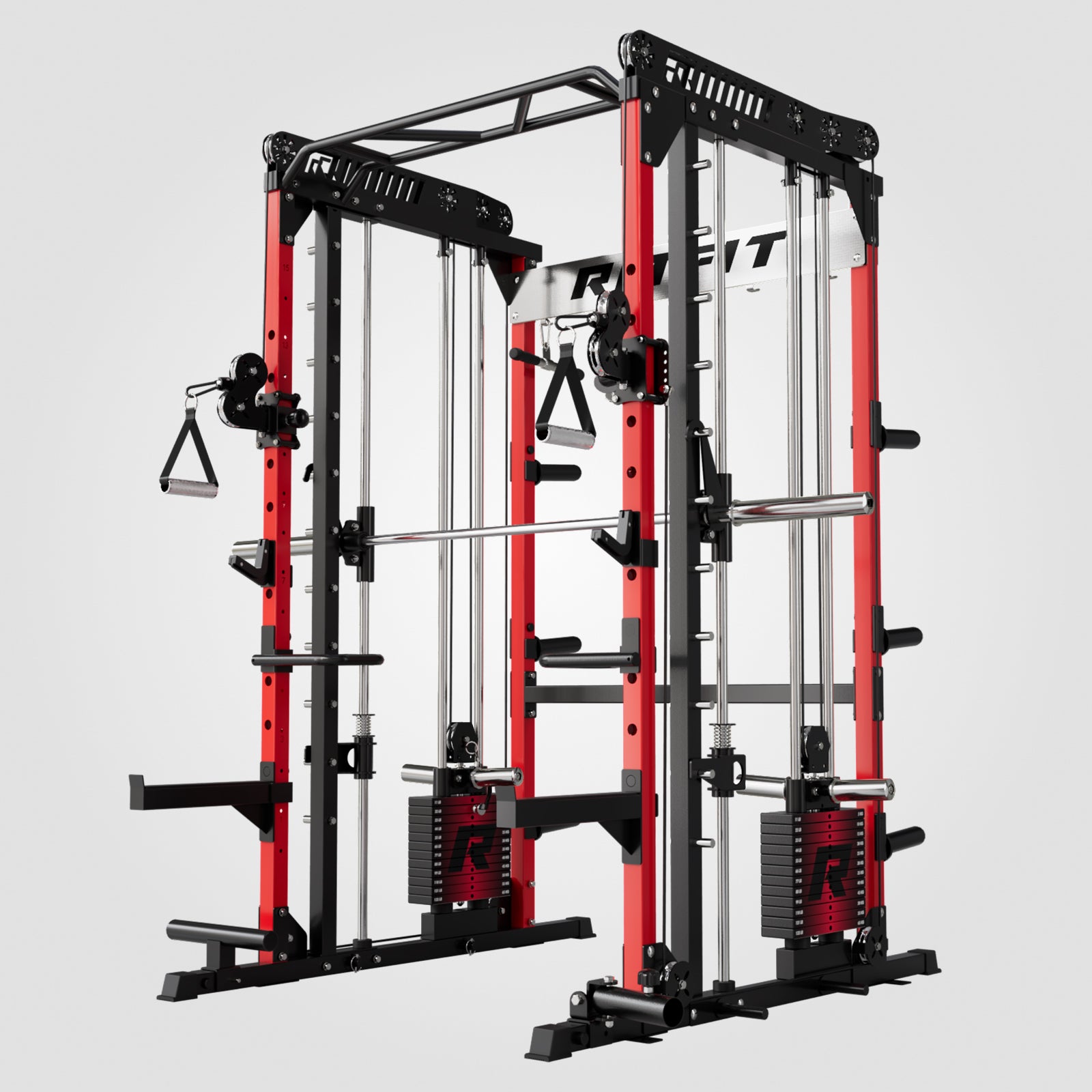
Multi-function stations combine a Smith machine, cables, and a lat tower in one frame, so you can train the whole body in a single footprint. They are the best answer when a spare room or garage needs to do the work of a full gym.
Multi-Gyms and All-in-One Stations
An all-in-one station such as the multi-functional Smith machine from RitFit lets you squat, bench, and cable-pull without owning separate machines. Pair it with an adjustable bench, and you have a complete strength setup that fits in one corner.
Adjustable Dumbbells and Bands
Adjustable dumbbells replace an entire rack of fixed weights, and resistance bands add light portable tension for travel or warm-ups. For a small space, this pair is often the most practical way to start.
If you like programmable guidance, our roundup of exercise machines with built-in workout programs covers the latest interactive stations. A full lineup of strength machines is also available if you want to compare options side by side.
How to Choose the Right Machines for Your Space and Goals
Choose equipment by matching your primary goal to a category, then fit that category to your floor space, ceiling height, and budget. One trial that compared home-based and gym-based training delivery showed both environments can support consistent training, so the routine you enjoy matters more than the venue [3].
- Goal first: cardio goals point to a treadmill, bike, or rower; strength goals point to a Smith machine, rack, or free weights.
- Measure space: check doorway widths and ceiling height, since a treadmill needs about 30 to 40 square feet and overhead presses need around 8 feet of clearance.
- Set a budget: start with a bench, dumbbells, and one multi-function machine, then add pieces only as your routine demands them.
- Start small: a compact 100-square-foot setup covers most beginner programs for the first year.
For rooms that do double duty, our guide to garage gym equipment packages shows how to lay out a full lifting zone alongside everyday storage.
Common Mistakes When Buying Gym Equipment
Most equipment mistakes come from buying for the future instead of the room, so shoppers end up with machines that do not fit, machines they never use, or duplicates they already had. Plan the space and the routine before you open the cart.
- Buying the room you wish you had: always measure actual floor space and ceiling height before choosing a machine.
- Overlooking how often you will use it: prioritize the two or three pieces your routine actually calls for.
- Ignoring cardio variety: a mix of one cardio machine and one strength station beats five similar tools.
- Skipping floor protection: rubber mats protect the floor and keep machines from sliding during hard intervals.
- Buying everything at once: start with a bench, dumbbells, and one machine, then add affordable home gym equipment pieces gradually.
Safety and Form Tips on Gym Machines
Machines keep your joints on a fixed path, but safety still depends on setting the machine to your body, loading sensible weight, and moving through a full range of motion. Slow, controlled reps beat swinging a stack you cannot control.
- Set the machine to you: adjust seats, pads, and handles so the movement starts in the correct position.
- Load conservatively: start light and add weight only when your form stays clean for the full set.
- Keep a clear zone: leave the manufacturer-recommended space behind treadmills and beside racks.
- Stop at pain: if a joint hurts instead of a muscle working, stop and check your position rather than pushing through.
- Use safety pins: on a rack or Smith machine, set safeties just below the bottom of your lift.
If you train arms often, our guide to arm workout machines names the specific stations and how to use them.
"If your space is limited, a good set of adjustable dumbbells might be your better option. They will allow you to progress to heavier weight as you get stronger."
Jeff Cavaliere, MSPT, CSCS, Physical Therapist and Strength Coach and Creator of ATHLEAN-X, Athlean-X
FAQs About Workout Machines and Equipment
What are the main types of workout machines and equipment?
Workout equipment falls into a few main categories.
Cardio machines include treadmills, stationary bikes, ellipticals, rowing machines, and stair climbers.
Strength machines include Smith machines, cable machines, functional trainers, and leg presses.
Free weights cover barbells, dumbbells, kettlebells, and plates, plus supporting gear like benches and racks.
Your goals, space, and budget decide the right mix.
Are exercise machines or free weights better for building muscle?
Both can build muscle effectively.
Free weights like barbells and dumbbells engage more stabilizer muscles and allow natural movement paths, while machines keep motion on a fixed track, which suits beginners and targeted isolation work.
Many lifters combine both, using machines for safety and control and free weights for compound strength.
Which strength machine is best for a home gym?
It depends on your space, budget, and goals.
A Smith machine or multi-function home gym combines squat, bench, and pulley movements in one footprint, which suits smaller rooms.
A power rack with a barbell offers the most versatility for heavy lifting but needs more space and clearance.
How much space do I need for home gym equipment?
A treadmill needs roughly 30 to 40 square feet of clear space once you count its safety zone.
A compact setup with a bench, dumbbells, and a foldable rack can fit in about 100 square feet.
Always measure ceiling height as well, because overhead pressing and pull-up bars typically need about eight feet of clearance.
What is the difference between plate-loaded and selectorized machines?
Plate-loaded machines require you to load weight plates onto sleeves, so you can use any plate size and progress in whatever increments you choose. Selectorized machines use a built-in weight stack selected with a pin, which makes weight changes fast and safe but limits you to the stack range.
Conclusion
Workout machines and equipment break into cardio machines, strength machines, free weights, and multi-function stations, and the right mix depends on your goal, space, and budget. Start with a bench, a pair of dumbbells, and one machine that matches your main training style, then add pieces as your routine grows.
Measure your floor space and ceiling height before you buy, and choose equipment you will actually use several times a week. For a complete setup, browse the equipment on the RitFit sales page and build your gym one piece at a time.
Disclaimer
This article is for general information about gym equipment and is not medical, training, or injury-prevention advice. Consult a qualified fitness professional or physician before starting a new exercise program, especially if you have joint issues or are new to lifting.
References
1. Krol H, Golas A. Effect of Barbell Weight on the Structure of the Flat Bench Press. J Strength Cond Res. 2017;31(5):1321-1337. PMCID: PMC5400411
2. Rodriguez-Ridao D, Antequera-Vique JA, Martin-Fuentes I, Muyor JM. Effect of Five Bench Inclinations on the Electromyographic Activity of the Pectoralis Major, Anterior Deltoid, and Triceps Brachii during the Bench Press Exercise. Int J Environ Res Public Health. 2020. PMCID: PMC7579505
3. Melo X, Simão B, Catela C, et al. Home- vs gym-based exercise delivery modes of two multicomponent intensity training regimes on cardiorespiratory fitness and arterial stiffness in adults with intellectual and developmental disability during the COVID-19 pandemic - a randomized controlled trial. J Intellect Disabil. 2024;29(1):66-85. PMCID: PMC11898390