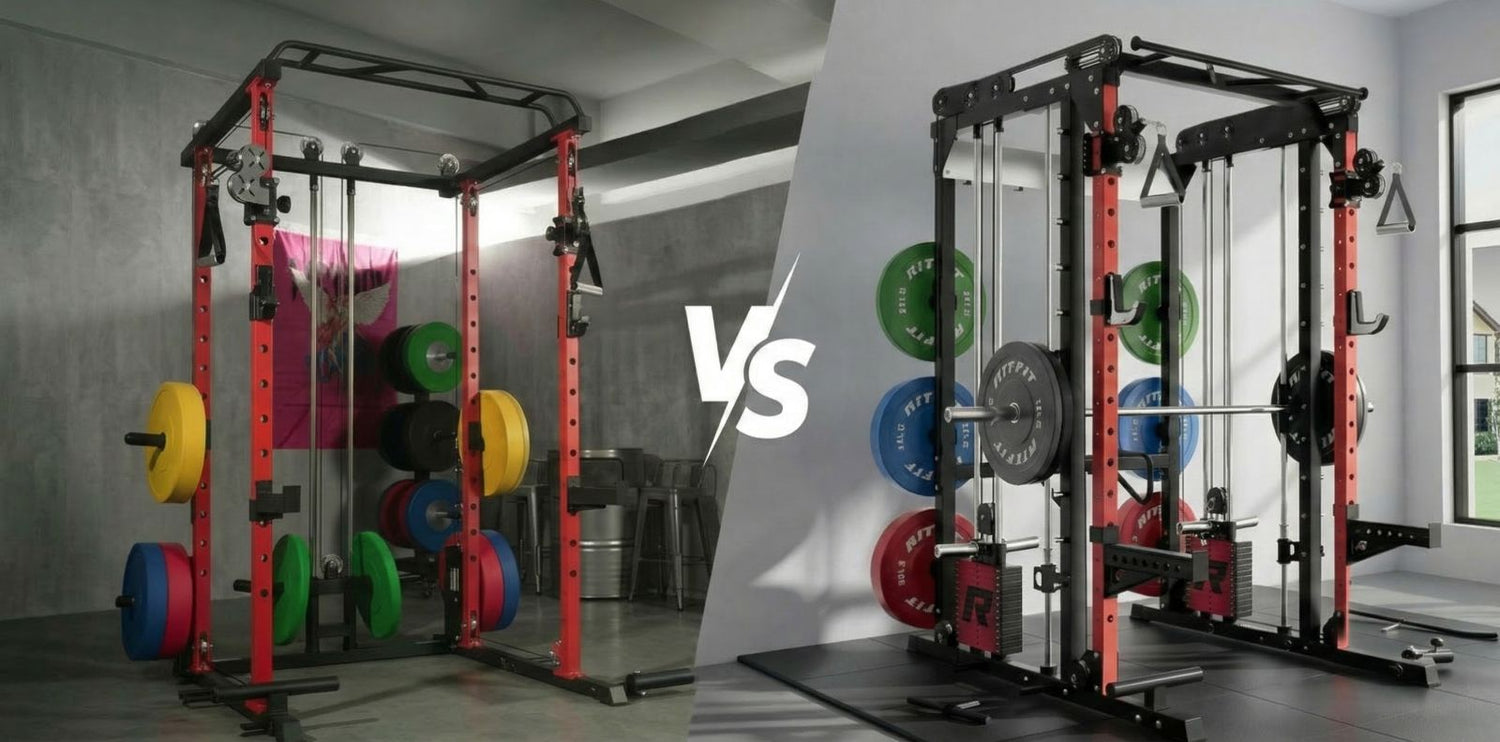
A plate loaded vs weight stack Smith machine decision comes down to how you train, how much you already own, and how fast you want to change weights. Plate loaded models suit lifters with existing plates who want higher long term loading, while weight stack models suit users who want quick pin adjustments and a cleaner, more beginner friendly setup.
This guide compares both Smith machine types across adjustability, space, cost, maintenance, training experience, and safety. You will also see RitFit machine options, a comparison table, and buying considerations to choose the right machine for your home or commercial gym.
Quick Answer: Plate loaded and weight stack Smith machines both guide a barbell on fixed rails, but they differ in how resistance is loaded. Plate loaded models use external plates and suit strength focused lifters who already own plates, while weight stack models use a selector pin and suit beginners, shared gyms, and fast paced training.
Key Takeaways
- Plate-loaded Smith machines are usually more budget-friendly at the machine level. They are a smart choice if you already own Olympic plates and want to use them across multiple pieces of equipment.
- Weight stack Smith machines are faster and easier to use. A simple pin change makes them ideal for circuit training, shared gyms, and beginners who want less setup time.
- Space needs are different in practice. Plate-loaded systems may look compact, but loose plates and storage racks often increase the total footprint around the machine.
- Maintenance demands are not the same. Plate-loaded models are mechanically simpler, while weight stack systems usually need more attention to cables, pulleys, and guide rods.
- The best choice depends on training style, not just price. Strength-focused lifters often prefer plate-loaded systems, while convenience-focused users often get more value from a selectorized setup.
What Is a Plate Loaded Smith Machine?
A plate loaded Smith machine uses external weight plates that slide onto the bar sleeves to create resistance through a guided barbell on fixed rails. This design delivers a traditional loading feel and a higher long term load ceiling than most built in stacks.
- Basic Design and Mechanism: A plate loaded Smith machine includes a steel frame, fixed guide rails, a barbell, and safety catches. Resistance comes from standard or Olympic plates that slide directly onto the bar sleeves.
- How Resistance Is Adjusted: You add or remove plates from both sides of the bar to change the load. The available weight jumps depend on the plates you own, which makes the system flexible but slower between sets.
- Common Settings and Users: Plate loaded Smith machines are especially popular in home gyms and strength focused training spaces. They appeal to users who already have plates, want simple mechanics, and prefer a more hands on lifting setup.
Plate loaded models reward lifters who already own a plate collection. You can pull from the Weight Plates collection or the Barbells Weight Plates collection to run heavy squats and presses, then drop back down for accessory work.
Because the same plates move across your rack, bench, and Smith machine, your whole gym stays flexible and your cost per exercise drops.
For a strength focused lifter, a plate loaded machine supports progressive overload across squat, press, and row variations inside one footprint. Compared with a weight stack model, it gives more headroom for future strength gains but needs slower weight changes between sets.
What Is a Weight Stack Smith Machine?
A weight stack Smith machine pairs a guided Smith bar with a built in selectorized stack, so you change resistance by moving a pin instead of handling plates. This makes weight changes near instant and keeps the training area clean and self contained.
- Definition and Design: This style combines a guided Smith bar with an integrated weight stack system. The result is a cleaner, more self contained machine that reduces the need for loose plates and separate storage.
- How a Weight Stack System Works: The machine uses stacked weight plates that move on guide rods when a pin selects the working load. Many models also include numbered labels and small add on increments for more precise progression.
- Common Settings and Users: Weight stack Smith machines are common in commercial gyms, hotels, studio spaces, and beginner friendly training environments. They are especially useful when multiple users need fast weight changes and a lower learning curve.
For fast circuit training, a weight stack Smith machine lets you move from squat to bench press to row by pulling one pin. Models like the RitFit BPC06 All In One Smith Machine with 260lb Weight Stacks and the RitFit Buffalo Smith Machine Home Gym Package with Weight Stack keep plates off the floor, so supersets and drop sets stay quick.
Compared with a plate loaded model, you trade a higher upfront cost for speed, tidiness, and a station that any family member can use safely. For a beginner running a full body program, the instant pin change removes friction between every set.

How Do Plate Loaded and Weight Stack Smith Machines Compare?
Plate loaded and weight stack Smith machines both provide safe, guided barbell training, but they differ in speed, space, cost, maintenance, feel, and confidence for new users. Your training style and available room decide which one wins.
- Adjustability and Ease of Use: Plate loaded machines take longer to change between working sets because you must add or remove plates manually. Weight stack machines allow near instant changes, which makes them better for drop sets, supersets, and shared training spaces.
- Space and Footprint: Plate loaded machines often need extra room for plate trees or on unit plate storage. Weight stack machines usually have a larger built in frame, but they remove the need for separate plate organization around the station.
- Cost and Long Term Value: Plate loaded models often have a lower upfront machine price, especially if you already own plates. Weight stack systems cost more initially, but they deliver strong all in one convenience and can reduce clutter and setup friction.
- Maintenance and Durability: Plate loaded Smith machines are simpler on the resistance side and usually have fewer service points. Weight stack systems can require more routine care because cables, pulleys, and guide rods need regular inspection and smooth operation.
- Training Experience and Performance: Plate loaded systems often feel more familiar to experienced lifters because loading real plates mirrors a traditional gym setup. Weight stack systems feel smoother and faster to use, though the resistance feel may differ slightly depending on the internal mechanism.
- Safety and User Confidence: Both machine types use a fixed bar path and safety stops to support safer training than many free weight setups. Weight stack systems can feel less intimidating for beginners because there are no loose plates to move, while plate loaded systems may feel more motivating for advanced lifters who like visual load feedback.
What Are the Pros and Cons of Each Smith Machine Type?
Plate loaded models win on cost and load ceiling, while weight stack models win on speed and convenience. The right choice depends on your training style, your budget, and the number of users sharing the machine.
Plate Loaded Smith Machines
Pros
- Lower initial machine cost
- Works well with existing Olympic plates
- Simple design with strong durability
- Often supports higher long term load potential
Cons
- Slower weight changes during training
- Requires manual plate handling
- Needs extra room for plates and storage
- Less convenient in shared or fast paced settings
Weight Stack Smith Machines
Pros
- Fast and simple weight adjustments
- Clean, organized, all in one setup
- Excellent for beginners and shared gyms
- Great for circuits, drop sets, and convenience focused training
Cons
- Higher upfront purchase price
- Maximum resistance is limited by stack capacity
- More moving parts may mean more maintenance
- Some users may prefer the feel of plate loading
Plate Loaded vs Weight Stack Smith Machines: Comparison Table
| Factor | Plate Loaded Smith Machines | Weight Stack Smith Machines |
|---|---|---|
| Initial Cost | Lower machine cost upfront | Higher upfront purchase price |
| Weight Adjustment Speed | Slower changes during workouts | Fast and simple pin based adjustments |
| Resistance Source | Uses external Olympic plates | Uses built in selectorized weight stack |
| Convenience | More manual setup and handling | Clean, organized, all in one setup |
| Durability | Simple design with strong long term durability | More moving parts may require more upkeep |
| Maximum Load Potential | Often supports higher long term loading | Limited by stack capacity unless upgradeable |
| Space Needs | Needs extra room for plates and storage | More self contained with less loose equipment |
| Best For | Strength focused home gym users who already own plates | Beginners, shared gyms, circuits, and convenience focused users |
| Main Advantage | Flexible, scalable, traditional loading feel | Fast, beginner friendly, efficient setup |
| Main Drawback | Slower and less convenient in fast paced training | Higher cost and capped resistance range |
Comparison based on typical Smith machine designs and user training patterns. Actual specs and stack capacities vary by model.
How Do You Choose the Right Smith Machine for Your Situation?
Choose a plate loaded machine if you already own plates and want the highest long term load ceiling. Choose a weight stack machine if you want fast changes, low intimidation, and a cleaner all in one station for shared or beginner friendly spaces.
- For Home Gyms: A plate loaded machine makes sense if you already own plates and want to maximize value across multiple tools. A weight stack machine is often better if you want a cleaner setup, faster workouts, and less equipment scattered around your training area.
- For Commercial or Semi-Commercial Gyms: A weight stack Smith machine is usually the better fit for member traffic and ease of use. Fast adjustments, lower intimidation, and a more polished look make it easier to serve beginners, general fitness users, and group style training spaces.
- For Strength and Hypertrophy Focused Training: Plate loaded systems are often the stronger choice for lifters who want heavier progression and a more traditional loading experience. If you want the opposite, a package like the RitFit M1 Pro Smith Machine Weight Stack Home Gym Package keeps strength work moving with pin based changes for drop sets and supersets.
- For General Fitness and Circuit Training: Weight stack systems are usually more efficient for fast moving workouts and mixed user environments. They reduce transition time between sets, which helps keep sessions smooth and accessible.
When your goal is training to failure without a spotter, the safety stops on either machine type let you push hard alone. A guided bar path also lets you add rep volume on squats and presses with less fear of losing the bar, which supports progressive overload for new lifters and advanced athletes alike.
"Next, I do Smith machine squats for the quads and glutes. Here I get as deep as I can and explode out of the hole. Doing these on the Smith allows me to push my last set to failure without worrying about dumping the bar."
Jeff Nippard, Science-Based Natural Bodybuilder and Powerlifter, JeffNippard.com
What Should You Consider Before Buying a Smith Machine?
Look beyond the headline price and add up the full cost of ownership, including plates, storage, and stack upgrades. The best machine fits how you train now and still supports your strength gains later.
- Budget and Total Cost of Ownership: Factor in the price of plates, storage, and accessories when evaluating a plate loaded machine. If you are building a plate set from scratch, bumper plates like the RitFit Fleck Bumper Plates 2 Inch Olympic Rubber Weight Plates protect your floor and your joints while you load the bar.
- Build Quality and Features: Check rail smoothness, safety stop construction, frame stability, and overall finish quality before buying. Extra features like pull up bars, cable attachments, benches, or multi function stations can add real value if they match how you actually train.
- Future Proofing: Think about how strong you may become over time and whether the machine can grow with you. Plate loaded models benefit from enough sleeve length for expansion, while weight stack systems are strongest when upgrade options are available, such as the RitFit WSBFL Weight Stack Set 286lbs for Buffalo or the RitFit WSM1 Weight Stack Set 264lbs for M1.
For a complete plate arsenal on a budget, the Cast Iron Weight Plates collection gives you durable iron plates that work across a plate loaded Smith machine, a barbell, and a rack. This shared ownership model is what makes plate loaded machines cost efficient for single user home gyms.
FAQs About Plate Loaded vs. Weight Stack Smith Machines
Which is cheaper between a plate loaded Smith machine and a weight stack Smith machine?
A plate loaded Smith machine usually has a lower initial cost. This option requires you to buy loose weight plates if you do not already own them. A weight stack Smith machine costs more upfront but provides a complete setup without needing extra storage or equipment.
Are weight stack Smith machines better for beginners?
Yes, a weight stack Smith machine is generally better for beginners. The simple pin adjustment makes changing weights fast and easy during your workout. There are no loose plates to carry around, which helps create a cleaner and less intimidating environment for new lifters to safely train.
What maintenance does a plate loaded Smith machine need compared to a weight stack model?
A plate loaded Smith machine requires less maintenance overall. It has a mechanically simple design with fewer moving parts that need routine service. A weight stack Smith machine demands more attention over time because you must regularly inspect the cables, pulleys, and guide rods for smooth operation.
Does a plate loaded Smith machine take up less space?
No, a plate loaded Smith machine often requires more overall space. The frame itself might seem compact but you must account for the loose weight plates and storage trees. A weight stack Smith machine has a larger built frame but removes the need for separate plate organization.
Why do advanced lifters prefer a plate loaded Smith machine?
Advanced lifters prefer a plate loaded Smith machine because it provides higher long term loading potential. This setup perfectly mirrors a traditional strength gym environment that feels familiar to experienced athletes. The manual handling of physical weight plates also offers satisfying visual feedback during heavy progression lifting sessions.
Can you upgrade a weight stack Smith machine with more weight?
Many weight stack Smith machines support add on stack sets or extension kits when the frame allows. Check the product specifications for stack capacity and upgrade options before buying. Plate loaded models are easier to extend because you simply add heavier plates to the bar sleeves.
Conclusion
Choose a plate loaded Smith machine if you want a lower machine cost, already own plates, and prefer a more traditional strength training feel. Choose a weight stack Smith machine if you value fast adjustments, cleaner organization, and a more beginner friendly all in one experience that keeps workouts efficient.
Measure your space, count your existing plates, and decide how many people will share the machine before you buy. For a solid start on saving for either setup, check the RitFit discount guide and compare real machine specs side by side.
Disclaimer
This article is for general guidance only and does not replace professional medical, training, or equipment safety advice. Always inspect your Smith machine, follow the manufacturer instructions, and consult a qualified coach or medical professional before starting a new training program.
References
1. Nippard J. Jeff Nippard's science-backed leg workout for massive quads. Men's Health UK. Accessed August 19, 2026. www.menshealth.com/uk/building-muscle/a63155684/jeff-nippard-leg-workout/