








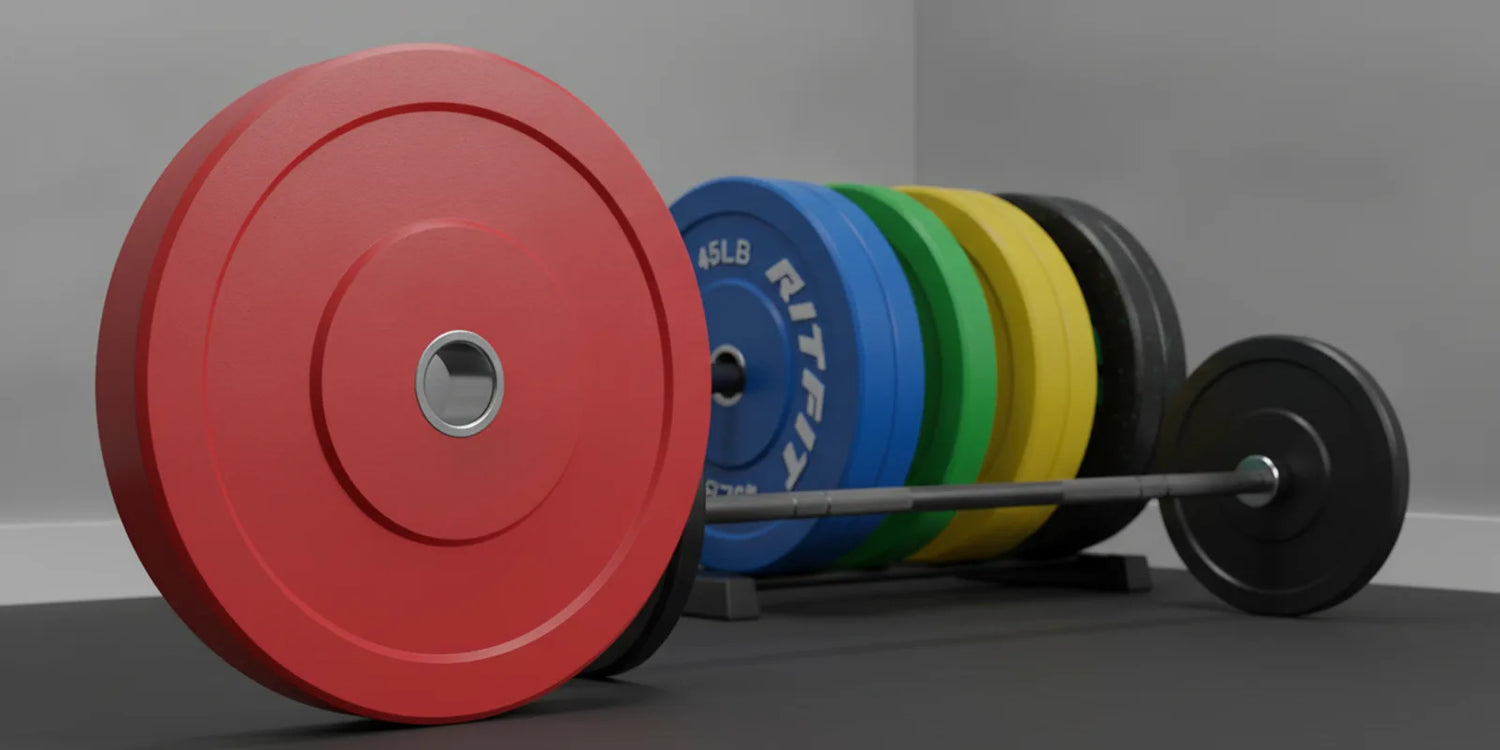
Red plate weight confuses new lifters because the same color marks two very different discs on a barbell. This guide decodes gym plate colors and explains what a calibrated weight plate actually is.
You will learn the kilogram and pound color schemes, the tolerance figures printed on competition plates, and how to total a loaded bar in seconds.
Quick Answer: A large red plate weighs 25 kg, or 55 lb in pound based sets, while the small red change plate weighs 2.5 kg. A calibrated weight plate is a precision machined steel plate built to a published tolerance, commonly plus or minus 10 grams, and color coded to federation standards.
Key Takeaways
- Red equals 25 kg: A full size red disc weighs 25 kg, which is about 55 lb, in both kilogram and pound competition color schemes.
- Red also equals 2.5 kg: The small red change disc weighs 2.5 kg, so plate diameter and the stamped number settle any doubt.
- Calibrated means measured: A calibrated plate carries a published weight tolerance, commonly listed as plus or minus 10 grams by the manufacturer.
- Color is a shortcut, not proof: Painted plates without a published tolerance are ordinary iron plates wearing federation colors.
- Most lifters do not need them: Calibrated steel earns its price at meets and near maximal attempts, not in general training.
What does a red plate weigh in the gym?
A red plate weighs 25 kg, roughly 55 lb, in every set that follows international color coding. The small red change disc is the single exception and weighs 2.5 kg.
That duplication is deliberate rather than sloppy. Federations reuse the same five colors for the large discs and the small change discs, scaled down by a factor of ten.
- Large red disc: 25 kg, or 55 lb in pound based sets, and always the heaviest plate a lifter will load in standard competition.
- Small red change disc: 2.5 kg, used for fine attempt increments and never confused with the big plate once you see them side by side.
- Diameter tells you instantly: Competition discs of 25 kg measure 450 mm across, while a 2.5 kg change disc is a fraction of that size.
- Printed markings settle it: Federation rules require every disc to carry a clear indication of its weight on the face.
Commercial gyms often mix systems, stocking painted bumpers alongside plain black iron. Browse the weight plates category to see how diameter and facing differ across plate families, and read our overview of types of weights for home gyms before you commit to one system.
What is a calibrated weight plate?
A calibrated weight plate is a precision machined steel plate that is manufactured and individually tested against a published weight tolerance. Manufacturer spec sheets commonly list plus or minus 10 grams, roughly 0.1 percent, and some brands publish 0.25 percent instead.
The tolerance is the whole point of the category. One equipment guide notes that standard iron and bumper plates are typically accurate to about plus or minus 3 percent, which is a far looser target.
- Published tolerance: A genuine calibrated plate states its tolerance on the plate face or in the spec sheet, and a plate without that figure is simply a painted iron plate.
- Calibration plugs: Many calibrated sets carry small plugs on the rear face that let the factory trim the final mass to the target figure.
- Thin profile: Dense machined steel occupies less sleeve length per kilogram than rubber, so calibrated plates stack tighter than bumpers of the same weight.
- Not drop rated: Calibrated steel chips and cracks if dropped from height, so it belongs on controlled lifts returned to the rack or lowered to the floor.
- Federation colors: The color coding lets officials read the load on a platform from a distance without counting individual discs.
Price follows precision, and a calibrated set usually costs several times what comparable iron costs per pound. Our home gym weight plates buying guide walks through where that budget is better spent for non competitive training.
How do IWF and IPF plate color codes compare?
The two federations use an identical color order, so red is always the heaviest disc and white is always the lightest of the five standard sizes. The difference sits in the unit, since weightlifting runs in kilograms while many powerlifting federations also stock pound sets.
| Color | Large disc (kg) | Change disc (kg) | Pound set plate |
|---|---|---|---|
| Red | 25 kg | 2.5 kg | 55 lb |
| Blue | 20 kg | 2 kg | 45 lb |
| Yellow | 15 kg | 1.5 kg | 35 lb |
| Green | 10 kg | 1 kg | 25 lb |
| White | 5 kg | 0.5 kg | 10 lb |
Kilogram columns follow the International Weightlifting Federation equipment rules. Pound column reflects the color scheme used by pound based powerlifting federations.
Bar color follows the same logic. The men's competition bar weighs 20 kg and carries blue markings, while the women's bar weighs 15 kg and carries yellow markings, matching the 20 kg and 15 kg discs.
- Rubber or plastic facing: Federation rules require 450 mm competition discs to be covered in rubber or plastic and coated in permanent color.
- Color is not a guarantee: A red plate in a commercial gym may be a 25 kg bumper, a 55 lb bumper, or a decorative iron plate, so read the number.
- Mixed floors are common: Many gyms run kilogram bumpers on the platform and pound iron on the racks, which is where loading errors happen.
If you are assembling a mixed floor at home, keep the two systems physically separated on different racks. The exercise weights range covers both unit systems, and storing them apart removes most of the guesswork.

How do you read a loaded barbell at a glance?
A loaded barbell is read from the inside out, because the heaviest disc always sits closest to the collar of the sleeve. Total one side, double it, then add the bar weight.
Researchers loaded discs in descending order by weight, with the heaviest disc nearest the collar, in a published bench press loading protocol.[1] That convention is why the innermost plate carries most of the load information.
- Identify the bar first: A men's competition bar weighs 20 kg and a women's bar weighs 15 kg, and getting this wrong skews every calculation that follows.
- Count one side only: One red and one blue disc per side on a 20 kg bar gives 25 kg plus 20 kg, doubled to 90 kg, for a total of 110 kg.
- Work outward for change plates: Small discs sit outside the large ones, so a 2.5 kg red change disc per side adds 5 kg to that same bar.
- Check the collars: Competition collars carry their own weight, commonly 2.5 kg each, and they belong in the total when you compare against a meet attempt.
- Trust the stamp over the paint: Faded or repainted plates are common in busy gyms, and the molded number remains the reliable reference.
Accuracy matters beyond bragging rights. Load monitoring and prescription models built on velocity and repetitions in reserve assume the absolute load on the bar is known accurately.[2]
Sorting plates by color on the rack removes most of the mental arithmetic. Dedicated weight storage racks keep each denomination in one place, and a RitFit A Frame Dumbbell Rack Stand handles the accessory weights that otherwise clutter a platform.
Do you need calibrated plates for home training?
Most home lifters do not need calibrated plates, because standard iron and bumper plates deliver the same training stimulus at a fraction of the cost. Calibrated steel earns its price when competition legal weight or sleeve space becomes the limiting factor.
Three situations justify the spend, and none of them apply to general strength training. Everything else is better served by a solid iron or bumper set plus a pair of change plates.
- You have a meet booked: Training on the same plates you will lift at the platform removes surprises on attempt day and matches the colors officials call.
- You are running out of sleeve: One manufacturer guide notes a standard Olympic sleeve offers roughly 415 mm of loadable length per side, and thin calibrated steel fits more weight into that space.
- You run attempt simulations: A study of load and velocity relationships in the free weight back squat and hexagonal bar deadlift measured performance against precise absolute loads.[3]
- You log every session: One wearable computing study observed that most commercially available resistance tracking apps record only basic manually entered data such as weight and repetitions.[4]
For everyone else, budget goes further elsewhere in the gym. A rack based setup such as the RitFit M1 PRO Smith Machine Home Gym Package adds more training options than a tolerance upgrade ever will, and our guide to building a free weight set for a home gym covers sensible plate denominations to start with.
Watch how standard bumper plates hold up under repeated drop testing before deciding that precision steel is the missing piece.
One more piece of hardware attracts the same overthinking as plate tolerance, and the answer is refreshingly simple.
"Collars are designed to keep the plates from sliding off of the barbell sleeves. That's all they are for. If the plates are not sliding off, you don't need collars."
Mark Rippetoe, Strength Coach and Author of Starting Strength, Collars on the Bar, Starting Strength
FAQs About Red Plates and Calibrated Weight Plates
How much does a red plate weigh in the gym?
A large red plate weighs 25 kg, which is about 55 lb. In pound based calibrated and competition sets, red is the 55 lb plate. The small red change plate is a different item and weighs 2.5 kg, so always check the printed number on the face.
What is a calibrated weight plate?
A calibrated weight plate is a precision machined steel plate built and tested to a published weight tolerance, then color coded to federation standards. Makers commonly list plus or minus 10 grams. Calibrated plates are thinner than bumpers and are used at powerlifting meets.
Are red plates always 25 kg?
No. Red marks the 25 kg disc and the 2.5 kg change disc in kilogram sets, and it marks the 55 lb plate in pound sets. Size makes the difference obvious, since change plates are far smaller. Read the stamped number before loading.
What is the difference between calibrated plates and bumper plates?
Bumper plates are rubber over a steel hub, built at 450 mm diameter so they can be dropped from overhead. Calibrated plates are machined steel with a tight published tolerance and a thin profile, and they should never be dropped from height.
Why are calibrated plates thinner than other plates?
Calibrated plates are machined from dense steel rather than wrapped in rubber, so the same weight occupies less sleeve length. That thin profile lets advanced lifters fit more total load on a bar before running out of loadable sleeve space.
Do commercial gyms use calibrated plates?
Most commercial gyms use standard iron, rubber coated, or bumper plates rather than calibrated steel. Color coded plates in a typical gym follow federation colors loosely, so treat the printed weight as authoritative rather than the paint color. Dedicated powerlifting gyms are the usual exception and often stock calibrated sets.
How do you work out total barbell weight from plate colors?
Add the plate weights on one side, double that figure, then add the bar weight. A bar loaded with one red and one blue disc per side plus a 20 kg bar totals 110 kg. Always confirm the bar weight first.
Should a home gym buy calibrated plates?
Most home lifters do not need them. Calibrated plates cost far more than iron or bumper plates and only matter when exact competition weight is required. Buy quality iron or bumpers first, then add calibrated plates when a meet is booked.
Conclusion
Red plate weight comes down to two answers, 25 kg for the large disc and 2.5 kg for the change disc, with 55 lb as the pound equivalent. Read the stamped number rather than trusting the paint.
Buy calibrated plates only when a meet is on the calendar. For everything else, load quality iron or bumpers, keep your unit systems separated, and check current RitFit deals before upgrading a plate set.
Disclaimer
This article covers weight plate specifications and federation color conventions for general reference, and it does not replace the current rulebook of any federation. Confirm competition equipment rules with your own federation and seek advice from a qualified coach before attempting maximal loads.
References
1. Ferri Marini C, Shoaei V, Micheli L, et al. Barbell load distribution and lifting velocity affect bench press exercise volume and perceived exertion. PLoS One. 2022;17(12):e0278909. PMCID: PMC9733861
2. Jukic I, Prnjak K, Helms ER, McGuigan MR. Modeling the repetitions-in-reserve-velocity relationship: a valid method for resistance training monitoring and prescription, and fatigue management. Physiol Rep. 2024;12(5):e15955. PMCID: PMC10901726
3. Gantois P, Fonseca FS, Nakamura FY, Fortes LS, Fernandez-Fernandez J, Batista GR. Analysis of velocity- and power-load relationships of the free-weight back-squat and hexagonal bar deadlift exercises. Biol Sport. 2023;40(1):201-208. PMCID: PMC9806758
4. Coates W, Wahlstrom J. LEAN: Real-Time Analysis of Resistance Training Using Wearable Computing. Sensors (Basel). 2023;23(10):4602. PMCID: PMC10222347





