








Choosing the right weight set for a 7 year old boy is simpler than most parents expect. The safest first set is a light, soft-coated option of 1 to 3 pounds per hand that your son can grip easily, paired with a short supervised routine that keeps form clean and sessions fun.
This guide covers safe starting weights, the best types of kids weight sets, how to teach a 7 year old proper lifting form, and a simple starter routine you can run together at home. Every recommendation stays age-appropriate and parent-supervised.
Quick Answer: For a 7 year old boy, the best weight set is a light, soft-coated set of 1 to 3 pounds per hand used under adult supervision. Start with bodyweight or 1 pound per hand, keep sessions short, and progress only after form stays clean.
Key Takeaways
- Safe under supervision: Pediatric and youth fitness groups support supervised resistance training for children when loads are light.
- Start light: Begin with 1 to 3 pounds per hand or bodyweight alone for a 7 year old.
- Pick soft-coated: Mini rubber plates and soft-coated dumbbells are easiest for small hands.
- Teach form first: An adult demonstrates each move and corrects form before any weight is added.
- Keep it short: Two to three 15 to 20 minute sessions per week on nonconsecutive days is plenty.
Is it safe for a 7 year old to use a weight set?
Yes, a weight set is safe for a 7 year old boy when the loads are light, an adult supervises every session, and form is taught before weight is added. Pediatric and youth fitness organizations support well-designed, competently supervised resistance training for children.
- Light loads: Start with 1 to 3 pounds per hand so joints and growing bones are not overloaded.
- Adult supervision: A parent stays in the room for every set and corrects form immediately.
- Proper form: Clean technique comes before any increase in weight or reps.
- Age-ready signs: A child is usually ready when he can follow directions, balance well, and squat with control.
Keep the first few sessions to bodyweight and the very lightest light weight plates so your son learns movement before load. For more options, browse the wider exercise weights category when you are ready to add variety.
What weight should a 7 year old start with?
A 7 year old should start with 1 to 3 pounds per hand, or bodyweight alone. Choose the lightest option that lets your son complete 10 to 15 controlled reps without strain, rushing, or changing posture.
Meta-analytic evidence shows that progressively increasing training load drives strength gains over time [1], which is exactly why starting light and adding slowly works best for a young beginner.
- 1 pound per hand: Ideal for overhead presses, curls, and rows at the start.
- 2 to 3 pounds per hand: Only after several sessions of clean form at lighter weight.
- Progress by reps first: Add a rep or a set before you add weight, and never more than 0.5 to 1 pound at a time.
- Watch for strain: If the back rounds, the body jerks, or he cannot finish a rep, the weight is too heavy.
Light weight plates let you fine-tune tiny increments as strength grows, so a growing boy never jumps too far too fast.
Which type of weight set is best for a 7 year old boy?
For a 7 year old boy, soft-coated dumbbells and mini rubber plates are the best starting options because they grip easily, protect floors, and let you add tiny increments as strength grows. These pick up the fastest for beginner moves like curls and presses.
| Weight set type | Best for | Starting weight | Why it fits a 7 year old |
|---|---|---|---|
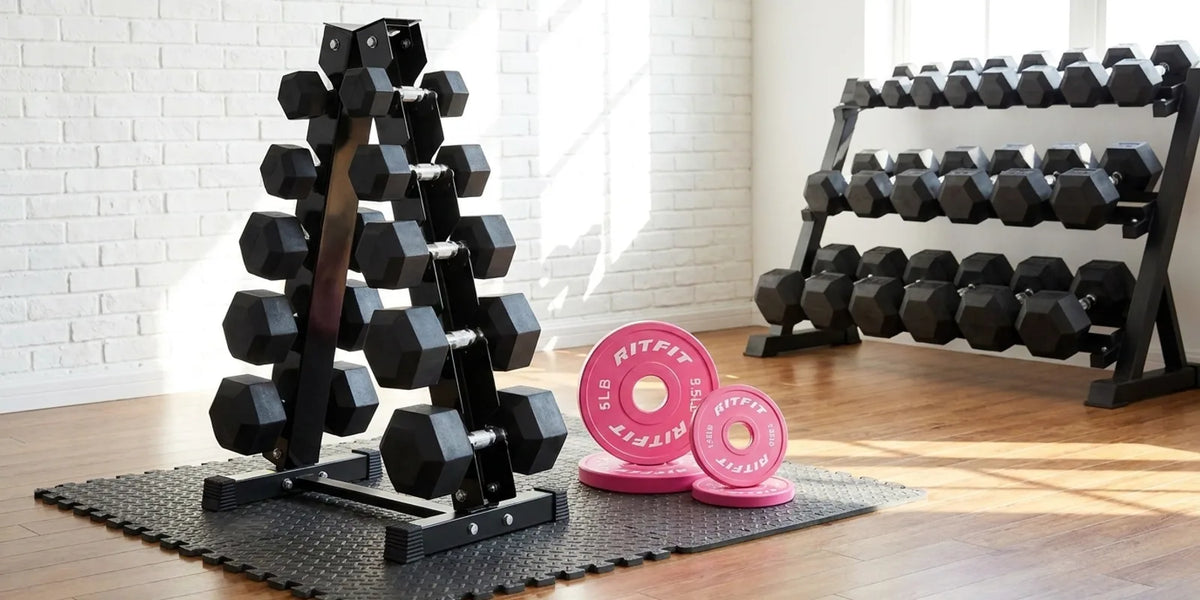
| Mini rubber weight plates | Light loads and small hands | 1 lb and up | Soft-coated, gentle on floors, easy to grip and load |
| Hexagon dumbbell sets | Quick curls and presses | 2 to 5 lbs | Rubber-coated heads stay stable on the floor between sets |
| Cast iron weight plates | Later progression | 5 lbs and up | Durable option for when he outgrows coated pieces |
Comparison within the RitFit weights range to match a young lifter's size and coordination.
- Mini rubber plates: The softest start because they protect floors and small hands during early practice.
- Hexagon dumbbells: A great next step once grip and coordination improve.
- Cast iron plates: Save these for later years when technique is automatic.
Start with the mini rubber weight plates for the gentlest introduction, then move to hexagon dumbbell sets and finally cast iron weight plates as he grows.
How do you teach a 7 year old to lift safely?
Teach a 7 year old to lift by demonstrating one exercise at a time, keeping reps slow, and correcting form before any weight is added. EMG data indicate that basic free-weight movements like squats activate the legs and posterior chain well [2], so start with bodyweight and light dumbbells.
- Show first: Demonstrate the move with no weight, then let him try it himself.
- Use simple cues: Keep it to "slow down", "chest up", and "feet wide".
- Stop and reset: If the back rounds or the knees cave in, pause and restart the rep.
- Add weight slowly: Only increase after several clean sessions at the current load.
Keep every session relaxed and fun. A boy who enjoys the routine builds the habit, and habits last longer than any single workout.
A simple starter routine for a 7 year old
A simple starter routine for a 7 year old is 2 sets of 8 to 12 controlled reps of four to six exercises, done twice a week on nonconsecutive days. Research on graded home-based resistance training shows that a progressive, simple plan is easy to follow [3].
- Bodyweight squats: The foundation move that builds leg strength and balance.
- Light dumbbell curls: 1 to 2 pounds per hand, slow and controlled.
- Overhead press: 1 pound per hand with a soft-coated dumbbell.
- Gentle rows: 1 to 2 pounds per hand, chest tall and back flat.
- Farmer carry: Walk across the room holding light weights at his sides.
- Plank or bird dog: A short core hold to finish, keeping it playful.
Warm up for 3 to 5 minutes with marching or light jogging, keep the whole session under 20 minutes, and stop at the first sign of fatigue or loss of form. Follow along with a guided kid-friendly session to keep energy up.
What to look for when buying a kids weight set
When buying a kids weight set, look for light, soft-coated weights with comfortable grips, rounded edges, and clearly marked poundage that starts at 1 to 3 pounds. Choose pieces that protect floors and can be stored safely out of reach.
- Light starting weight: The set should begin at 1 to 3 pounds per hand.
- Soft or rubber coating: Easier on small hands and on your floors.
- Comfortable grip: A narrower handle lets small fingers wrap fully.
- Clearly marked weight: Printed poundage teaches numbers and prevents guesswork.
- Safe storage: A rack or shelf keeps weights off the floor between sessions.
For the gentlest coated option, consider the mini rubber weight plates set, and keep them tidy with a weights storage rack when not in use.
FAQs About Kids Weight Sets
Is it safe for a 7 year old to lift weights?
Yes, with light loads, close supervision, and proper form.
Pediatric groups support children participating in well-designed resistance training.
Start with 1 to 3 pounds per hand, keep sessions to 15 to 20 minutes, and always watch form.
The goal is movement quality, not heavy lifting.
What weight should a 7 year old start with?
Start with 1 to 3 pounds per hand, or just bodyweight.
The weight should let your child complete 10 to 15 controlled repetitions without strain, rushing, or changing posture.
Increase resistance only after form stays clean for several sessions, and never skip supervision while weights are out.
Are dumbbells or weight plates better for a child?
Soft-coated dumbbells and mini rubber plates are the friendliest for small hands.
Plates let you add tiny increments as strength grows, while light dumbbells are quick to grip for curls and presses.
Pick a set sized for a child, not scaled-down adult gear.
How often should a 7 year old strength train?
Two to three short sessions per week on nonconsecutive days is plenty.
Each session can be 15 to 20 minutes including a warm-up.
Leave at least one rest day between sessions so young muscles recover, and stop any exercise if your child feels pain or loses form.
Can weight training stunt a child's growth?
No.
Age-appropriate, supervised resistance training does not stunt growth and can support coordination, bone strength, and confidence.
The risks come from too-heavy loads, poor form, and unsupervised lifting.
Keep weights light, form clean, and an adult present for every session.
What exercises are best for a 7 year old beginner?
Start with bodyweight squats, light dumbbell curls, overhead presses, and gentle rows using 1 to 3 pound weights.
Add short carries for grip and balance.
Two sets of 8 to 12 controlled reps per move is enough.
Keep it fun and stop before fatigue breaks form.
Conclusion
A light, soft-coated weight set for a 7 year old boy is a safe and rewarding first step into strength training when you keep loads small and supervision constant. Start at 1 to 3 pounds per hand, run short supervised sessions twice a week, and progress only as form improves.
Pair the routine with a durable home setup you can grow into, and check current RitFit sales and deals before you buy. For a deeper look at how sets and stacks are configured, read the weight stack set guide.
Disclaimer
This article is for general information only and is not medical, developmental, or training advice for any individual child. Always consult a pediatrician or qualified professional before starting a child on any strength program.
References
1. Lopez P, Radaelli R, Taaffe DR, et al. Resistance Training Load Effects on Muscle Hypertrophy and Strength Gain: Systematic Review and Network Meta-analysis. Med Sci Sports Exerc. 2021;53(6):1206-1216. doi:10.1249/MSS.0000000000002585. PMCID: PMC8126497
2. Bautista D, Durke D, Cotter JA, Escobar KA, Schick EE. A Comparison of Muscle Activation Among the Front Squat, Overhead Squat, Back Extension and Plank. Int J Exerc Sci. 2020;13(1):714-722. doi:10.70252/BTUH3630. PMCID: PMC7241624
3. Liu M, Li J, Xu J, et al. Graded Progressive Home-Based Resistance Combined with Aerobic Exercise in Community-Dwelling Older Adults with Sarcopenia: A Randomized Controlled Trial. Clin Interv Aging. 2024;19:1581-1595. doi:10.2147/CIA.S473081. PMCID: PMC11444075





