Pulley ratio means the relationship between the weight selected on a cable machine and the resistance you actually feel at the handle. If 50 pounds feels different from one cable station to another, the pulley ratio is usually the reason.
This matters for home gym buyers, strength tracking, rehab work, and anyone comparing a functional trainer, cable crossover, or Smith machine with cable system. A clear understanding of pulley ratio helps you train with better precision instead of guessing what the stack number really means.
Key Takeaways
- Pulley ratio explains real resistance: It shows how the selected stack weight converts into the load you feel at the handle.
- A 1:1 ratio feels closest to true stack weight: It is useful for heavy rows, lat pulldowns, and strength focused cable work.
- A 2:1 ratio balances resistance and cable travel: It is common on functional trainers because it supports smoother movement and longer range.
- A 4:1 ratio is lighter and more controlled: It works best for speed work, rehab style training, and very light accessory movements.
- Machine feel is not only math: Friction, cable routing, pulley quality, handle angle, and maintenance can change the real resistance.
What Does Pulley Ratio Mean?
Pulley ratio describes the mechanical relationship between the selected weight stack and the resistance delivered to the handle. In simple terms, it tells you whether the machine gives you true load, reduced load, or extra cable travel.
The most common fitness equipment ratios are 1:1, 2:1, and 4:1. As the ratio gets higher, the handle usually feels lighter, while the available cable travel becomes longer.
How to Calculate Actual Cable Resistance
To estimate actual cable resistance, divide the selected stack weight by the pulley ratio. This gives a practical estimate before friction, cable angle, and machine condition are considered.
| Selected Stack Weight | 1:1 Ratio | 2:1 Ratio | 4:1 Ratio |
|---|---|---|---|
| 100 lb | About 100 lb at the handle | About 50 lb at the handle | About 25 lb at the handle |
| 150 lb | About 150 lb at the handle | About 75 lb at the handle | About 37.5 lb at the handle |
| 200 lb | About 200 lb at the handle | About 100 lb at the handle | About 50 lb at the handle |
This is why the printed number on the stack should not be treated as the same thing as handle resistance. For accurate training logs, record both the selected stack weight and the machine ratio whenever possible.
Common Pulley Ratios Explained
Most cable machines use pulley ratios to trade raw load for smoother movement and longer cable travel. The right choice depends on whether your priority is heavy strength, functional range, or controlled light resistance.
The 1:1 Ratio
A 1:1 pulley ratio usually means the selected stack weight feels close to the resistance at the handle. This setup is common on traditional lat pulldown stations, seated rows, and heavier single path cable machines.
- Best for: Heavy lat pulldowns, seated cable rows, triceps pressdowns, and strength focused accessory work.
- Main advantage: The resistance feels more direct because there is less mechanical load reduction.
- Main limitation: Cable travel is shorter, so long range functional movements may feel restricted.
The 2:1 Ratio
A 2:1 pulley ratio usually means the handle resistance is about half of the selected stack weight. This is one of the most common layouts for functional trainers, cable crossovers, and home gym cable stations.
- Best for: Cable flys, curls, lateral raises, face pulls, chops, rows, and functional full body training.
- Main advantage: It gives longer cable travel and smaller effective weight jumps.
- Main limitation: Advanced lifters may need a heavier stack for heavy pulldowns or rows.
For home gym users comparing a cable crossover machine or a compact all in one station, a 2:1 system often feels more versatile for daily training. It supports more movement variety without making every plate jump feel too large.
The 4:1 Ratio
A 4:1 pulley ratio usually means the handle resistance is about one quarter of the selected stack weight. This setup is useful when the goal is light resistance, long cable travel, and controlled movement speed.
- Best for: Rehab style exercises, speed drills, shoulder isolation, elderly users, and early stage accessory work.
- Main advantage: It feels smooth and controlled because each stack jump becomes much smaller at the handle.
- Main limitation: It may feel too light for heavy strength training unless the stack is very large.
Why Pulley Ratio Matters for Strength Tracking
Pulley ratio matters because progressive overload depends on knowing what load you are actually using. If one machine is 1:1 and another is 2:1, the same selected weight can represent very different training stress.
Research on resistance training supports the importance of matching loading decisions to the training goal, especially when programming for strength, hypertrophy, or local muscular endurance.[1] For cable training, that means the stack number alone is not enough.
Why Pulley Ratio Does Not Always Feel Exact
Pulley ratio gives a theoretical estimate, not a perfect measurement of real world resistance. Friction, pulley diameter, cable routing, bearing quality, lubrication, stack guide smoothness, and handle angle can all change how the movement feels.
This is why two 2:1 machines can still feel different even when both use the same selected weight. A well maintained cable path can feel smoother, while a poorly maintained one may feel heavier or inconsistent.
How Pulley Ratio Changes Cable Travel
A higher pulley ratio usually increases cable travel because the handle moves farther than the weight stack. This is one reason functional trainers often use 2:1 systems instead of direct 1:1 systems.
For example, in a 2:1 system, pulling the handle 2 feet usually raises the stack about 1 foot. That extra travel helps with standing cable flys, rotational chops, lateral lunges, and long range athletic movements.
Which Pulley Ratio Should You Choose?
The best pulley ratio depends on your training goal, strength level, and available space. Use the machine for the exercises you perform most often, not just the heaviest number printed on the stack.
| Pulley Ratio | Best Use | Main Benefit | Watch Out For |
|---|---|---|---|
| 1:1 | Heavy rows, pulldowns, and strength work | More direct resistance | Shorter cable travel |
| 2:1 | Functional training, cable flys, curls, raises, and home gyms | Balanced resistance and travel | Stack weight feels lighter than selected |
| 4:1 | Rehab, speed work, and light isolation | Very smooth small increments | May not provide enough heavy load |
If your training combines strength work and functional cable movements, a 2:1 cable system is often the most balanced choice. If your main goal is heavy pulling, a 1:1 station or a heavier stack may be more useful.
Pulley Ratio and Home Gym Equipment
Home gym buyers should compare pulley ratio together with stack weight, cable travel, footprint, attachment options, and exercise selection. A machine with a lighter effective ratio can still be valuable if it allows more exercises in less space.
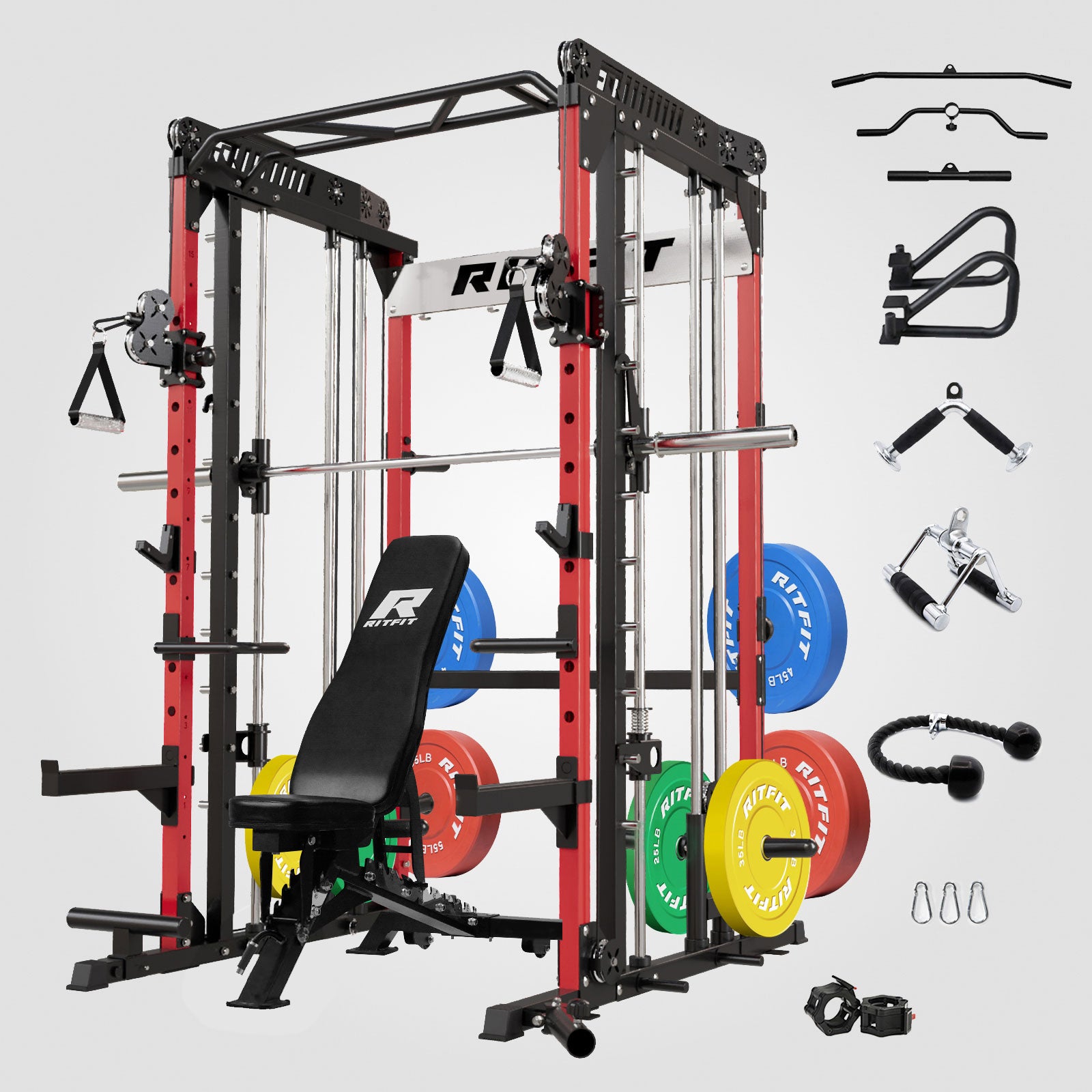
For example, users comparing the RitFit M1 Smith Machine with Cable Crossover System or the RitFit M2 Multi Functional Modular Home Gym Smith Machine should think about both resistance feel and exercise variety. A cable system is most useful when it fits your movement goals, not only your maximum load goal.
If you prefer a weight stack format, compare the listed stack capacity with the ratio before estimating handle resistance. The RitFit BPC06 All In One Smith Machine With 260LB Weight Stacks is one example of why stack weight and ratio should be read together.
Pulley Ratio and Exercise Selection
A 1:1 ratio can be excellent for heavy pulling exercises, while 2:1 and 4:1 ratios are often easier to control for isolation and long range movements. The best setup is the one that supports the exercises you repeat consistently.
For lat focused training, pair the machine ratio with the right attachment and setup. You can compare lat pulldown attachments and review a practical lat pulldown on a Smith machine guide to match resistance feel with correct movement technique.
Pulley Ratio, Muscle Growth, and Progressive Overload
Pulley ratio does not directly build muscle, but it changes how you measure and progress resistance. Muscle growth still depends on effort, progressive overload, range of motion, recovery, and exercise consistency.
Progressive overload can happen through more load, more repetitions, better control, or higher training quality, not only by adding stack weight.[2] This is important because a 5 pound stack increase on a 2:1 machine is usually only about a 2.5 pound increase at the handle.
Machines and free weights can both support strength and hypertrophy when programmed well, and evidence suggests the choice should match goals, preferences, and exercise specificity.[3] For cable systems, the practical goal is to track the real training stimulus clearly.
Pulley Ratio and Range of Motion
Higher ratio cable systems can make long range movements easier because they provide more cable travel. This can be helpful for exercises such as cable flys, woodchoppers, lateral lunges, and standing single arm rows.
Resistance training itself can also improve range of motion when performed with appropriate control and external load.[4] That makes pulley setup, exercise form, and movement range all part of a useful cable training plan.
Quick Buying Checklist for Cable Machines
Use pulley ratio as one part of your buying decision, not the only factor. A better cable machine should match your space, exercises, strength level, and long term progression plan.
- Check the pulley ratio: Confirm whether the machine is 1:1, 2:1, 4:1, or adjustable.
- Estimate real resistance: Divide the stack weight by the ratio before comparing machines.
- Look at cable travel: Choose longer travel for functional training and athletic movements.
- Review attachment compatibility: Handles, bars, straps, and pulldown attachments can expand exercise variety.
- Match your training goal: Heavy pulling favors direct load, while isolation and rehab work often benefit from smoother ratios.
- Plan your workouts: For more programming ideas, review stack weight home gym workouts and build around the movements you will actually perform.
FAQs
What does pulley ratio mean on a cable machine?
Pulley ratio means how the selected stack weight translates into resistance at the handle. A 2 to 1 system usually makes 100 pounds feel like about 50 pounds before friction, cable angle, pulley quality, and machine maintenance change the real feel.
Is a 1 to 1 pulley ratio better than a 2 to 1 pulley ratio?
Yes. A 1 to 1 pulley ratio can be better for heavy lat pulldowns and rows because it gives more direct load. It is not automatically better for cable flys, curls, raises, or athletic movements because shorter cable travel can limit range and smoothness.
How do I calculate real cable machine resistance?
Divide the selected stack weight by the pulley ratio to estimate handle resistance. For example, 120 pounds on a 2 to 1 cable machine usually feels like about 60 pounds, while the same stack on a 4 to 1 system usually feels like about 30 pounds.
Why does the same cable machine weight feel different?
The same cable machine weight feels different because pulley ratio is only the starting point. Bearing quality, cable routing, pulley diameter, lubrication, stack guide friction, handle angle, and maintenance can all change how much resistance reaches your hands during the movement.
Which pulley ratio is best for a home gym?
A 2 to 1 pulley ratio is often the best fit for a home gym because it balances usable resistance and longer cable travel. It works well for flys, curls, rows, lateral raises, functional training, and many full body cable exercises.
Does pulley ratio affect muscle growth?
Yes. Pulley ratio can affect how you track muscle growth because it changes the real load you are recording. Muscle growth still depends on effort, progression, exercise selection, range of motion, recovery, and consistency, not only the number printed on the stack.
Can a 2 to 1 pulley ratio work for lat pulldowns?
Yes. A 2 to 1 pulley ratio can work for lat pulldowns if the machine has enough total stack weight for your strength level. Stronger lifters may prefer a 1 to 1 setup for heavier pulldowns, while general users may value smoother travel.
Should beginners choose a lower pulley ratio for cable training?
Beginners should usually choose the pulley ratio that matches their exercises and control level, not simply the lightest setup. A 2 to 1 system is often beginner friendly because smaller effective jumps make progression easier and longer cable travel supports better movement variety.
Conclusion
Pulley ratio explains why cable machine weights do not always feel the same from one station to another. A 1:1 ratio supports heavier direct resistance, a 2:1 ratio balances resistance with longer travel, and a 4:1 ratio gives lighter control for rehab, speed, and precision work.
For smarter training, track the selected stack weight, the pulley ratio, and how the movement feels. That simple habit makes your cable workouts easier to compare, progress, and repeat.
Disclaimer
This article is for general fitness education only and should not replace guidance from a qualified trainer, physical therapist, or medical professional. If you are recovering from injury, managing pain, or unsure which cable machine resistance is appropriate, seek individualized advice before changing your training load.
References
- Schoenfeld BJ, Grgic J, Van Every DW, Plotkin DL. Loading recommendations for muscle strength, hypertrophy, and local endurance: a re-examination of the repetition continuum. Sports (Basel). 2021;9(2):32. doi:10.3390/sports9020032
- Plotkin D, Coleman M, Van Every D, Maldonado J, Oberlin D, Israetel M, Feather J, Alto A, Vigotsky AD, Schoenfeld BJ. Progressive overload without progressing load? The effects of load or repetition progression on muscular adaptations. PeerJ. 2022;10:e14142. doi:10.7717/peerj.14142
- Haugen ME, Vårvik FT, Larsen S, Haugen AS, van den Tillaar R, Bjørnsen T. Effect of free-weight vs machine-based strength training on maximal strength, hypertrophy and jump performance: a systematic review and meta-analysis. BMC Sports Sci Med Rehabil. 2023;15:103. doi:10.1186/s13102-023-00713-4
- Alizadeh S, Daneshjoo A, Zahiri A, Anvar SH, Goudini R, Hicks JP, Konrad A, Behm DG. Resistance training induces improvements in range of motion: a systematic review and meta-analysis. Sports Med. 2023;53(3):707-722. doi:10.1007/s40279-022-01804-x