








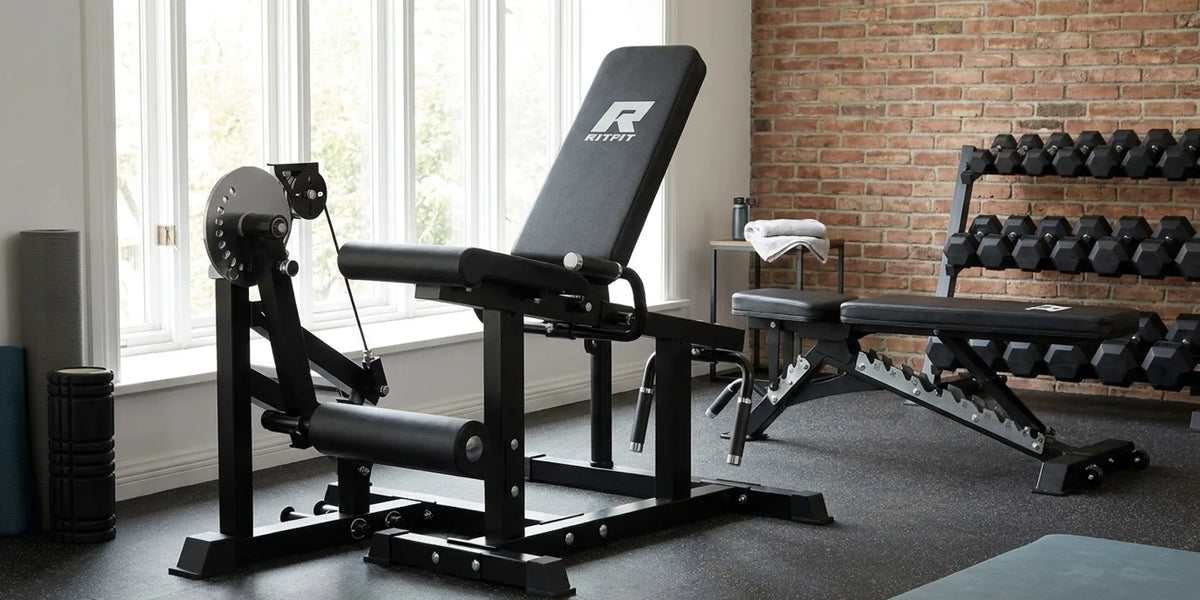
The leg curl machine is a strength-training machine that isolates the hamstrings by bending your knees against a padded lever, and it is one of the most reliable ways to build the back of the thigh. This guide explains what it is, which muscles it works, and how seated and lying versions compare.
You will learn the anatomy, what the research says about seated versus lying versions, step-by-step setup, common mistakes, machine-free alternatives, and how to choose a home machine. Start light, control the weight on every rep, and stop if you feel sharp pain.
Quick Answer: A leg curl machine is a piece of gym equipment that trains the hamstrings by flexing the knee against adjustable resistance, and it is the standard way to isolate knee flexion and build balanced hamstring strength. You sit or lie with your ankles hooked under a padded lever and curl it toward your glutes through a controlled range of motion.
Key Takeaways
- What it is: The leg curl machine is an isolation machine that works the hamstrings through knee flexion against a padded lever.
- Muscles worked: It targets the biceps femoris, semitendinosus, and semimembranosus, the three hamstring muscles on the back of the thigh.
- Seated wins on growth: A 12-week study found the seated leg curl grew hamstring volume about 14% versus about 9% for the lying version.[1]
- Form drives results: Use a full range of motion, keep your hips down, and lower the weight slowly to protect your knees and lower back.
- Home option: A dual-function leg extension curl machine combines the curl and extension in one compact station for a complete leg day at home.
What Is a Leg Curl Machine?
The leg curl machine is a strength-training machine that isolates the hamstrings by bending your knees against a padded lever, usually from a seated or lying position. It provides adjustable resistance through a guided range of motion so you can load the back of your thighs safely and progressively.
Machines in this category come in three main configurations: seated, lying, and standing single-leg versions. The setup principle is the same in every case, because you anchor your thighs, hook your ankles over a padded lever, and curl the lever toward your glutes against a weight stack or plate-loaded carriage.
- Seated leg curl: You sit upright with your legs extended, which places the hamstrings in a stretched position for each rep.
- Lying leg curl: You lie face down, which is easier to set up and lets you press your hips into the bench.
- Dual-function units: Many home machines combine the leg curl with a leg extension, so one station trains both the front and back of the thighs.
If you are building out a home setup, a dual-function unit is the most space-efficient place to start. Browse the leg machine collection to see how these stations fit into a full leg day.
What Muscles Does the Leg Curl Work?
The leg curl primarily works the hamstrings, the group of three muscles on the back of your thigh: the biceps femoris, semitendinosus, and semimembranosus. It trains knee flexion, the movement that most other hamstring exercises do not load directly.
Hamstring Anatomy: Three Muscles You Are Targeting
The three hamstring muscles share a common job but each adds something to knee flexion and hip extension.
- Biceps femoris: The long head crosses both the hip and knee, so it flexes the knee and extends the hip.
- Semitendinosus: This muscle crosses both joints too and assists strongly in knee flexion.
- Semimembranosus: The deepest of the three, it also flexes the knee and helps stabilize the joint.
The leg curl matters because it hits a job the others miss.
Hip-hinge exercises such as the Romanian deadlift train hip extension, but the short head of the biceps femoris only crosses the knee.
A knee-flexion movement like the leg curl is the only way to fully load it, which is why the hamstrings stay incomplete when leg day has no curl.
Seated vs Lying Leg Curl: Which Is Better?
Research suggests the seated leg curl builds slightly more hamstring muscle because it trains the hamstrings at a longer, stretched length. In one 12-week comparison the seated version grew whole hamstring volume about 14% versus about 9% for the lying version.[1]
Both versions are effective, but they load the hamstrings differently because the hip angle changes muscle length.
- Seated leg curl: The hips are flexed, so the biarticular hamstrings are fully lengthened at the start of each rep.[1]
- Lying leg curl: The hips are extended, which shortens the hamstrings and makes it easier to lock your hips down for heavy reps.[1]
- The growth difference: The seated position produced about 1.5 times more whole hamstring growth in the same study, and the pattern is exercise-specific: lengthened-state seated training grew hamstrings about 18% versus 11% for Nordic hamstring training.[2]
For most lifters, the seated version is the stronger choice for muscle size, while the lying version is a useful second curl or a simpler option when you want to push heavy reps without the machine shifting you around.
How to Use a Leg Curl Machine
To use a leg curl machine, adjust the thigh pad snugly above your knees, hook your ankles under the padded lever, and curl your heels toward your glutes through a full range of motion. Keep your hips and back anchored, pause at the top, and lower the weight slowly under control.
Seated Leg Curl Setup and Form
Set the seat so the thigh pad sits snugly across your lower thighs and the ankle pad rests just above your heels.
- Adjust the pads: The thigh pad holds you down, and the ankle pad should sit across your Achilles tendons.
- Grip and posture: Grab the handles, press your back into the pad, and keep your hips grounded.
- Curl: Bend your knees and pull the pad toward your glutes as far as it will go.
- Lower slowly: Return to the start under control without letting the weight drop.
Lying Leg Curl Setup and Form
Lie face down with the ankle pad above your heels and your hips pressed into the bench.
- Anchor your hips: Press your hips down so your lower back stays flat.
- Curl: Pull your heels toward your glutes until your calves reach your hamstrings.
- Pause and lower: Squeeze at the top, then lower slowly to full extension.
Common Leg Curl Mistakes to Avoid
- Lifting your hips: Raising the hips off the bench or seat cuts hamstring engagement and strains the lower back.
- Using momentum: Jerking the weight or dropping it fast reduces muscle tension and raises injury risk.
- Skipping the range: Partial reps leave out the most effective part of the movement, especially at the top.
- Poor pad placement: A loose thigh pad or an ankle pad set too low makes every rep less effective.
Always start from a fully extended knee and always bring the pad to touch your butt with each rep. If you can't touch the pad to your butt, it doesn't count as a rep unless you're purposefully training lengthened partials.
Dr. Mike Israetel, PhD in Sport Physiology and Co-founder of Renaissance Periodization, Complete Hamstring Training Guide
Benefits of the Leg Curl Machine
The leg curl machine builds hamstring strength and size, balances quad-dominant leg training, improves knee stability, and trains the posterior chain without loading your lower back. It is an efficient isolation movement that many leg days are missing.
- Direct knee-flexion loading: It trains the exact movement that squats and deadlifts barely touch, so the hamstrings get a complete stimulus.
- Lower back friendly: Seated and lying curls remove spinal loading, so you can push the hamstrings hard even when your back needs a break.
- Balanced legs: Strong hamstrings protect the knees and even out quad-dominant training patterns that develop over time.
- Beginner friendly: The guided movement path makes it easy to learn and safe to load progressively.
- Easy progression: Small weight increments and a fixed range of motion let you track strength gains reliably.
Leg Curl Variations and Alternatives Without a Machine
If you do not have a leg curl machine, you can still train knee flexion with a Nordic curl, a ball leg curl, a resistance band, or a set of sliders. These are effective options, though an EMG study found the Nordic curl produced the highest peak hamstring activation of the knee-flexion exercises tested.[3]
- Nordic curl: A bodyweight eccentric movement with high hamstring activation, best started with assisted negatives.[3]
- Ball leg curl: Lie on your back, drive your heels into a stability ball, and roll the ball toward your glutes.[4]
- Banded curl: Loop a resistance band around a low anchor and your ankle, then flex the knee against the band.
- Slider curls: Kneel with your feet on sliders and drag them back under your body.
At the closest knee angles tested, the Nordic curl showed higher biceps femoris and semitendinosus activation than the ball leg curl.[4] If you already own equipment, a cable machine with a low pulley makes a smooth banded curl, and a smith machine offers another solid anchor point.
How to Choose a Home Leg Curl Machine
To choose a home leg curl machine, look for a seat and pad system that fits your body, smooth and adjustable resistance, a compact footprint, and a sturdy frame rated for your training load. A dual-function leg extension curl machine gives you the most value in a garage gym.
Home buyers should weigh a few practical factors before picking a unit.
- Footprint: Measure your space and confirm the machine fits with room to move around it.
- Resistance: A weight stack is easiest for quick changes; a plate-loaded carriage is more compact and cheaper.
- Adjustability: Check that the seat, thigh pad, and ankle pad adjust for your height and leg length.
- Dual function: A leg extension curl machine trains the quads and hamstrings in one station, which is the most space-efficient choice for most home gyms.
- Build quality: A steel frame and stable base keep the machine solid under heavy reps.
The RitFit PLC01 Leg Extension Curl Machine is a compact dual-function unit built for home use, with the RitFit PLC01 Pink available for aesthetic-led setups. For heavier loads or a more commercial feel, the Mustang Pro Leg Extension Curl Machine is the step up.
To pair a curl with a compound press, the RitFit BLP01 and PLC01 set covers a full leg day, and the leg press machine collection has more options. Add a RitFit Cougar leg adduction abduction machine for complete inner and outer thigh coverage.
FAQs About the Leg Curl Machine
What is a leg curl machine?
A leg curl machine is a piece of gym equipment that works the hamstrings by bending the knee against resistance. You sit or lie with your ankles hooked under a padded lever and curl the lever toward your glutes. It controls the range of motion and provides adjustable resistance.
What muscles does the leg curl work?
The leg curl primarily targets the hamstrings, the group of three muscles on the back of the thigh called the biceps femoris, semitendinosus, and semimembranosus. It also trains knee flexion, a movement that many hip-hinging hamstring exercises miss. The glutes and calves assist to a small degree.
Is the seated or lying leg curl better?
Research suggests the seated leg curl builds slightly more hamstring muscle because it trains the hamstrings in a more stretched position at a longer muscle length. One 12-week study found about 14 percent growth for the seated version versus about 9 percent for the lying version. Both are effective.
How much weight should I use for leg curls?
Start light and focus on a full range of motion before adding weight. A good starting point is a load that lets you complete 8 to 12 controlled reps while keeping your hips and back in place. Add weight only when you can finish all reps with clean form and a slow lowering phase.
Can I do leg curls at home without a machine?
Yes. Resistance bands, a stability ball, and sliders can all recreate knee-flexion hamstring work at home. The Nordic curl is an effective bodyweight option, and a band attached to a low anchor works too. A machine simply makes the movement easier to load progressively and control.
How often should I do leg curls each week?
Most lifters do well training hamstrings two to three times per week, leaving at least one rest day between sessions. Start with two to three sets of 8 to 12 reps and add sets or weight gradually. Adjust frequency based on how well you recover and respond to the training.
Is the leg curl machine good for beginners?
Yes. The machine guides your movement path, so it is easy to learn and safe for someone new to hamstring training. Adjust the seat and pads first, start light, and control both the curling and lowering phases. It builds hamstring strength without putting load on the lower back.
Conclusion
Every leg day needs a movement that trains knee flexion, and the leg curl machine is the most direct way to isolate the hamstrings. Choose the seated version for stretched-length growth or the lying version for easier heavy reps, then train through a full range of motion.
For a home gym, a dual-function leg extension curl machine delivers quad and hamstring work in one compact station. Start light, build volume gradually, and check the RitFit discount guide before you buy.
Disclaimer
This article is for general information only and does not replace medical or professional training advice. Consult a qualified coach, physician, or physical therapist before starting a new exercise program, especially if you have a history of knee, hip, or lower back injury.
References
1. Maeo S, Huang M, Wu Y, et al. Greater Hamstrings Muscle Hypertrophy but Similar Damage Protection after Training at Long versus Short Muscle Lengths. Med Sci Sports Exerc. 2021;53(4):825-837. doi:10.1249/MSS.0000000000002523. PMCID: PMC7969179
2. Maeo S, Balshaw TG, Nin DZ, et al. Hamstrings Hypertrophy Is Specific to the Training Exercise: Nordic Hamstring versus Lengthened State Eccentric Training. Med Sci Sports Exerc. 2024;56(10):1893-1905. doi:10.1249/MSS.0000000000003490. PMCID: PMC11419281
3. Krommes K, Jakobsen MD, Bandholm T, et al. Cross-sectional Study of EMG and EMG Rise During Fast and Slow Hamstring Exercises. Int J Sports Phys Ther. 2021;16(4):1033-1042. doi:10.26603/001c.25364. PMCID: PMC8329323
4. Monajati A, Larumbe-Zabala E, Goss-Sampson M, Naclerio F. Analysis of the Hamstring Muscle Activation During two Injury Prevention Exercises. J Hum Kinet. 2017;60:29-37. doi:10.1515/hukin-2017-0105. PMCID: PMC5765783





