








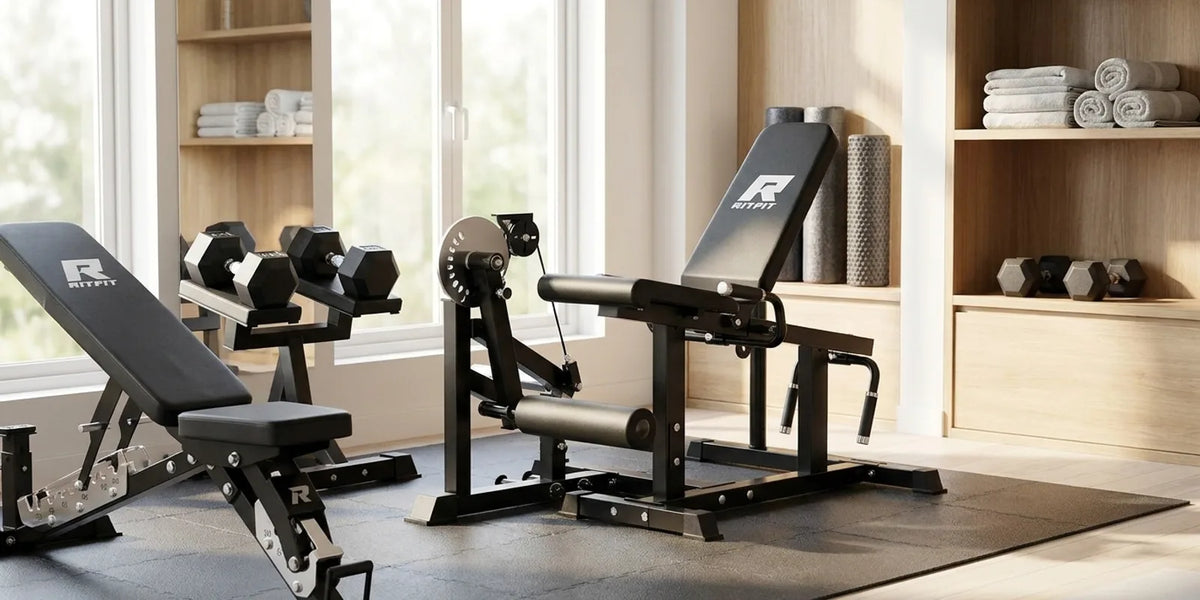
A leg extension machine is a strength machine that isolates your quadriceps by having you sit down and extend your knees against a weighted pad. This guide explains how it works, the muscles it builds, correct form, and what to look for in a version for your home gym.
You will also learn how the leg extension compares with the leg curl, which alternatives work when space is tight, and how the RitFit PLC01 and Mustang Pro bring this movement into your garage.
Quick Answer: A leg extension machine is a pin loaded or plate loaded strength machine that isolates the quadriceps, the four muscles on the front of the thigh, by having you sit down and extend your knees against a padded lever. It is one of the most direct ways to build quad strength and size at home.
Key Takeaways
- Isolation tool: A leg extension machine isolates the quadriceps by extending your knees against resistance from a seated position.
- Primary mover: The machine works the rectus femoris, vastus lateralis, vastus medialis, and vastus intermedius on the front of the thigh.
- Knee friendly: Controlled leg extensions with a load you can handle add quad strength without forcing your hips and lower back to compensate.
- Combo option: A leg extension curl machine adds a seated leg curl station so you can train both quads and hamstrings in one footprint.
- Home setup: Stable frame, smooth resistance, and a seat that aligns your knees with the pivot matter more than brand when choosing a home version.
What Is a Leg Extension Machine?
A leg extension machine is a strength machine that isolates the quadriceps by having you sit down and extend your knees against a weighted pad. It turns the simple movement of straightening your knee into a stable, adjustable exercise you can load precisely for quad growth.
- Seated movement: You sit with your back supported and hook your lower shins behind a padded lever arm.
- Knee extension: You push the lever forward by straightening your knees against a weight stack or loaded plates.
- Controlled return: You lower the weight slowly back to the starting stretch before the next rep.
Because the machine handles your balance and posture, the quads do most of the work, which makes the movement easy to learn for beginners and easy to overload for advanced lifters. For a complete lower body station, a leg extension curl machine pairs this exercise with a seated leg curl in a single frame.
What Muscles Does a Leg Extension Machine Work?
A leg extension machine works the quadriceps, the four muscles on the front of the thigh: the rectus femoris, vastus lateralis, vastus medialis, and vastus intermedius. It isolates these muscles with little help from the hips, glutes, or lower back.[1]
- Rectus femoris: The only quad muscle that also crosses the hip, so it helps lift your thigh toward your body as it straightens the knee.
- Vastus lateralis: The outer quad head that gives your thigh its width.
- Vastus medialis: The inner teardrop muscle near the knee that helps keep your kneecap tracking straight.
- Vastus intermedius: The deepest quad head, sandwiched under the rectus femoris, that assists with straightening the knee.
In a peer reviewed EMG study, knee extensions performed on a training machine produced high quadriceps muscle activity, above 70 percent of maximal voluntary contraction, during the lifting phase.[1] That high activity is why the leg extension is a trusted isolation movement for quad strength in gyms.
What Are the Benefits of Leg Extensions?
The main benefits of leg extensions are targeted quad growth, better knee stability, and the ability to work one leg at a time to correct imbalances. Because the machine removes the need to balance, you can take the quads close to fatigue without worrying about your form breaking down.
- Direct quad isolation: Squats and lunges hit the quads, but the leg extension isolates them completely with no help from your hips or back.
- Knee support: Strong quads help stabilize the knee joint and support compound lifts like squats and deadlifts.
- Single-leg work: Training one leg at a time exposes and corrects strength differences between your right and left side.
- Beginner friendly: The fixed path teaches the knee extension pattern safely, making it a good starting point for new lifters.
One study of sedentary women found open chain knee extensions activated the rectus femoris quadriceps more than squats alone.[2] For a research driven home gym builder, that makes the leg extension a smart complement to compound lower body work.
If maximum quad growth is the goal, do squats and also do exercises such as front squats, leg press, lunges, and leg extensions.
Bret Contreras, PhD, PhD in Sports Science, known as The Glute Guy at Contreras Strength Institute, in Do More than 'Just Squat'
How to Use a Leg Extension Machine
To use a leg extension machine, adjust the seat so your knees line up with the machine pivot, place the shin pad just above your ankles, and extend your knees to lift the weight with control. Lower slowly to a full stretch before starting the next rep.
- Set the seat: Adjust the backrest so your knees sit in line with the pivot point of the machine arm.
- Position the pad: Rest the padded lever against your lower shins, just above the ankles.
- Keep your back braced: Sit tall with your lower back against the pad and grip the side handles.
- Extend with control: Breathe out and straighten your knees to lift the weight, stopping just short of a hard lockout.
- Lower slowly: Breathe in and return to the start over about two seconds, keeping tension in the quads.
Start with a weight you can control for 10 to 15 clean reps. Use a full range of motion and progress the load gradually over weeks rather than chasing heavier weights too early.
Common Leg Extension Mistakes to Avoid
The most common leg extension mistakes are using too much weight, bouncing at the bottom, and letting the pad drift away from your shins. These cut tension off the quads and add stress to the knee joint.
- Loading too heavy: When the load forces you to swing or bounce, the quads stop doing the work and your knees take the strain.
- Cutting the range short: Partial reps skip the loaded stretch that drives most of the quad growth.
- Locking out hard: Snapping the knees fully straight under load puts unnecessary pressure on the joint.
- Moving the pad: If the pad creeps up toward your shins, the force shifts off the quads and onto the joint.
- Leaving kids unsupervised: A US study of emergency department visits found mechanical home exercise equipment injuries are common and that unsupervised children are at higher risk.[3] Keep the machine cleared of children when not in use.
If you feel sharp knee pain instead of muscle fatigue, stop and check your seat height and pad position. Recovering a little and using a lighter load is better than training through joint pain.
Leg Extension vs Leg Curl: What's the Difference?
A leg extension works the quads on the front of the thigh by straightening the knee, while a leg curl works the hamstrings on the back of the thigh by bending the knee. The two movements train opposite sides of the leg, so a two-in-one machine lets you hit both in one session.
| Aspect | Leg Extension | Leg Curl |
|---|---|---|
| Primary muscles | Quadriceps, front of the thigh | Hamstrings, back of the thigh |
| Movement | Straightening the knee | Bending the knee |
| Body position | Seated, shins behind the pad | Seated or prone, ankles under the pad |
| Typical role | Quad isolation and knee support | Hamstring strength and knee balance |
Both are isolation exercises that target opposite sides of the same joint. Training them together keeps the front and back of the leg balanced.
Balanced leg development matters because strong quads without matching hamstrings can leave the knee unstable. A two-in-one leg extension curl machine combines both movements in one compact frame, so you can alternate between quads and hamstrings without switching stations.
Leg Extension Alternatives for Home Gyms
If you have limited space, you can train the quads with banded leg extensions, reverse lunges, sissy squats, or split squats. These load the same muscles, but a dedicated machine gives you a stable, isolated path that is hard to replicate with free equipment.
- Banded leg extensions: Anchor a band behind you, sit on a bench, loop the band around your lower shin, and extend the knee against the resistance.
- Reverse lunges: Step backward into a deep lunge to load the quads and glutes through a long range of motion.
- Sissy squats: Keep your hips extended and let your knees travel forward while leaning back to load the quads heavily.
- Split squats: Hold a dumbbell or kettlebell and drop into a lunge to build single-leg quad strength.
If you prefer a machine route, the RitFit Gazelle 3-in-1 Leg Press Hack Squat Machine targets the quads through compound pressing, and the RitFit Cougar Leg Adduction Abduction Machine covers the inner and outer thigh. For a full leg room setup, the Leg Press and Leg Extension Machine Set pairs a hack squat and leg press with a leg extension and curl station.
Choosing a Leg Extension Machine for Your Home Gym
When choosing a home leg extension machine, focus on frame stability, smooth resistance, an adjustable seat that aligns your knees with the pivot, and whether it adds a leg curl station. Also check the footprint and how much weight it supports so it fits your room and your training level.
- Stable frame: A solid base keeps the machine from rocking during heavy sets, which protects your knees and your floor.
- Smooth resistance: A well guided lever arm and quiet pivot make each rep feel consistent from the stretch to the lockout.
- Seat adjustability: A seat and backrest that move in height let you match your knee to the pivot for a comfortable, safe path.
- Two-in-one design: A leg extension curl machine doubles your lower body work without doubling the floor space.
- Footprint and capacity: Measure your room and check the supported weight so the machine suits your space and your goals.
Browse the full Leg Machine Collection for all the options in one place, and check the Leg Press Machine Collection if you also want compound pressing. A dedicated leg station like the RitFit PLC01 below gives you a commercial feel at a home gym price.
RitFit PLC01 vs Mustang Pro: Which One Fits Your Home Gym?
Both the RitFit PLC01 and the Mustang Pro are two-in-one leg extension and curl machines, with the Mustang Pro built for higher capacity and heavier training. Choose the PLC01 for a compact, budget friendly setup and the Mustang Pro if you want more headroom for strength work.
| Feature | RitFit PLC01 | Mustang Pro |
|---|---|---|
| Movement | Leg extension and seated leg curl | Leg extension and seated leg curl |
| Best for | Compact home gyms and first-time buyers | Heavier training and taller lifters |
| Footprint | Space saving, single station | Larger frame with more capacity |
| Training level | Beginner to intermediate | Intermediate to advanced |
Comparison is limited to the RitFit product line so you can match the machine to your space and training level.
The RitFit PLC01 Leg Extension Curl Machine is the value pick for a garage gym that wants both quad and hamstring work in a small footprint. The Mustang Pro Leg Extension Curl Machine steps up the frame and capacity for lifters who want room to grow into heavier loads, while the RitFit PLC01 Pink Leg Extension Curl Machine brings the same movement in a colorway that matches your room.
FAQs About Leg Extension Machines
What is a leg extension machine?
A leg extension machine is a strength machine that isolates the quadriceps by having you sit down and extend your knees against resistance. A leg extension curl machine also adds a seated leg curl station for the hamstrings, making it a two-in-one lower body machine.
What muscles does a leg extension machine work?
The leg extension machine primarily works the quadriceps, the four muscles on the front of the thigh. These are the rectus femoris, vastus lateralis, vastus medialis, and vastus intermedius. A leg curl attachment targets the hamstrings on the back of the thigh.
Are leg extensions bad for your knees?
Leg extensions are not inherently bad for your knees when performed with controlled form and a load you can handle. Keeping your knees aligned with the machine pivot and avoiding heavy forced reps reduces joint strain. Consult a professional if you have an existing knee condition.
What is the difference between leg extension and leg curl?
A leg extension targets the quads on the front of the thigh by straightening the knee. A leg curl targets the hamstrings on the back of the thigh by bending the knee. Many home machines combine both movements into a single leg extension curl machine.
Can you do leg extensions without a machine?
Yes, you can train the same muscle with alternatives such as banded leg extensions, reverse lunges, sissy squats, or split squats. These work the quads, but a real leg extension machine gives you a stable, isolated movement that is hard to replicate with free equipment.
What to look for in a home leg extension machine?
Look for a stable frame, smooth resistance, a padded shin pad, and an adjustable seat that aligns your knees with the pivot point. Consider the footprint, whether it adds a leg curl station, and how much weight it supports for your home gym.
Conclusion
A leg extension machine gives your home gym one of the most direct ways to isolate the quads, and a leg extension curl machine adds the hamstrings in the same footprint. With correct form, a controlled load, and a stable frame, it is a safe and effective addition to a balanced leg day.
Start with the RitFit PLC01 for a compact two-in-one station, or step up to the Mustang Pro if you want more capacity for heavier training. Browse the full leg machine lineup and save with the RitFit discount guide before you build out your garage.
Disclaimer
This guide is for general information only and is not medical, training, or injury advice. Always consult a qualified professional before starting a new exercise program or training around an existing knee condition.
References
1. Jakobsen MD, Sundstrup E, Andersen CH, et al. Muscle activity during knee-extension strengthening exercise performed with elastic tubing and isotonic resistance. Int J Sports Phys Ther. 2012;7(6):606-16. PMCID: PMC3537465
2. Thongduang P, Chatchawan U, Puntumetakul R, Yamauchi J, Peungsuwan P. Quadriceps Electromyographic Activity in Closed and Open Kinetic-Chain Exercises with Hip-Adductor Co-Contraction in Sedentary Women. Int J Environ Res Public Health. 2022;19(19). doi:10.3390/ijerph191912929. PMCID: PMC9566802
3. Graves JM, Iyer KR, Willis MM, Ebel BE, Rivara FP, Vavilala MS. Emergency department-reported injuries associated with mechanical home exercise equipment in the USA. Inj Prev. 2014;20(4):281-5. doi:10.1136/injuryprev-2013-040833. PMCID: PMC4306571





