








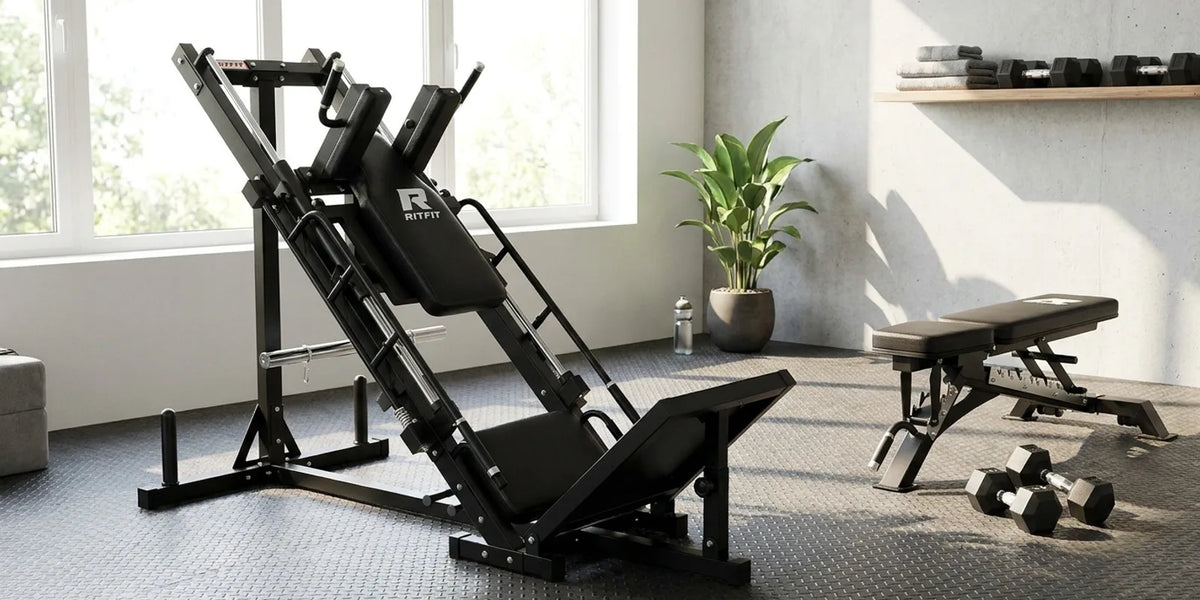
A leg press machine is a strength-training station that lets you push a loaded sled or platform away from your body with your feet while seated, reclined, or lying on your back. It trains the quadriceps, hamstrings, glutes, and calves along a guided rail with back support, so you can load the legs heavily without balancing a barbell.
This guide explains the main leg press types, the muscles each one works, and the benefits for a home gym. You will also get a safe starting-weight plan and a buying checklist that fits your space and training level.
Quick Answer: A leg press machine is a fixed-path lower-body machine where you push a loaded platform with your feet to train the quadriceps, hamstrings, glutes, and calves. The main types are horizontal, 45-degree, vertical, and seated leg presses, each with a different angle and muscle emphasis.
Key Takeaways
- Back-supported lower-body training: A leg press trains the quads, hamstrings, glutes, and calves along a fixed rail, so you can push heavy loads without balancing a barbell.
- Several machine types: Horizontal, 45-degree, vertical, seated, and isolateral leg presses each offer a different angle, range, and muscle emphasis.
- Foot placement changes the target: Higher feet on the platform shift work to the glutes and hamstrings, while lower feet emphasize the quads.
- The sled counts as weight: The platform or carriage is part of the load, so start lighter than you think and add plates in small steps.
- Pairs well with squats: A leg press is a strong complement for volume work, joint-friendly loading, and lifters with lower back sensitivity.
What Is a Leg Press Machine?
A leg press machine is a strength-training station where you sit, recline, or lie on your back and push a loaded platform or sled away from your body with your feet. The machine guides the movement along a fixed rail, so the legs do the work without needing balance or core control from a free bar.
- Fixed path of motion: The sled travels along set rails, which keeps the knees and hips in a stable line and removes the balance demands of a barbell squat.
- Back support: A padded backrest supports the spine while you push, which is why the machine is popular for heavy leg volume.
- Progressive loading: You add plates or move a weight stack to increase resistance, and the sled itself is part of the load you lift.
Most gyms keep at least one leg press, and many home setups add a compact 45-degree model for dedicated leg day work.
What Are the Different Types of Leg Press Machines?
The five main types are the horizontal, 45-degree, vertical, seated, and isolateral leg press, and they differ mainly in angle, range of motion, and which muscles they emphasize. The 45-degree incline is the most common in commercial gyms and pairs well with a home leg press hack squat machine.
| Machine Type | How It Moves | Best For |
|---|---|---|
| Horizontal leg press | Seat glides back as you push a footplate straight ahead | Beginners, low starting resistance, joint-friendly |
| 45-degree leg press | Incline sled pushed at a 45-degree angle | Most common, more glute emphasis, greater range of motion |
| Vertical leg press | You lie on your back and push straight up | Compact footprint, heavy direct load, quad focus |
| Seated leg press | Weight stack, the seat moves and adds your bodyweight | Easy weight changes, quads and glutes |
| Isolateral leg press | Each leg moves independently | Correcting strength imbalances |
Notes: on weight-stack horizontal machines, the moving carriage is part of the resistance, so your bodyweight and the seat add to the load you press.[1]
If you want both a leg press and a squat-pattern movement at home, a 2-in-1 like the RitFit 3-in-1 Leg Press and Hack Squat Machine (BLP01) combines a leg press with a hack squat station. To finish a full leg day, pair it with a leg extension curl machine or the Mustang Pro Leg Extension Curl Machine for isolation work.
What Muscles Does a Leg Press Work?
The leg press primarily works the quadriceps on the front of the thighs, with the hamstrings, glutes, and calves assisting through the press. A study comparing the leg press with the Smith machine measured quadriceps activation and found strong quadriceps activity during the movement.[1]
- Quadriceps: The quads drive knee extension and dominate the press, especially with lower foot placement.
- Hamstrings: The hamstrings assist as the knees near full extension, more so with higher foot placement.
- Glutes: The glutes help drive hip extension, and a 45-degree incline with high feet recruits them more.
- Calves: The gastrocnemius works during the press and in dedicated calf-press foot positions.
- Adductors: The inner thighs assist when you use a wider stance.
Foot position is the main dial, because high feet shift emphasis to the glutes and hamstrings while low feet bias the quads and a wide stance adds the hip adductors. For extra inner- and outer-thigh work, you can add a leg adduction and abduction machine to the rotation.
What Are the Benefits of a Leg Press Machine?
A leg press builds lower-body strength and muscle with a safe, back-supported loading pattern, and it suits everyone from beginners to advanced lifters. One pilot study found that twice-weekly home-based resistance training, which included machine-based leg work, improved mood scores in middle-aged adults over eight weeks.[2]
- Lower-body strength and size: You can load the legs with heavy resistance while the backrest keeps the spine stable.
- Joint-friendly loading: The fixed path reduces balance demands and allows a controlled range of motion that is easier on the knees than heavy free-weight squats.
- Safe overload for beginners: The machine guides the path, so new lifters can practice the push pattern without loading a barbell.
- Single-leg option: Unilateral presses help correct left-to-right strength imbalances.
- At-home consistency: A home leg press removes setup time, which makes it easier to hit regular leg sessions.
Leg presses pair well with squats, hip thrusts, and lunges, so most lifters use them as a volume builder rather than a full replacement for free-weight movement.
Is the Leg Press Safe for Your Back and Knees?
A leg press is generally safe for the back and knees when you use a controlled range, keep your lower back against the pad, and avoid locking out or dropping the knees too deep. The machine supports the spine, which is why it is often recommended for lifters who want heavy leg work without the spinal loading of a barbell squat.
- Keep your back on the pad: Do not let the hips lift off the backrest, which keeps the lower back supported through the press.
- Control the descent: Stop the knees at a depth you can reverse smoothly, and avoid excessive knee flexion that loads the joint.
- Do not lock out: Stop just short of full knee extension to keep tension on the muscles and off the joint.
- Use the safety stoppers: Most machines have racks or stops so you can bail safely on a heavy set.
Higher foot placement on the platform shifts more work to the glutes and hamstrings and is easier on the knees, while lower placement biases the quads.
Squats are my favorite exercise, but a lot of people can't do them because of various lower-back issues.
In that case, the leg press is also a really good exercise for building the thigh.
It's such a simple movement that works so well.
John Meadows, IFBB Pro Bodybuilder and Coach, Mountain Dog Diet, Mountain Dog Training for Legs
How to Choose a Leg Press Machine for Your Home Gym
Choose a leg press by matching the machine type to your space, your training goal, and your budget, then check the footprint, weight capacity, and range-of-motion fit for your height. A 45-degree 2-in-1 that also does hack squats gives the most training value per square foot of floor space.
- Measure your space: Confirm the floor footprint and ceiling height before you buy, and leave room to load plates and move around the machine.
- Check the weight capacity: Match the rating to your current leg strength plus room to progress, since you will outgrow a low-rated frame quickly.
- Fit the range of motion to your height: Taller and shorter lifters need different seat and footboard adjustments to hit a full, comfortable range.
- Decide plate-loaded vs weight stack: Plate-loaded machines are simpler and usually cheaper, while weight stacks offer fast changes for shared gyms.
- Start light: The sled is part of the load, so begin lighter than your free-weight squat and add plates in small steps.
A study on total leg press load confirmed that the weight you lift includes the sled or carriage itself, not just the plates you add.[3] One older-adult strength program started on an inclined leg press at under 60 lb before adding weight.[4]
For a home gym, the leg press machine collection includes 45-degree 2-in-1 and 3-in-1 models that combine leg press, hack squat, and calf raise stations, from the compact RitFit 3-in-1 Leg Press and Hack Squat Machine (BLP01) to the RitFit Gazelle Pro 3-in-1 and RitFit Gazelle 3-in-1 Leg Press Hack Squat Machine with more adjustment range for different heights. The leg machines category holds the full lower-body lineup, and a pink BLP01 45-degree model is available for matching a themed gym.
FAQs About Leg Press Machines
Is a leg press the same as a squat?
No, a leg press is a machine-supported movement with a fixed path and back support, while a squat is a free-standing pattern that requires more balance and core control. Both train the quads, hamstrings, and glutes, and they pair well together for a complete leg day.
How much weight should I start with on a leg press?
Start light enough to complete controlled reps with full range of motion, because the sled and platform are already part of the load. One strength program used an inclined leg press starting under 60 lb, and you add weight only once you can move it smoothly.
Can a leg press replace squats?
A leg press complements squats rather than fully replacing them for a well-rounded routine. It lets you load the legs safely with back support and a fixed range of motion, while squats build more balance, core stability, and athletic transfer. Use both movements across the week for a complete lower-body program.
Does the leg press work your glutes?
Yes, the glutes help drive the press, especially when you place your feet higher on the platform or use a 45-degree incline machine. Your foot position shifts emphasis among the quads, hamstrings, and glutes, so higher and wider foot placement recruits the glutes more while lower placement favors the quads.
Is the leg press bad for your knees?
A leg press is generally knee-friendly when you use a controlled range and avoid excessive knee flexion or locking out. Lower foot placement shifts emphasis to the quads, while higher placement is easier on the knees. Ask a professional if you have knee concerns before training.
How often should I do leg presses?
Train the leg press one to two times per week as part of a lower-body split, with at least one rest day between sessions. Progress by adding small weight increments only when you can keep clean reps and full range of motion.
Conclusion
A leg press machine is a back-supported way to train the quads, hamstrings, glutes, and calves through a guided range of motion. Pick a horizontal, 45-degree, vertical, seated, or isolateral model that fits your space, then start light and add weight in small steps.
Start with two leg press sessions per week and pair the machine with squats and leg curls for a complete lower-body split. Check the RitFit discount guide before you order to find current savings on your setup.
Disclaimer
This article is for general information only and is not medical or rehabilitation advice. Consult a qualified trainer or healthcare professional before starting a new leg training program, especially if you have a history of knee, hip, or lower back injury.
References
1. Migliaccio GM, Dello Iacono A, Ardigo LP, et al. Leg Press vs. Smith Machine: Quadriceps Activation and Overall Perceived Effort Profiles. Front Physiol. 2018;9:1481. PMCID: PMC6206431
2. Kikuchi N, Ohta T, Hashimoto Y, et al. Effect of Online Home-Based Resistance Exercise Training on Physical Fitness, Depression, Stress, and Well-Being in Middle-Aged Persons: A Pilot Study. Int J Environ Res Public Health. 2023;20(3). doi:10.3390/ijerph20031769. PMCID: PMC9914297
3. Effects of Different Types of Lower Body Resistance Exercise on Upper-body Strength in Men and Women, with Special Reference to Anabolic Hormones. Int J Exerc Sci. 2021;14(3):1052-1069. PMCID: PMC8439705
4. Bray NW, Jakobi JM, et al. Practical Implications for Strength and Conditioning of Older Pre-Frail Females. J Frailty Aging. 2020;9(2):118-121. PMCID: PMC12275756





