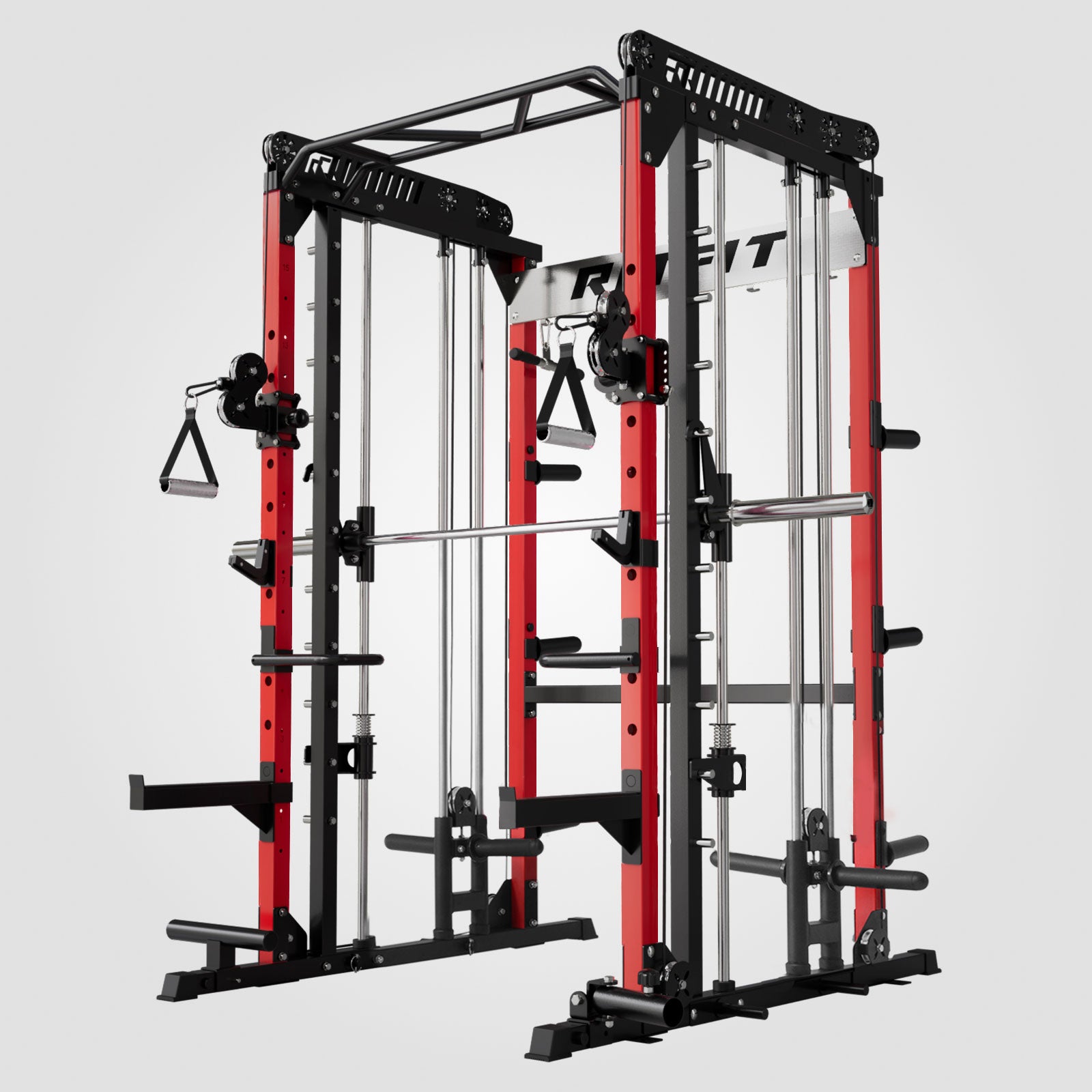
A Smith machine is good for controlled strength training, safer solo lifting, guided barbell exercises, and building a compact home gym around one versatile station. It works best for squats, bench presses, hip thrusts, rows, shoulder presses, lunges, calf raises, and accessory work where a fixed bar path helps with setup and repeatability.
It is not a complete replacement for free weights, but it can be a practical bridge between machine training and barbell training. For many home gym users, the biggest value is simple setup, built in safety support, and full body training without needing a spotter.
Key Takeaways
- A Smith machine is best for controlled barbell style training: The guided rails help lifters repeat the same movement path with less setup uncertainty.
- It is useful for solo home gym workouts: Adjustable safety stops and bar hooks can make pressing and squatting more manageable when used correctly.
- It supports full body strength training: Common exercises include squats, bench presses, shoulder presses, hip thrusts, rows, lunges, and calf raises.
- It does not replace every free weight benefit: Free weights usually require more balance and stabilization, while Smith machines provide more guidance.
- It can be a strong home gym centerpiece: An all in one Smith machine with cables can combine guided bar work, pulley exercises, and rack based training in one footprint.
What Is a Smith Machine Good For?
A Smith machine is good for strength training when you want a fixed bar path, repeatable setup, and extra support for solo workouts. It is especially useful for lifters who train at home and want a controlled way to perform barbell style movements.
In a home gym, a Smith machine can support lower body, upper body, push, pull, and accessory exercises. You can explore RitFit's full Smith machine collection if your goal is to compare guided bar systems for home use.
Main Smith Machine Benefits
The main benefit of a Smith machine is controlled movement, which can help beginners and solo lifters train with more confidence. Research comparing machine based and free weight training suggests that both methods can improve strength and hypertrophy when programmed properly, so the best choice depends on the goal, exercise, and training context.[1]
- Guided bar path: The bar travels along rails, which helps keep each rep consistent. This can be helpful for lifters who want repeatable technique during hypertrophy work.
- Solo training support: Safety catches and bar hooks can reduce the need for a spotter during selected exercises. They still need to be set before heavy sets.
- Beginner friendly setup: The fixed path can reduce some balance demands. This can make the machine feel less intimidating than starting with a loose Olympic barbell.
- Good accessory exercise value: Smith machine hip thrusts, calf raises, rows, shrugs, and split squats are strong choices. These movements often benefit from stable setup and repeatable loading.
- Home gym space efficiency: A Smith machine can combine guided lifting, rack functions, and cable options depending on the model. This is valuable when space is limited.
Best Smith Machine Exercises
The best Smith machine exercises are movements where a guided bar path improves setup, stability, or loading control. For lower body training, Smith machine squats and related machine based movements can create meaningful quadriceps loading, although exercise selection should match body mechanics and comfort.[2]
| Exercise | Best For | Why It Works Well |
|---|---|---|
| Smith Machine Squat | Quads, glutes, leg strength | The fixed bar path helps lifters repeat stance, depth, and tempo more easily. |
| Smith Machine Bench Press | Chest, triceps, pressing strength | The guided bar can make solo pressing simpler when safety stops are set correctly. |
| Smith Machine Hip Thrust | Glutes and posterior chain | The bar path can make loading and positioning easier than setting up a loose bar. |
| Smith Machine Shoulder Press | Shoulders and triceps | The machine can help maintain a consistent overhead pressing path. |
| Smith Machine Inverted Row | Back, arms, beginner pulling strength | The adjustable bar height lets users scale difficulty by body angle. |
| Smith Machine Romanian Deadlift | Hamstrings, glutes, hip hinge control | The fixed path can help lifters focus on hip movement and controlled tempo. |
| Smith Machine Calf Raise | Calves and lower leg strength | The stable bar setup makes it easier to load standing calf raises progressively. |
For more movement ideas, use the RitFit guide to best Smith machine exercises for muscle building. If you want to understand starting load, read the guide on how much a Smith machine bar weighs.
Who Should Use a Smith Machine?
A Smith machine is best for home gym lifters who want a safer feeling setup, full body exercise variety, and a guided bar path for repeatable strength training. It is especially practical for beginners, solo lifters, hypertrophy focused users, and people building a garage or basement gym.
- Beginners: A Smith machine can make basic pressing and squatting patterns feel more approachable. Beginners should still learn stance, bracing, range of motion, and safety stop setup.
- Solo lifters: The machine is useful when no spotter is available. This matters most for pressing and squatting exercises where missed reps can be risky.
- Hypertrophy focused lifters: The guided path can help keep tension on target muscles. This is useful for controlled reps, moderate loads, and repeatable progress.
- Compact home gym owners: A Smith machine can serve as the center of a strength station. Models with cable systems can expand exercise variety without adding multiple separate machines.
If you want one central setup for guided barbell training and cable based accessories, the RitFit M1 PRO Smith Machine Home Gym Package is a relevant option to compare. For users who prefer a modular platform, the RitFit M2 Multi Functional Modular Home Gym Smith Machine may fit better.
Smith Machine vs Free Weights
A Smith machine gives more guidance, while free weights usually demand more balance, stabilization, and movement freedom. Studies comparing free weight and machine based strength training show that both can be effective, but adaptations can depend on exercise specificity and how the program is structured.[4]
| Training Option | Main Advantage | Main Limitation | Best Use |
|---|---|---|---|
| Smith Machine | Guided path and easier solo setup | Less natural bar freedom | Controlled hypertrophy, solo pressing, guided squats, accessories |
| Free Weights | More natural movement and stabilization demand | Higher skill and setup requirement | Powerlifting, athletic strength, technical barbell development |
| Cable System | Constant tension and exercise variety | Less direct heavy barbell loading | Rows, pulldowns, curls, flys, lateral raises, core work |
If you are comparing equipment paths, read the RitFit guide on Smith machine vs free weights. If your main concern is training alone, the article on how to train safely on the Smith machine at home is the next logical read.
How to Choose a Smith Machine for a Home Gym
The best Smith machine for a home gym should match your space, training style, ceiling height, loading needs, and preferred attachments. Do not choose only by price, because frame design, cable options, safety stops, footprint, and exercise variety affect long term usability.
- Check your training goal: Choose a simpler guided bar setup for basic strength work. Choose an all in one system if you want cable rows, lat pulldowns, flys, and more accessory options.
- Measure your room first: Confirm ceiling height, floor width, rack depth, and walking clearance. Leave enough space for plates, bench movement, and safe exercise setup.
- Review safety features: Look for adjustable safety stops, stable hooks, and a frame that supports your intended training load. Safety setup matters more than marketing claims.
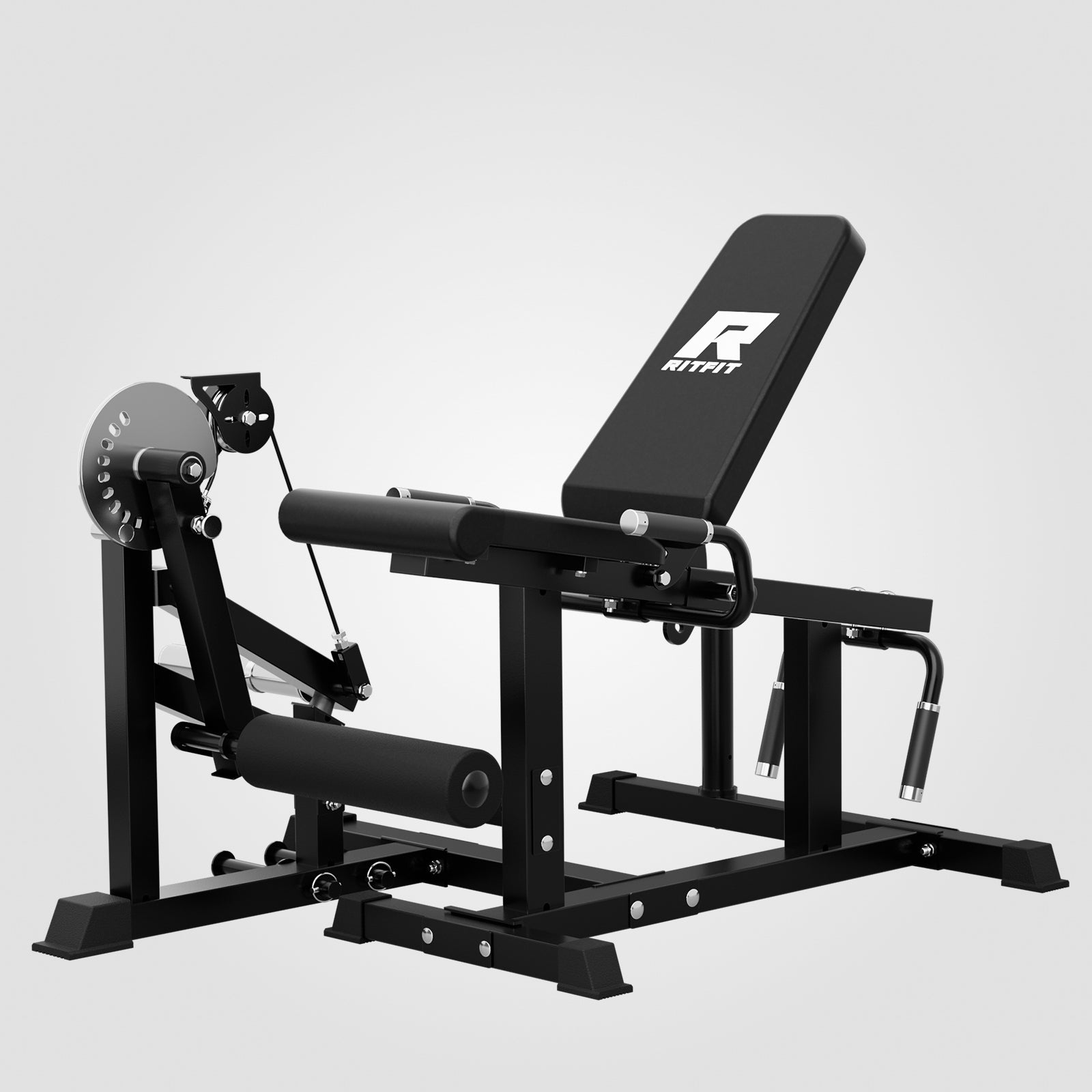
- Match attachments to exercises: Cable attachments, landmine options, lever arms, and leg holders can expand training variety. Only buy attachments you will actually use in your program.
- Plan your ecosystem: A bench, plates, collars, and cable handles often matter as much as the machine itself. A complete setup is usually more useful than a single frame without accessories.
For heavier all in one training, compare the RitFit BUFFALO Multifunctional Smith Machine. If you are still deciding whether the investment makes sense, read is a Smith machine worth it.
How to Train on a Smith Machine Effectively
Effective Smith machine training depends on progressive overload, correct exercise selection, controlled range of motion, and safe setup. Current loading research suggests strength, hypertrophy, and muscular endurance can be trained across different loading zones when effort, volume, and progression are managed well.[3]
- Start with lighter loads: Learn the machine path before increasing weight. The fixed path may feel different from a free barbell.
- Set safety stops first: Adjust stops before bench presses, squats, and overhead presses. They should catch the bar before your body reaches a risky position.
- Use controlled reps: Avoid bouncing, twisting, or forcing your joints to follow an uncomfortable path. A guided bar should feel stable, not restrictive or painful.
- Track progress: Add reps, sets, load, tempo control, or range of motion over time. Consistent tracking helps you avoid random workouts.
- Balance your program: Combine pushing, pulling, squatting, hinging, and core training. A Smith machine is powerful, but a complete program still needs balanced movement patterns.
Common Smith Machine Mistakes
The most common Smith machine mistake is assuming the guided bar makes every exercise automatically safe. The machine can support training, but poor setup, excessive load, or awkward joint positioning can still create risk.
- Forgetting safety stops: Always set safety stops before challenging sets. Do not rely only on the hook system during heavy reps.
- Standing in the wrong position: Adjust your body to the bar path, not the other way around. If a movement feels forced, reduce load and reset your stance.
- Using too much weight too soon: The machine can make heavy loads feel more controlled. This can tempt lifters to overload before technique is ready.
- Ignoring free weight skills: Smith machine training is useful, but it does not teach every stabilization demand of a free barbell. Use both when your goals require both.
- Skipping warmups: Warm up with lighter sets before heavy work. This helps you assess range of motion, setup, and comfort on that day.
FAQs
What is a Smith machine good for?
A Smith machine is good for controlled strength training, solo workouts, and guided barbell exercises. It is useful for squats, bench presses, shoulder presses, hip thrusts, rows, lunges, and calf raises, especially when users want repeatable setup and built in safety support.
Is a Smith machine good for beginners?
Yes. A Smith machine can be good for beginners because the guided bar path makes setup feel simpler. New lifters should still learn proper stance, bracing, range of motion, and safety stop placement before increasing weight or training close to failure.
Can you build muscle with a Smith machine?
Yes. You can build muscle with a Smith machine when you train with enough effort, volume, and progressive overload. The machine works well for controlled hypertrophy exercises, especially squats, presses, hip thrusts, rows, calf raises, and other movements that benefit from stable loading.
Is a Smith machine safer than free weights?
It can be safer for selected solo exercises when safety stops are set correctly. It is not automatically safer in every situation, because poor stance, excessive load, or an uncomfortable bar path can still create joint stress and training risk.
What exercises can you do on a Smith machine?
You can do squats, bench presses, shoulder presses, hip thrusts, lunges, Romanian deadlifts, rows, shrugs, calf raises, and inverted rows on a Smith machine. The best choices are exercises where the guided bar path supports control, stability, and repeatable loading.
Should I buy a Smith machine for a home gym?
Yes. A Smith machine can be worth buying for a home gym if you want guided barbell training, solo workout support, and full body exercise variety in one station. Compare footprint, ceiling clearance, cable options, safety stops, and attachment compatibility before choosing.
Does a Smith machine replace a power rack?
No. A Smith machine does not fully replace a power rack because it uses a guided bar path instead of a free moving barbell. It can replace some rack based exercises for certain users, but lifters who need free barbell training may still want a rack.
Which RitFit Smith machine is best for home gym training?
The best RitFit Smith machine depends on your space, budget, and training style. M1 PRO suits all in one guided training, M2 suits modular upgrades, and BUFFALO suits users who want a heavier multifunctional Smith machine with cable training options.
Conclusion
A Smith machine is good for lifters who want controlled strength training, safer solo setup, and full body exercise variety in a home gym. It works best when used for the right exercises, with safety stops set correctly, and with realistic expectations about how it differs from free weights.
Disclaimer: This article is for general fitness education only and is not medical advice. If you have pain, injury, balance limitations, medical restrictions, or are new to resistance training, consult a qualified fitness or healthcare professional before starting a new program.
References
- Haugen ME, Vårvik FT, Larsen S, Haugen AS, van den Tillaar R, Bjørnsen T. Effect of free weight vs machine based strength training on maximal strength, hypertrophy and jump performance, a systematic review and meta analysis. BMC Sports Sci Med Rehabil. 2023;15(1):103. doi:10.1186/s13102-023-00713-4
- Migliaccio GM, Dello Iacono A, Ardigò LP, Samozino P, Iuliano E, Grgantov Z, Padulo J. Leg press vs Smith machine, quadriceps activation and overall perceived effort profiles. Front Physiol. 2018;9:1481. doi:10.3389/fphys.2018.01481
- Schoenfeld BJ, Grgic J, Van Every DW, Plotkin DL. Loading recommendations for muscle strength, hypertrophy, and local endurance, a re examination of the repetition continuum. Sports. 2021;9(2):32. doi:10.3390/sports9020032
- Wirth K, Keiner M, Hartmann H, Sander A, Mickel C. Effect of 8 weeks of free weight and machine based strength training on strength and power performance. J Hum Kinet. 2016;53:201-210. doi:10.1515/hukin-2016-0023