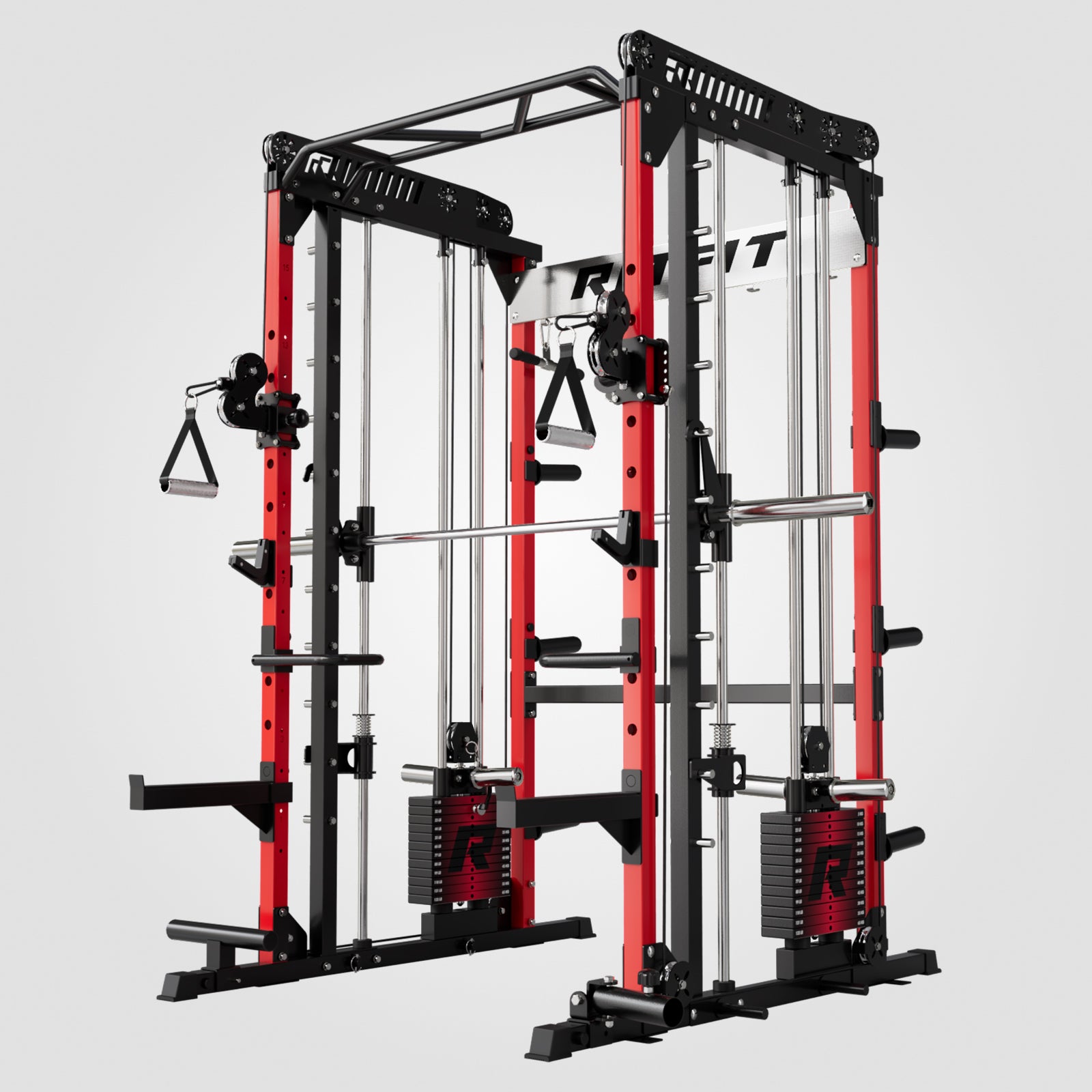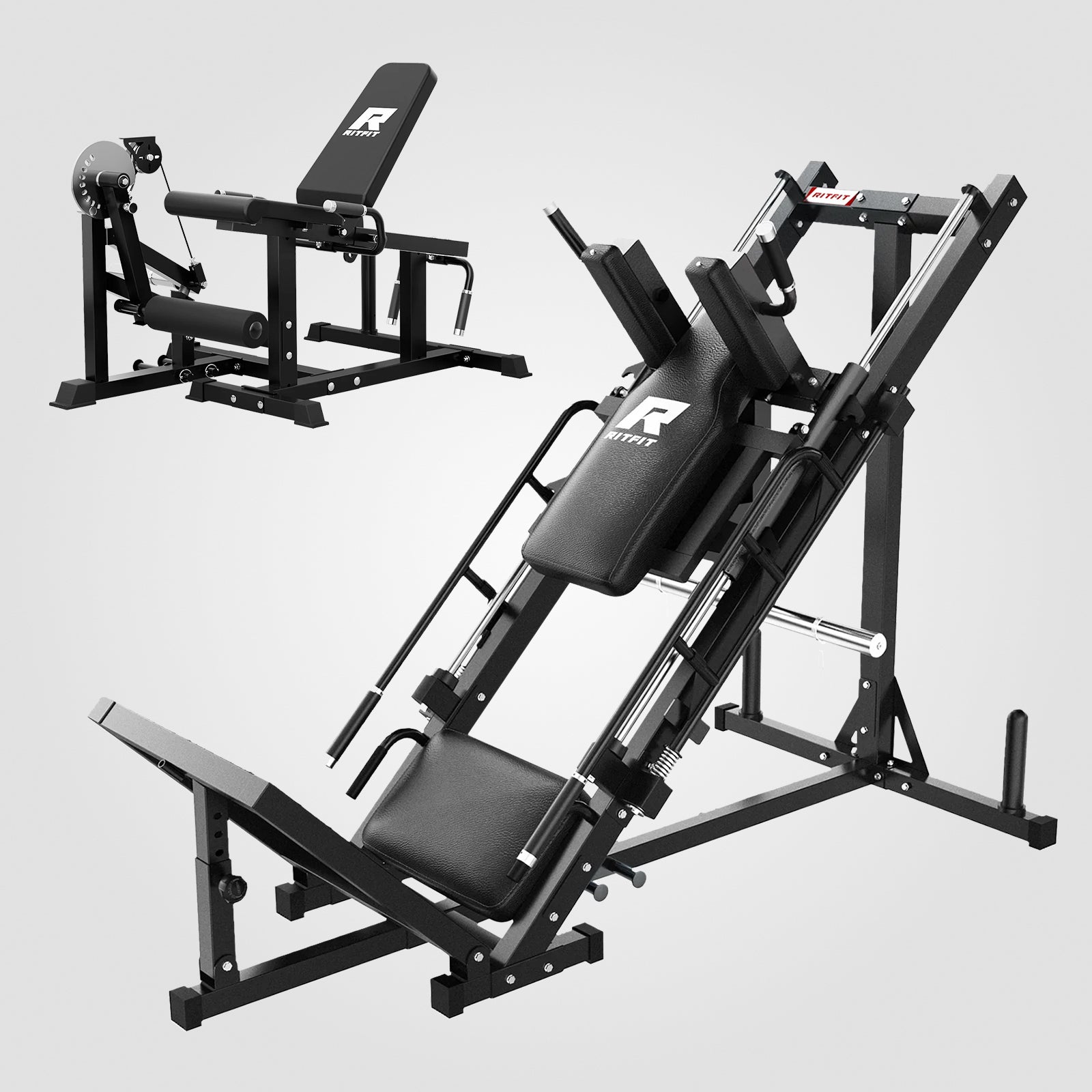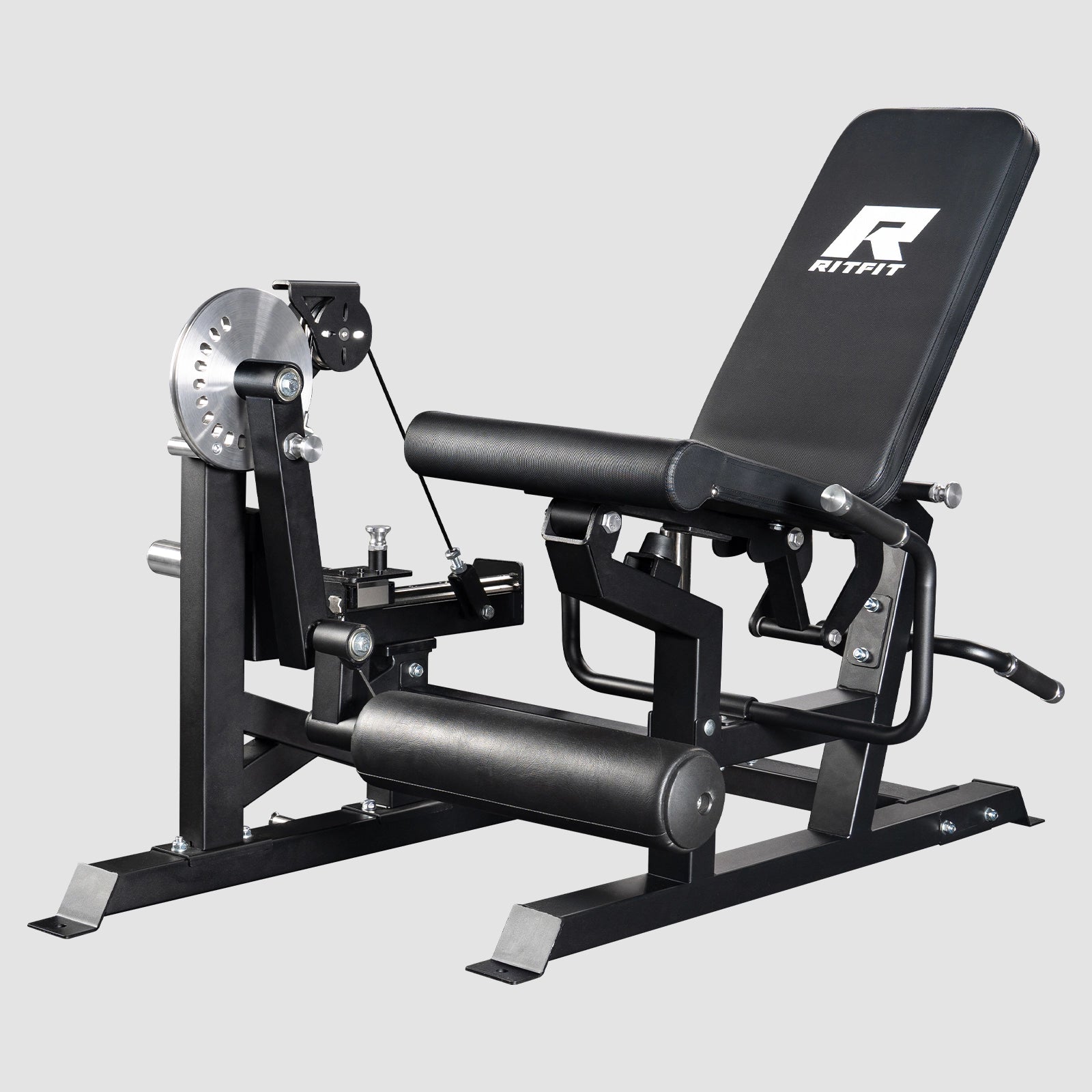
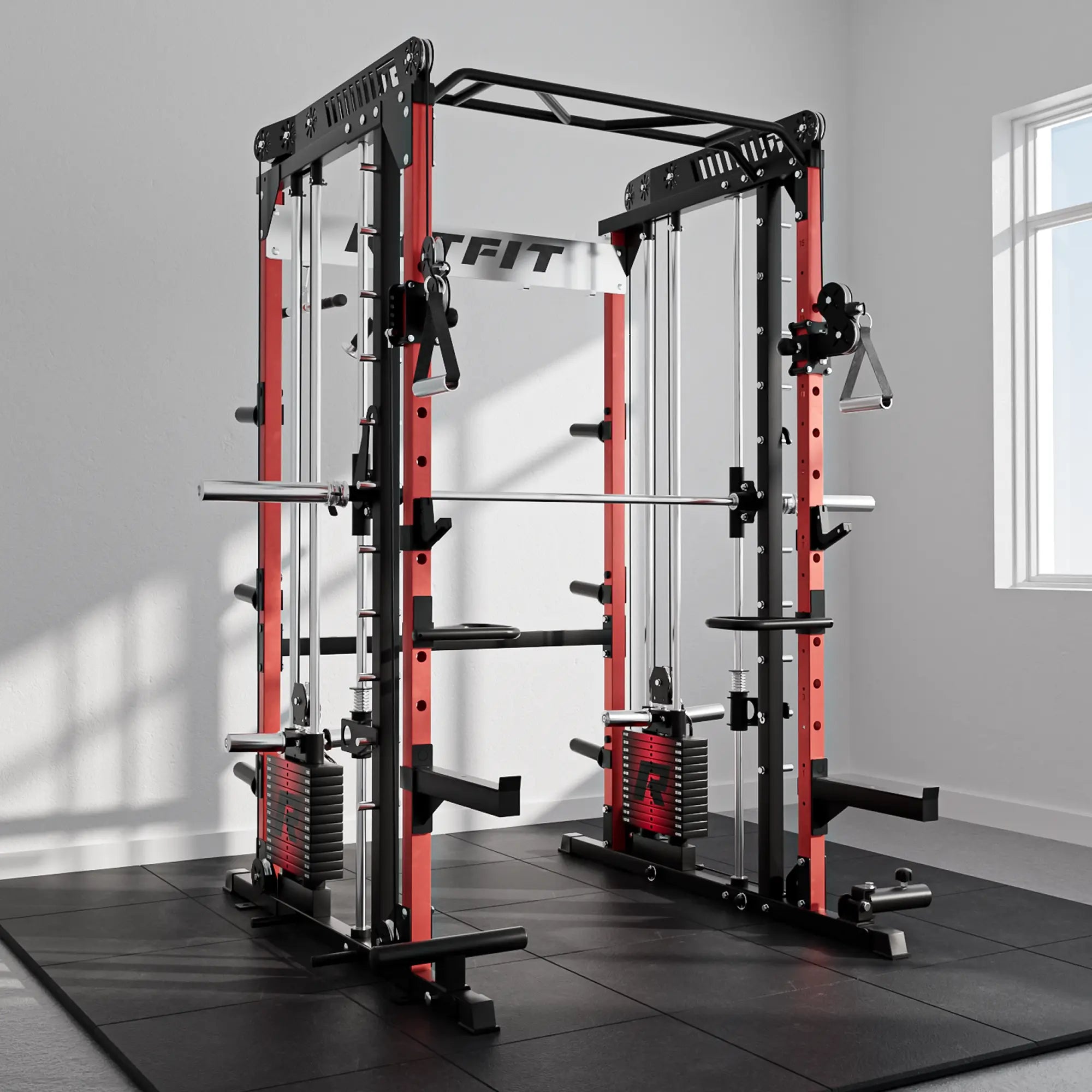

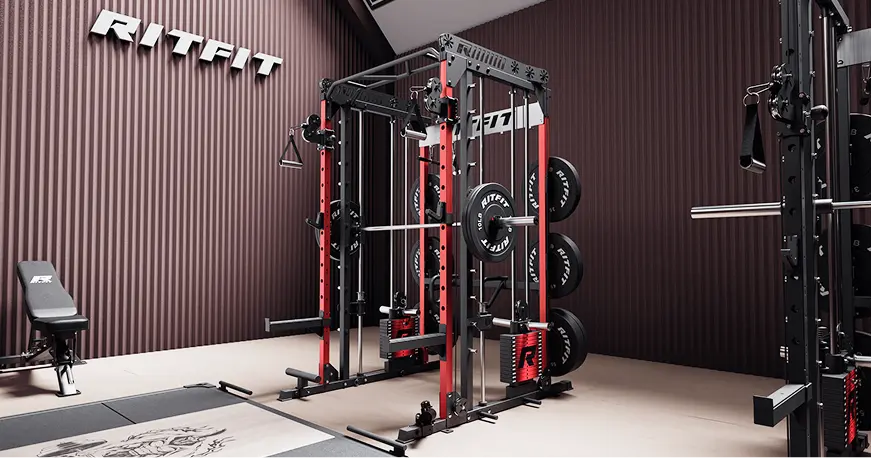
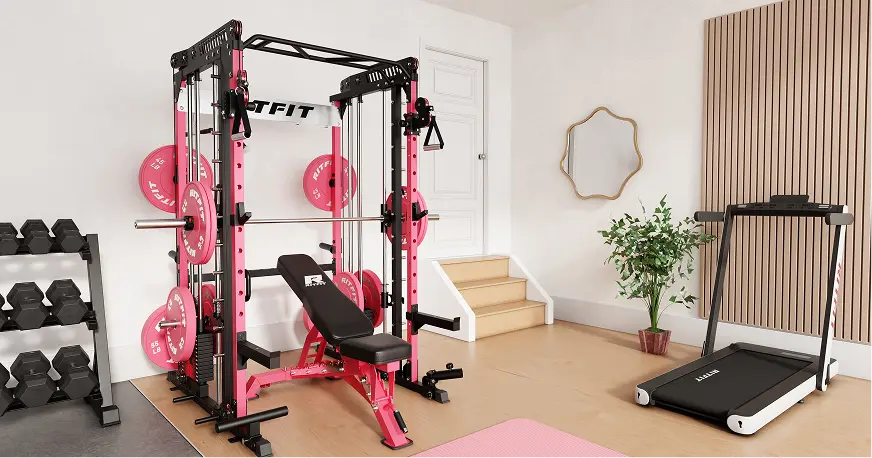
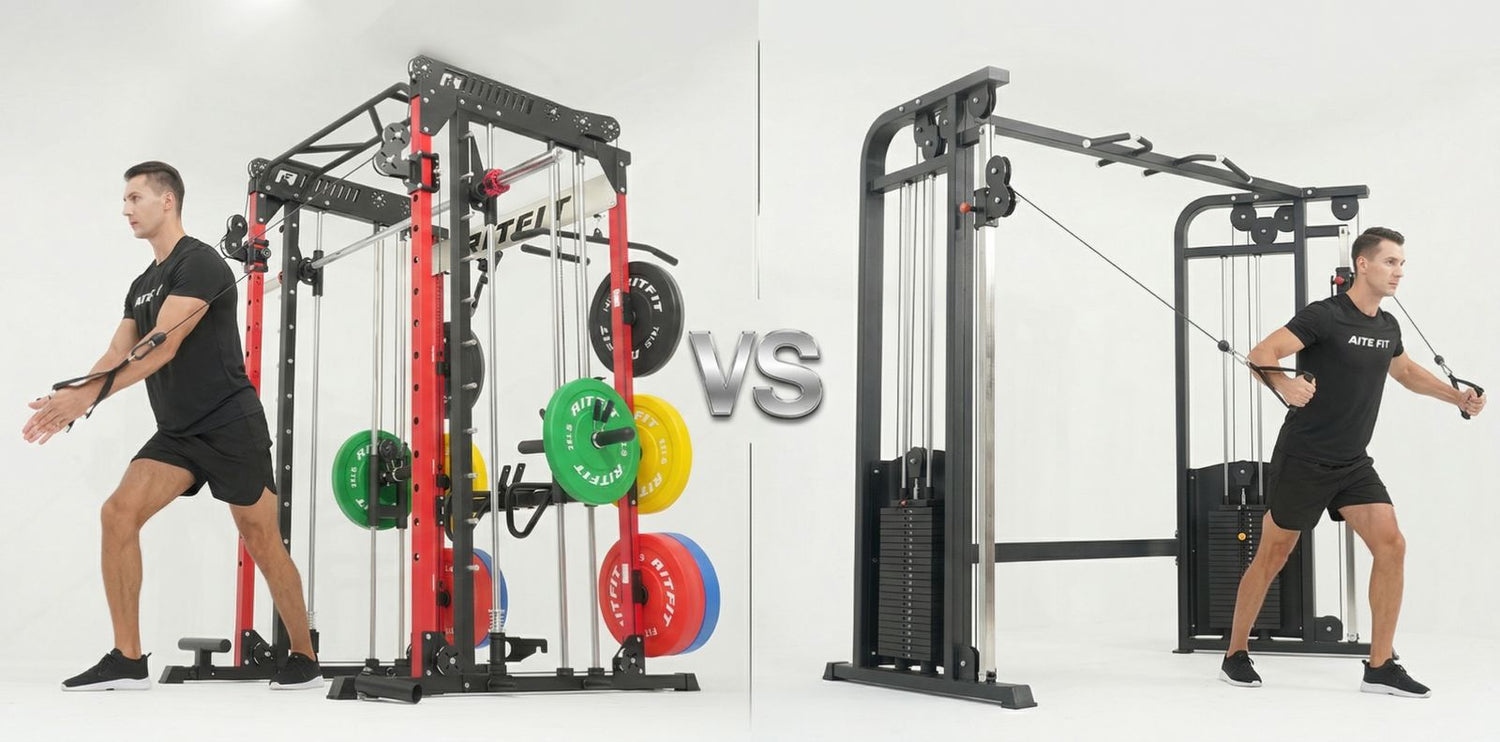
The Smith machine vs cable machine question usually ends the same way for a home gym: a Smith machine with an integrated cable system wins, because one frame covers guided barbell compounds and cable isolation in a single footprint.
This guide compares bar path, frame capacity, footprint, pulley hardware, exercise range and total cost, then matches RitFit models to real rooms and budgets. Measure your ceiling and your floor before you order anything.
Quick Answer: A Smith machine with cables is the better single purchase for most home gyms because it combines a guided bar for squats and presses with a cable system for flyes, rows and pulldowns in one frame. A dedicated cable machine makes sense only when a rack and barbell are already in place.
Key Takeaways
- Guided path versus free path: A Smith machine locks the bar to rails for squats and presses, while a cable machine leaves the handle path free for flyes, rotation and single arm work.
- One frame versus two stations: A Smith machine with cables replaces a rack and a cable unit in one footprint, and the RitFit M1 PRO lists 20.9 sq ft with 15 cable positions and 11 bar settings.
- Capacity and hardware are published numbers: The M1 PRO lists a 1,600 lb frame capacity, a 420 lb single side pulley rating and a 2 to 1 pulley ratio in 14-gauge steel.
- A dedicated cable machine is an add on, not a base: It cannot support guided pressing or squatting with safety arms, so it only pays off when a rack and barbell already exist.
- Measure before you buy: Ceiling height and usable floor decide more home gym purchases than brand preference does.
What Is the Difference Between a Smith Machine and a Cable Machine?
A Smith machine guides a barbell along fixed rails, while a cable machine pulls a handle through a free path. Capacity, footprint and exercise range all follow from that one mechanical difference.
What a Smith machine with cables actually is
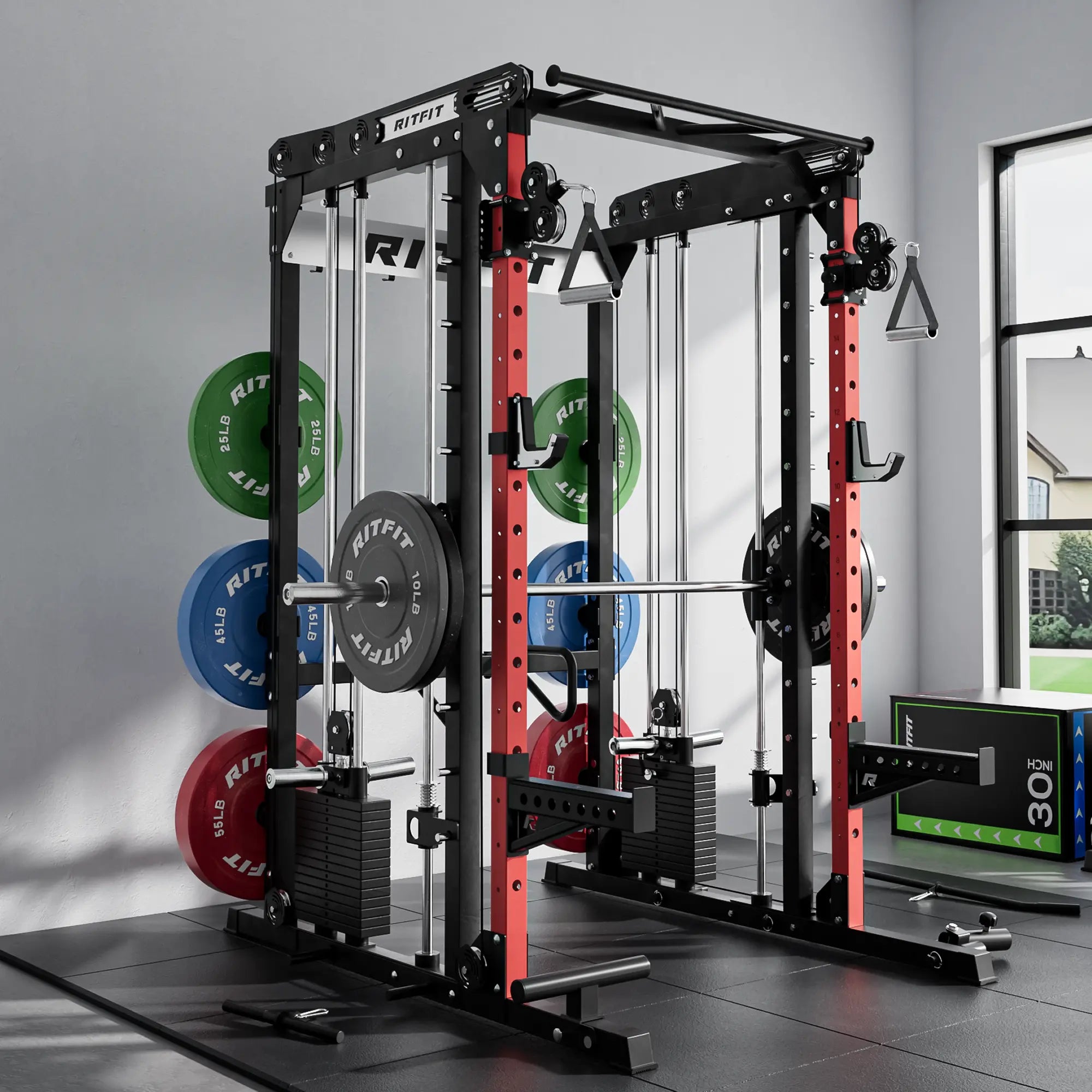
A Smith machine with cables is one frame carrying both a rail guided barbell and one or more pulley columns. The RitFit M1 PRO is built this way, with a linear bearing Smith bar and 15 cable adjustment positions in the same rack as the bar.
What a dedicated cable machine actually is
A dedicated cable machine is a pulley station with two upright columns and either selectorized weight stacks or plate loaded carriages. It has no guided bar, so it cannot hold a loaded barbell for squats or presses with safety arms.
Fixed bar path vs free cable path
- Guided bar: The rails remove most of the balance demand, which lets a solo lifter push a working set closer to failure without a spotter.
- Free cable path: The handle travels wherever your hand goes, which is what makes flyes, rotation and single arm rows feel natural.
- Resistance profile: Cables hold constant tension through the range, while a guided bar loads you the way a barbell does on the same lift.
Neither path is better in isolation. You pick the path your program needs most often.
"Awesome product… Put together by myself, took me around 3 -4 hrs. Great built and real sturdy, smith machine is real smooth… The aluminum pulleys was a great upgrade. Would recommend this product to anyone wanting a home gym, can't go wrong !"
Jeff F. Verified Buyer, RitFit M1 PRO Multi-Functional Smith Machine with Cable Crossover System and Squat Rack for Home Gym
How Do a Smith Machine and a Cable Machine Compare by the Numbers?
The two machine types differ on measurable specifications, not only on feel. Published numbers cover frame capacity, footprint, height and pulley hardware.
| Specification | Smith machine with cables | Dedicated cable machine |
|---|---|---|
| Bar path | Guided rails with a linear bearing carriage | Free handle path, no bar guidance |
| Guided barbell work | Squats, presses and rows on rails with safety arms | Not supported |
| Frame capacity | 1,600 lb published frame rating | Frame rating varies by model |
| Footprint | 20.9 sq ft | Two upright columns set the width |
| Height | 85.3 inches | Varies by model and stack size |
| Cable range | 15 adjustment positions at a 2 to 1 pulley ratio | Position count varies by model |
| Pulley hardware | Aluminum pulleys on stainless steel rails | Entry units often use plastic or nylon wheels |
| Role in a home gym | Complete station on its own | Add on to an existing rack |
The Smith machine column lists published RitFit M1 PRO specifications, checked in 2026.
The cable machine column describes the machine class, because pulley spacing, stack size and footprint vary by unit.
Frame capacity is the manufacturer rating for the structure, not a tested limit for an individual lifter.
Which numbers decide the choice
- Ceiling height: An 85.3 inch rack needs headroom that a low basement joist may not allow, and no rating matters if the machine does not fit.
- Frame capacity: A 1,600 lb published rating covers most home lifters, while heavier long term loading points to an 11-gauge frame.
- Pulley hardware: Aluminum pulleys on stainless rails are the load bearing standard, while plastic and nylon wheels sit in the light to medium duty bracket.
Is a Smith Machine with Cables Better for Building Muscle?
A Smith machine with cables covers more muscle groups in one station. A cable machine covers fewer movements, but it covers them with a freer handle path and constant tension.
Exercises only the guided bar covers
The guided bar is what lets you load squats, bench presses, incline presses, shoulder presses, hip thrusts and calf raises without a spotter. Each of those movements uses the same rails, the same safety arms and the same 11 bar height settings on the M1 PRO.
Exercises only cables cover
Cables reach angles that a bar cannot, including flyes, lateral raises, face pulls, wood chops and single arm rows. Those movements keep tension at the stretched position, which is where a cable system earns its place in a program.
If your program is built on squats, presses and rows with cable work between them, one frame covers both needs. Browse Smith machines and cable machines side by side before you commit to a single path.
Which Machine Fits a Small Home Gym Better?
A Smith machine with cables usually fits a small home gym better. It occupies one footprint, while a rack and a separate cable machine need two.
Footprint and ceiling height
- Floor: The M1 PRO lists 20.9 sq ft, which leaves working room in a single car garage or a basement corner.
- Height: The same frame lists 85.3 inches, so a low joist decides the purchase before floor space does.
- Clearance: The published guidance recommends at least 8 ft of ceiling height and 1 to 2 ft of clearance around the frame for safe movement.
When a separate cable machine is worth the extra floor
A dedicated cable machine earns its space when a rack, barbell and bench are already in place. It then adds movement freedom instead of duplicating equipment you already own, including a wider pulley spread for chest flyes.
Is the RitFit M1 PRO Both a Smith Machine and a Cable Machine?
The RitFit M1 PRO is one frame with two systems, and the published specifications treat them separately. The bar side lists 11 height settings on a linear bearing Smith system, and the cable side lists 15 adjustment positions.
Cable and pulley build quality
The M1 PRO cable system is listed with a 2 to 1 pulley ratio, a 420 lb single side pulley load capacity, aluminum pulleys and stainless steel rails. Those parts decide how long a cable system keeps feeling smooth, because plastic or nylon wheels belong to the light to medium duty bracket rather than to the loads a Smith machine cable system actually sees.
Where the hybrid stops short
A hybrid covers both categories, but it does not offer the widest pulley spacing that a dedicated crossover can provide. It also carries a 1,600 lb frame rating with a 3 year warranty on frame and welding, which suits home and light commercial use rather than a commercial floor.
"Few pieces of equipment in the home exercise industry are as comprehensive and versatile as this all-in-one gym system. The robust system provides a natural, centered bar path for compound lifts like squats, presses, and rows, and incorporates a dual cable crossover station with a full rack of precision-engineered attachments."
Tom Eskey, CF-L1, CPT, Home Gym Equipment Reviewer, Garage Gym Revisited review of the RitFit M1
"This thing is great! I have a home gym and having the capability to get so many exercises in one machine is great. The smith and cables are very smooth. Love it!"
Nikolas S. Verified Buyer, RitFit M1 PRO Multi-Functional Smith Machine with Cable Crossover System and Squat Rack for Home Gym
If the hybrid route fits your room, compare the RitFit M1 PRO with cable crossover system against the dual cable system Smith machine layout before you settle on pulley spacing.
Which RitFit Smith Machine Should You Choose?
The right model depends on ceiling height, floor space and how much cable work you plan. The matrix below shows the profile each RitFit machine is best suited to, with the published reason to pick it.
| Best for | RitFit model | Why it fits |
|---|---|---|
| Starting from zero in a garage | M1 PRO | 1,600 lb frame rating, 20.9 sq ft footprint, 15 cable positions and 11 bar settings in one frame |
| Wanting the heaviest frame and the most cable positions | M3 PRO | Published comparison table lists a 2,500 lb frame in 3 by 3 inch 11-gauge steel with 29 cable positions and a 360 lb built-in weight stack |
| Wanting a wider cable path | Buffalo Wild | Adjustable dual cable layout for buyers who want more pulley spread than a single column pair gives |
| Working to a first machine budget | PSR05 2.0 | Smith machine with a lat pulldown station for a first home gym rather than a full attachment ecosystem |
Model specifications are the published RitFit figures, checked in 2026. Compare them against your own ceiling height and floor plan before ordering, and confirm current pricing and package contents on each product page.
Match the machine to your space and budget
The M1 PRO and the M3 PRO both run a guided bar and a cable system from one frame, so the choice between them comes down to frame rating and cable range. The RitFit M3 Smith machine is the heavier of the two, while the RitFit PSR05 2.0 is the lighter entry point into the same category.
Attachments change the cable side more than the frame does, so price the cable attachments and a lat pulldown attachment before you finalize an order. Buyers who want a wider choice of frames can also compare the full strength machines range.
What Does a Smith Machine with Cables Cost Versus a Separate Cable Machine?
A hybrid usually costs more up front than a bare cable machine. It also replaces a rack and a cable station instead of adding to them, which is where the total cost comparison changes.
Up front cost and long term upgrade cost
Published RitFit pricing lists the M1 PRO at $1,299.99 without a weight stack and $2,199.99 with a 264 lb stack at the time of writing. Building the same coverage from separate pieces means a rack, a cable unit and a bench, and each of those arrives with its own delivery and assembly time.
Which upgrade path costs less later
An all-in-one frame accepts attachments later, so a lat pulldown or a lever arm station can be added without buying a second machine. A dedicated cable machine cannot absorb that growth, because it offers no rails to mount guided work onto.
Check the functional training equipment range if cable work is your main goal, then price the whole setup before you decide between one machine and three.
FAQs About Smith Machine vs Cable Machine
Which machine is better for a small home gym?
A smith machine with cables is the ideal choice for limited home spaces. This hybrid setup stacks multiple training functions into one deep frame. It allows you to perform heavy compound lifts and accessory work while saving more floor area than a dedicated cable crossover.
Does a cable crossover replace a smith machine with cables?
No, a separate cable crossover does not replace a guided barbell station. The crossover only provides free path resistance for isolation work and wide angle movements. You will still need a separate rack or guided pressing machine for heavy compound lifting with built in safeties.
Why should a beginner choose a smith machine with cables?
A beginner should choose this hybrid machine because it provides more stability and safety. The fixed bar path reduces coordination demands while you learn basic squatting and pressing mechanics. Integrated safeties make solo training much less intimidating compared to using an open cable crossover system.
Can a cable crossover build a complete home gym setup?
No, a standalone cable crossover usually leaves a gap in your strength training setup. It is excellent for isolation movements and constant tension exercises, but it lacks the guided barbell mechanics required for heavy compound lifts. It works best when paired with another main rack.
What is the main structural difference between the two machines?
The primary difference is the fixed bar path versus free movement resistance. A smith machine uses guided rails to assist with balance during heavy presses. A crossover features wider pulley columns that offer uninterrupted tension and allow your joints to move in a natural direction.
Can a cable machine replace a Smith machine for squats?
No. A cable machine provides free cable resistance with no guided bar, so it cannot support a loaded barbell squat with fixed rails or spotter arms. Squats on a Smith machine use the guided bar and safety arms, while a cable machine is best used for cable squats with much lighter loads.
Is a Smith machine with cables the same as a cable machine?
No. A Smith machine with cables combines a guided bar on rails with a cable pulley system in one frame, while a cable machine only has pulleys and weight stacks. The hybrid covers squats, presses and rows with the bar, then switches to cables for flyes, rows and pulldowns.
Conclusion
A Smith machine with cables gives most home gyms more training per square foot, because it holds a guided bar and a cable system in one frame. A dedicated cable machine is the better buy only when a rack already stands in the room.
Decide with two measurements before you order: your ceiling height and your usable floor. Then check the RitFit discount guide and the current home gym packages to plan the buy.
Disclaimer
This article offers general fitness equipment information and is not medical or physical therapy advice. Consult a qualified professional before starting a new training program, and follow the manufacturer assembly and safety instructions for any machine you purchase.