








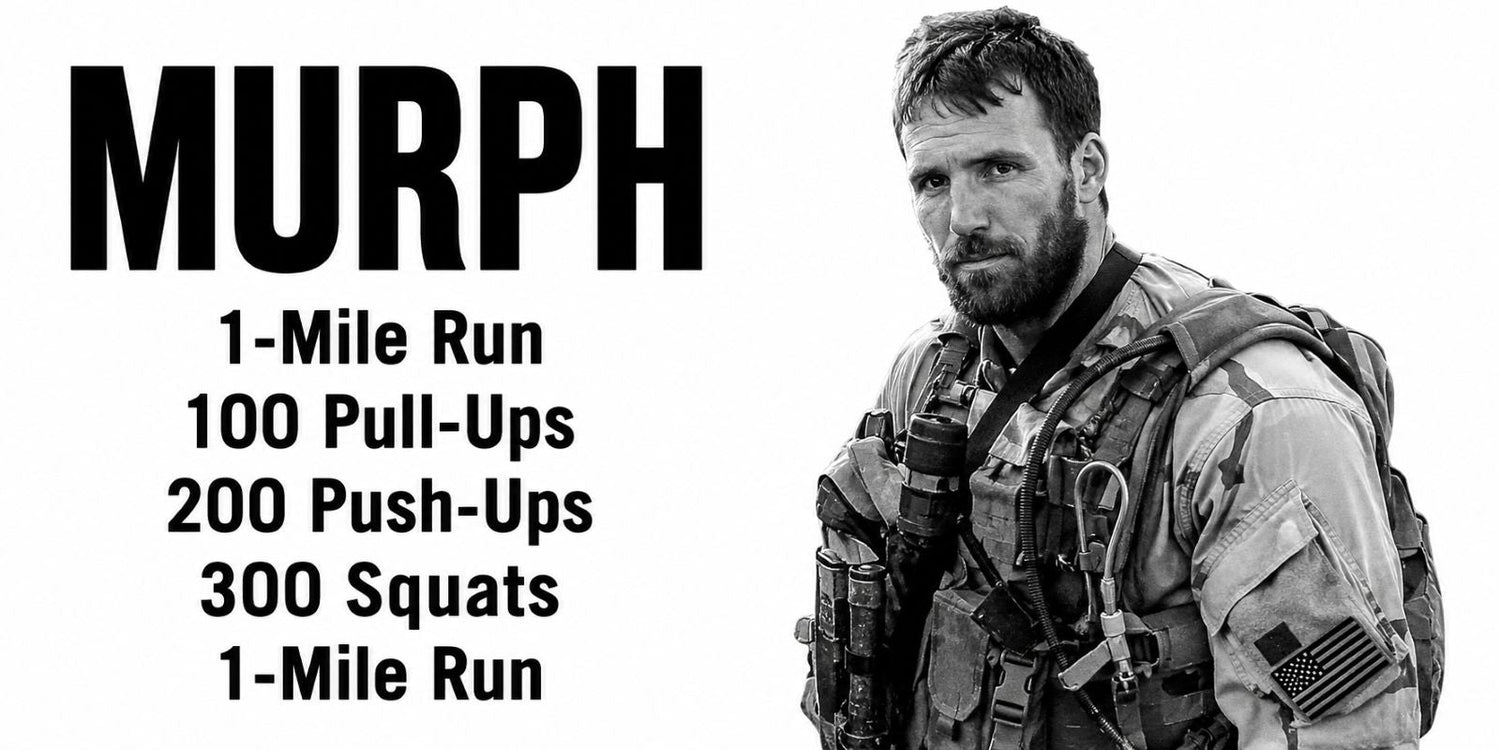
The Murph workout is a timed Hero WOD that combines running, pull ups, push ups, and air squats into one demanding full body endurance challenge. It is traditionally completed as 1 mile run, 100 pull ups, 200 push ups, 300 air squats, and another 1 mile run.
Most beginners should not attempt the full weighted version on their first try. This guide explains the rules, origin, scaling options, training plan, safety risks, and home gym setup considerations.
Table of Contents
- What Is the Murph Workout?
- Origin and Meaning of the Murph Workout
- Murph Workout Rules and Movement Standards
- Partitioned vs Unpartitioned Murph
- Benefits of the Murph Workout
- Who Should and Should Not Do Murph?
- How to Scale the Murph Workout
- How to Train for Murph
- What Equipment Do You Need?
- Common Murph Mistakes to Avoid
Key Takeaways
- Murph is a Hero WOD: It includes 2 total miles of running, 100 pull ups, 200 push ups, and 300 air squats.
- The weight vest is optional: First timers should complete Murph unweighted before considering a 14 lb or 20 lb vest.
- Scaling is smart training: Quarter Murph, Half Murph, ring rows, and elevated push ups help preserve the stimulus without forcing unsafe volume.
- Pacing matters most: The first mile should feel controlled, because going too fast early can destroy the bodyweight section.
- Safety comes first: Stop if you feel chest pain, severe dizziness, confusion, sharp joint pain, or unusual swelling after the workout.
What Is the Murph Workout?
The Murph workout is a high volume fitness challenge performed for time. It tests cardiovascular endurance, muscular endurance, bodyweight strength, pacing, and mental toughness.
- Run: Start with a 1 mile run at a controlled pace.
- Pull ups: Complete 100 total pull ups or a scaled pulling variation.
- Push ups: Complete 200 total push ups with full control.
- Air squats: Complete 300 total air squats with consistent depth.
- Run: Finish with a final 1 mile run.
The advanced version is commonly performed with a weight vest, but the vest is not required for most athletes. Unweighted Murph is still a serious test of stamina and should be treated with respect.
Origin and Meaning of the Murph Workout
The Murph workout is named in honor of Navy Lieutenant Michael P. Murphy, who was killed in Afghanistan in 2005. The workout is widely known as a Memorial Day fitness tradition and is often performed as a tribute rather than a casual gym challenge.
Its original spirit matters because Murph is not only about speed. It is also about discipline, preparation, humility, and respect for the people the workout honors.
Murph Workout Rules and Movement Standards
The standard Murph workout is completed for time, which means the goal is to finish all prescribed work as efficiently as possible while maintaining safe form. Rx means the athlete performs the workout as prescribed, without reducing the reps, changing the movements, or removing the load.
- Pull ups: Start from full arm extension and finish with the chin clearly above the bar.
- Push ups: Lower the chest toward the floor and press back to full arm extension without sagging through the hips.
- Air squats: Lower the hips below parallel when possible and stand fully tall at the top.
- Running: The 1 mile runs bookend the workout and should remain part of the standard version.
- Weight vest: Advanced athletes may use a 14 lb or 20 lb vest if they have already built the capacity to handle full volume safely.
Good reps matter more than rushed reps. Poor standards can turn a meaningful challenge into unnecessary shoulder, elbow, knee, or lower back stress.
Partitioned vs Unpartitioned Murph
Partitioned Murph means you break the 100 pull ups, 200 push ups, and 300 squats into smaller rounds. Unpartitioned Murph means you finish all pull ups first, then all push ups, then all squats.
| Method | Best For | Why It Works |
|---|---|---|
| 20 rounds of 5, 10, 15 | Most intermediate athletes | It spreads fatigue evenly across pulling, pushing, and squatting. |
| 25 rounds of 4, 8, 12 | Beginners with limited pull ups | It keeps each round small enough to maintain cleaner reps. |
| 10 rounds of 10, 20, 30 | Advanced athletes | It reduces transitions but requires much higher muscular endurance. |
| Unpartitioned | Experienced athletes only | It creates deep local fatigue and is much harder to pace. |
Most first timers should choose a partitioned format. It protects movement quality and reduces the chance of early failure during push ups or pull ups.
Benefits of the Murph Workout
The Murph workout builds endurance because it combines sustained running with high repetition calisthenics. Concurrent endurance and strength training can produce broad physical adaptations when programmed with appropriate volume and recovery.[1]
- Cardiovascular endurance: The 2 total miles of running challenge aerobic capacity and fatigue management.
- Muscular endurance: The high rep pull ups, push ups, and squats train repeated force output under fatigue.
- Full body conditioning: Pulling, pushing, squatting, and running create a balanced training stimulus.
- Mental discipline: Murph teaches pacing, patience, and emotional control during discomfort.
- Community motivation: Many gyms perform Murph in groups, which can improve accountability and effort.
Who Should and Should Not Do Murph?
Murph is best for athletes who already have a base of running fitness, strict bodyweight control, and experience with high volume training. Beginners can do Murph only when the workout is scaled to their current capacity.
- Good candidates: Intermediate and advanced athletes who can run 2 miles, perform repeated push ups, and complete safe pulling variations.
- Use caution: New exercisers, heavier athletes returning after a long break, and anyone with shoulder, elbow, knee, heart, or heat illness history should scale aggressively.
- Avoid full Rx: Do not wear a vest if you have never completed the full unweighted version with clean form.
- Ask a professional: Consult a qualified healthcare professional if you have a medical condition or unexplained symptoms during hard exercise.
High intensity exercise can contribute to exertional rhabdomyolysis in rare cases, especially when volume, heat, dehydration, and poor preparation combine.[2] This is why Murph should be earned through progressive training rather than attempted impulsively.
How to Scale the Murph Workout
Scaling Murph means adjusting distance, volume, loading, or movement difficulty while keeping the basic workout pattern intact. The best scaled version should feel challenging but repeatable without form breakdown.
| Version | Workout | Best For |
|---|---|---|
| Quarter Murph | 400 meter run, 25 pulls, 50 push ups, 75 squats, 400 meter run | New athletes and first timers |
| Half Murph | 800 meter run, 50 pulls, 100 push ups, 150 squats, 800 meter run | Fit beginners and intermediates |
| Partner Murph | Run together or split reps with a partner | Community events and mixed ability groups |
| No Vest Murph | Full reps without extra load | Most first full Murph attempts |
For pull up substitutions, use ring rows, band assisted pull ups, jumping pull ups, or cable based pulling work. If you train at home, a stable power rack with a pull up bar can make Murph practice more consistent.
How to Train for Murph
Train for Murph by gradually building running capacity, pulling volume, pushing volume, squat tolerance, and recovery habits. Resistance training adaptations can occur across a wide range of loading zones, but volume should still be progressed carefully to match the athlete.[3]
- Week 1: Establish your baseline with easy runs, strict push ups, assisted pulling, and light squat volume.
- Week 2: Add small Murph style circuits such as 5 rounds of pulling, push ups, and air squats.
- Week 3: Practice a Quarter Murph or Half Murph at steady pace without chasing a fast time.
- Week 4: Reduce total volume, keep movement quality sharp, and prioritize sleep, hydration, and easy movement.
Your weekly training setup should include one running focused day, one calisthenics volume day, and one mixed conditioning day. For a garage gym setup, consider pairing a home gym rack package with enough open floor space for push ups and squats.
What Equipment Do You Need for Murph?
The minimum Murph setup includes running shoes, a pull up station, and floor space for push ups and air squats. A weight vest is optional and should be reserved for athletes who already tolerate the full unweighted version.
- Pull up station: Use a secure bar, rack, or assisted pulling setup that does not shake during reps.
- Floor protection: Use interlocking gym flooring mats to create a cleaner push up and squat area.
- Push up scaling: Use a box, bench, or adjustable weight bench to elevate the hands when full floor push ups break down.
- Home gym upgrade: A Smith machine home gym can support broader strength training outside Murph preparation.
- Accessory option: Cable handles and a multi grip lat pull down bar can help develop pulling strength if strict pull ups are not yet available.
- Bodyweight scaling: A 3 in 1 soft foam plyo box can support elevated push ups, step ups, and warm up drills.
Keep equipment simple if your goal is your first Murph. The priority is a safe pulling station, reliable footing, and enough space to move without interruption.
Murph Safety Tips and Warning Signs
Murph should feel difficult, not dangerous. Exertional rhabdomyolysis can present with severe pain, weakness, swelling, and dark urine, and athletes should seek medical care if these symptoms occur after intense training.[4]
- Stop immediately: Stop if you feel chest pain, faintness, confusion, or sharp joint pain.
- Watch heat stress: Avoid wearing a vest in high heat if you have not trained in similar conditions.
- Hydrate early: Start the day hydrated rather than trying to fix dehydration during the workout.
- Respect soreness: Extreme swelling, severe weakness, and dark urine after Murph are not normal training soreness.
- Do not chase ego: Scaling is better than finishing with unsafe form or medical risk.
Common Murph Mistakes to Avoid
The biggest Murph mistake is attempting the full weighted version without preparation. The second biggest mistake is sprinting the first mile and losing all control during the push ups.
- Starting too fast: Run the first mile at a pace you can repeat under fatigue.
- Ignoring scaling: Reduce reps or change movements before form collapses.
- Using a vest too soon: Add load only after you can complete the unweighted workout safely.
- Skipping warm up: Prepare the shoulders, hips, ankles, wrists, and core before the clock starts.
- Training randomly: Build volume over several weeks instead of testing Murph without a plan.
Murph Variations and Related Challenges
Murph variations help different athletes experience the workout without forcing the same volume. The right variation depends on your training age, joint history, available equipment, and recovery capacity.
- Half Murph: Use half the reps and keep both runs at 800 meters or 1 mile depending on fitness.
- Quarter Murph: Use one quarter of the reps and shorter runs for a beginner friendly entry point.
- Partner Murph: Split the reps with a partner while keeping steady movement quality.
- No Vest Murph: Complete the full workout with body weight only.
- Strict Murph: Use strict pull ups only if your shoulders and elbows are ready for the volume.
How Often Should You Do the Murph Workout?
Most athletes should treat Murph as an occasional benchmark rather than a weekly routine. Once or a few times per year is enough for most people to test progress without creating excessive overuse stress.
You can train Murph components more often without repeating the full challenge. Run, pull, push, squat, recover, and retest only when your body is prepared.
FAQs About the Murph Workout
How long does the Murph workout take?
Most recreational athletes finish the Murph workout in 45 to 90 minutes. Faster athletes may finish near 35 to 45 minutes, while beginners using scaled reps may need more time, especially if pull ups and push ups require frequent breaks. Safe pacing matters more than speed.
Should I wear a weight vest for my first Murph workout?
No. First timers should complete the Murph workout without a weight vest. The vest increases impact, shoulder fatigue, and heat stress, so it should be added only after you can finish the full unweighted workout with controlled reps, steady breathing, and no joint pain.
Can beginners do the Murph workout at home?
Yes. Beginners can do a scaled Murph workout at home if they have safe running space, a stable pull up option, and enough room for push ups and squats. Start with a quarter Murph or half Murph, then build volume gradually.
What can I do if I cannot do pull ups in Murph?
Use ring rows, band assisted pull ups, jumping pull ups, or controlled lat pull down work. The goal is to keep the pulling pattern trainable without forcing failed reps, because excessive grip and elbow fatigue can make the rest of Murph break down quickly.
Which Murph rep scheme is best for beginners?
The best beginner Murph rep scheme is small repeated rounds. Try 20 rounds of 5 pull ups, 10 push ups, and 15 squats only if that volume is realistic, or use 25 rounds of smaller sets to reduce early burnout.
How should I train for the Murph workout?
Train for Murph by building running endurance, pull up volume, push up stamina, and squat tolerance. Use two or three weekly sessions that combine easy runs, strict movement practice, and small Murph style circuits, then reduce volume in the final few days.
Is the Murph workout dangerous?
It can be dangerous when athletes attempt full volume, high heat, or a weight vest without preparation. The main concerns are overuse pain, dehydration, heat stress, and rare exertional rhabdomyolysis, so scaling and stopping early are smarter than pushing through warning signs.
What equipment do I need for the Murph workout?
You need running shoes, a pull up bar or safe pulling station, floor space for push ups, and room for air squats. A weight vest is optional, and most beginners should skip it until they can complete Murph unweighted with consistent form.
Conclusion
The Murph workout is a demanding Hero WOD that tests endurance, strength, pacing, and discipline. Do it with respect, scale it intelligently, and earn the full version through consistent preparation.
Beginners should start with a smaller version, skip the vest, and focus on smooth movement. Advanced athletes can use Murph as an occasional benchmark, not a weekly punishment.
Disclaimer
This article is for general educational purposes only and is not medical advice. If you have a heart condition, joint injury, previous rhabdomyolysis, high blood pressure, heat illness history, or any medical concern, consult a qualified healthcare professional before attempting the Murph workout.
References
- Hughes DC, Ellefsen S, Baar K. Adaptations to endurance and strength training. Cold Spring Harb Perspect Med. 2018;8(6):a029769. doi:10.1101/cshperspect.a029769
- Kim J, Lee J, Kim S, Ryu HY, Cha KS, Sung DJ. Exercise induced rhabdomyolysis mechanisms and prevention, a literature review. J Sport Health Sci. 2016;5(3):324-333. doi:10.1016/j.jshs.2015.01.012
- Schoenfeld BJ, Grgic J, Van Every DW, Plotkin DL. Loading recommendations for muscle strength, hypertrophy, and local endurance, a re examination of the repetition continuum. Sports. 2021;9(2):32. doi:10.3390/sports9020032
- Tietze DC, Borchers J. Exertional rhabdomyolysis in the athlete, a clinical review. Sports Health. 2014;6(4):336-339. doi:10.1177/1941738114523544





