The 2026 FIFA World Cup group stage kicks off on June 11, giving home gym owners a concrete deadline to build meaningful fitness before the tournament begins. A structured four-week training plan turns that fixed date into a motivating goal anchor rather than a passive deadline.
This guide provides a complete four-week progressive home gym program calibrated for the World Cup season, covering exercise selection, weekly structure, progressive overload principles, and the equipment that makes each phase practical for solo training at home.
Table of Contents
Key Takeaways
- Timed Goal Anchor: The 2026 World Cup group stage begins June 11, making mid-May the ideal start date for a four-week plan that delivers noticeable fitness gains by tournament day one.
- Research Supports Lower-Volume Programs: A 2023 narrative review found that minimalist resistance training with lower doses can still effectively improve physical fitness, validating structured home gym programs that fit around a busy schedule.
- Progressive Overload Is the Key Mechanism: Systematically increasing reps, sets, or load each week is the primary driver of strength adaptation, and this plan applies one overload variable per phase to keep adaptation consistent without risking injury.
- Home Training Works: A 2025 study found that adults who transitioned to home-based resistance training experienced positive outcomes, supporting the effectiveness of a structured home gym approach.
- Compound Movements First: Each week prioritises squats, deadlifts, presses, and rows as the primary strength stimulus, with accessory work added from week two to address muscular balance and injury prevention.
Why Train for World Cup Season?
According to FIFA, the 2026 World Cup group stage begins June 11, making it the most widely anticipated fitness deadline of the summer for sports fans who want to arrive at the tournament feeling strong and energetic. A four-week program starting in mid-May aligns the build and peak phases precisely with the opening fixtures.
Beyond the deadline motivation, the World Cup provides an unusual social context for fitness: watch parties, shared viewing sessions, and group matches create natural opportunities to discuss training progress with other fans who have set similar goals. Check the full 2026 World Cup match schedule now to identify the opening fixtures you are training toward.
The Fitness-Fan Mindset
Watching elite athletes perform at peak physical condition is one of the most motivating triggers for recreational training, and the World Cup delivers that stimulus across three weeks of continuous competition.
- Deadline clarity: Specific event dates remove ambiguity from "I want to get in shape," converting it into a trackable eight-session target across four weeks.
- Social accountability: Sharing a training goal tied to an event creates natural check-in points with friends watching the same matches.
- Identity reinforcement: Training during the World Cup connects recreational fitness to the same discipline displayed by the athletes on screen.
How the 4-Week Plan Works: Progressive Overload Explained
A 2023 narrative review found that minimalist resistance training with lower volume can still effectively improve physical fitness, supporting the efficacy of this structured home gym program that fits within three to four sessions per week.[1] Resistance training is well established for improving muscle strength and metabolic health in adults, with adaptations building across consistent training blocks.[2]
Progressive overload is the principle of systematically increasing training stress over time. This plan applies one overload variable per week, sets in week one, reps in week two, intensity in week three, and neural activation in week four, so each phase adds a clear new stimulus without stacking too many variables simultaneously.
The Four-Week Progression Framework
Each phase targets a different adaptation mechanism, building on the previous week so the body arrives at the final phase primed for a strength peak.
| Week | Phase | Days/Week | Sets x Reps | Rest | Focus |
|---|---|---|---|---|---|
| Week 1 | Base Camp | 3 | 3 x 10 | 60 sec | Movement patterns |
| Week 2 | Build | 4 | 3 x 12 | 60 sec | Volume increase |
| Week 3 | Peak | 4 | 4 x 10 | 75 sec | Intensity |
| Week 4 | Match Ready | 3 | 3 x 8 | 90 sec | Peak strength |
Week 1: Base Camp: Build Your Foundation
A 2025 study found that adults who transitioned from gym-based to home-based resistance training experienced positive outcomes, demonstrating that structured home programs are a viable and effective training modality from the very first week.[3] Week one prioritises learning movement patterns with manageable load rather than chasing maximum weight.
Three sessions of 40 minutes each, spaced evenly across the week, let the body adapt to the stimulus without accumulating the fatigue that would limit quality in week two. The video below demonstrates proper squat depth and foot position mechanics that form the technical foundation for the lower body work throughout all four weeks:
Week 1 Session Template
Each session follows the same push-pull-hinge-squat structure, hitting every major movement pattern three times across the week.
- Squat pattern: Smith machine squat or goblet squat, 3 sets x 10 reps, focusing on depth and knee tracking over load.
- Hinge pattern: Romanian deadlift with dumbbells or barbell, 3 sets x 10 reps, emphasising hip push back and hamstring tension at the bottom.
- Push pattern: Bench press or dumbbell chest press, 3 sets x 10 reps, controlling the descent over two seconds before pressing.
- Pull pattern: Dumbbell row or lat pulldown, 3 sets x 10 reps, driving the elbow back rather than pulling with the hand.
- Core stability: Plank hold 3 sets x 30 seconds, maintaining a rigid line from heels to head without any sagging at the hips.
Week 2: Build Phase: Add Volume and Complexity
Week two increases training frequency to four sessions and expands the rep range to three sets of twelve, the most direct form of volume overload that drives muscular adaptation without adding load. Adding one extra training day and two reps per set creates a meaningful new stimulus while keeping the technique built in week one intact.
Week 2 Accessory Additions
Single-leg and shoulder accessory exercises join the core compound movements from week two, addressing muscular balance that compound-only programming under-develops.
- Unilateral lower body: Bulgarian split squats or reverse lunges, 3 sets x 12 reps per leg, added after the primary squat set to build single-leg stability.
- Shoulder accessory: Dumbbell lateral raises and face pulls, 3 sets x 12 reps each, added at the end of push and pull sessions.
- Core progression: Progress from plank holds to dead bugs or hollow body holds, 3 sets x 30 seconds, maintaining a rigid midline throughout.
Knowing when to push harder and when to hold back is one of the most common challenges in home training. The home gym training to failure guide explains how to judge proximity to failure accurately on each set throughout this build phase.
Week 3: Peak Phase: Intensity Rises
Week three shifts the overload variable from reps to intensity by adding a fourth set and increasing load by roughly five to ten percent above week two working weights. Extending rest to 75 seconds supports heavier compound sets while keeping total session time under 55 minutes.
Week 3 Intensity Cues
Each working set should finish at a perceived exertion of eight to nine, leaving one or two reps in reserve rather than training to absolute failure at this stage.
- Load increase: Select a weight where the final two reps require genuine effort but form stays consistent across all four sets.
- Tempo control: Use a three-second lowering phase on squats and deadlifts to increase time under tension without adding further load.
- Deload signal: If recovery quality drops noticeably between sessions, reduce load by ten percent for one session before resuming the heavier sets.
The 8-week squat progression plan provides a more detailed model that can extend this peak phase beyond the four-week cycle for anyone who wants to continue building after the World Cup group stage.
Week 4: Match Ready: Maintain and Activate
Week four reduces frequency back to three sessions and lowers rep volume to three sets of eight at the heaviest load used across the plan, letting the nervous system express the strength built across weeks one through three. This taper-and-peak pattern is standard in periodised programs and consistently produces a strength expression effect in the final session.
Week 4 Session Priorities
Shorter, higher-quality sessions take priority over volume accumulation in the final week before tournament day.
- Extended warm-up: Add ten minutes of hip circles, banded squats, and thoracic rotations before any loaded sets to arrive at each session fully primed.
- Full rest intervals: Take the complete 90 seconds between sets and resist the urge to shorten rest in the interest of efficiency during week four.
- Match day protocol: On the day of the first fixture, do a ten-minute bodyweight-only mobility session instead of a full training session to arrive at the watch party feeling fresh.
Equipment You Need and RitFit Picks
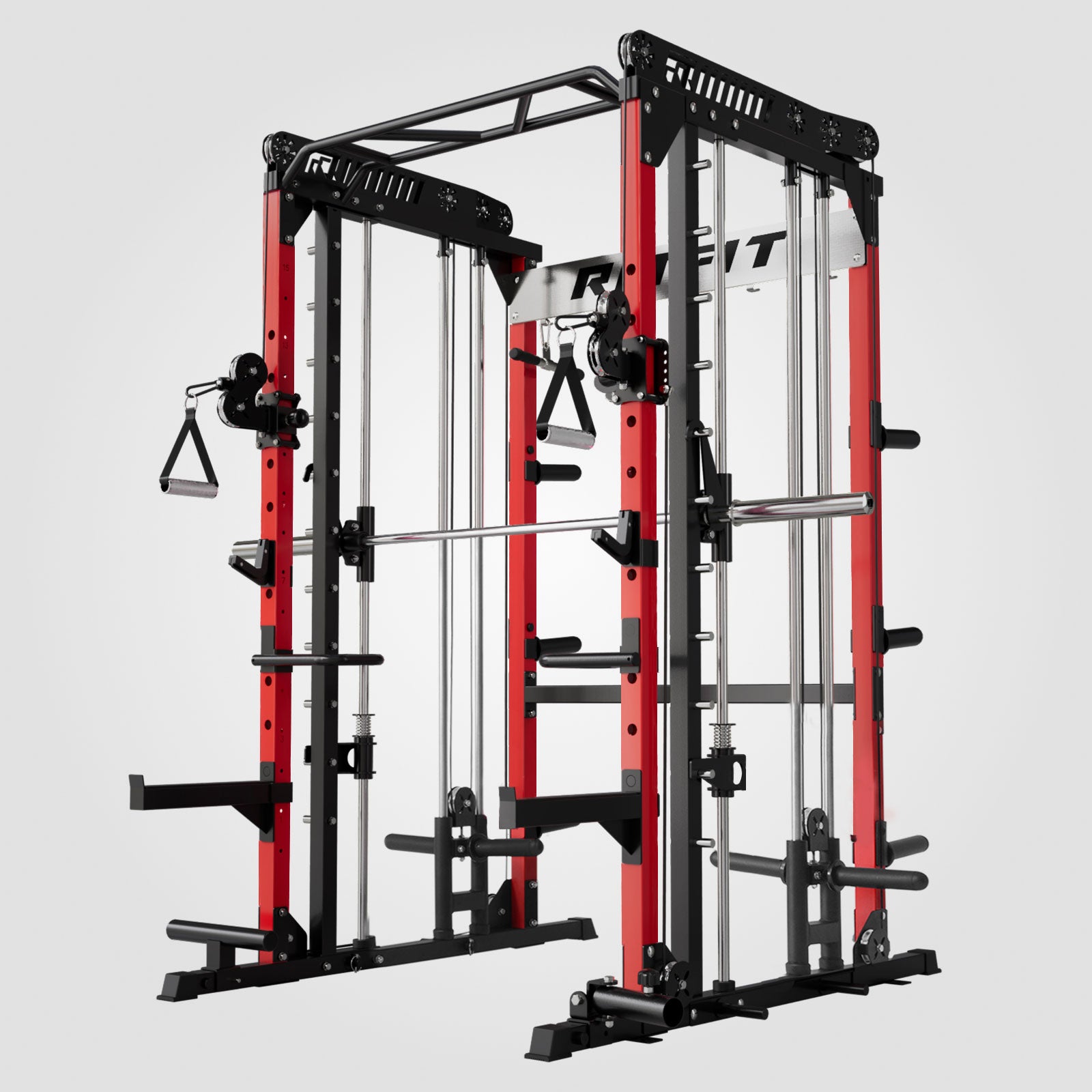
A compact home gym running this plan requires three categories of equipment: a Smith machine or power rack for primary compound work, an adjustable barbell or dumbbell set for loading variation, and a utility bench for pressing angles. Each category covers a distinct movement pattern family and together they unlock every exercise across all four weeks.
Priority Equipment Picks
Prioritise the Smith machine or power rack first, as it anchors squats, bench press, and Romanian deadlifts through every week of the plan.
- Smith machine: The RitFit M1 Smith Machine provides a guided bar path suited to Week 1 technique learning that remains fully relevant through the Week 3 peak phase.
- Adjustable bench: An adjustable utility bench converts flat press work to incline for upper chest variation, which becomes useful from week two onward.
- Barbell selection: The home gym barbell guide covers knurling pattern, sleeve length, and tensile strength ratings relevant to Week 3 heavier loading.
The complete home gym setup guide covers space planning, flooring, and equipment purchase order for anyone building or expanding their training space before June 11.
FAQs
How many days per week do I need to train to get fit for World Cup season?
Yes, three days per week is sufficient for meaningful fitness gains in four weeks. This plan opens and closes at three sessions in weeks one and four, rising to four in weeks two and three. Consistent effort in each session matters more than raw frequency, so three quality workouts reliably outperform four rushed ones.
Can I build real strength at home without a commercial gym membership?
Yes. A study found that adults who transitioned to home-based resistance training experienced positive outcomes, supporting structured home programs as an effective alternative to gym access. A Smith machine, adjustable bench, and barbell set cover every major movement pattern in this four-week plan without requiring a membership or commute.
What is progressive overload and why does it matter in a four-week plan?
No, a single workout produces only temporary fatigue, not lasting strength adaptation. Progressive overload means systematically adding training stress week by week so the body continues adapting. This plan changes one variable per phase, sets in week one, reps in week two, intensity in week three, and neural activation in week four, driving continuous adaptation throughout.
Which muscle groups should this four-week program prioritise?
Yes, compound movements targeting the lower body and posterior chain form the foundation of each session. Squats and deadlifts develop the quadriceps, hamstrings, and glutes. Bench press and rows address the chest, upper back, and shoulders. Accessory work introduced in week two adds single-leg stability and rotator cuff support for long-term performance.
How do I know when to increase weight during the program?
Yes, the rule is simple: if you complete all prescribed sets and reps with two or more reps left in reserve on the final set, add the smallest available increment at the next session. If the last set reaches a perceived exertion above nine, hold the same load for one additional session before progressing further.
Conclusion
A four-week progressive home gym plan turns the June 11 World Cup group stage into a concrete fitness deadline rather than a passive calendar date. Starting in mid-May aligns the foundation, build, peak, and taper phases precisely with opening fixtures, giving every training session a real-world anchor.
Begin with the Week 1 session template, track your sets and loads in a notebook, and apply one overload variable per week. Twelve consistent sessions across four weeks are enough to arrive at the tournament feeling noticeably stronger.
Disclaimer
This article provides general fitness and training information for educational purposes only and does not constitute medical advice, diagnosis, or treatment. Consult a qualified healthcare professional before beginning any new exercise program, particularly if you have a pre-existing medical condition, injury, or health concern.
References
- Behm DG, Granacher U, Warneke K, et al. Minimalist training: is lower volume and dose resistance training effective to improve physical fitness? A narrative review. Sports Medicine. 2023;53(10):1909-1929. https://pmc.ncbi.nlm.nih.gov/articles/PMC10933173/
- Law TD, Clark LA, Clark BC. Resistance exercise to prevent and manage sarcopenia and dynapenia. Annual Review of Gerontology and Geriatrics. 2016;36(1):205-228. https://pmc.ncbi.nlm.nih.gov/articles/PMC4849483/
- Glavas C, Renault-Macklem A, Fiogbee-Hickson L, et al. The feasibility and effects of transitioning gym-based to home-based resistance training. BMC Geriatrics. 2025;25(1):1-14. https://pmc.ncbi.nlm.nih.gov/articles/PMC12309126/