








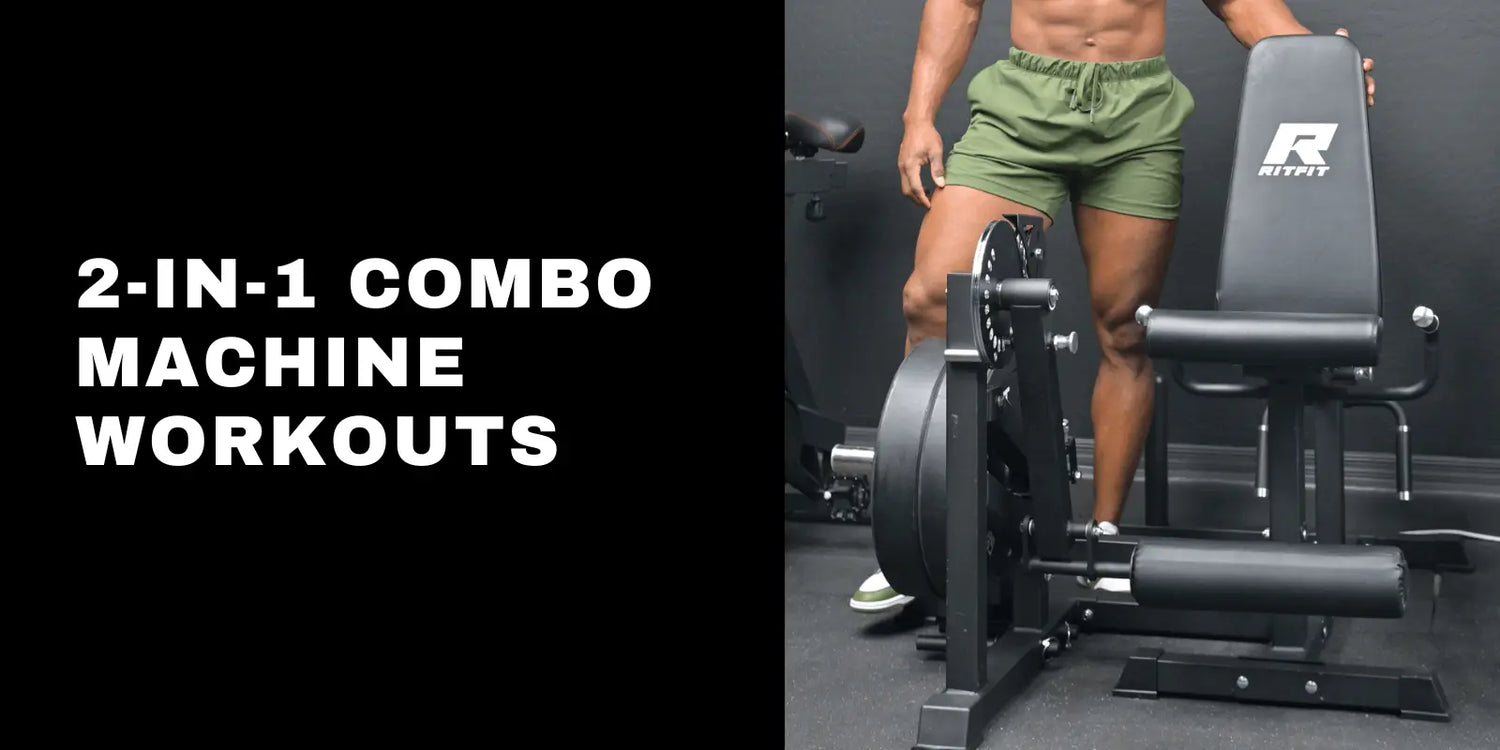
Building muscular legs in a home gym usually means heavy squats, but 2-in-1 combo machine workouts add what a barbell alone cannot. The leg extension and curl machine isolates your quadriceps and hamstrings with commercial-level precision, and the RitFit PLC01 packs that dual-function training into a compact footprint.
This guide covers the science of isolation, a step-by-step PLC01 setup, three goal-based training templates, and the form cues that make every rep count. If your knees are sensitive, scale the load and range of motion as described, and seek professional advice before training through pain.
Quick Answer: A 2-in-1 combo machine workout builds leg size by pairing leg extensions for the quadriceps with prone leg curls for the hamstrings as antagonistic supersets. Align your knee with the pivot point, lower the weight for 3 seconds, and train 1 to 2 times per week after compound lifts.
Key Takeaways
- Isolation fills the gap: A leg extension and curl machine loads the rectus femoris and hamstrings in positions squats cannot fully reach, adding growth that compound-only training misses.
- Pivot alignment is the golden rule: Your knee joint must line up with the machine's pivot point, otherwise tension shifts from the muscle to the joint.
- Superset for efficiency: Pair 12 to 15 leg extensions with 10 to 12 prone leg curls, and rest 90 seconds only after completing both.
- Program it as a finisher: Run the protocol 1 to 2 times per week at the end of leg day, after squats or leg presses.
- Safety beats ego: Make a moderate weight feel heavy with a 3-second lowering phase, and stop at any sharp knee pain.
Why Does a 2-in-1 Combo Machine Build Leg Mass?
A 2-in-1 combo machine builds leg mass because it isolates the quadriceps and hamstrings without the systemic fatigue that limits compound lifts. Hypertrophy requires mechanical tension and metabolic stress, and this machine delivers both directly to the target muscles.
Compound movements like squats and lunges are excellent sources of mechanical tension because you can load them heavily, but they are systemic exercises. Your lower back or cardiovascular system often fatigues before your quads and hamstrings truly reach failure.
Research confirms that the leg extension is one of the only movements that loads the rectus femoris, the large muscle down the middle of the thigh, in its fully shortened position, stimulating growth that squats often miss.[1] That fully shortened load is how you build the teardrop definition just above the knee.
The prone leg curl completes the picture for the posterior chain. Many lifters develop quad-dominant legs because they only squat, and isolating the hamstrings builds the sweep that gives your legs a three-dimensional look while adding a layer of protection to the knee joint.
"If maximum quad growth is the goal, do squats and also do exercises such as front squats, leg press, lunges, and leg extensions."
Bret Contreras, PhD, Contreras Strength Institute, Do More than 'Just Squat'
How Do You Set Up the RitFit PLC01 for Safe Training?
Correct setup is the foundation of growth because a machine that fits your body keeps tension on your muscles instead of your knee joints. The biggest mistake home gym owners make is a poor fit, which transfers workload from the muscle to the joint and stalls both comfort and gains.
Use a simple self-check every session. If you feel more pressure in the front of the knee joint than in the muscle, or your knees feel pulled in an odd direction, stop and adjust before adding weight.
- The golden rule: Align your knee joint with the machine's pivot point, the rotating axis the arm swings around, so the machine moves exactly how your leg moves. A knee that sits too far forward or back creates shear force on the joint.
- Backrest: Adjust the back pad so your knees line up directly with the red pivot point on the cam, and move the backrest forward if your knees pass the edge of the seat.
- Ankle pad for extensions: Rest the pad on your lower shin just above the ankle, never on your foot.
- Ankle pad for curls: Set the pad on the Achilles tendon area just below the calves, because a pad that rides up the calf costs you leverage.
- Thigh pad: Tighten the thigh holder against your quads just above the knee so your legs cannot lift during the movement, which is essential for isolating the hamstrings.
- Seat height and hip position: Aim for a neutral pelvis with your lower back lightly touching the pad, neither tucked under nor excessively arched, so you load the thighs without inviting low-back strain.
- Range of motion: Choose a depth where your knees feel stable and controlled, and slightly shortening the most flexed portion of the curl or extension can improve comfort without sacrificing the muscle stimulus.
Take one or two light setup sets before you go heavy, and photograph your pin holes and pad settings once you find your position. These adjustments apply to any PLC01, from the standard unit to the pink PLC01 edition designed for styled home gym spaces.
"Love Ritfit couldn't of made a better choice of equipment to start my home gym with, easy instructions to build, and sturdy"
Jackie c. Verified Buyer, RitFit The Ultimate Leg Day Duo
What Is the Antagonistic Superset Workout?
The antagonistic superset strategy pairs leg extensions with prone leg curls so your quads rest while your hamstrings work. This back-to-back format keeps your heart rate elevated and floods your legs with blood, creating the metabolic stress that drives a serious pump.
Perform the superset for 3 to 4 rounds with no rest between the two exercises, and rest 90 seconds only after completing both the extension and the curl. Aim to run this protocol 1 to 2 times per week at the end of leg day, after compound movements like squats or leg presses.
- Exercise A, leg extension: 12 to 15 reps, explosive up, 1-second squeeze, 3 seconds down. Grip the handles, keep your hips glued to the seat, and squeeze your quads as hard as you physically can at the top instead of just moving the weight.
- Exercise B, prone leg curl: 10 to 12 reps, 1 second up, 3 seconds down. Lie face down, grip the handles for stability, and curl your heels toward your glutes with a heavy focus on the slow lowering phase, because the hamstrings are fast-twitch muscles that respond very well to controlled negatives.
- Transition: Switch the pin and the arm to the curl position in under 60 seconds to keep the intensity high.
How to do leg extensions:
- Step 1: Sit with your back pressed firmly against the backrest and the round pad resting on your lower shins just above the ankles.
- Step 2: Grip the side handles tightly to lock your upper body in place and prevent swinging or lifting your glutes.
- Step 3: Exhale and extend your legs explosively upward until your knees are fully straight but not hyperlocked.
- Step 4: Hold the peak contraction for one full second and focus on squeezing the vastus medialis, the inner quad muscle.
- Step 5: Inhale and lower the weight slowly for a three-second count, stopping just before the stack touches down to maintain constant tension.
How to do prone leg curls:
- Step 1: Lie face down with your knees aligned to the pivot point and the ankle pad secured on your Achilles tendon.
- Step 2: Grip the handles or the sides of the bench, and actively drive your hips into the pad to stabilize your lumbar spine and keep the lower back out of the lift.
- Step 3: Exhale and curl your heels toward your glutes smoothly, without using momentum to jerk the weight up.
- Step 4: Squeeze your hamstrings hard at the top of the movement to ensure full engagement.
- Step 5: Inhale and lower the weight very slowly for three seconds, fighting the resistance to maximize muscle fiber recruitment without snapping your knees into full extension.
For a slower walkthrough of the curl pattern, see our tutorial on how to do prone leg curls on a leg extension and curl machine.
Which Training Template Fits Your Goal?
The right template depends on your training experience, recovery, and how your knees feel, and all three options use the same two movements. You only change sets, reps, load, and rest, so the machine keeps working as your training age grows.
| Template | Leg Extension | Prone Leg Curl | Rest Between Sets |
|---|---|---|---|
| Beginner, 2 days per week | 2 to 3 sets of 10 to 12 reps, 2 to 3 reps in reserve | 2 to 3 sets of 10 to 12 reps, 2 to 3 reps in reserve | 60 to 90 seconds, no superset yet |
| Strength, 1 to 2 days per week | 3 to 4 sets of 8 to 10 reps | 3 to 4 sets of 8 to 10 reps | 90 to 120 seconds, straight sets or slow superset |
| Joint-friendly, 1 to 2 days per week | 2 to 3 sets of 12 to 15 reps, light to moderate load, shortened range if uncomfortable | 2 to 3 sets of 12 to 15 reps, controlled tempo on the way down | 60 to 90 seconds, never chase the burn |
Templates use the same two movements, so you only adjust sets, reps, load, and rest as your goal changes.
- Beginner progression: When every set feels smooth and controlled for two workouts in a row, add one small weight jump to one exercise the following week, and keep the focus on clean reps rather than maximal load.
- Strength focus: Pick a load that leaves about 1 to 2 reps in reserve on the final set, and skip true max-effort work on isolation lifts. Moving relatively heavy but controlled loads through the same clean range every week is the goal.
- Joint-friendly cautions: Stop before any sharp pulling sensation behind the knee or hamstring, and end the set immediately if you notice sharp, stabbing, or catching feelings. When in doubt, consult a qualified medical or rehabilitation professional before pushing harder.
New to machine training, our roundup of the best leg extension and curl machines for beginners explains what to check before buying your first unit. To see how this machine fits a complete lower-body lineup, browse the full leg machine collection.
For press movements in a compact setup, RitFit also bundles the unit in a 3-in-1 leg press, hack squat, and PLC01 set for home gyms. For inner and outer thigh work the combo machine does not cover, the Cougar home leg adduction and abduction machine rounds out leg day.
Which Form Cues Get Better Results?
Better results come from executing every rep with intention, not from moving heavier pins. These cues keep tension on the target muscle through the full range of motion.
- Toes up on extensions: Pull your toes back toward your shins to keep the knee joint from shifting and make the vastus medialis work harder. If you have to swing your body to move the load, drop the pin one slot and refocus on tension.
- Hips down on curls: Lifting the hips off the pad is the number one error on prone leg curls, because it recruits the lower back and takes the work off the hamstrings. Imagine a belt strapping your waist to the pad, and the deep cramping sensation that follows is exactly the stimulus that drives growth.
- Control range and tempo: Use a deliberate 2 to 3 second lowering phase, pause briefly at the hardest point, and return with a steady, powerful contraction. If you cannot control the last third of the range without swinging, shorten the range and reduce the weight until your form improves.
- Feel the muscle, not the machine: On extensions you should feel the front of your thigh doing the work, not your hip flexors or lower back, and on curls the back of your thighs, not your calves or spine. When tension drifts away from the target muscle, pause, reset your position, and adjust the pads or load.
Is Training to Failure Safe on a Leg Extension and Curl Machine?
Training to failure is safe on these machines when your form is locked in and your setup is correct. The goal of isolation training is making a moderate weight feel heavy by eliminating momentum, not moving the entire stack.
Avoid ego lifting and treat sharp knee pain as a hard stop. If you feel any sharp pain in the knee joint, end the set immediately and check your pivot point alignment again before your next attempt.
"I own a personal training studio and do one on one training! All my clients love the new leg extension, leg, curl machine!👍💪"
Fred P. Verified Buyer, RitFit PLC01 Leg Extension Curl Machine
FAQs About the 2-in-1 Combo Machine
Can you build leg muscle with a 2-in-1 combo machine?
Yes. Leg extensions isolate the quadriceps and prone leg curls isolate the hamstrings, so each muscle reaches true fatigue without your lower back or cardiovascular system giving out first. Pair the machine with heavy compound lifts, control a slow lowering phase, and progress the load gradually over time for steady hypertrophy.
How often should you use a leg extension and curl machine?
Most lifters get strong results from 1 to 2 sessions per week, placed at the end of leg day after squats or leg presses. Isolation work adds focused volume on top of your compounds, and spacing the sessions a few days apart gives your quads and hamstrings time to recover between hard efforts.
Should you do leg extensions before or after squats?
After. Compound lifts like squats and leg presses deserve your freshest energy, and isolation work then finishes off the quads and hamstrings with focused tension. Running extensions and curls as an antagonistic superset at the end of leg day also keeps the total session short while still creating meaningful metabolic stress.
Are leg extensions bad for your knees?
No. When your knee joint aligns with the pivot point, the pad sits correctly on your shin, and the tempo stays controlled, leg extensions are a safe way to load the quadriceps. Stop if you feel sharp pain in the knee, shorten the range slightly at the most flexed portion, and have a qualified professional assess any persistent discomfort.
What weight should a beginner start with on the PLC01?
Start with a light load that lets you complete 10 to 12 clean reps with 2 to 3 reps left in reserve on every set. When all sets feel smooth and controlled for two workouts in a row, add one small weight jump to one exercise the following week, and keep progressing gradually rather than chasing the full stack.
Conclusion
You do not need a warehouse full of equipment to build impressive legs. A 2-in-1 combo machine like the RitFit PLC01 targets your quads and hamstrings with professional precision, and the antagonistic superset strategy turns two simple movements into a serious growth stimulus.
Respect the setup rules, control every inch of every rep, and make tension the goal of each session. Before you order anything, check the current offers in the RitFit discount guide to build your home gym at the best price.
Disclaimer
This article is for general fitness information only and does not replace individualized medical, rehabilitation, or training advice. If you have knee pain, a recent injury, or an ongoing joint condition, consult a qualified physician or physical therapist before starting any new training program.
References
1. Kassiano W, Costa B, Kunevaliki G, Lisboa F, Prado A, Alves L, Tricoli I, Stavinski N, Francsuel J, Cyrino ES. Comparison of Muscle Hypertrophy and Strength Adaptations Induced by Back Squat and Leg Extension Resistance Exercises. J Strength Cond Res. 2025. doi:10.1519/JSC.0000000000005338. PMID: 41379528.





