Table of Contents
A 3D Smith machine keeps the guided safety of a Smith while adding controlled front to back bar travel. That makes many squats, hinges, presses, and selected power movements feel more natural for home gym lifters who want more freedom without losing built in safeties.
Key Takeaways
- More natural bar path: A 3D Smith can feel less restrictive than a fixed rail Smith for many lower and upper body lifts.
- Still safety focused: You keep guided rails, quick re racking, and a more controlled setup for solo training.
- Best for hybrid training: It works especially well for lifters who want strength, hypertrophy, and skill practice in one station.
- Not a full free barbell replacement: It can cover a lot, but free weights still demand more total balance and bar control.
- Programming matters: Beginners should start with simple squats, rows, presses, and hip thrusts before trying cleans or overhead squats.
Introduction to 3D Smith Machine
A traditional Smith machine is helpful for stability, but its fixed vertical path can feel limiting on lifts that naturally move slightly forward or backward. A 3D Smith machine addresses that gap by giving you guided movement with a more adaptable bar path.
If you train at home and want a machine that supports safer solo work without feeling overly locked in, a 3D Smith is one of the most practical formats to consider. It also fits well inside a broader Smith machine collection built for compact home gyms.
What Is a 3D Smith Machine?
A 3D Smith machine guides the bar vertically while also allowing controlled front to back travel. In practice, that gives many lifters a bar path that feels closer to real movement while still keeping rails, hooks, and safeties.
- Why it matters: Squats, presses, hinges, and some athletic pulls do not always feel best in a perfectly fixed vertical groove. A small amount of front to back freedom can help the bar stay closer to your natural line of force.
- What it is not: A 3D Smith is not the same as a free barbell. The bar still stays guided, which means stability demands are lower and movement freedom is still partially constrained.
- Who it suits best: It works well for home gym lifters who want more exercise variety than a standard Smith, but do not want to give up the confidence of guided lifting. It is also useful for people training alone who still want hard sets with a clear rerack option.
If you are newer to Smith work overall, start with the basics first and build skill through a simple guide like how to use a Smith machine at home. Then move into the 3D format once you understand setup, safeties, and bar alignment.
What Sets a 3D Smith Machine Apart?
A 3D Smith sits between a fixed rail Smith and a free barbell, because squat mechanics change with stance, trunk angle, and load, while machine based and free weight training can both build strength and muscle when programmed well.[1][2] That middle ground is exactly why many home gym users find the format appealing.
| Feature | Traditional Smith | 3D Smith | Free Barbell |
|---|---|---|---|
| Bar path | Fixed vertical only | Vertical plus controlled front to back travel | Fully free in all planes |
| Stability demand | Low | Moderate | High |
| Solo training feel | Very controlled | Controlled, but less restrictive | Most skill dependent |
| Best fit | Basic guided compounds | Hybrid strength and hypertrophy | Skill heavy barbell training |
For many home users, the 3D Smith is the sweet spot because it feels more usable than a fixed path Smith without becoming as demanding as a free barbell setup. It also gives context to common comparisons such as Smith machine vs power rack.
Key Features of the RitFit M2
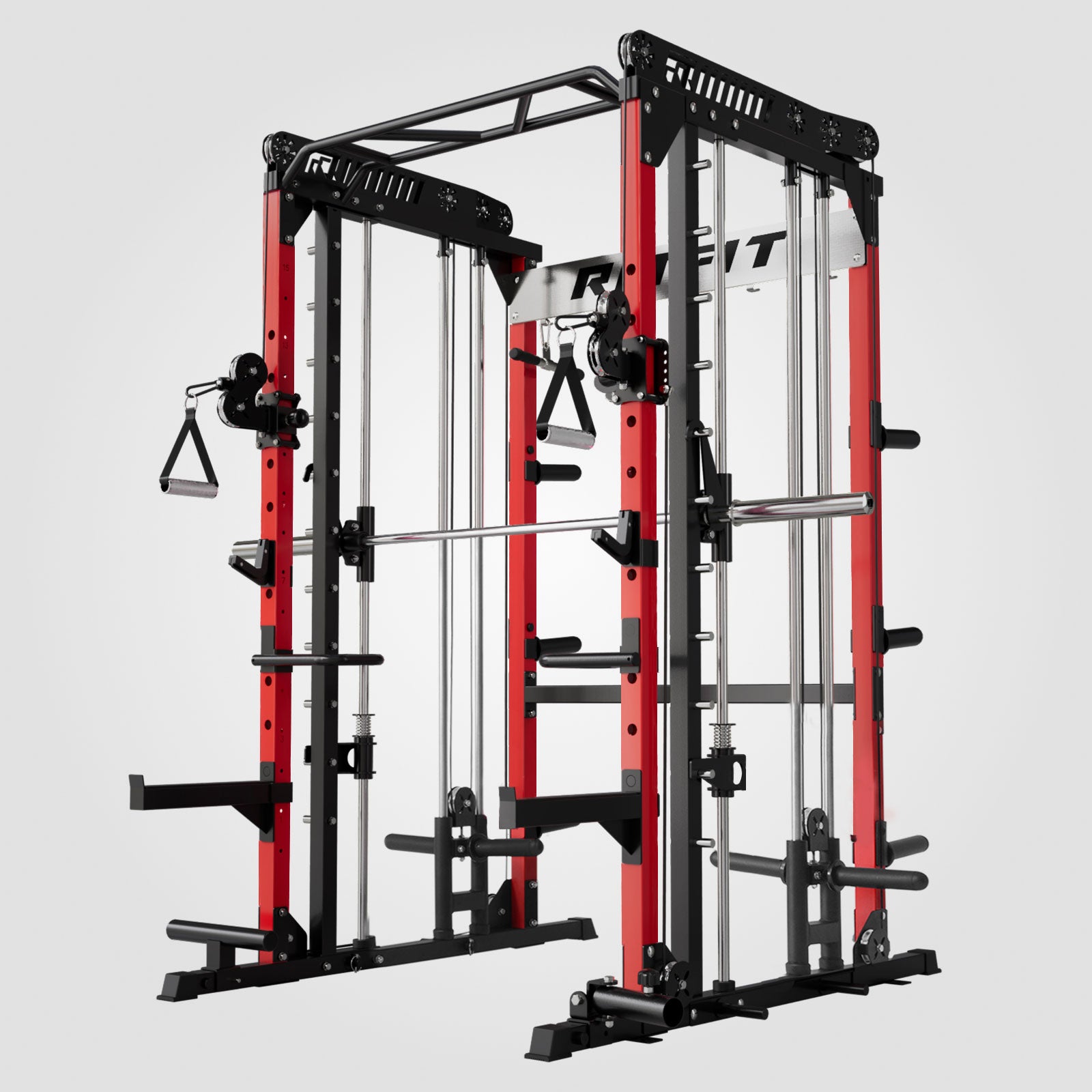
The RitFit M2 matters because it turns the 3D Smith concept into a compact home gym system instead of a single specialty station. Depending on the configuration, the current product page lists a compact 22.8 square foot footprint, 10 adjustable 3D Smith positions, a 2:1 cable ratio, and up to 2000 pounds of total capacity.
- Space efficient footprint: The M2 line combines Smith work, rack work, cables, pull ups, and storage in one station. That matters for garages, spare rooms, and shared training spaces where separate machines are unrealistic.
- 3D Smith adjustment options: Multiple front to back positions help different lifters find a better groove for squats, hip thrusts, curls, and power work. This is one of the main reasons the platform feels more versatile than a fixed rail design.
- Cable integration: The 2:1 pulley setup expands the machine beyond bar work. That gives you rows, flyes, pull downs, curls, triceps work, and core patterns in the same footprint.
- Load and frame capacity: High capacity numbers matter because a home gym rack should not feel like a compromise as training gets heavier. Stronger safeties, J hooks, and pull up ratings also improve long term confidence.
- Modular expansion: The M2 platform supports add ons that widen exercise selection over time. That is useful if you want one rack that can grow instead of replacing major equipment later.
If your goal is variety rather than a single use rack, the M2 also fits naturally into content paths like best multi function Smith machine for home gym and functional trainer with Smith machine. Those pages help frame where the M2 sits inside a broader home gym buying decision.
The 5 Best 3D Smith Machine Exercises
The best 3D Smith machine exercises are the ones that benefit from guidance but still appreciate a less rigid bar path. That usually means lower body compounds, glute focused lifts, selected upper body work, and a few technically advanced patterns for experienced lifters.
Hang Power Clean
The hang power clean is one of the clearest examples of why controlled front to back travel matters, because clean movement patterns change with barbell load and the action is not just straight up and down.[5] Use it only if you already understand clean timing, bar proximity, and the catch position.
- Muscles worked: Glutes, hamstrings, quads, traps, upper back, and core.
- How to do it: Start with the bar just above knee height, brace hard, and drive through the floor while keeping the bar close. Pull under quickly, catch high, then stand tall before resetting each rep.
- Coaching cues: Think jump, shrug, and catch. Do not muscle the bar with your arms too early or let it drift away from your body.
- Best for: Intermediate to advanced lifters who want a guided environment for power practice. It is a skill drill first, not a max load exercise.
Overhead Squat
The overhead squat benefits from a bar path that can stay centered over your midfoot instead of forcing you into one strict vertical groove. It is still an advanced lift, so load should stay light until your shoulders, ankles, and trunk control can hold a stable bottom position.
- Muscles worked: Quads, glutes, upper back, shoulders, and core.
- How to do it: Set the bar around shoulder height, press it overhead, and lock in a stable wide grip. Sit down between the hips while keeping the bar stacked over the midfoot, then stand up without letting the rib cage flare.
- Coaching cues: Keep the chest proud and elbows locked. If the bar keeps drifting, reduce the load and improve mobility before pushing depth.
- Best for: Lifters with good shoulder mobility who want a controlled way to train full body stability. Beginners should use simpler squat patterns first.
Good Morning
The good morning pairs well with a 3D Smith because load changes can alter hinge mechanics and posterior chain demand, so controlled positioning matters more than load selection alone.[4] The goal is a clean hip hinge, not a maximal weight attempt.
- Muscles worked: Hamstrings, glutes, spinal erectors, and upper back.
- How to do it: Set the bar on the upper traps, brace, and push the hips back while keeping a neutral spine. Let the bar travel slightly with you, then drive the hips forward to return to standing.
- Coaching cues: Think hips back, soft knees, and long spine. Stop when hamstring tension is high and spinal position is still clean.
- Best for: Intermediate lifters who want a strong hip hinge accessory. Newer lifters can build the pattern first through a Smith machine Romanian deadlift.
Preacher Curl
The preacher curl is not the most glamorous 3D Smith movement, but it is one of the easiest ways to use the extra bar travel for comfort instead of novelty. Small front to back adjustment can help many lifters line up the wrists and elbows more cleanly on the pad.
- Muscles worked: Biceps brachii, brachialis, and forearms.
- How to do it: Place a preacher bench in front of the machine and set the bar just above your fully extended hand position. Curl with elbows pinned to the pad, then lower under control until the arm is nearly straight.
- Coaching cues: Keep the torso quiet and the shoulder joint calm. Use the 3D travel only to improve alignment, not to swing the load.
- Best for: Lifters who want stricter arm work after compound training. It is also a practical finisher after presses, rows, or pull work.
Hip Thrust
The hip thrust is one of the best 3D Smith machine options for glute focused training, and current literature supports hip thrust use for strong glute involvement and performance relevance.[3] The 3D path also helps many lifters center the bar more comfortably over the midfoot at lockout.
- Muscles worked: Glutes, hamstrings, adductors, and core.
- How to do it: Set your upper back on a bench, roll the bar into the hip crease, and place the feet so the shins are close to vertical at the top. Drive through the heels, lock out with a strong glute squeeze, then lower without losing pelvic control.
- Coaching cues: Keep ribs down and avoid hyperextending the low back. Pause briefly at the top and make the glutes do the work.
- Best for: Nearly every training level. If you want more setup detail, use this companion guide on the Smith machine hip thrust.
These five lifts are only a starting point, because a 3D Smith also works well for rows, split squats, lunges, presses, shrugs, and calf raises. If your main goal is variety and muscle gain, pair this article with Smith machine squat exercises and must do Smith machine exercises for full body gains.
Sample 3D Smith Machine Workout
This full body session is designed to help you use the machine for both strength and hypertrophy without turning the workout into a technical circus. Run it 1 to 2 times per week and leave at least one day between sessions.
Warm Up
The warm up should raise temperature, groove the bar path, and prepare the hips and shoulders for stable lifting. Keep it simple and focus on movement quality, not fatigue.
- 3 to 5 minutes light cardio: Use a bike, brisk walk, or rower. The goal is heat, not conditioning stress.
- Dynamic prep: Do bodyweight squats, hip hinges, arm circles, and band pull aparts. Add a few empty bar reps on the machine before your first work set.
- Skill ramp up: For any advanced lift, use multiple warm up sets. This matters even more when you are learning how the 3D path feels under load.
Workout Structure
Start with your most technical or strength focused lift, then move toward glute and accessory work. Rest long enough to keep execution sharp and bar path consistent.
- 3D Smith Back Squat or Overhead Squat: 3 to 4 sets of 5 to 8 reps.
- 3D Smith Hip Thrust: 3 sets of 8 to 12 reps.
- 3D Smith Good Morning or Smith Machine Romanian Deadlift: 3 sets of 6 to 10 reps.
- 3D Smith Hang Power Clean: 3 sets of 3 to 5 reps, technique focus only.
- 3D Smith Preacher Curl: 3 sets of 10 to 15 reps.
If you are still learning the machine, swap the clean for rows or presses and keep the overhead squat optional. A safer beginner path is to master the Smith machine front squat, the hip thrust, and the hinge before adding technical lifts.
FAQs
What is a 3D Smith machine and how is it different from a regular Smith machine?
A 3D Smith machine guides the bar vertically while also allowing controlled front to back travel. That added path freedom can make squats, presses, and hinges feel less restrictive than a fixed rail Smith, while still giving you hooks, safeties, and a more beginner friendly setup.
Is a 3D Smith machine better than free weights for home workouts?
No. A 3D Smith machine is not automatically better than free weights, but it can be a smarter home option for solo training, technical practice, and fatigue driven sets. Free weights still demand more total balance and skill, which is why many lifters use both instead of choosing only one.
Can beginners use a 3D Smith machine safely?
Yes. Beginners can use a 3D Smith machine safely if they start light, set safeties correctly, and learn the bar path before pushing intensity. It is usually best to master squats, rows, presses, and hip thrusts first, then add more technical lifts after movement control improves.
Which 3D Smith machine exercises are best for glutes and legs?
Hip thrusts, squats, split squats, Romanian deadlifts, and good mornings are usually the best 3D Smith machine exercises for glutes and legs. These lifts use the guided setup for stability, while the slight front to back travel helps many lifters find a more natural lower body pattern.
How much space do you need for a 3D Smith machine at home?
Most home users need enough room for the machine footprint, plate loading, bench setup, and safe movement around the rack. For the RitFit M2 line specifically, the current product page lists a footprint of about 22.8 square feet, so planning extra clearance around it is still important.
Should you do cleans and overhead squats on a 3D Smith machine?
Yes. You can do cleans and overhead squats on a 3D Smith machine, but only if your technique and mobility already support those lifts. It is more practical than a fixed path Smith for these patterns, yet beginners should still start with simpler squat and hinge variations first.
Conclusion
A 3D Smith machine is not magic, but it is one of the smartest ways to blend guided safety with a more natural bar path in a home gym. If you want one station that can handle serious lower body work, glute training, presses, rows, and selected power practice, the RitFit M2 is a strong example of why this format keeps gaining traction.
Disclaimer: This article is for educational purposes only and is not medical advice. Stop any exercise that causes sharp pain, numbness, dizziness, or loss of control. If you are new to lifting, returning from injury, or managing shoulder, spine, hip, or knee issues, get clearance from a qualified clinician or coach before progressing load.
References
- Straub RK, Powers CM. A Biomechanical Review of the Squat Exercise: Implications for Clinical Practice. Int J Sports Phys Ther. 2024;19(4):490-501. doi:10.26603/001c.94600
- Haugen ME, Vårvik FT, Larsen S, Haugen AS, van den Tillaar R, Bjørnsen T. Effect of free-weight vs. machine-based strength training on maximal strength, hypertrophy and jump performance: a systematic review and meta-analysis. BMC Sports Sci Med Rehabil. 2023;15:103. doi:10.1186/s13102-023-00713-4
- Krause Neto W, Vieira TL, Gama EF. Barbell Hip Thrust, Muscular Activation and Performance: A Systematic Review. J Sports Sci Med. 2019;18(2):198-206.
- Vigotsky AD, Harper EN, Ryan DR, Contreras B. Effects of load on good morning kinematics and EMG activity. PeerJ. 2015;3:e708. doi:10.7717/peerj.708
- Werner I, Szelenczy N, Wachholz F, Federolf P. How Do Movement Patterns in Weightlifting Clean Change When Using Lighter or Heavier Barbell Loads? A Comparison of Two Principal Component Analysis Based Approaches to Studying Technique. Front Psychol. 2021;11:606070. doi:10.3389/fpsyg.2020.606070