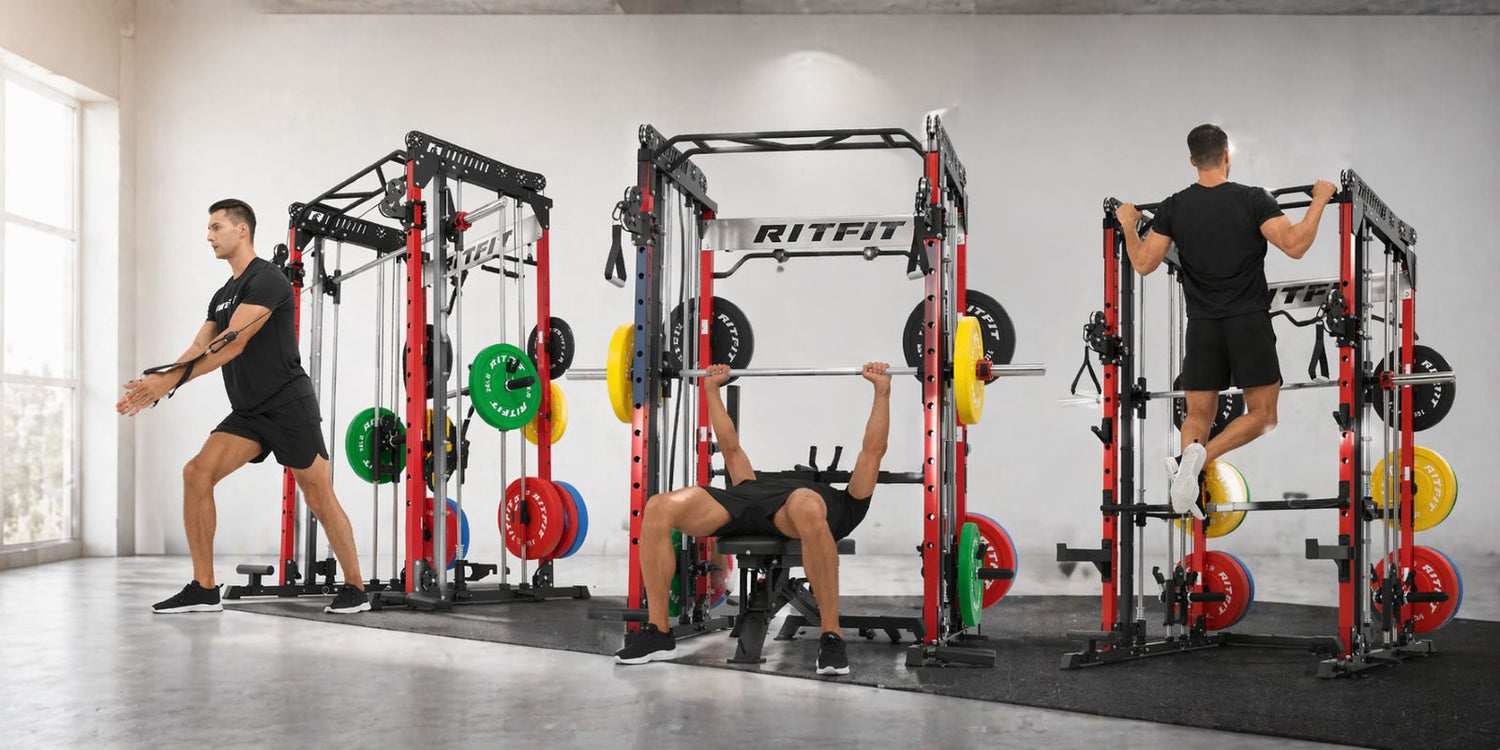
A Smith machine can be a strong home gym centerpiece because it makes solo lifting more controlled and lets you train multiple movement patterns in one station. This guide shows how to plan your space, set safeties, choose effective exercises, and build a practical home program.
A Smith machine fits many home gyms because it combines guided bar work, repeatable setup, and broad exercise variety in a compact footprint. It works best with a stable bench, matching plates, collars, floor protection, and enough room to move safely around the unit.
Quick Answer: A Smith machine is a safe and effective home gym choice when you set the safety stops before every set, plan your ceiling and floor space, and use a balanced mix of squats, presses, rows, and hinges. It suits beginners and busy lifters who want repeatable solo training in one compact station.
Key Takeaways
- Setup first: Measure ceiling height, usable floor space, plate loading room, and bench clearance before you buy or assemble.
- Safety stops: Set the safety stops before every set and match them to the real bottom position of each lift.
- Approachable bar path: The fixed bar path makes home training more approachable, but good technique still matters for comfort, control, and progress.
- Full body coverage: Lower body, upper body push, upper body pull, and accessory work can all be trained effectively on one Smith centered station.
- Simple program wins: A full body or upper lower plan is usually enough to make a home Smith machine setup productive for busy lifters.
Understanding the Smith Machine
A Smith machine is a guided barbell station that locks the bar to two vertical rails, so the path stays straight and you do not need a spotter for most lifts. This fixed path reduces balance demands and makes bar path setup easier to repeat from session to session.
What Is a Smith Machine?
A Smith machine guides the bar on fixed rails, which reduces balance demands and makes bar path setup easier to repeat from session to session. If you want a deeper primer before buying, read what is a Smith machine.
Smith Machine vs. Free Weights vs. Other Home Gym Systems
A Smith machine does not replace every free weight lift, but it can cover a large share of strength work when training alone or in limited space. Current evidence suggests both machine based and free weight training can improve strength and hypertrophy, with results partly specific to the mode you practice.[1]
- Learning curve: A fixed path can make setup simpler for squats, presses, rows, and split stance work.
- Versatility: A Smith centered station can handle more weekly use than a single purpose machine when your goal is full body home training.
- Comparison help: If you are weighing broader layout choices, see Smith machine vs power rack and plate loaded vs weight stack Smith machines.
What Makes a RitFit Smith Machine Distinct?
RitFit gives home users multiple ways into the category, from simpler Smith configurations to all in one packages that combine Smith work with cable training and storage friendly layouts. If you train in a compact room, the RitFit M1 Smith Machine lets you press, row, and do cable work without a second station, while the RitFit M1 PRO home gym package adds a weight stack for fast changes between sets.
Setting Up Your RitFit Smith Machine at Home
Setting up a Smith machine at home starts with measuring ceiling height, floor footprint, plate loading room, and bench travel space so the unit can be used safely every day. Do these measurements before unboxing and compare your room against the full Smith machine collection to pick a footprint that fits.
Pre Setup Planning
Good planning matters because a home Smith machine only feels practical when the room supports safe movement, smooth loading, and daily use. Before unboxing, measure height, width, walking room, and bench travel space, and compare your room to best Smith machine for low ceilings if overhead clearance is tight.
- Flooring: Use a stable, level surface and protect it with rubber flooring or mats.
- Support gear: A solid adjustable bench and correctly matched weight plates make the station more useful from day one.
- Traffic flow: Leave room to load plates, reposition a bench, and step in and out of split stance exercises without clipping walls or storage.
Assembly Basics
Assembly should be treated as a safety job, not just a furniture task. Organize parts first, follow the manual sequence, and tighten hardware only after the frame is level and aligned.
- Work with help: A second person makes guide rail placement, cross member alignment, and final leveling more controlled.
- Check hardware: Confirm bolts, safeties, hooks, and storage posts match the required positions before final tightening.
- Move slowly: Rushing frame alignment usually creates the problems people notice later as wobble, noise, or rough bar travel.
Initial Safety and Function Checks
The first test should happen with the empty bar and no pressure to train. You want smooth travel, secure racking, predictable safety stop contact, and no visible rocking before the first loaded set.
- Test bar travel: Run the empty bar through its usable path and confirm there is no sticking or uneven movement.
- Test racking: Practice rotating the bar into the hooks at several heights so the motion becomes automatic.
- Test safeties: Set safeties at several positions and confirm the bar lands cleanly without shifting the frame.
Safety Fundamentals for Using a Smith Machine at Home
The safety fundamentals for a Smith machine at home are setting the safety stops before every set, loading plates symmetrically, and warming up with the empty bar before you add weight. A fixed path helps confidence, but it never replaces patient loading and correct technique.
Body Position and Bar Path
You still need to fit your body to the lift even when the bar is guided, because the fixed path changes how your feet, bench, and torso line up with the load. Technique quality still matters on a fixed track because range of motion, joint position, and control influence both training stimulus and comfort.[2]
Using the Safety Stops Correctly
The safety stops are only useful when you set them before the set and match them to the real bottom position of the exercise. For squats, bench presses, and hip hinges, the goal is to leave enough working room while still giving yourself a true catch point if a rep breaks down.
Loading, Unloading, and Warm Ups
Load and unload plates symmetrically because uneven loading makes any machine feel less predictable and less stable. Warm up with the empty bar first, add weight gradually, and wear flat, stable shoes on a non slip surface.
Training Alone at Home
Home training works best when you aim for controlled reps, honest effort, and a clear exit plan instead of testing limit lifts without support. The fixed path can improve confidence, but it should never replace patient loading, correct safety height, and attention to form.
How to Use the RitFit Smith Machine: Core Exercises
The core exercises on a Smith machine at home cover lower body, upper body push, upper body pull, and accessory work when you set the bench and safeties for each lift and match your stance to the fixed bar path. Start each exercise with the empty bar to confirm the path feels natural before loading.
Lower Body Exercises
Lower body work is where many home users get the most value from a Smith machine because the setup is fast and the movement options are broad. Research comparing Smith machine squat and leg press patterns also shows meaningful differences in quadriceps activation and perceived effort, so exercise choice should match your goal instead of defaulting to one pattern.[3]
- Smith squat: Set your stance so the bar path and your balance feel natural, not forced. Many lifters do better with the feet slightly forward compared with a free bar squat.
- Smith Romanian deadlift: Start from a standing position, unlock the knees slightly, and hinge by sending the hips back. Keep the bar close to the body and stop where you can maintain a neutral trunk.
- Smith lunges and split squats: These are excellent for single leg strength because the guided bar lets you focus on stride length and depth. Use a stance that keeps the front foot planted and the torso stacked.
- Smith calf raises: Use a full, controlled range and pause briefly at the top. Calf work is simple to load and easy to repeat consistently on a Smith machine.
- Smith glute bridge: Use a pad, secure your shoulder position, and drive through the full hip extension you can control. This is a practical option when you want direct glute work without a separate barbell setup.
Upper Body Pushing Movements
Upper body pushing becomes more repeatable on a Smith machine because you can standardize bar height, bench placement, and safety position from session to session. That repeatability is useful for home lifters who want more setup consistency and less wasted time between sets.
- Smith bench press: Center the bench so the bar touches around mid chest with your natural shoulder position. Set safeties before loading and keep the wrists stacked over the forearms.
- Incline Smith press: An incline bench shifts emphasis upward and can feel more stable than an incline free bar setup at home. Check the bench angle first so the bar still tracks naturally over the press line.
- Smith shoulder press: Seated or standing can both work, but the goal is the same, keep the rib cage controlled and press through a path that does not jam the shoulders. Start lighter than you think and standardize your seat or foot position.
- Smith push ups: Raising the bar lets you scale bodyweight pressing for warm ups, beginners, or higher rep finishers. Lowering the bar over time is a simple way to progress difficulty.
Upper Body Pulling Movements
Pulling patterns on a Smith machine are often underrated, but they are useful for building the back and balancing pressing volume in a compact setup. Rows, rack pulls, and upright row variations can all work when you keep the path controlled and choose loads you can own.
- Smith bent over row: Hinge into position, brace the trunk, and row toward the lower ribs or waist. Keep the torso stable so the back does the work instead of momentum.
- Smith upright row: Use this cautiously and stop the pull before the shoulder position becomes cramped. A moderate range is usually more comfortable than trying to lift the elbows excessively high.
- Smith rack pulls: Start from a set height that lets you brace well and keep the bar close. This is a practical overload option when you want posterior chain work without pulling from the floor.
- Smith inverted row: Set the bar at a workable height and use body angle to scale difficulty. This is a strong choice when you want pulling volume with minimal setup time.
Accessory and Full Body Movements
Accessory work is where a Smith machine helps turn one station into a more complete home training hub. You can fill gaps in your program without needing a separate platform or a large free weight footprint.
- Shrugs: Keep the motion strict and let the traps do the work, not the knees.
- Hack style squats: Some lifters use a forward foot position to emphasize the quads more directly. Only use ranges and loads that feel controlled and comfortable in your joints.
- Good mornings: Use very light loads until the hinge pattern is dependable. This movement is technique sensitive and should never be rushed.
- Circuit work: A Smith machine can pair well with bodyweight work or dumbbells when you want a full body circuit in limited space.
Next, I do Smith machine squats for the quads and glutes.
Here I get as deep as I can and explode out of the hole.
Doing these on the Smith allows me to push my last set to failure without worrying about dumping the bar.
Jeff Nippard, Science-Based Natural Bodybuilder and Powerlifter, JeffNippard.com, "Jeff Nippard's Science-Backed Leg Workout for Massive Quads", Men's Health UK
Building a 2026 Ready Home Workout Program
A 2026 ready home workout program with a Smith machine works best as a simple full body or upper lower split repeated consistently with gradual overload. It needs lower body work, pushing, pulling, and accessory patterns to cover every major muscle group in one station.
Programming Principles for Home Lifting
A home program works when it is simple enough to repeat and progressive enough to matter. If time is your biggest constraint, a small number of compound lifts done consistently can still drive strength and hypertrophy, which makes a Smith centered plan practical for busy home lifters.[4]
- Train three to five days: This is enough for most home users when effort and exercise selection are sensible.
- Progress gradually: Add weight, reps, sets, or cleaner execution over time rather than chasing random variety.
- Balance movement patterns: Keep lower body work, pushing, pulling, and accessory work in the same weekly plan.
- Track what matters: Record load, reps, bench position, and safety height so sessions stay comparable.
Sample Training Splits
The best split is the one your schedule and equipment let you repeat consistently. A small exercise menu with clear progression usually beats a complex plan that never settles into a rhythm.
- Three day full body: Use one squat pattern, one press, one row, one hinge, and one accessory in each session.
- Four day upper lower: Split your week into two upper sessions and two lower sessions when you want more volume per pattern.
- Two day minimalist plan: Focus on a squat, a press, a row, and a hinge each day if your week is crowded.
- Home circuit option: Pair Smith lifts with bodyweight or dumbbell movements when you want a faster paced workout.
Integrating Other Home Gym Gear
A Smith machine becomes more useful when it is not asked to do everything alone. A bench, dumbbells, bands, and a few basic plates usually create a more flexible and satisfying home setup than the machine by itself.
Optimizing Your RitFit Smith Machine for 2026 and Beyond
Optimizing a RitFit Smith machine for long term home use comes down to filming sets, logging loads, timing rests, and keeping a repeatable bench and safety setup. These simple habits deliver more value than chasing novelty and make your training easier to track over time.
Smart Training and Tech Integration
Simple technology can make home training cleaner without making it complicated. Filming sets, logging loads, timing rests, and keeping a repeatable bench and safety setup often delivers more value than chasing novelty.
Adjusting Training Over Time
Your program should change when your goals, strength level, or space needs change. Increase volume or exercise complexity slowly, plan easier weeks when fatigue builds up, and keep the setup useful for the lifts you actually do most often.
Maintenance, Care, and Longevity of Your RitFit Smith Machine
Keeping a RitFit Smith machine reliable comes down to wiping rails and contact surfaces regularly, inspecting hooks and safeties, and checking hardware for loosening over time. A yearly full review keeps the machine predictable and catches problems before they become safety issues.
Routine Maintenance
Routine maintenance keeps the machine feeling predictable and helps you notice problems before they become safety issues. Wipe rails and contact surfaces regularly, inspect hooks and safeties, and check hardware for loosening over time.
Safety Recap and Annual Checks
At least once or twice a year, review the full setup as if you were inspecting a new install. Confirm level placement, stable footing, smooth bar travel, and reliable contact points everywhere the bar may be racked or caught.
Common Mistakes and How to Avoid Them
The most common Smith machine mistakes at home are copying free bar positions without adjustment, skipping the safety setup, and loading too fast. Avoiding them keeps training repeatable and keeps the machine safe to use alone.
- Copying free bar positions without adjustment: A fixed path often needs slightly different foot or bench placement.
- Skipping the safety setup: A Smith machine is most useful when the safeties are part of every set, not an afterthought.
- Loading too fast: Home training rewards repeatability, not guesswork, so build up with honest warm ups and small progressions.
- Ignoring room constraints: Low ceilings, narrow walkways, and poor flooring can make a good machine feel frustrating.
- Doing only presses and squats: A balanced home plan also needs pulling, hinge work, unilateral work, and accessories.
FAQs About Smith Machine at Home
What is the best way to use a Smith machine at home?
The best way to use a Smith machine at home is to set the safeties first, test the empty bar path, and start with controlled compound lifts. A bench, collars, stable flooring, and enough overhead clearance make the setup safer and more repeatable.
Is a Smith machine good for a home gym beginner?
Yes. A Smith machine can be good for a home gym beginner because the fixed path reduces balance demands and makes solo practice easier. It still requires proper setup, sensible loading, and good movement habits, so beginners should progress gradually and avoid ego lifting.
How much space do you need for a Smith machine home gym?
The space you need depends on the machine footprint, bench movement, plate loading room, and overhead clearance. Measure floor length, width, walking space, and ceiling height before buying, especially if your home gym is in a basement, garage, or narrow spare room.
Can you build muscle with a Smith machine at home?
Yes. You can build muscle with a Smith machine at home if you train hard enough, use full ranges that fit your body, and progress over time. Squats, presses, rows, split squats, hip hinges, and calf work can cover most major muscle groups effectively.
How should you set Smith machine safety stops for home workouts?
You should set Smith machine safety stops just below the lowest safe point of your working range for each lift. That gives you room to complete the rep normally, while still letting the bar land on the safeties if you lose position or fail a repetition.
Which Smith machine exercises are best for a home gym?
The best Smith machine exercises for a home gym are squats, bench presses, shoulder presses, rows, split squats, Romanian deadlifts, calf raises, and glute bridges. These movements cover lower body, upper body push, upper body pull, and accessory work in one station.
Should you choose a plate loaded or weight stack Smith machine?
You should choose a plate loaded Smith machine if you already own plates and want a lower entry cost, while a weight stack setup is often faster to adjust and cleaner to use. The better choice depends on budget, space, convenience, and how many people will train.
What should you check before buying a Smith machine for a low ceiling home gym?
You should check machine height, pull up bar clearance, bench angle clearance, and room lighting or fixtures before buying for a low ceiling home gym. Also confirm enough space for plate changes, bar travel, and safe movement around the machine during setup and training.
Conclusion
A Smith machine can be an excellent home gym anchor when you set it up around real room dimensions, repeatable safety habits, and a program you can sustain. Start with a few dependable lifts, keep your setup simple, and let gradual progression do the work.
New to a home Smith setup? Measure your space, use the safety stops from day one, and check our RitFit discount guide for savings on your first complete package.
Disclaimer
This guide is for general educational purposes and does not replace individualized medical or coaching advice. Adjust exercise selection, range of motion, and loading to your training history, available space, and current symptoms, and stop any movement that causes sharp pain or loss of control.
References
1. Haugen ME, Vårvik FT, Larsen S, et al. Effect of free-weight vs. machine-based strength training on maximal strength, hypertrophy and jump performance, a systematic review and meta-analysis. BMC Sports Sci Med Rehabil. 2023;15:103. doi:10.1186/s13102-023-00713-4
2. Androulakis Korakakis P, Wolf M, Coleman M, Burke R, Piñero A, Nippard J, Schoenfeld BJ. Optimizing resistance training technique to maximize muscle hypertrophy: a narrative review. J Funct Morphol Kinesiol. 2024;9(1):9. doi:10.3390/jfmk9010009
3. Migliaccio GM, Dello Iacono A, Ardigò LP, Samozino P, Iuliano E, Grgantov Z, Padulo J. Leg Press vs. Smith Machine: quadriceps activation and overall perceived effort profiles. Front Physiol. 2018;9:1481. doi:10.3389/fphys.2018.01481
4. Iversen VM, Norum M, Schoenfeld BJ, Fimland MS. No time to lift? Designing time-efficient training programs for strength and hypertrophy: a narrative review. Sports Med. 2021;51(10):2079-2095. doi:10.1007/s40279-021-01490-1